
Bacopa Monniera Extract for Capsules, Functional Powders, and Nutraceutical Blends
2026-10-13 14:00:04
Bacopa Monniera Extract is a standardised botanical powder whose commercial value now rests less on where the herb is grown than on how precisely the extract is characterised and how predictably it behaves on a filling line. Supplied as a powder standardised on bacosides — the triterpenoid saponin markers — the ingredient is offered at defined marker levels, most commonly 20% and 50% bacopasides by HPLC alongside a 10:1 extract, and it is water soluble at food grade. For the teams who place it into capsules, functional powders, stick packs and multi-ingredient blends, that specification sheet is the start of an engineering problem.
This article takes the formulator's view of the three formats named in the title. It sets out the specification fields that decide formulation, the process decisions that separate a reproducible capsule or sachet from an intermittent one, and the quality-control plan that proves a blend is uniform before it is filled.
Specification Fields That Decide Formulation
Every line of a specification for this material is a formulation constraint in disguise. Before a blending trial, the team should be able to trace each field to a decision further downstream.
| Specification field | Typical statement | What it decides in formulation |
|---|---|---|
| Marker / characterisation basis | Bacosides (bacopaside A and B fractions) | The assay that anchors the label and the blend-uniformity target |
| Method of characterisation | HPLC | Whether results are comparable batch to batch and laboratory to laboratory |
| Standardisation versus ratio | 20% / 50% bacopasides by HPLC; 10:1 extract | The inclusion rate needed to reach a target marker level, and the diluent load that follows |
| Part used / botanical source | Whole herb of Bacopa monnieri(L.) Wettst | Identity testing and the heavy-metal risk profile |
| Solubility | Soluble in water | The dispersibility route for stick packs and powder blends |
| Sieve / particle size | NLT 95% through 80 mesh | Segregation risk against co-ingredients; capsule and sachet flow |
| Loss on drying | ≤5.0% | Dusting, sticking and moisture pick-up between blending and filling |
| Bulk and tapped density | Measured per batch | Fill-volume calculation and the Carr index / Hausner ratio |
| Grade | Food grade | Excursion limits and the route of manufacture |
Marker basis and method
Bacosides are the recognised marker family for this material, and the bacopaside fractions are what most specifications quantify. Whether a certificate reports a single total-bacoside figure or a profile of individual bacopasides changes how comparable two batches really are. An HPLC method that resolves the individual saponins gives a formulator more to work with than a summed result, because the same total can be reached by different profiles. When the raw-material supplier and the contract laboratory use the same marker anchor, a low-inclusion-rate blend has a fighting chance of meeting its target without overage.
Extraction ratio versus standardisation
A 10:1 extract and a 20% bacopaside standardised extract are not interchangeable, even when both are sold under the same name. A ratio product is defined by the mass of herb that went in, not by the marker that came out, so its marker content can drift with the crop. A standardised grade is enriched or diluted to a declared marker window, which makes the inclusion rate calculable and the diluent load predictable. In practice the standardised grades carry the formulation load, while ratio grades are reserved for formulas where the marker content is not the point. Confusing the two is one of the most common reasons a finished product cannot meet its stated marker level at the intended fill weight.
Mesh, moisture and density
Particle size, moisture and density are the three fields that most often decide whether a format is comfortable or marginal. A powder passing 95% through 80 mesh flows readily and blends easily, but it also dusts and is more likely to segregate from coarser or denser partners. A loss-on-drying limit, typically stated at 5.0% or below for this material, bounds how much free moisture the powder can carry before it becomes sticky under compression or clumps in a sachet hopper. Bulk and tapped density set the fill volume a given mass will occupy, and their ratio — expressed as the Carr index or the Hausner ratio — is the fastest available indicator of flow behaviour.
Water activity
Moisture content and water activity are related but not the same measurement. Water activity describes the free moisture available to drive reactions and caking, and it is the more useful number once a powder sits inside a hygroscopic film or beside a deliquescent partner. A powder within its loss-on-drying limit can still take up surface moisture between blending and filling, which is why water activity is best tracked as an in-process value rather than only as an incoming one.
Format-by-Format Process Routes
| Format | Typical route | Principal process risk | Primary in-process control |
|---|---|---|---|
| Hard-shell capsules | Dry blend, direct fill by volume | Fill-weight variance from bulk-density drift; dusting | Fill-weight range across the hopper; blend uniformity |
| Tablets (direct compression) | Dry blend with lubricant and disintegrant, then compaction | Sticking at the punch; over-lubrication reducing inter-particle bonding | Compression force versus tablet weight; sticking and capping checks |
| Sachets / stick packs | Dry blend, auger or volumetric fill | Segregation in the hopper; fill-accuracy drift | Fill-weight accuracy; particle-size match |
| Multi-active blends | Staged addition, extended blend, then fill | Incomplete dispersion of minor actives; caking | Stratified blend-uniformity sampling |
Capsules and tablets
Capsules and tablets convert the powder into discrete units, and that step exposes every weakness in the blend. Fill weight and fill volume are the first controls: a powder with variable bulk density fills a capsule by volume, so a change in density between the start and end of a hopper translates directly into weight variance. Defining a fill-weight range that is wide enough for density drift yet tight enough for the label is the first act of format design.
Blend uniformity matters most at low inclusion rates. When the extract is the minority component of a multi-active formula, the mixing time that produces a uniform blend has to be established rather than assumed — too short and the marker is unevenly distributed, too long and segregation begins. Flow and dusting then decide how evenly the blend reaches the tooling. How to use milk thistle extract in capsules and tablets works through the same fill-weight and blending logic for another standardised extract, and the principles transfer directly.
Lubricants and disintegrants are the next interaction to manage. A magnesium stearate addition improves flow and release but can reduce inter-particle bonding if the blend is mixed too long, and a poorly chosen disintegrant competes with the extract for moisture. Sticking at the punch face is usually a moisture or fines problem rather than a formula problem, and it is often resolved by tightening the loss-on-drying window or by re-screening the powder before compaction rather than by adding more lubricant.
Moisture pick-up between blending and filling is the silent variable. The blend leaves the mixer at one water activity and reaches the capsule filler or press at another, especially in humid rooms or over a long campaign. Sealed transfer, humidity control in the filling room and a mid-campaign water-activity check close that gap.
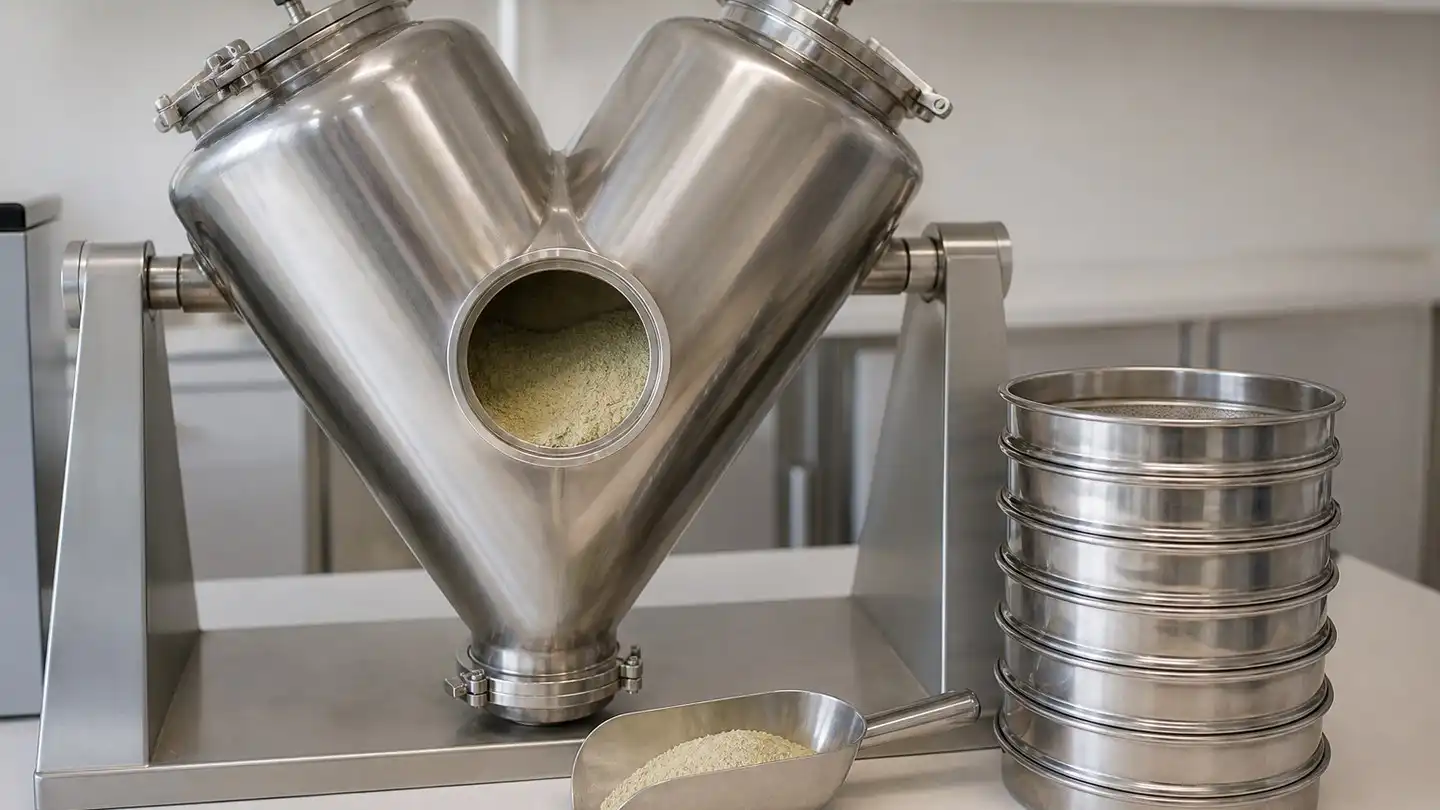
Functional Powders and Stick Packs
Functional powders and single-serve stick packs are sold by the scoop or the sachet, so the powder is never hidden inside a shell. Every physical property of the blend is now visible to the consumer, and every source of variability lands in a scoop.
Particle-size matching
The dominant risk in a dry powder blend is segregation, and segregation is driven by differences in particle size, shape and density. Matching the extract to the co-ingredients on the particle-size distribution chart is more effective than simply extending mixing time. When a fine extract is combined with a coarse carrier, the fine material sifts downward in the hopper and the blend stratifies; when the sizes are close, the blend holds. Using barley grass powder in green superfood blends covers the same size-matching discipline for a leafy powder vehicle.
Dust control and carrier selection
A fine, low-density extract dusts heavily, which costs yield and creates a housekeeping burden. Granulating or agglomerating the blend, or building it onto a denser carrier, controls dust and improves flowability at the same time. Carriers and diluents are chosen for their own density, solubility and moisture behaviour, not only for cost: a water-soluble carrier keeps the blend simple to disperse, while an insoluble one can settle out and leave sediment in the glass.
Sachet fill accuracy and dispersibility
Sachet and stick-pack lines fill by volume, usually through an auger or a volumetric cup, so fill accuracy tracks the bulk-density stability and flow of the blend. A consistent particle-size distribution and a stable moisture level are what keep fill weights inside tolerance across a shift. Cold-water dispersibility is the final format decision: a blend designed to wet out quickly needs a soluble carrier and a controlled particle-size profile, and the extract's own water solubility helps here. Testing dispersion in cold water, rather than warm, exposes the agglomeration that a warm-water test would hide.

Nutraceutical Blends
A nutraceutical blend combines the extract with several other actives and excipients, and the number of partners multiplies the ways the mixture can go wrong before it is filled.
Multi-active compatibility and order of addition
Not all co-actives tolerate the same conditions. Hygroscopic partners, acidic partners and fine, low-density powders each change the behaviour of the blend, and the order of addition determines whether the mixture reaches uniformity or merely looks uniform. The standard sequence — coarse and dense components first, the extract and other minor actives added last, with the fines distributed through a portion of the carrier — keeps the minority components from being buried or floated.
Sensory constraints at higher loads
When the extract is used at a higher inclusion rate, its colour and bitterness begin to shape the formula. A pale green-brown powder at a low load disappears into a coloured blend; at a higher load it dictates the taste profile and the masker requirement. This is a sensory decision, not a labelling one, and it is easier to solve with a masker, a flavouring system or a coated carrier than to fight with a change of extract grade.
Setting a blend-uniformity sampling plan
A blend-uniformity plan defines where samples are taken, how many, and what acceptance criterion applies. Stratified sampling — several locations across the blender, top to bottom and front to back — catches the segregation that a single thief sample would miss. The plan should specify the sampler, the sample size, the assay that will be run and the statistical acceptance rule, and it should be agreed before the first commercial batch rather than after. How quercetin dihydrate powder solves solubility challenges in powder blends illustrates how a solubility-driven property reshapes the same sampling logic.
| Parameter | What it gates | Representative check or method |
|---|---|---|
| Marker assay | Stated marker level and the blend-uniformity target | HPLC against the same standard used for the raw material |
| Particle-size distribution | Segregation risk, flow and dusting | Sieve analysis, e.g. NLT 95% through 80 mesh |
| Loss on drying | Sticking, clumping and moisture pick-up | Gravimetric method, typical limit ≤5.0% |
| Water activity | Free moisture that drives caking and reaction | Water-activity meter, tracked in-process |
| Bulk and tapped density | Fill volume; capsule and sachet sizing | Tapped-density apparatus |
| Carr index / Hausner ratio | Flowability class | Computed from bulk and tapped density; ≤15 good, >25 poor |
| Angle of repose | Flowability class | Fixed-height cone method; below 25° excellent, above 40° poor |
| Blend uniformity | Even distribution of the marker before filling | Stratified sampling across the blender with a defined acceptance rule |
| Fill weight or fill volume | Unit-to-unit consistency | In-process check at the start, middle and end of the run |
| Cold-water dispersibility | Consumer preparation for powder formats | Dispersion test in cold water |
Scale-Up and Stability Handover Checklist
Scale-up is where a laboratory blend becomes a commercial one, and the handover is where most formulation knowledge is lost. A short, explicit checklist keeps the decisions attached to the product.
- Confirm that the marker basis, the method and the acceptance window are identical at the raw-material and finished-product stages.
- Record the particle-size distribution of the extract and of every co-ingredient, and confirm they were matched before blending.
- Fix the mixing time from trial data, with a defined end point, rather than from habit.
- Set the in-process controls — bulk density, water activity, blend uniformity — and their sampling points.
- Validate fill weight or fill volume on the commercial line, not on a pilot unit.
- Confirm the packaging is moisture-barrier and that the storage condition matches the material's sensitivity.
- Carry stability samples from the first three commercial batches and test the attributes that can change with time.
- Document the packaging, the storage statement and the shelf-life basis that will support the label.
The stability handover should state which attributes are shelf-life limiting for your formula — for a hygroscopic powder in a moisture-sensitive film that is usually water activity and the physical attributes that follow from it — and it should record the container-closure system that was actually tested. A stability study run in a different pack from the one you ship proves very little.
Formulating With Wellgreen Bacopa Monniera Extract
Wellgreen supplies Bacopa Monniera Extract as a food-grade, water-soluble powder standardised at 20% and 50% bacopasides by HPLC, tested against a defined mesh, loss-on-drying and heavy-metal window, and supported by a full certificate of analysis. The product page lists ISO 9001:2015, ISO 22000, Halal, Kosher and HACCP, and the material is offered with OEM, ODM and private-label support. To discuss a specification that fits your capsule, stick-pack or blend programme, write to wgt@allwellcn.com.
The information above is technical and commercial in nature and is intended for industry professionals. It is not medical advice. Extract use levels, regulatory status and any label claim must be confirmed against the rules of your target market and against your own finished-product data.
References
- U.S. Food and Drug Administration. Questions and Answers on Current Good Manufacturing Practice Regulations — Production and Process Controls (powder blend sampling and stratified in-process sampling). https://www.fda.gov/drugs/guidances-drugs/questions-and-answers-current-good-manufacturing-practice-regulations-production-and-process
- ICH Harmonised Tripartite Guideline Q1A(R2). Stability Testing of New Drug Substances and Products, 6 February 2003. https://database.ich.org/sites/default/files/Q1A(R2)%20Guideline.pdf
- U.S. Code of Federal Regulations, 21 CFR Part 111 — Current Good Manufacturing Practice in Manufacturing, Packaging, Labeling, or Holding Operations for Dietary Supplements (eCFR). https://www.ecfr.gov/current/title-21/chapter-I/subchapter-B/part-111
- Murthy, P. B. S., Raju, V. R., Ramakrisana, T., et al. Estimation of Twelve Bacopa Saponins in Bacopa monnieri Extracts and Formulations by High-Performance Liquid Chromatography. Chemical and Pharmaceutical Bulletin 54(6):907–911, 2006. https://www.jstage.jst.go.jp/article/cpb/54/6/54_6_907/_pdf/-char/en
- Roos, Y. H. Importance of glass transition and water activity to spray drying and stability of dairy powders. Lait 82(4):475–484, 2002. DOI 10.1051/lait:2002025. https://lait.dairy-journal.org/articles/lait/ref/2002/04/10/10.html
- Nandi, K., Sen, D. J., Patra, F., et al. Angle of repose walks on its two legs: Carr index and Hausner ratio. World Journal of Pharmacy and Pharmaceutical Sciences. https://www.wjpps.com/Wjpps_controller/abstract_id/12321