
Can Oat Beta Glucan Powder Improve Texture and Stability in Yogurt and Beverages?
2026-09-23 15:18:36
Oat Beta Glucan Powder is a soluble cereal fibre that behaves, in formulation terms, much like a hydrocolloid: dispersed in water it binds a large volume of solvent and builds viscosity that depends heavily on concentration and molecular weight. The practical question for dairy and beverage developers is narrower than the marketing one — does that viscosity survive pasteurisation, homogenisation and the shear of filling, and can it displace part of the stabiliser system without moving mouthfeel out of specification?
Why β-Glucan Behaves Like a Hydrocolloid
Oat β-glucan is a linear glucose polymer built from β-(1→4) linked cellulosic stretches interrupted by single β-(1→3) linkages. That irregular pattern prevents the chain from packing into crystalline microfibrils, so the polymer stays soluble and adopts an extended, semi-flexible random-coil conformation that occupies far more hydrodynamic volume per gram than a compact globular polymer and entangles with its neighbours at lower concentration — background on the molecule is set out in our explainer on what oat beta glucan is.
Two consequences follow. Solutions are shear-thinning — viscosity falls under shear and recovers at rest — which keeps a thickened liquid pumpable and fillable. And every effect is dose- and molecular-weight-dependent: a high-molecular-weight fraction delivers more viscosity per unit of β-glucan than a hydrolysed one, while a lower-molecular-weight fraction can be dosed further before viscosity limits handling but stops contributing structure sooner [1].
Water binding and the viscosity ceiling
Water binding matters more than raw viscosity in dairy systems. The coil traps water in a network immobilised between protein aggregates, reducing the free water available to migrate to the surface — the mechanism normally cited for reduced whey separation, and the reason the effect is not linear in dose.
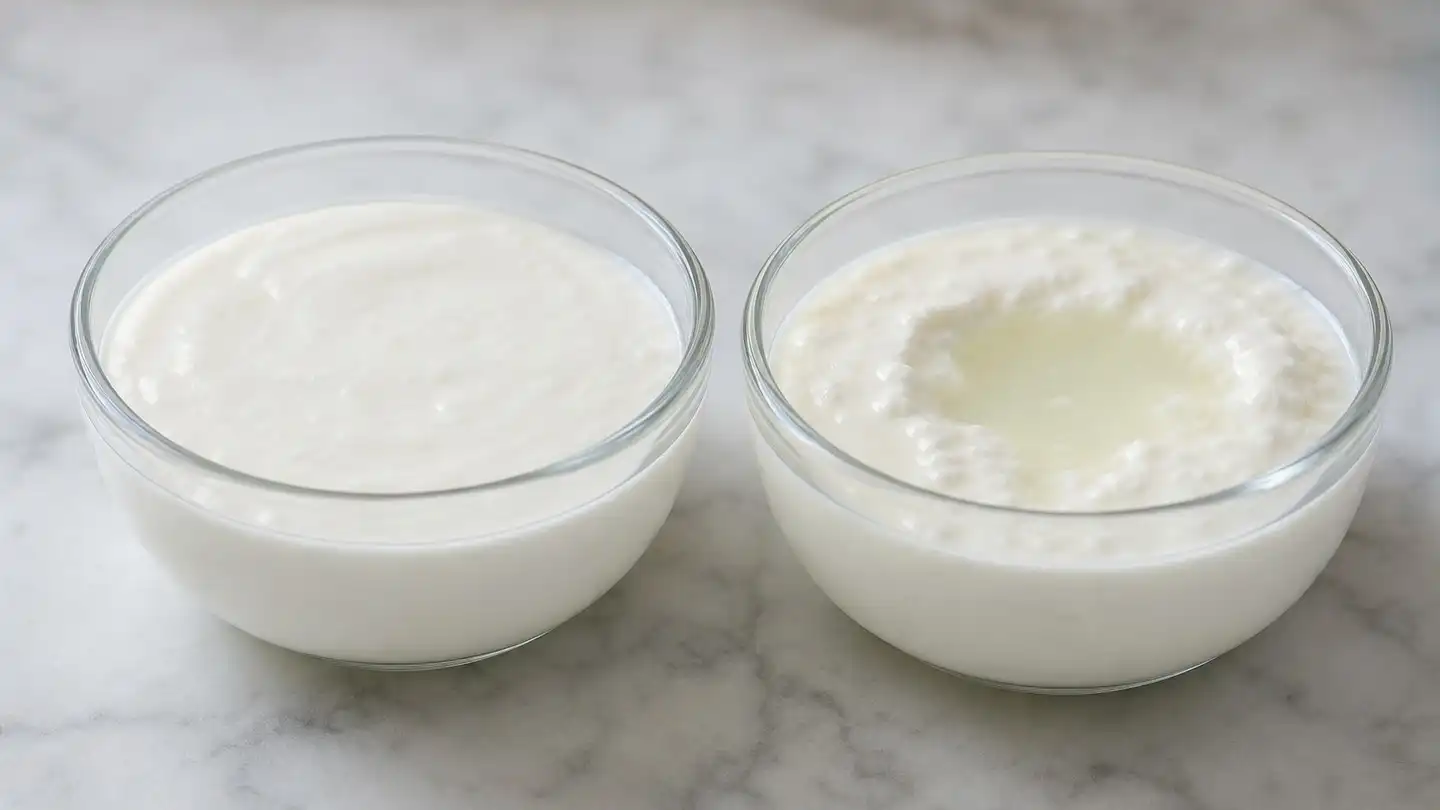
Work on set-type yogurt shows that non-linearity: water-holding capacity rose as oat β-glucan was increased, peaked at 94.67%, then fell back — a decline the authors linked to disruption of the yogurt's three-dimensional protein network, with spherical aggregates visible in the microstructure [2]. Viscosity alone would have predicted continued improvement.
| Behaviour | High-molecular-weight fraction | Medium / low-molecular-weight fraction |
|---|---|---|
| Viscosity contributed | Highest of the fractions tested | Lower, so more can be dosed before viscosity limits handling |
| Firmness of the acid gel | Highest firmness | Lower firmness at equal β-glucan content |
| Acidification during fermentation | Did not impede acidification | Initially slowed acidification, with increased early starter metabolic activity |
| Protein hydrolysis in the gel | Mildly delayed, attributed to higher local viscosity | Promoted protein hydrolysis in the in vitro digestion model |
| Sensory performance at 1.0% (w/v) | Not the best-liked fraction | Medium-molecular-weight fraction gave the best sensory attributes |
Syneresis Control in Set and Stirred Yogurt
Set yogurt
In set yogurt the gel forms in the pack and is never disturbed, so the stabiliser must reinforce the casein network and hold water inside it; β-glucan added to the milk base before fermentation becomes part of that network. The key observations are in Tables 1 and 2: firmness is a high-molecular-weight lever, whereas water-holding capacity has an optimum that a viscosity-only view will miss [1][2]. Both concentrations are experimental conditions reported by those studies, not recommended use levels.
Stirred yogurt and post-fermentation shear
Stirred yogurt breaks the gel after fermentation and pumps it to the filler, so the network must survive mechanical work. The shear-thinning behaviour that helps filling also works against structure here: apparent viscosity recovers at rest, but the gel fragments giving stirred yogurt its body do not reassemble. A high-molecular-weight fraction also delays proteolysis in the acid gel by raising local viscosity [1], which helps during fermentation but makes pump and filler work harder.
Suspension and Stability in Beverage Systems
In beverages the requirement shifts from gel reinforcement to particle suspension: a drink carrying insoluble material needs a yield stress or a sufficiently viscous continuous phase to keep particles from settling, and it needs that property to persist through shelf life rather than only at filling. Oat β-glucan contributes through the same entangled-coil mechanism. In an oat-drink model system, oat β-glucan combined with microbial exopolysaccharides stabilised the drink against phase separation and outperformed pectin, the additive it was compared against [3]; in a shelf-stable high-protein dairy beverage it delivered suspension stability above 80%, with the formulation and viscosity figures set out in Table 2 [4]. Those are study conditions rather than recommended use levels. Consistency across production batches is the other half of beverage stability, and the dosing variables involved — particle size, bulk density and flowability — are covered in our note on high purity quercetin dihydrate powder in food and beverage applications.
| Parameter | Set / stirred yogurt | Ready-to-drink beverage |
|---|---|---|
| β-glucan level studied | 0.3% oat β-glucan reported as the optimum for water-holding capacity [2]; 1.0% (w/v) optimum in the molecular-weight study [1] | At least 0.75 g oat β-glucan per serving, from 1.50–2.30% oat flour with 2.50–4.00% milk protein isolate [4] |
| Thermal process applied | Heat treatment of the milk base followed by fermentation [1][2] | Rotary retort sterilisation of the filled beverage [4] |
| Water-holding / suspension outcome | Water-holding capacity peaked at 94.67% at 0.3% and fell to about 80% at 0.5% [2] | Suspension stability above 80% [4] |
| Apparent viscosity | Firmness and viscosity highest with the high-molecular-weight fraction [1] | Nectar-like, between 51 and 100 mPa·s [4] |
| Stability measurement used | Water-holding capacity plus microstructure of the acid gel [2] | Apparent viscosity at 110 s⁻¹ at day 0 and day 14 [3] |
| Principal risk identified | Loss of network integrity above the optimum load [2] | Phase separation during storage [3] |
Shear and heat history: what the molecule can tolerate
β-glucan's weak point is mechanical rather than thermal. The polymer survives normal pasteurisation and retort conditions without losing its linkage pattern, but high-pressure homogenisation and intense high-shear mixing can cleave the backbone and reduce molecular weight — and depolymerisation is irreversible, so no downstream change will recover the lost viscosity. The order of unit operations therefore matters more than any single shear figure: where the process allows it, add the β-glucan after the highest-shear step and rely on a later, gentler mixing stage for dispersion. Where it does not, accept that the molecular weight reaching the filler will be below the incoming specification and verify it in the finished product rather than on the raw material.
Interaction with Milk Proteins
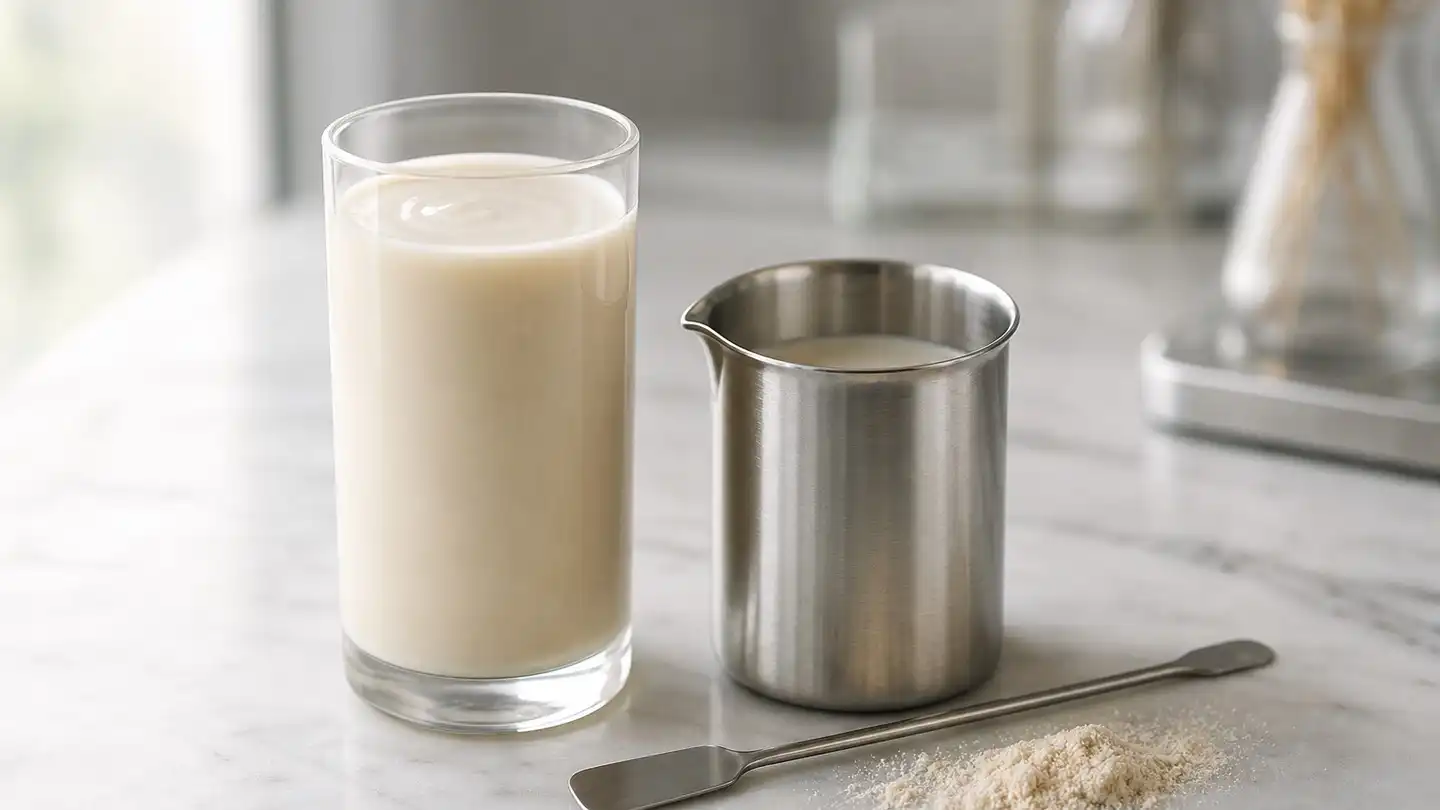
Oat β-glucan and milk proteins are thermodynamically incompatible polymers: each prefers its own solvent environment, and above a threshold concentration the system can separate into a protein-rich and a polysaccharide-rich phase. In yogurt this is often beneficial, because the polysaccharide concentrates in the serum phase and reinforces the water-holding network instead of precipitating protein. Raise the concentration, or pair a high β-glucan load with a high protein isolate in a beverage, and the same driving force can produce protein-rich sediment or an unstable upper layer. Protein type shifts that threshold: yogurt is an acidified casein system in which the polysaccharide is incorporated during acid gelation, while neutral high-protein beverages carry far higher ionic strength. In plant bases it is the polysaccharide–protein pairing, not the β-glucan alone, that decides whether the drink holds; teams comparing cereal raw materials at different degrees of refinement may find our oat extract range a useful reference.
Practical Process Points for Dairy and Beverage Lines
Hydration, order of addition and shear
β-glucan hydrates slowly. Added dry to a cold aqueous phase it tends to form lumps with a hydrated shell and a dry core that shears into visible specks later. Standard hydrocolloid practice applies: disperse the powder into the dry blend or into a small volume of a non-solvent such as a sugar or polyol, add it to the aqueous phase under moderate agitation, and allow enough time at a hydration temperature sufficient to swell the coil fully before the protein and acidification steps. Keep the highest-shear operations upstream of the β-glucan wherever the sequence allows, and treat any homogenisation downstream of addition as a molecular-weight risk to be measured rather than assumed.
Combining with pectin, gelatin and starch
β-glucan rarely replaces a stabiliser system outright; the usual pattern is partial substitution, with β-glucan carrying water binding and viscosity while the incumbent hydrocolloid keeps the job it does best.
- Pectin. High-methoxyl pectin stabilises acidified dairy drinks by adsorbing onto casein micelles — a surface-chemistry job β-glucan cannot do. The β-glucan system outperformed pectin on structural stabilisation in the oat-drink study [3], but in a low-pH dairy drink the pectin is protecting protein, not merely thickening, so treat the two as complementary.
- Gelatin. Gelatin sets into a thermo-reversible gel with a clean melt-away breakdown; β-glucan adds non-gelling, shear-thinning body. Combining them can hit a target texture at lower total hydrocolloid solids, but gelatin governs the melt profile.
- Starch. Cooked or modified starch contributes bulk and a short, pasty texture and competes strongly for water, so where starch is already high the β-glucan's viscosity contribution falls; balance the two rather than simply adding both.
In all three cases, measure the finished system rather than the individual ingredients.
The Sensory Ceiling: Gumminess and Slimy Mouthfeel
Every hydrocolloid has a load above which its contribution stops reading as richness and starts reading as a defect. For oat β-glucan that point arrives as gumminess in spoonable products and as a slick or slimy mouthfeel in drinks, and it is strongly molecular-weight dependent: a high-molecular-weight fraction reaches the ceiling at a lower dose than a hydrolysed one.
The yogurt data show the ceiling from the other direction — the medium-molecular-weight fraction rated best on sensory attributes even though the high-molecular-weight fraction gave the highest firmness and viscosity [1], and sensory scores peaked at the same time as the microstructure already showed a disrupted network [2]. More structure and better liking did not coincide, which is why sensory testing has to run alongside instrumental texture from the first trial rather than after the formulation is locked.
How to test for it
- Descriptive panel first. Train panellists on a defined attribute list with explicit terms for gumminess, cohesiveness of mass, slimy mouthfeel and mouthcoating; hedonic liking alone will not separate a texture defect from a flavour preference.
- Instrumental texture in parallel — firmness, adhesiveness and cohesiveness by texture analyser on the acid gel, apparent viscosity at a defined shear rate for drinks, water-holding capacity by centrifugation.
- Report viscosity at a fixed shear rate. A value quoted without a shear rate is not comparable between suppliers or trials — the oat-drink work reports values at 110 s⁻¹ at day 0 and day 14 [3].
- Use a dose series across shelf life: at least three loads plus a β-glucan-free control, repeated at the end of shelf life, because water redistribution continues in storage.
Regulatory Context: EU and US Health-Claim Status
European Union
Health claims on foods in the EU are governed by Regulation (EC) No 1924/2006, and the list of permitted claims is set out in Commission Regulation (EU) No 432/2012. That list contains an authorised claim linking beta-glucans to the maintenance of normal blood cholesterol levels, with conditions of use attached: it may be used only for food containing at least 1 g of beta-glucans from oats, oat bran, barley, barley bran or mixtures of those sources per quantified portion, and consumers must be informed that the beneficial effect is obtained with a daily intake of 3 g of beta-glucans from those sources [5] — a threshold consistent with EFSA's assessment of the corresponding Article 14 claim [6]. The permitted wording is fixed and may not be paraphrased, and qualification of a specific ingredient is a question for the target market's competent authority rather than the supplier.
United States
In the US, authorised health claims must meet FDA's significant scientific agreement standard and follow a petition process [8]. For soluble fibre and coronary heart disease, 21 CFR 101.81 permits a claim that diets low in saturated fat and cholesterol that include soluble fibre from certain foods may reduce the risk of heart disease, provided the claim uses the specified terms, states the required daily intake and the contribution one serving makes, and the food contains at least 0.75 g of beta-glucan soluble fibre per reference amount customarily consumed, with the associated daily intake set at 3 g or more per day from whole oats or barley [7]. The regulation also names its eligible sources — oat bran, rolled oats, whole oat flour, oatrim and specified barley fractions — and AOAC method 992.28; a standardised oat beta glucan preparation is not itself one of those sources, so a product intended to bear the claim must also include a qualifying whole-oat or barley component. Every other market applies its own rules.
Sourcing Oat Beta Glucan Powder from Wellgreen
Wellgreen supplies Oat Beta Glucan Powder standardised at 80%–90% oat beta-glucan, customized, measured by HPLC, as a white powder with a two-year shelf life and CAS Registry No 9051-97-2. The product page lists ISO 9001:2015, ISO 22000, Halal, Kosher and HACCP certification and an application range covering food, health product addition and dietary supplements. Development teams can request specification sheets, certificates of analysis and samples for bench work at wgt@allwellcn.com.
This article provides technical and commercial information for industry professionals and is not medical or nutritional advice; use levels, processing parameters, regulatory status and any label claims must be confirmed against the rules of your target market and your own finished-product data.
References
- Effects of oat β-glucans with different molecular weights on the properties, fermentation kinetics and in vitro digestibility of set-style yogurt. PubMed PMID: 42134119. https://pubmed.ncbi.nlm.nih.gov/42134119/
- Effect of Oat β-Glucan on the Rheological Characteristics and Microstructure of Set-Type Yogurt. Molecules 2021, 26(16):4752. https://www.mdpi.com/1420-3049/26/16/4752
- Stabilisation of the oat drink structure with oat β-glucan and microbial exopolysaccharides. Applied Food Research. DOI: 10.1016/j.afres.2026.102320. https://www.sciencedirect.com/science/article/pii/S2772502226006608
- Functional Properties of a High Protein Beverage Stabilized with Oat-β-Glucan. Journal of Food Science 2018. DOI: 10.1111/1750-3841.14119. https://ift.onlinelibrary.wiley.com/doi/10.1111/1750-3841.14119
- Commission Regulation (EU) No 432/2012 of 16 May 2012 establishing a list of permitted health claims made on foods, other than those referring to the reduction of disease risk and to children's development and health (consolidated text, 20.08.2025). EUR-Lex. https://eur-lex.europa.eu/legal-content/EN/TXT/HTML/?uri=CELEX:02012R0432-20250820
- EFSA Panel on Dietetic Products, Nutrition and Allergies (NDA). Scientific Opinion on the substantiation of a health claim related to oat beta glucan and lowering blood cholesterol and reduced risk of (coronary) heart disease pursuant to Article 14 of Regulation (EC) No 1924/2006. EFSA Journal 2010, 8(12):1885. DOI: 10.2903/j.efsa.2010.1885. https://efsa.onlinelibrary.wiley.com/doi/10.2903/j.efsa.2010.1885
- 21 CFR § 101.81 — Health claims: Soluble fiber from certain foods and risk of coronary heart disease (CHD). Cornell Law School Legal Information Institute. https://www.law.cornell.edu/cfr/text/21/101.81
- U.S. Food and Drug Administration. Authorized Health Claims That Meet the Significant Scientific Agreement (SSA) Standard. https://www.fda.gov/food/nutrition-food-labeling-and-critical-foods/authorized-health-claims-meet-significant-scientific-agreement-ssa-standard