
Egg Yolk Lecithin for Emulsion Stability in Food Manufacturing
2026-10-26 11:37:53
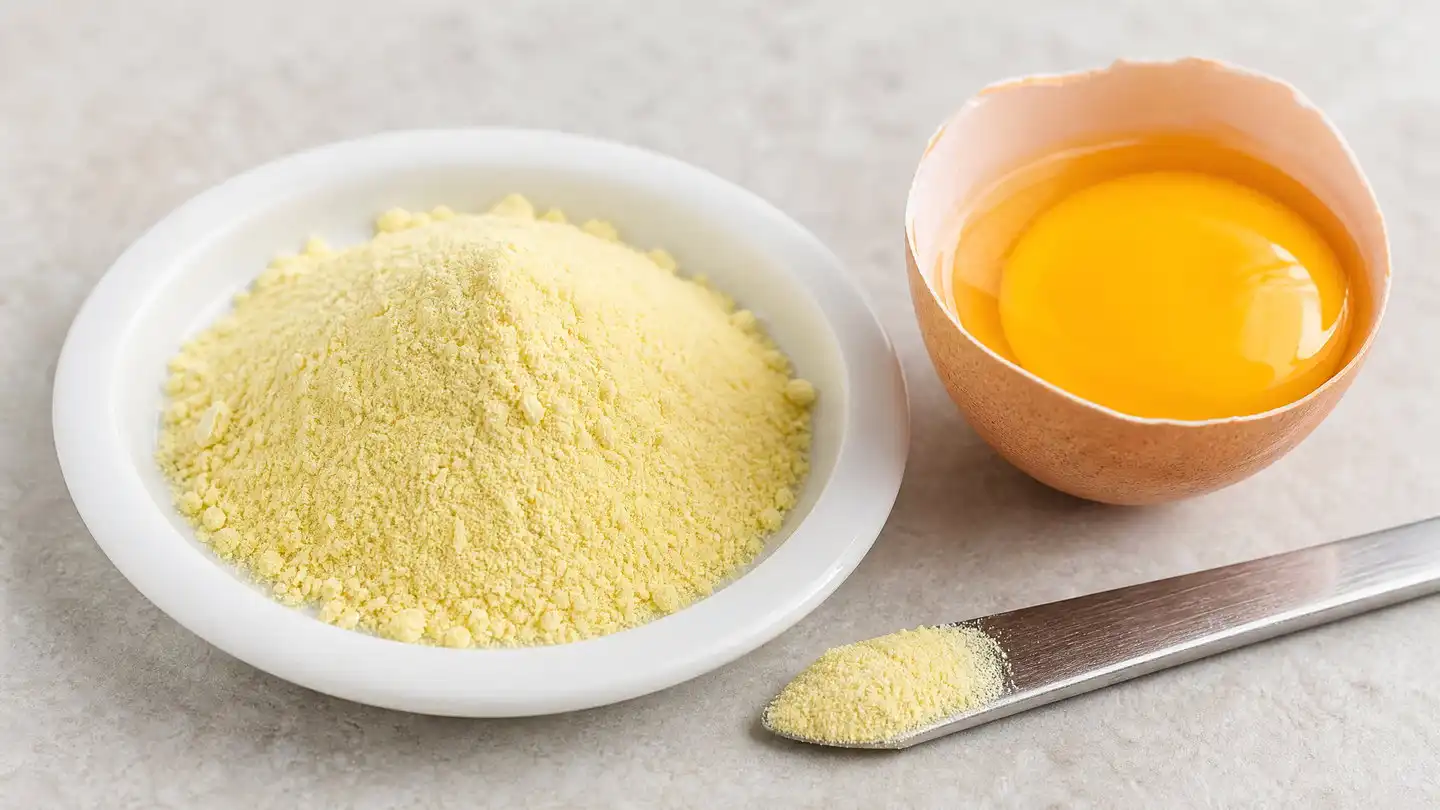
Formulators rarely choose the wrong emulsifier class. They choose a grade that worked in one matrix and then behaves differently in the next. Egg yolk lecithin is a good example: the powder that holds a pourable dressing can leave a visible cream line in a protein beverage within a few weeks, with no change to the supplier, the certificate or the dosage. The difference sits at the oil–water interface, and the interface is built by the whole formula, not by the emulsifier alone. Wellgreen supplies egg yolk lecithin as a food-grade powder; this article is about what happens to it after it enters your process.
Egg Yolk Lecithin Is a Mixture, Not a Specification
At raw-material level, egg yolk lecithin is a natural phospholipid concentrate. Its main components are phosphatidylcholine and phosphatidylethanolamine, together with smaller phospholipid fractions, neutral lipids and sterols that remain from the yolk. It is sold as a mixture with a declared specification, not as a single purified compound.
Two consequences follow. Batch-to-batch variation in the phospholipid profile is normal and should be visible on the COA rather than recorded as a defect. And functional performance cannot be inferred from appearance: two yellow powders that pass the same mesh screen can build films of different thickness and charge.
Egg-derived and soy-derived lecithin are not interchangeable on paper
Both are phospholipid emulsifiers used at similar points in a process, which is why purchasing teams often use them as direct substitutes. They differ in five commercial respects that have nothing to do with emulsifying power.
| Attribute | Egg yolk lecithin | Soybean lecithin |
|---|---|---|
| Allergen status | Egg is a declarable major allergen in the EU, the United States and China | Soy is also declarable; the exact obligation depends on the market |
| Label impact | Finished label must carry an egg declaration | Finished label must carry a soy declaration |
| Flavour contribution | Mild yolk note that becomes noticeable at higher use levels | Neutral to beany, depending on grade and refining |
| Regulatory identity | Falls under the lecithin entry for direct food use; egg carryover brings allergen labelling into scope | Same entry — lecithin is affirmed as GRAS under 21 CFR 184 |
| GMO documentation | No plant GM input, so the question normally does not arise | Identity-preserved and non-GMO certificates are standard requirements |
The practical point: switching a line from soy to egg yolk lecithin is not a one-line change in the ERP. It reopens allergen labelling, may reopen flavour balance, and adds a certificate to collect. That work is manageable, but it has to be scheduled before the trial rather than after it. If you are comparing sources, our soybean lecithin page carries the equivalent specification.
Where Egg Yolk Lecithin Fits, and Where It Does Not
Egg yolk lecithin earns its cost where the interface has to survive heat, acid or a high dispersed-phase load. Typical evaluation points are oil-in-water dressings and sauces, bakery emulsions, confectionery fillings, instant powders that must redisperse, and emulsified beverages with a narrow droplet target. The pure extracts range lists the lecithin grades side by side if you need to shortlist before sampling.
It is a weaker first choice in very high-acid, high-salt systems, where the electrical part of the film is screened, and in water-in-oil systems, where the hydrated head group points the wrong way. Neither point excludes the ingredient; both are reasons to test it in your own matrix before writing it into a specification.
Why the Interface Decides Emulsion Stability
An emulsion is not held together by viscosity. It is held together by a film that keeps droplets apart long enough for the product to reach the consumer. Lecithin works through three simultaneous effects.
Adsorption. Phospholipid molecules migrate to the freshly created oil–water boundary during homogenisation and assemble into a multilayer. Adsorption is fast but not instantaneous, which is why the order of addition and the delay between premix and homogenisation change the result.
Interfacial tension. The film lowers the energy penalty of the new interface, so a given amount of mechanical energy reaches a smaller droplet size, with less heat damage to sensitive ingredients.
Film properties. Phosphatidylcholine is zwitterionic and contributes little net charge across a wide pH range, while the acidic phospholipid fraction ionises with pH and gives the droplet a negative surface charge. Combined with the hydrated head-group layer, this produces an electrostatic and steric barrier at the same time.
Oil-in-water and water-in-oil systems behave differently
In an oil-in-water system the hydrophilic heads face the continuous phase and the film is well oriented; this is the natural operating mode for egg yolk lecithin. In a water-in-oil system the same molecules must stabilise water droplets in oil, and the hydrated head group points inward. Coverage is less efficient, film thickness is harder to control, and the emulsion usually depends on a co-emulsifier or on crystallised fat at the interface. Reading application data without checking which system it refers to is one of the most common causes of a failed first trial.
The Six Variables That Decide Whether the Emulsion Holds
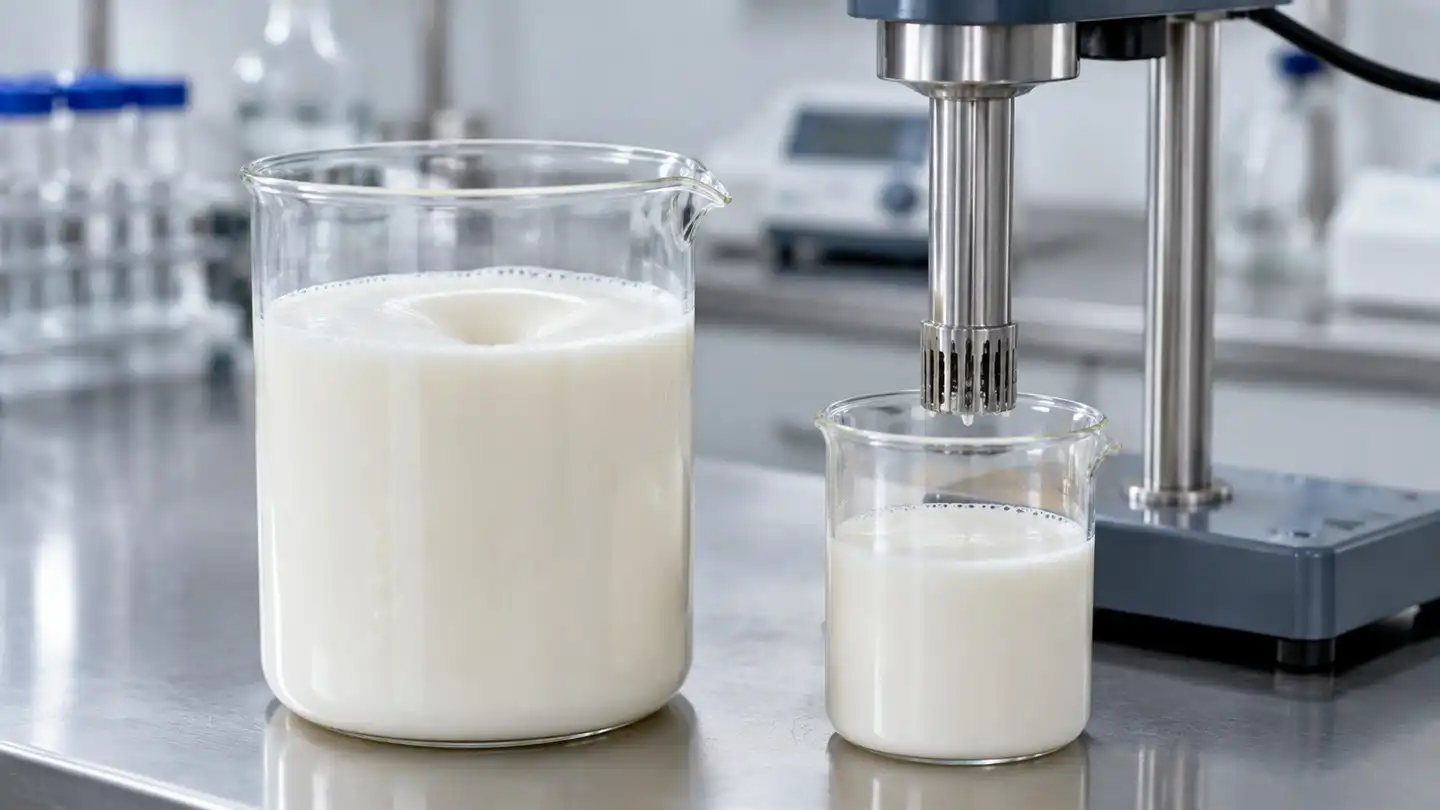
Emulsion stability is a multivariate outcome. In practice, six variables explain most of the difference between a pilot batch that holds for twelve months and one that separates in the warehouse. Each one below is paired with its mechanism, its characteristic failure risk, and a verification method a QA team can run without new equipment.
| Variable | Mechanism | Risk if uncontrolled | Verification |
|---|---|---|---|
| Homogenisation pressure and number of passes | Shear energy sets the initial droplet size; a second pass narrows the distribution | Under-processing leaves a coarse tail; over-processing generates heat and can desorb the film | Laser diffraction after one and two passes: D[4,3], D[3,2] and span |
| Temperature through the process | Changes phospholipid solubility, film fluidity and protein conformation | Hot filling weakens the film; a cold premix can leave lecithin undispersed | Sample at premix, post-homogenisation and post-fill; measure droplet size at a fixed 20 °C |
| Oil phase volume fraction | More dispersed phase means more interfacial area per gram of emulsifier | Above the practical loading, droplets are under-covered and coalesce | Phase-volume ladder at fixed dose; plot D[3,2] against oil percentage |
| pH and ionic strength | pH sets ionisation of acidic phospholipids; salt screens the surface charge | Near the isoelectric region the electrostatic barrier collapses; divalent ions bridge droplets | Zeta potential versus pH curve, plus a salt ladder at fixed pH |
| Co-existing protein or starch | Proteins compete for the interface; polysaccharides raise viscosity and can cause depletion flocculation | Competitive displacement leaves patches of bare interface; excess hydrocolloid promotes flocculation | Interfacial tension or confocal imaging; pair viscosity data with droplet size |
| Lecithin dose and phase of addition | Dose sets surface coverage; the addition point sets whether the emulsifier meets oil or water first | Too little leaves incomplete coverage; too much produces multilayer thickening, foaming or free-fat effects | Dose ladder from 0.2% to 2%, with oil-phase and water-phase addition run as a split trial |
The variables interact: raising the oil fraction at a fixed dose is effectively a dose reduction, and moving pH changes the dose you need. What is harmless in a beaker can dominate at scale.
Reading Droplet Size Before You Blame the Lecithin
Laser diffraction is the standard tool, and most disputes about a "bad lot" are disputes about reading the report. Two averages matter, and they answer different questions.
D[4,3] and D[3,2] are not interchangeable
D[4,3], the volume-weighted mean, is dominated by the largest droplets and correlates with visible oiling-off or a cream line. D[3,2], the surface-weighted mean, is dominated by the smallest droplets and tracks the interfacial area actually available, which makes it the better indicator of whether the emulsifier is doing its job. D[4,3] alone hides a coarse tail; D[3,2] alone hides a few large droplets. Read both with the span: narrow after two passes is evidence that homogenisation is sufficient, while a wide span points to insufficient shear or partial recoalescence.
Creaming, flocculation, coalescence and ripening
These four failure modes look similar on a shelf and need different corrections. A bottle test plus a microscope usually separates them:
- Creaming — droplets rise but keep their size, and the layer redisperses on gentle shaking. Reduce droplet size or raise continuous-phase viscosity.
- Flocculation — droplets cluster while remaining individual, and the cluster breaks under low shear. Usually a charge or depletion effect rather than a coverage problem.
- Coalescence — droplets merge and the number of large droplets rises irreversibly; D[4,3] climbs while D[3,2] stays flat. Points to weak film strength or bare interface.
- Ostwald ripening — small droplets shrink and large ones grow over weeks with no visible floc, typical in fine emulsions with a partly soluble oil phase. Slow it by narrowing the distribution and controlling storage temperature.
Oxidation Is the Weak Point of Every Lecithin Grade
The phospholipids that make lecithin functional are also what makes it vulnerable. Unsaturated acyl chains oxidise, and the hydroperoxides decompose into aldehydes and ketones that carry off-flavours into the finished product long before any emulsion failure becomes visible.
Three numbers on the COA describe the state of the material. Peroxide value measures primary oxidation products and is the earliest warning. p-Anisidine value measures secondary products and shows how far degradation has progressed. Free fatty acid measures hydrolysis of the ester bonds, which points to moisture and enzymatic activity rather than to oxidation.
The accelerants are predictable: transition metal ions, light, heat and headspace oxygen. Copper and iron are active at trace levels, so contact with unpassivated stainless steel, mild steel drums or ordinary metal scoops matters more than most plants assume. The protective strategy is therefore engineering rather than an additive decision: opaque or amber packaging, nitrogen flushing, cool storage, and separation from metal contact and pro-oxidant premixes. Where a secondary antioxidant is used, check how it partitions — a compound that stays in the aqueous phase will not protect the interface.
From Emulsion to Powder: Dispersibility, Caking and Flow
Most egg yolk lecithin sold into food manufacturing arrives as a powder, and powder behaviour is a separate discipline from emulsion behaviour. A spray-dried or carrier-blended grade has to wet, disperse, then stay free-flowing in the bag. These three properties fail independently.
Wetting is a surface-energy problem: lecithin is itself surface-active, so a powder rich in free phospholipid can be slow to wet. Dispersion is mechanical: particles that wet but do not separate form lumps with a dry core, and those lumps then need more shear than the process provides. Caking is a storage problem, driven by moisture migration, temperature cycling and stack pressure.
Particle size sets the starting point. Our standard grade is specified at 100% pass 80 mesh, a practical balance between wetting speed and dust control in dry blending. A finer cut disperses faster but generates more dust and compacts harder; a coarser cut flows better but can leave specks in a clear system. For instant beverages, test the powder in water as a separate attribute — wetting time, lump count after a fixed stirring protocol, resuspension after ten minutes — rather than inferring it from emulsion data.
Storage belongs in the specification too. The declared two-year shelf life assumes a cool, dry place in the original sealed packaging: 1–5 kg aluminium foil bags for pilot work, 25 kg drums for production, with OEM formats where the line requires them. Certificate documentation for supplier qualification follows the same route, described on the quality and accreditation page.
Designing the Trial: A 0.2%–2% Ladder, Then a Response Surface
Emulsifier optimisation fails when it is run as a single-point comparison. A ladder first and a surface second is the fastest route to a defensible number.
Stage one, screening ladder. Hold the process fixed and run five levels of lecithin, typically 0.2%, 0.5%, 1.0%, 1.5% and 2.0%, on a stated basis — percentage of oil phase or of total formula. Measure D[4,3], D[3,2], span and a cream index at 24 hours and 30 days across two storage temperatures. The deliverable is not a single optimum; it is the range in which droplet size stops improving.
Stage two, interaction design. Take the two or three factors that plausibly interact with dose — homogenisation pressure, oil fraction, pH — and run a factorial or central composite design around the useful part of the ladder. Two factors at three levels with a centre point usually suffice; add the third only if the first round shows unexplained curvature.
Stage three, confirmation. Run the predicted optimum in triplicate on production-representative equipment. A result that reproduces only in a lab homogeniser is not a result.
| Record block | Fields to capture | Why it is recorded |
|---|---|---|
| Material | Lecithin lot number, COA reference, carrier type, received date | Links every result back to a single incoming lot |
| Dose | Percentage used, and the basis it was calculated on | Avoids the most common reporting error in dose ladders |
| Formula | Oil percentage, protein or starch type and level, pH, salt level | Documents the matrix the result belongs to |
| Process | Pressure, passes, temperature at premix, homogenisation and fill | Distinguishes formulation effects from equipment effects |
| Droplet size | D[4,3], D[3,2], span, instrument, obscuration | Makes results comparable between labs |
| Stability | Cream index at 24 h, 30 d and 90 d, storage temperatures | Separates fast creaming from slow coalescence |
| Oxidation | Peroxide value, p-anisidine value, free fatty acid at t=0 and at end of test | Shows whether failure is physical or chemical |
| Decision | Verdict, next step, owner | Closes the loop before the next batch is scheduled |
Quality and Compliance: What the COA Should Actually List
A specification describes what a supplier intends to ship; a COA describes what was shipped. Both should be read for the same parameters, and the items below are the minimum set for an emulsifier entering a food plant.
| Parameter | Method | What to check when buying |
|---|---|---|
| Appearance | Visual | Yellow powder, free of visible foreign matter; compare with a retained sample |
| Identity | TLC, UV | Confirms the phospholipid pattern, not only the colour |
| Moisture | Loss on drying | High moisture drives hydrolysis and caking; agree the limit before the first order |
| Acid value | Titrimetric | Indicator of hydrolysis and of raw-material handling |
| Peroxide value | Titrimetric | Primary oxidation; the earliest signal of a degraded lot |
| Heavy metals | ICP-based methods | Must meet the target market limit; ask which reporting basis is used |
| Microbiology | ISO 4833-1, ISO 6579-1, ISO 21527-1 | Total viable count, Salmonella, yeasts and moulds |
| Particle size | Sieve analysis | 100% pass 80 mesh on the standard grade; affects dispersion and dust |
| Residual solvents | GC, where applicable | Relevant to solvent-extracted grades; confirm the scope of the test |
Allergen, Halal and GMO status
Egg is a declarable major allergen in the EU, the United States and China, and lecithin derived from egg yolk does not escape that obligation: the label must carry an egg declaration, and cross-contact controls on shared lines should be documented. Confirm the wording against the regulation of each target market rather than reusing text from another product.
Halal is usually straightforward for egg-derived material, because the input does not come from slaughtered animals, but a certificate is still expected and should cover the manufacturing site, not only the trading entity. GMO status is a soy-side question: identity-preserved and non-GMO documentation apply to soybean lecithin, while egg yolk lecithin has no plant GM input. Wellgreen's certificate set — ISO 9001:2015, ISO 22000, Halal, Kosher and HACCP — is available for supplier qualification files.
What to Send a Supplier Before the First Purchase Order
The useful first conversation is technical, not commercial. Send your target droplet size, oil fraction, pH range, process temperatures, homogenisation capability and the label declarations your market requires. A supplier who answers those points with data rather than adjectives is worth a sample request.
Wellgreen can provide the specification sheet, COA, allergen and certificate documentation, 1–5 kg samples for bench trials, and a formulation compatibility discussion before you commit to a drum. Custom mesh, carrier and packaging formats are handled through the OEM/ODM programme. Write to wgt@allwellcn.com with your matrix and target specification.
References
U.S. Food and Drug Administration. 21 CFR Part 184 — Direct Food Substances Affirmed as Generally Recognized as Safe. 2025.
U.S. Food and Drug Administration. 21 CFR Part 182 — Substances Generally Recognized as Safe. 2025.
United States Pharmacopeia. USP–NF Monograph: Lecithin. 2024.
International Organization for Standardization. ISO 4833-1 — Microbiology of the food chain: horizontal method for the enumeration of microorganisms, colony count at 30 °C. 2013.
International Organization for Standardization. ISO 6579-1 — Microbiology of the food chain: horizontal method for the detection of Salmonella spp. 2017.
International Organization for Standardization. ISO 21527-1 — Microbiology of food and animal feeding stuffs: horizontal method for the enumeration of yeasts and moulds. 2008.
This article is intended for business-to-business ingredient sourcing and formulation discussion. It does not provide medical, nutritional, or regulatory advice for any specific product or market.