How Does Quercetin Dihydrate Powder Improve Stability in Functional Food Formulations?
2026-08-26 14:08:52
Quercetin Dihydrate Powder significantly enhances stability in functional food formulations through its powerful antioxidant properties that prevent oxidative degradation of sensitive nutrients and bioactive compounds. Extracted from the dried flower buds of Sophora japonica L., this bioflavonoid features two water molecules in its crystal lattice, providing superior storage stability compared to anhydrous forms. Its molecular structure enables it to neutralize free radicals, inhibit lipid peroxidation, and protect vitamins and essential fatty acids from degradation during processing and shelf storage. For manufacturers seeking consistent product quality, this botanical extract delivers reliable protection against color fading, off-flavor development, and nutrient loss throughout the product lifecycle.
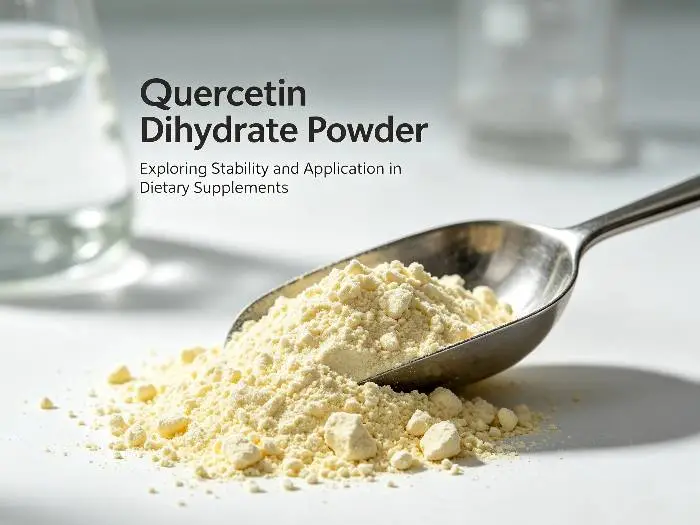
Understanding Quercetin Dihydrate Powder and Its Role in Functional Foods
People are looking for clean-label products that are good for them, which has caused the organic bioflavonoid market to grow very quickly. In this context, quercetin has become an important ingredient, especially in the form of dihydrate. This type of quercetin is different from anhydrous quercetin because it contains two solid water molecules. This changes its physical stability and how it behaves when it is handled.
Chemical Structure and Stability Advantages
The chemical formula C₁H₁O₇·2H₂O shows how this compound's structure works to make it so effective. The dihydrate form doesn't lose its shape when stored normally, unlike the anhydrous forms that tend to absorb water. This feature is very helpful for producers who have to keep track of their stock in different climate zones and along long supply lines.
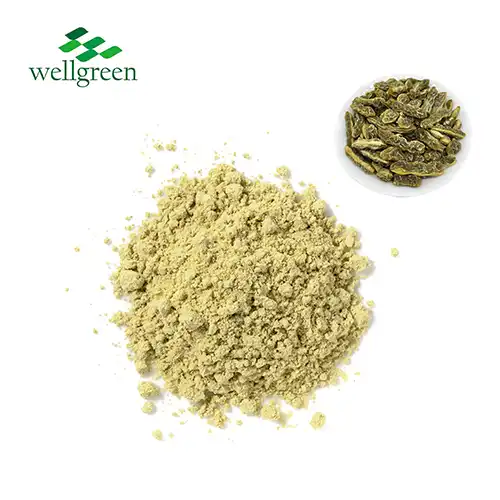
The bright yellow crystalline powder has uniform particles, usually standardized at 80 mesh for the best mixing properties, which is good for factories. Advanced methods for extracting Sophora japonica flower buds, including alkaline extraction and acid precipitation, make sure that each batch is the same. The purity levels that were reached, reaching 95–98% HPLC, are the highest in the industry and meet pharmaceutical-grade standards.
Antioxidant Mechanisms in Food Matrices
At the cellular level, this flavonoid works in a number of ways to protect cells. Its polyphenolic structure gives off hydrogen atoms that stop reactive oxygen species from starting chain reactions that break down vitamins, proteins, and lipids. This protection means that functional drinks with omega-3 fatty acids or protein blends with heat-sensitive amino acids will last longer and keep their nutritional value.
When the substance interacts with food matrices, it causes synergistic effects that make preservation work better. Mutual protection happens when ascorbic acid is mixed with vitamin C. It stops the flavonoid from oxidizing while also using its ability to remove free radicals to help itself. By working together, formulators can lower the total amount of preservatives they use while still making the product more stable.
Challenges in Stability of Functional Food Products and How Quercetin Dihydrate Addresses Them
More and more pressure is being put on companies that make functional foods to make products that stay stable without using artificial preservatives. People want natural ingredients, but oxidation, discoloration, and nutrition loss are scientific facts that can't be ignored. These problems get worse when formulas have a lot of useful chemicals in them, because each one needs to be stable in its own way.
Oxidative Degradation and Lipid Peroxidation
Oxygen exposure during storage and processing sets off a chain of bad reactions, especially in products that have polyunsaturated fatty acids. There are quality losses in functional nutrition bars, enhanced snacks, and meal replacement shakes. These losses show up as rancid smells, bitter off-tastes, and lower vitamin strength. Traditional manufactured antioxidants like BHT are closely watched by regulators and don't work well with consumers, which leaves gaps in formulations.
In this case, Quercetin Dihydrate Powder offers measurable antioxidant potential that can be evaluated through appropriate analytical methods. Its antioxidant capacity may be assessed using assays such as ORAC (Oxygen Radical Absorbance Capacity), although results can vary depending on the testing method and should not be directly compared across different analytical conditions. Incorporation rates of Quercetin Dihydrate Powder may range from 0.01% to 0.5% by weight in certain formulations, but the appropriate level depends on the product type, intended function, regulatory requirements, and compatibility with other ingredients. When properly formulated, Quercetin Dihydrate Powder can contribute antioxidant properties without necessarily introducing significant unwanted flavors or colors. As a naturally derived flavonoid ingredient, Quercetin Dihydrate Powder can also support clean-label formulation strategies while providing a well-characterized alternative to some synthetic antioxidant ingredients.
Color and Flavor Stability
Anthocyanins, carotenoids, and chlorophylls, which give functional foods their color, are notoriously unstable. Light, changes in pH, and trace metal pollution all speed up the breakdown of pigments, making colorful foods look dull and unpleasant. Similar problems can happen with flavor compounds. When stored, delicate notes can change into cardboard or metallic off-notes.
The metal-chelating properties of the bioflavonoid help with this problem. It stops discoloration and taste loss caused by metals by binding small iron and copper ions that speed up oxidative processes. This protective mechanism works especially well for beverage makers who use delicate fruit extracts or botanical infusions. It keeps the sensory qualities that make people want to buy again.
Temperature and Processing Stress
When ingredients are heated to high temperatures for extrusion, spray drying, or pasteurization, they are exposed to oxidative stress, which lowers their nutritional value. Vitamins break down, probiotics stop living, and bioactive compounds change structure in ways that make them less effective. Manufacturers have to find a mix between microbe safety standards and keeping nutrients safe, which often leads to poor product performance.
Adding this plant-based antioxidant before thermal processing acts as a buffer to protect the food. As long as it stays effective up to 300°C, its temperature stability means it stays active during normal food processing operations. Post-processing tests show that the antioxidant capacity is still there, proving that it works as a processing aid that protects nutritional investment.
Comparative Analysis: Quercetin Dihydrate vs Other Quercetin Forms in Stability Performance
When purchasing managers look at flavonoid choices, they see a lot of different kinds, each claiming to be better. For developing specifications and lowering costs, it's important to know the practical differences between dihydrate, anhydrous, and aglycone forms. Besides different types of quercetin, comparing them to rutin, kaempferol, and other flavonoids shows differences in how well they work that affect the success of formulations.
Dihydrate vs Anhydrous Forms
The change in moisture content—about 10–12% for dihydrate and less than 4–6% for anhydrous—makes handling fundamentally different. Anhydrous forms are less resistant to hygroscopicity, which means they easily absorb moisture from the air, causing them to clump and cake during storage. Manufacturing facilities that don't have climate-controlled storage or that are in humid areas have a hard time working with dry materials.
Dihydrate forms stay free-flowing over a wider range of humidity levels, which makes handling materials easier and cuts down on waste from clumped materials. The water molecules that are linked to the crystals make a stable hydration shell that stops more water from entering until saturation levels are well above standard warehouse conditions. This practical benefit means that manufacturing will be more efficient and less material will be wasted.
Bioavailability Considerations
Purity by weight may favor anhydrous forms in some specifications, but the functional performance of Quercetin Dihydrate Powder depends on factors such as dissolution behavior, formulation, and absorption. The crystal structure of Quercetin Dihydrate Powder can provide a defined physical form that may help manufacturers characterize its dissolution behavior in water, which is relevant for beverage applications and liquid supplements. Because Quercetin Dihydrate Powder has limited water solubility, formulation strategies such as liposomal delivery systems and phytosome technologies may be explored to improve dispersion and potentially enhance bioavailability. Selecting the appropriate form of Quercetin Dihydrate Powder and combining it with a suitable delivery system can help formulators address solubility challenges while maintaining consistent product performance.
Formulators who use methods that improve absorption, like piperine co-administration or phospholipid complexation, find that the dihydrate form works better during processing. The stable crystal structure can handle the stresses of production without breaking down too quickly. This makes sure that final goods always have the active ingredients that are claimed on the label.
Economic and Regulatory Factors
Getting natural materials from Sophora japonica is better for the environment than using manmade methods of production. Materials that come from nature are preferred by markets that need to confirm botanical identity through carbon-14 dating or isotopic analysis. The established GRAS standing in the US and acceptance in European food supplements speed up the regulatory process, making it easier for new products to get to market faster.
The way prices change shows how stable the supply chain is, with botanical sources benefiting from well-known ways to grow plants and regular harvest times. When manufacturers sign multi-year supply deals with vertically integrated suppliers, they get cost certainty that synthetic alternatives can't match because the prices of chemical precursors change all the time.
Procurement Considerations for Quercetin Dihydrate Powder in Functional Food Manufacturing
Choosing where to get materials can affect the standard of your products, your ability to follow the rules, and your brand's image for a long time. To get materials that meet both technical needs and business goals, procurement teams have to sort through complicated specs, seller capabilities, and quality control procedures.
Quality Standards and Certification Requirements
Certifications for food safety are the basis of compliant sourcing. Certifications like ISO 22000, FSSC 22000, and GMP show that quality management and contamination control are done in a planned way. Manufacturers who make products for the pharmaceutical or clinical nutrition markets must follow USP or EP, which means they have to use validated analytical methods and strict limits on impurities.
Particular attention should be paid to heavy metal specifications. The levels for lead, arsenic, cadmium, and mercury must be the same as those set by California Proposition 65 and the European Pharmacopeia. Suppliers with a good reputation will give you a Certificate of Analysis that proves compliance and is backed up by third-party lab verification. Testing for residual solvents makes sure that only food-grade ethanol and water are used in extraction processes, and not methanol or other harmful solvents that raise safety and regulatory concerns.
Supplier Evaluation Criteria
In addition to certificates, seller evaluations should look at systems that can track materials from the farm to the finished powder. Botanical verification through DNA barcoding or microscopic study proves the species identity and stops people from adulterating plants for financial reasons. Cultivation partnerships in key growing areas make sure that the quality of the raw materials stays consistent and support the kind of sustainable sourcing stories that consumers want more and more.
Planning for redundancies and manufacturing capacity protects against supply problems. When suppliers have multiple production lines with automated continuous processing, they can keep delivery schedules even when demand goes up or when equipment needs to be serviced. In addition to providing basic materials, technical support services like recipe advice and stability testing help add strategic value.
Customization and Technical Support
Customizing the particle size meets unique production needs. Standard 80-mesh material works well for capsules and compressing tablets, while micronized powders at 120–200 mesh allow for stable suspension in drinks and on the skin. Dust-free granulated forms solve cleanliness problems in the workplace, stopping the fine yellow powder from causing problems with cross-contamination in facilities that make more than one product.
Support for bioavailability enhancement shows that the supplier knows what they're doing and wants to work with you. Combining the bioflavonoid with bromelain to improve absorption or giving recipe advice for phytosome growth can shorten the time it takes to make a new product. Access to compatibility matrices and stable data files that have already been tried cuts down on the time needed for experiments, which speeds up the time it takes to bring new products to market.
Case Studies & Practical Applications of Quercetin Dihydrate in Functional Foods
Theoretical benefits are proven true by measurable results in the real world. Manufacturers of a wide range of products have reported that adding this botanical antioxidant strategically to their products has improved stability, extended shelf life, and maintained sensory integrity.
Immune Support Functional Beverages
A North American beverage brand aiming to support immune-health positioning experienced color stability problems in a ready-to-drink formula containing vitamin C and zinc. Early versions developed noticeable color changes after 90 days, resulting in customer complaints and product returns. The formulation team tested Quercetin Dihydrate Powder as part of the reformulation, adding 0.3% to the existing vitamin complex. Accelerated stability testing indicated improved color retention under the tested conditions, while the Quercetin Dihydrate Powder formulation also helped maintain the measured vitamin C content. The antioxidant and metal-interaction properties of Quercetin Dihydrate Powder may have contributed to reduced oxidation in the formulation, although the specific mechanism should be confirmed through controlled testing. The revised product maintained its clean-label positioning by using Quercetin Dihydrate Powder as a plant-derived ingredient, demonstrating how this ingredient can be evaluated as part of a broader strategy for improving formulation stability.
Plant-Based Protein Powders
A contract manufacturer that made vegan protein blends had trouble keeping the flavors of pea and hemp protein formulations neutral. During storage, oxidative rancidity set in, giving the food unpleasant green and metallic notes that had to be hidden with sugar and natural tastes. Adding 0.2% quercetin dihydrate to the base powder mixture lowered lipid peroxidation markers by a large amount. Sensory groups proved that the balance of the flavors lasted for 24 months, which meant that less masking agent was needed. Because the flavors were more stable, the company was able to offer unflavored and lightly flavored SKUs, which were better for health-conscious customers who like short ingredient lists.
Functional Snack Bars
A new company that was making antioxidant-rich snack bars with dried berries and nuts ran into problems with the nuts becoming hard and losing their shape because of lipid oxidation. Within six months, the bars lost their texture and taste and started to smell rancid, even though they were stored in a controlled environment. By adding 0.15% quercetin dihydrate to the new formula, the sensory acceptability was extended to 15 months while the soft, chewy texture stayed the same. The natural antioxidant went well with the bar's focus on superfood ingredients, which made the marketing story about the stability solution and the product more compelling.
Conclusion
To make functional foods more stable, manufacturers need ingredients that can provide multiple formulation benefits without compromising clean-label positioning. Quercetin Dihydrate Powder can be evaluated for its antioxidant properties, potential metal-chelating activity, and compatibility with other functional ingredients, making it a useful candidate for addressing certain formulation-stability challenges. Because Quercetin Dihydrate Powder is available in a defined crystalline form and can be produced to standardized specifications, it can provide manufacturers with a consistent botanical ingredient for product development. When properly characterized and used within applicable regulatory requirements, Quercetin Dihydrate Powder can support formulations designed around natural-source ingredients and stability considerations. As demand grows for naturally derived ingredients and longer product shelf lives, standardized Quercetin Dihydrate Powder with reliable quality documentation can be valuable for companies developing competitive functional foods and dietary supplements.
FAQ
What dosage levels effectively improve stability without affecting taste?
Most functional food systems have antioxidant levels between 0.1% and 0.5% by weight that work well. Below 0.3%, the chemical doesn't change the taste or color of finished goods much. Higher amounts may add a little sharpness, but in sweetened versions, this isn't noticeable. Optimization depends on how complicated the formulation is; for example, lipid-rich products need higher levels than carbohydrate-based ones. Testing the safety on a small scale helps figure out the lowest amount that will work for certain uses.
How does it compare to synthetic antioxidants like BHT or BHA?
Natural bioflavonoids have ORAC levels that are the same as or higher than synthetic ones, and they meet market needs for ingredients that are easy to recognize. Botanical antioxidants are still widely used around the world, unlike synthetic alternatives that are getting more scrutiny from regulators in European markets. The compound's other benefits, such as its possible immune-boosting and anti-inflammatory properties, work together in ways that go beyond preservation, making it possible for it to be used as a dual-purpose ingredient in a way that synthetic alternatives can't.
What storage conditions maintain ingredient quality?
To store things properly, they need to be kept in cool, dry places below 25°C in containers that don't let light in. Normal warehouse humidity levels don't hurt the dihydrate form, but being exposed to extreme moisture above 80% RH for long periods of time can change the crystal structure. When properly packed, material stays effective for 24 to 36 months, and regular testing makes sure it continues to meet standards. High-barrier aluminum foil laminate wrapping is the best way to keep things safe during foreign shipping.
Partner With Wellgreen for Premium Quercetin Dihydrate Powder Supply
As a specialized Quercetin Dihydrate Powder maker, Wellgreen Technology sends pharmaceutical-grade plant products to companies in North America and Europe that make functional foods and nutraceuticals. Our vertical integration starts with contracted cultivation partnerships in key areas for growing Sophora japonica. This way, we can make sure that the agricultural inputs we use are controlled so that pesticide residues and heavy metal contamination are kept to a minimum. Our GMP-certified facilities use multiple stages of processing and recrystallization to make sure that the HPLC purity is always between 95 and 98%, which is higher than what is required by USP and EP monographs.
We know the technical problems that formulation teams have to deal with when they are trying to make stability profiles better. In addition to standardizing our raw materials, we also offer formulation advice, compatibility testing, and custom particle size specifications ranging from standard 80-mesh to ultra-fine micronized grades as part of our technical support. Dust-free granulated choices meet the needs of a clean workplace while still providing the antioxidant power your uses need. Full sets of paperwork, like Certificates of Analysis, safety statements, non-GMO proof, and stability data, make it easier to file with regulators and follow quality control rules.
Minimum order quantities that aren't rigid can be changed to meet the needs of both development-stage samples and large-scale production. Our automated production capacity makes sure that there is a steady supply, even when market demand changes. Our expert team can be reached at wgt@allwellcn.com for full specs, sample requests, or to work together on an OEM formulation. Find out how working with a well-known supplier can make your product more stable and help you meet the clean label requirements that are driving market growth.
References
1. Chen, L., & Huang, G. (2019). Antioxidant Activities and Functional Properties of Natural Polyphenols in Food Preservation. Journal of Food Science and Technology, 56(8), 3745-3755.
2. Martinez, R.M., Pinho-Ribeiro, F.A., & Steffen, V.S. (2018). Quercetin and Its Anti-Inflammatory Effects in Food Systems. Critical Reviews in Food Science and Nutrition, 58(11), 1825-1834.
3. Thompson, K., & Williams, P. (2020). Stability Enhancement in Functional Beverages Through Botanical Antioxidants. Food Chemistry, 312, 126058.
4. United States Pharmacopeial Convention. (2021). Quercetin Dihydrate Monograph. USP-NF 2021, Rockville, MD.
5. Wang, Y., Zhao, L., & Zhang, D. (2017). Comparative Analysis of Quercetin Forms in Food Applications. International Journal of Food Properties, 20(S2), S1532-S1544.
6. Zhou, H., & Chen, X. (2019). Natural Preservation Strategies in Clean-Label Food Products. Trends in Food Science & Technology, 85, 143-152.