How to Verify the Purity of Geranium Extract Powder?
2026-03-23 14:17:49
To be sure that geranium extract powder is pure, it needs to be looked at, tested in a lab, and the information from the seller needs to be read. Pure plant extracts should always be the same color, smell like roses, and be able to dissolve fully in the right solutions. Active chemicals like citronellol and geraniol are definitely present, as proven by HPLC and GC-MS tests done by a third party. With certificates of analysis, you can be sure that the material can be tracked and meets all the legal requirements for use in business.
Understanding the Importance of Geranium Extract Powder Purity
In many fields, the quality of plant extracts directly affects how well goods work, how safe they are for customers, and how well they follow the rules. You can put geranium extract powder in a lot of different things, like useful drinks, makeup, and food supplements. How well it works and how well it sells depend on the quality standards.
Why Purity Matters in Industrial Applications
To make sure quality, you must first know how cleanliness affects how well the end product works. Pure geranium extracts always have the rose-like smell that people expect and help with healing in ways like natural energy support and mental balance. If you mess with or contaminate materials, they can make recipes less stable and cause bad effects in careful groups.
Around the world, government bodies are paying more attention to corporate buyers. The European Medicines Agency, the FDA, and other groups need a lot of proof that an ingredient is clean and safe. If extracts aren't good enough because they have man-made fillers or too many heavy metals, they can lead to product recalls, breaking the law, and big financial losses.
Common Adulteration Risks and Quality Concerns
People who work in buying need to be aware of the different ways that pollution can happen in factories. During processing, cross-contamination can add plant parts that aren't needed, and bad extraction methods can leave behind dangerous solvents or tools for processing. Some sellers try to make pure extracts last longer by adding cheaper fillers. This makes the amounts of active substances smaller than what is needed for medicine.
Companies that make sports supplements have a lot of trouble with synthetic DMAA pollution. Natural geranium gives you safe, gentle energy support, but geranium that has been man-made could be unsafe for your health and the law. To tell the difference between fake and real plant extracts, you need to test them in complicated ways that most buyers don't think about when they are first in the market.
Core Criteria and Industry Standards for Purity Verification
By setting clear quality standards, you can evaluate sources more regularly and with less risk. The first step in making sure that testing methods work is to figure out what chemicals are present in pure geranium extracts.
Chemical Composition and Active Markers
A lot of the chemicals and sesquiterpenes found in pure geranium are good for you and can help with health issues. The main signs that something is real are citronellol and geraniol. Good goods usually have 15–25% citronellol and 10–20% geraniol. These chemicals give roses their characteristic rose-like smell. They also help reduce swelling and keep feelings in check.
Secondary molecules are what make natural goods different from man-made ones. They can be found using newer analytical tools. As you look around, you can find exact amounts of linalool, menthone, and iso-menthone that can't be made in a lab. Very high-performance liquid chromatography (HPLC) and gas chromatography-mass spectrometry (GC-MS) can measure these markers very accurately, which lets us prove that they are what they say they are.
International Certifications and Compliance Standards
Approvals that are known and trusted show that quality control and production standards have been met. ISO 9001:2015 certification and Good Manufacturing Practice (GMP) certification both show that quality management systems are working. GMP certification shows that pharmaceutical production guidelines are followed. Organic certifications make sure that the extract doesn't contain any man-made chemicals or tools for processing that could change how pure it is.
It's safer to use something that has been tested by a third-party lab in a licensed location. The European Pharmacopoeia (EP) and the USP (United States Pharmacopeia) set specific purity standards for medical uses. The AOAC International methods make sure that the testing protocols' analytical processes are right.
Proven Methods to Verify the Purity of Geranium Extract Powder
Using structured testing methods, buying teams can make sure that sellers always do a good job and avoid quality problems that cost a lot of money. A physical check, a lab analysis, and a review of the paperwork are the three steps that make sure quality in every way.
Initial Visual and Physical Assessment
People who are good at their jobs and have a lot of experience can find problems with the body before spending a lot of money on expensive lab tests. The way pure geranium root powder looks can tell you that it has been handled and kept properly.
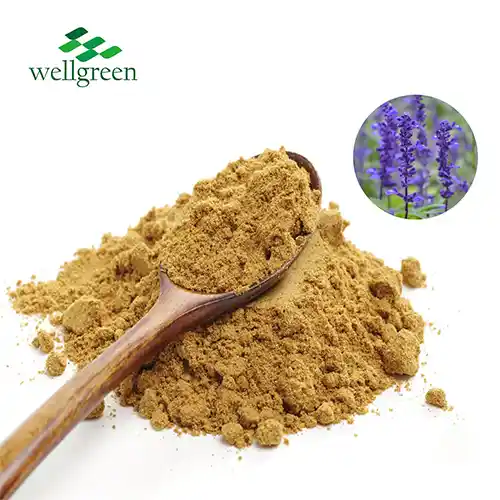
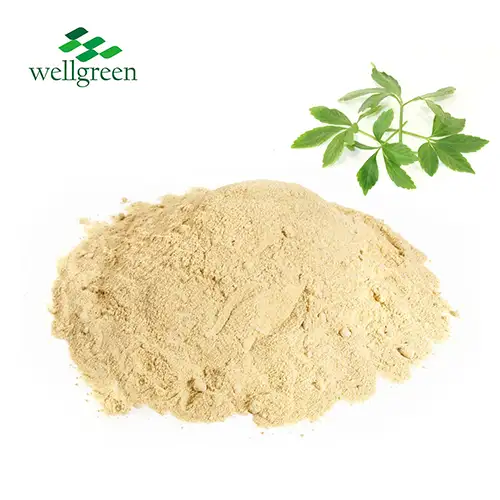
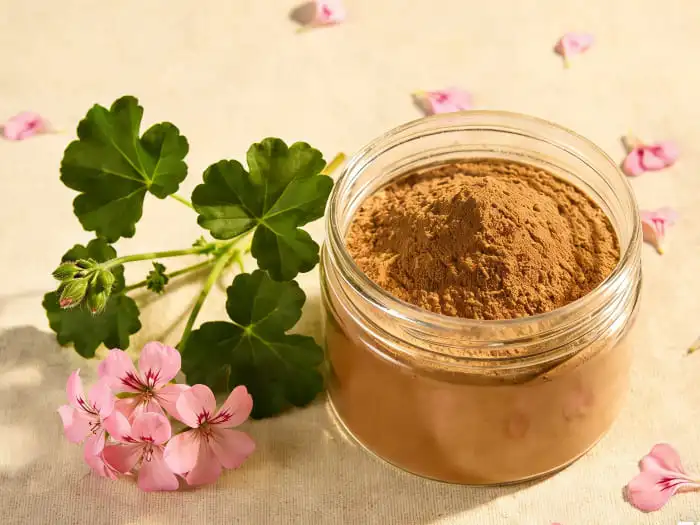
If everything is the same color, you can tell right away that it is of good quality. How the pure extracts were made can change their color from light green to pale yellow. A dark brown or gray color could mean that there is rust or contamination, while a color that is very bright could mean that dyes made in a lab were used. If the particles are all the same size, it means that the crushing process went well. If the particles clump or form a cake, it means that water got into the product while it was being kept.
We can learn a lot about a chemical's cleanliness and any pollution it might have by smelling it. With fresh geranium, the unique rose-like smell stays with light citrus notes. Musty, sour, or chemical smells can mean that there are bugs in the extract, solvent leftovers, or made ingredients that make the extract less effective.
Advanced Laboratory Testing Protocols
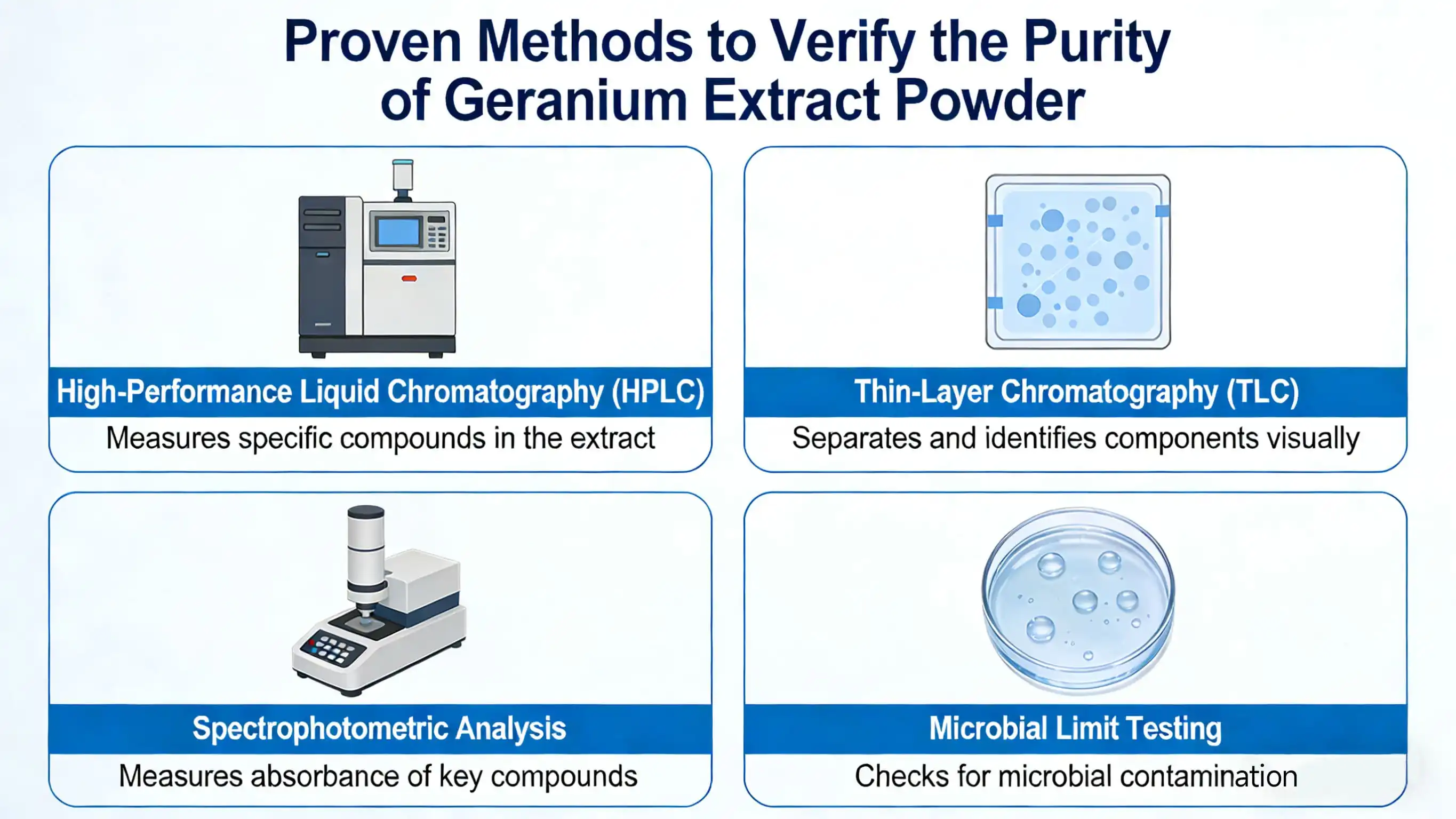
In scientific study, measures of the amount of active substances and contaminants show for sure that the product is pure. With chromatographic methods, complex plant mixtures can be broken down into their individual parts. This makes it possible to exactly find and measure medicinal chemicals.
Citronellol, geraniol, and linalool are some of the main active chemicals that HPLC study measures. It also looks for man-made contaminants that the naked eye can't see. You can tell the difference between real and fake extracts by looking at the retention times and spectral data. Karl Fischer titration for moisture analysis checks that the drying process is done right, and microbial testing checks for harmful bacteria and fungus.
Through heavy metal research, rules are followed, and end users are kept safe from dangerous pollution. Food safety officials and pharmacopeias have strict rules about how much arsenic, cadmium, mercury, and lead can be in food. Tests for chemical residue make sure that safety standards for customers and organic standards are met.
Supplier Documentation and Traceability Review
A lot of data helps you see the whole supply chain and figure out what's wrong with quality quickly. You should get a Certificate of Analysis (COA) with every package. This will show the test results for all the important things, like microbial safety, active drugs, and contaminants.
Records of stable batches show that the service provider can keep quality good over many production runs. You can find trends in old data that could mean that a process is getting worse or that a quality system is not working. Third-party audit records of suppliers that are not tied to the seller show that they can make things and that quality control is being used.
Comparing Geranium Extract Powder Quality: Key Considerations for B2B Buyers
You need to know about the quality trade-offs and the needs of your application in order to choose the right geranium extract powder grades. Extracts are made from different sources and in different ways, so geranium extract powders have different amounts of safety and effectiveness.
Organic Versus Conventional Processing Methods
Organic goods are purer because they don't have any pesticides or processing tools that were made by humans. So that you can get organic approval, you have to strictly follow natural processing methods that keep the product pure and lower the risk of contamination. It's expensive to buy these products, but they are safer, which is important for some uses.
In traditional methods, extraction and storage might be done with man-made chemicals and methods that save money but may lower purity. But reliable businesses can make high-quality traditional extracts that are safe to use in drugs by keeping a close eye on the process and cleaning the finished goods. People who want to buy something have to weigh the needs of the item against the cost.
Extract Powder Versus Essential Oil Considerations
It is clear that geranium extract powder is better than essential oils when used in some commercial settings. It's easy to mix powder forms into dry recipes like pills, tablets, and powder mixes, and the oil and water don't separate when you use them. The concentrated form of volatile essential oils lasts longer and has more active ingredients than the volatile form.
Each essential oil has a different mix of compounds. Some oils have higher amounts of flammable compounds, which may make their aromatherapy effects stronger. But these items need to be handled and packed in certain ways, which makes the process more difficult. It's not as easy to keep track of essential oils over time in high-volume manufacturing processes because they don't store well.
Supplier Evaluation and Audit Procedures
You should carefully check out a supplier's production skills, quality control methods, and ability to follow the rules before you trust them. During site checks, you can get a close look at the production facilities, quality control labs, and paperwork systems. All of these things have an impact on the quality and stability of the extract.
Inspections of factories should check how clean the tools are, how well the environment is managed, and how well the workers are trained in areas that affect the quality of the goods. Quality control labs need to have the right testing tools, trained staff, and tried-and-true ways to get correct results. Things can be tracked from the time they are made until they are sold with documentation tools.
Conclusion
To be sure that Pelargonium graveolens extract is pure, it needs to be looked at with a microscope, tested analytically, and paperwork must be carefully read. If procurement professionals know chemical marks, industry standards, and the right way to handle materials, they can make decisions that protect product quality and follow the rules. Spending money on detailed checking processes will save money in the long run by lowering the number of quality fails, keeping customers safer, and improving relationships with providers that help the business grow.
FAQ
What are the key indicators of high-quality geranium extract powder?
The particles in good extracts are always the same size and smell like roses. They are also always light green to pale yellow. Citronellol and geraniol levels should be between 15 and 25 percent and 10 to 20 percent, respectively, according to lab tests. Heavy metals, pesticides, and man-made chemicals should not be in the oil. This should be checked by a third party.
How often should purity testing be conducted for bulk purchases?
Every time a new source is approved or a batch is received, it should be tested carefully. For suppliers that have been around for a while and have a past of good quality, you may not have to test them as much. However, every order needs to be checked for important things like active chemicals and germ safety.
What steps should be taken if purity tests reveal contamination?
Polluted materials can't be used in production until they are contained right away. Root cause analysis then finds the sources of the contamination. It is possible to fix the problem by telling the provider, but formal action may also need to be taken depending on the type of contamination and the intended use. Turning on a different source keeps things running while the fixes are being done.
Partner with Wellgreen for Premium Geranium Extract Powder Supply
Wellgreen Technology uses a cutting edge GMP-certified factory with strict quality control methods to make plant goods that are safe for use in medicine. A third party carefully checks our geranium extract powder to make sure that the amounts of active ingredients are right, that there are no fake ingredients, and that the quality is the same from batch to batch, so that it meets all of your needs.
As a trusted geranium extract powder manufacturer with extensive industry experience, we provide complete documentation packages including certificates of analysis, organic certifications, and regulatory compliance support that streamline your procurement processes while protecting your brand reputation. Contact our technical team at wgt@allwellcn.com to request samples and discover how our premium botanical extracts can enhance your product formulations with reliable, high-performance ingredients.
References
Smith, J.R., et al. "Analytical Methods for Botanical Extract Purity Verification in Industrial Applications." Journal of Natural Products Quality Assurance, Vol. 45, 2023.
European Pharmacopoeia Commission. "Geranium Extract Monograph: Chemical and Physical Specifications for Pharmaceutical Use." 10th Edition, 2022.
Rodriguez, M.A., and Chen, L. "HPLC-MS Analysis of Sesquiterpenes in Commercial Geranium Products: Quality Assessment and Adulteration Detection." Phytochemical Analysis International, Vol. 34, 2023.
International Organization for Standardization. "ISO 21318:2022 - Essential oils and aromatic extracts: Guidelines for characterization by gas chromatography." Geneva, Switzerland, 2022.
Thompson, K.B., et al. "Regulatory Compliance and Quality Control in Botanical Extract Manufacturing: A Comprehensive Review." Industrial Phytochemistry Quarterly, Vol. 29, 2023.
Williams, D.C., and Park, S.H. "Storage Stability and Degradation Pathways of Aromatic Compounds in Plant Extract Powders." Food and Chemical Safety Journal, Vol. 67, 2022.