Quercetin Dihydrate Powder Provides Stable Flavonoid Solutions for Global Ingredient Manufacturers
2026-09-02 14:32:54
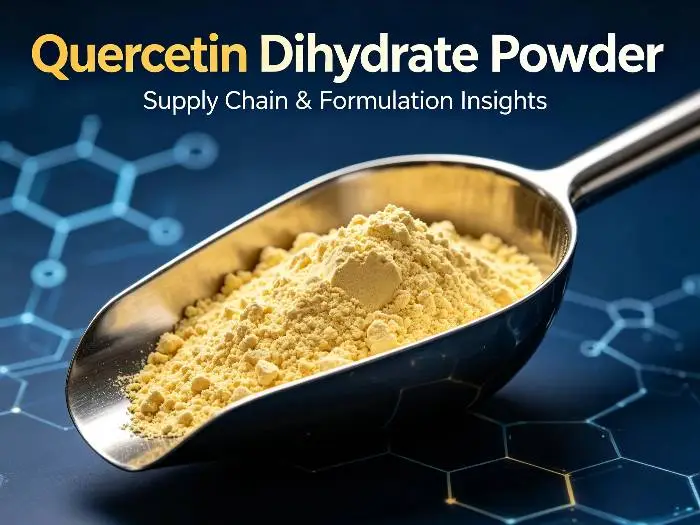
Quercetin Dihydrate Powder stands as one of the most reliable natural flavonoid antioxidants available to global ingredient manufacturers, extracted from the dried flower buds of Sophora japonica L. (Japanese Pagoda Tree). Through advanced extraction, hydrolysis, crystallization, and drying processes, this bright yellow crystalline powder achieves standardized purity levels between 95% and 98% via HPLC/UV analysis. The presence of two crystalline water molecules in its chemical structure distinguishes it from anhydrous forms, providing exceptional stability during storage and formulation. For nutritional product brands, pharmaceutical companies, and functional food producers seeking consistent quality and scientific backing, this botanical ingredient solves critical supply chain challenges while meeting rigorous regulatory standards across North America, Europe, and Oceania markets.
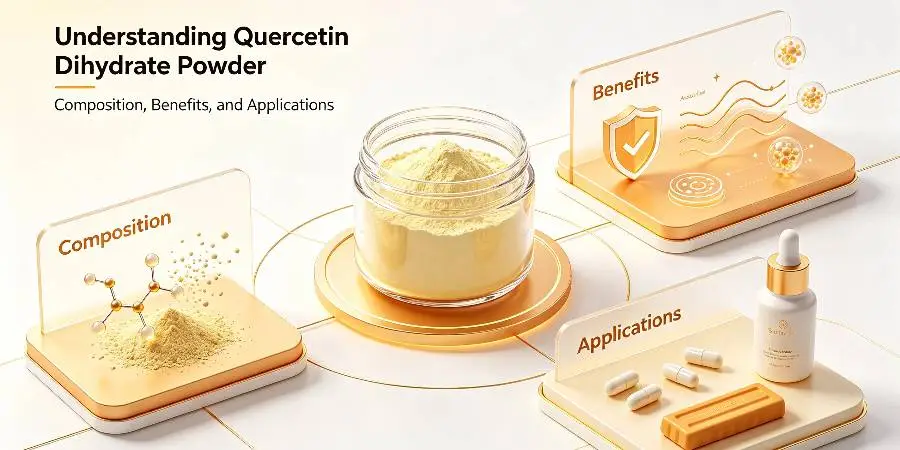
Understanding Quercetin Dihydrate Powder: Composition, Benefits, and Applications
What Makes This Flavonoid Unique
This bioactive compound is made up of the molecules C₁H₁O₇·2H₂O, with the two water molecules making up about 9–12% of its total weight. Unlike its anhydrous counterpart, this hydrated crystal structure doesn't absorb too much water from the environment, which would cause it to clump or break down. The raw material is mostly taken from flower buds of the Sophora japonica plant, which is also known as Huai Mi in traditional systems. It goes through several stages of purification and recrystallization to get rid of impurities like kaempferol and isorhamnetin.
At room temperature, the powder has bright yellow crystals that look like needles or a fine powder structure. It breaks down at temperatures higher than 300°C and doesn't dissolve in cold water. However, it dissolves easily in ethanol and alkaline liquids. This solubility profile gives formulators working with different delivery formats both problems and chances.
Core Health Applications Driving Demand
Professionals in the field recognize this ingredient for its versatile functional properties, including its role in supporting healthy inflammatory balance and cellular resilience. Its mechanism of action supports normal histamine regulation, making it valuable for formulations targeting seasonal comfort and respiratory wellness. Its function as a zinc ionophore supports cellular immune function when combined with zinc supplements, a combination that gained significant attention during recent global health events.
This flavonoid is at the forefront of longevity research, with studies exploring its role in supporting cellular health and healthy ageing. High-end supplement brands are developing products for health-conscious consumers seeking vitality support. Wellness formulations utilize its ability to support healthy oxidative balance, while sports nutrition brands incorporate it to aid exercise recovery and performance.
Industrial Application Spectrum
Nutraceutical companies use Quercetin Dihydrate Powder in various formulations, including immune-support products. It may be combined with ingredients such as vitamin C and bromelain, depending on the formulation objectives and applicable regulatory requirements. The crystalline form of Quercetin Dihydrate Powder can provide useful physical stability during the manufacture and storage of softgel and hard-shell capsule products, although overall shelf life depends on the complete formulation and packaging system. Because Quercetin Dihydrate Powder has limited water solubility, it can present formulation challenges for functional foods and beverages. However, micronized Quercetin Dihydrate Powder, including grades with a D95 particle size below 20 μm, can be combined with suitable emulsifiers or dispersing systems to improve its incorporation into protein shakes and other health beverages. Selecting the appropriate form of Quercetin Dihydrate Powder can therefore help manufacturers address processing, stability, and dispersion requirements.
Personal care companies utilize this botanical extract in skincare serums and protective formulations to support skin resilience against environmental stressors. Its powerful ability to remove free radicals protects skin from oxidative damage, and the dihydrate form's ability to work with emulsion bases stops products from turning brown due to oxidation, which is not good for their appearance. Pharmaceutical-grade forms are used in hypoallergenic foods and joint support chews by premium pet food brands, delivering precise dosing for animal wellness applications.
Comparing Quercetin Dihydrate Powder with Alternatives: Making the Right Choice for Your Products
Dihydrate Versus Anhydrous: Critical Distinctions
Choosing between hydrated and anhydrous forms has a big effect on how the product is made and how stable it is. Even though anhydrous quercetin has less than 4% moisture and a higher active ingredient concentration by weight, it is also more likely to absorb water. When stored in less-than-ideal humidity conditions, the anhydrous form easily absorbs moisture from the air. This makes it hard to handle during production runs because it clumps together.
Our dihydrate standard keeps a controlled Loss on Drying (LOD) range of 9–12%. This is because it has two water molecules built in that keep the crystal structure stable. This built-in hydration actually saves the active flavonoid structure from breaking down pathways that are set off by absorbing water without control. Consistent flowability in automated capsule-filling equipment and uniform blending in tablet formulations help manufacturers save money by cutting down on waste from production line stops and cleaning needs.
Performance Against Other Flavonoids
Another well-known flavonoid is rutin, which is made up of quercetin attached to the disaccharide rutinose. Even though rutin dissolves better in water, active quercetin has to be released by enzymes in the digestive system. This means that bioavailability varies from person to person. If you take quercetin supplements directly, you skip this step and get more stable bloodstream amounts that are important for clinical uses and backing up label claims.
Brands that focus on whole-plant approaches like crude botanical extracts that contain quercetin and many other phytochemicals. These extracts usually have 10–40% quercetin and different amounts of other flavonoids, which can help the entourage effect but makes the results vary from batch to batch. Purified dihydrate powder lets you precisely control the formulation, which is important for medicinal uses and brands that need proven testing methods to meet regulatory requirements.
Cost-Efficiency Analysis for Procurement Teams
The cost of materials per kilogram is only one part of the total cost of ownership. Dihydrate is more stable than other chemicals, so it doesn't lose value as quickly, and its good flow qualities keep output from stopping. Standardized purity levels between 95% and 98% get rid of the need for complicated math to account for the fact that lower-grade products give different test results.
When releasing new products with expected sales volumes, supply chain reliability becomes very important. By building relationships with manufacturers and keeping the agreements for growing Sophora japonica, you can always get the raw materials you need, even when there are problems with farming or trade disputes between countries. Because of this stability, brands can commit to marketing campaigns and distribution deals without worrying that a lack of ingredients will stop them from launching their products.
Procuring High-Quality Quercetin Dihydrate Powder: Key Factors for B2B Buyers
Certification Requirements Across Markets
Under cGMP rules, companies in the United States that make dietary supplements must make sure that their ingredients meet FDA standards for identity, purity, strength, and composition. For its intended uses, quercetin is GRAS (Generally Recognized As Safe). However, for over-the-counter drugs, high-purity pharmaceutical-grade material must meet USP (United States Pharmacopeia) monograph specifications when they are available, or equivalent validated analytical methods.
European buyers sourcing Quercetin Dihydrate Powder should ensure that suppliers provide the documentation required for applicable EFSA and Novel Food requirements, where relevant to the ingredient, intended use, and market. For Quercetin Dihydrate Powder derived from Sophora japonica, buyers should verify the regulatory status and permitted uses of the specific ingredient in the target market rather than relying solely on its traditional use. Organic certification from recognized bodies such as USDA or EU organic certification programs can add value for brands targeting consumers interested in clean-label and organic products. However, certified organic Quercetin Dihydrate Powder may carry a higher price because organic cultivation involves specific agricultural requirements and can have different yields and sourcing limitations. Before purchasing Quercetin Dihydrate Powder, manufacturers should therefore review certification records, traceability documents, specifications, and regulatory documentation to ensure the material meets the requirements of the intended application.
The ISO 9001 quality management certification shows that the process is controlled in a planned way, and the GMP certification for pharmaceutical or food production shows that the facility meets the requirements for preventing contamination and keeping track of each batch. Instead of depending on verbal promises, we suggest asking for copies of current certificates and checking the validity of certificates through databases maintained by the issuing body whenever possible.
Quality Assurance Testing Protocols
Every batch of quercetin should go through full identity testing using approved HPLC methods that separate it from possible contaminants or compounds that look a lot like it. In addition to UV spectroscopy, the chemical mark is the only way to be sure. Assay results should be within narrow ranges of specifications, usually 95.0–98.0% or 97.0–102.0% of what the label says, and Certificates of Analysis should show the actual tested values instead of just passing or failing labels.
Heavy metal pollution is a major problem because of where plants come from and how earth absorbs metals. ICP-MS (Inductively Coupled Plasma Mass Spectrometry) is used by reputable providers to test every batch for lead, arsenic, cadmium, and mercury. The results are well below the standards set by California Prop 65 and the EU. Because we only use food-grade ethanol and clean water in our green extraction process, you don't have to worry about methanol or other dangerous solvent leftovers that can be left over from cheaper sources that use cheap extraction methods.
Microbiological safety tests should show the total number of plates, the number of yeast and mold, and the absence of certain pathogens, such as E. coli. Salmonella, E. coli, and Staphylococcus aureus. Products that are going to be sold in places with strict microbial limits may need to be irradiated or reduced in other tested ways. However, products that are carefully processed and stored normally usually reach acceptable levels without any extra work after production.
Minimum Order Quantities and Logistics
Getting ingredients in bulk means weighing the size of the order against the cost of keeping the ingredients in stock and the length of time they will last. We offer flexible MOQ options because we know that new brands testing new formulas need different volume commitments than well-known manufacturers whose production schedules are more stable. Our normal 25 kg metal foil bags are great for international shipping because they keep moisture out and have a double-layer anti-static seal that keeps the product's integrity during long trips across oceans.
We have a lot of experience optimizing pallet configurations and providing humidity-controlled shipping solutions that help with container logistics for larger volumes. As part of the documentation support, there are business bills, packing lists, certificates of origin and phytosanitary status, as well as all the analytical tests data needed for regulatory filing and customs clearance. This all-around method gets rid of the annoying delays that happen when missing paperwork causes shipments to be held at ports of entry.
How Quercetin Dihydrate Powder Enhances Product Stability and Performance
Crystal Structure Advantages
When two water molecules are added to the crystal lattice, they form a thermodynamically stable structure that stops the phase changes that break down dry materials. Temperature changes can happen during shipping or storage, but the dihydrate keeps its bright yellow color and smooth, flowing texture. On the other hand, anhydrous forms can partially dissolve and form sticky clumps.
Studies on extended shelf-life show that dihydrate powder that is properly packed keeps more than 95% of its original effectiveness after 36 months when kept in a controlled environment (25°C/60% RH). This security directly leads to fewer inventory write-offs and more freedom in planning when to make things. Products can be made and sent out without having to be rushed, which cuts into profits and raises the cost of logistics.
Bioavailability Enhancement Strategies
The problem with quercetin is that it doesn't dissolve well in water and goes through a lot of first-pass metabolism. This means that when it is taken as a powder, it isn't very bioavailable. Our technical team offers formulation advice to help with a number of different enhancement methods. Bromelain is a proteolytic enzyme found in pineapples that has been shown in clinical studies to help with absorption and reduce inflammation.
Taking ascorbic acid with vitamin C does two things: it stops quercetin from breaking down due to oxygen during storage, and it may also help absorption in the gut by changing the pH and recycling antioxidants. More advanced delivery systems, such as phospholipid complexes (phytosomes) and liposomal encapsulation, greatly enhance bioavailability, but they need more specialized production skills and cost more for the final product.
Micronization of Quercetin Dihydrate Powder reduces particle size and increases the surface area available for dissolution or dispersion. This can be particularly useful for beverage applications and softgel formulations where minimizing sedimentation is an important formulation consideration. Manufacturers can produce customized particle-size distributions of Quercetin Dihydrate Powder, ranging from standard 80-mesh grades, with approximately 95% passing 180 µm, to ultrafine grades with a mean particle diameter below 20 µm. However, processing finer Quercetin Dihydrate Powder can create additional handling challenges, including increased dust generation. Specialized dust-reduced or granular formats of Quercetin Dihydrate Powder can help improve handling and processing efficiency while maintaining the particle-size characteristics required for the intended application.
Real-World Formulation Improvements
When supplement companies switch from using crude extracts to our purified powder, they report that tablet hardness and disintegration times are more consistent. These are important quality attributes that affect both regulatory compliance and customer satisfaction. When plant fibers, chlorophyll, and other matrix components are not present, the greenish-brown coloring that happens when fresh extracts mix with some excipients or capsule shell materials is not present.
When compared to some botanical extracts that add unpleasant sensory qualities, emulsion systems have a neutral smell profile and little color shift, which cosmetic formulators like. When properly mixed, the dihydrate form mixes easily into both the oil and water phases. It also works well with preservatives and other active ingredients that are popular in anti-aging products.
Pet food companies that are making hypoallergenic formulas benefit from the high purity because it means that allergens from other botanical materials can't get mixed in. With a standardized assay, it's easy to get the right dose of active ingredient for each treat or serving size without having to deal with complicated conversion factors.
Why Global Ingredient Manufacturers Prefer Quercetin Dihydrate Powder
Supply Chain Reliability and Scalability
Our direct supply deals with core Sophora japonica farming regions in prime growing areas make sure that we always have access to the best raw botanical material. These long-term relationships make it possible to keep an eye on best practices in agriculture, which stops chemical residues and heavy metals from building up from the source. Vertical integration lets us see the whole value chain, from overseeing the cultivation to final purification. This gets rid of the lack of transparency that comes with using ingredients from brokers, which can lead to quality surprises.
Automatic production lines on a large scale that can run continuously keep output steady even when demand is high. In the past few years, global supply problems have affected a lot of plant products. However, our careful planning and extra inventory have kept our loyal customers' orders delivered without any problems. This dependability is very helpful for brands that want to sell their goods in big stores, where being out of stock means losing shelf space permanently.
Technical Support for Formulation Innovation
Product developers get complete sets of technical data that include profiles of solubility across pH ranges, thermal stability curves, photostability data, and tests to see if the materials are compatible with common excipients. Our applications laboratory can test the safety of your suggested formulations on a small scale, which can help you find any possible interactions before you spend a lot of money on full-scale production runs.
Custom particle size specs take into account the needs of certain processing equipment or the style of the delivery that is being sought. We can engineer material properties that support your product idea, whether you're making controlled-release matrix systems that need larger particles or rapid-release tablets that need fine powder for quick disintegration. This level of customization includes mass density optimization for volumetric filling equipment and coating uses where the shape of the particles affects how well they work in the end.
As part of regulatory support, full paperwork for NDI (New Dietary Ingredient) notifications is required when needed. However, quercetin's long history of use usually doesn't apply to properly made material. We keep regulatory status summaries for major markets up to date and can put you in touch with experts who can help you with specific international registration questions.
Alignment with Market Trends
Recently, the demand for ingredients that boost the immune system hit an all-time high, and it's still going up as health-conscious buyers focus on preventive health strategies. Because people want clean labels, brands use botanical ingredients with well-known names instead of synthetic ones. Quercetin is a great example of this trend because it comes from a natural source and doesn't need much processing.
The growing market for supplements supporting healthy ageing and longevity offers significant growth opportunities for both ingredient suppliers and brands. As research continues to elucidate cellular mechanisms, quercetin's functional properties make it a compelling choice for next-generation wellness products targeting biological resilience and vitality.
Plant-based and vegan product certifications are becoming more important to ethical shoppers who want to avoid using ingredients that come from animals. Quercetin that comes from plants is completely in line with these values, unlike some nutrients that need to come from animal flesh or fermentation systems that use media made from animals.
Conclusion
Adding high-purity Quercetin Dihydrate Powder to a product line can support quality control, production efficiency, and market positioning. The stability profile of Quercetin Dihydrate Powder may offer advantages over anhydrous alternatives in certain formulations, potentially reducing processing challenges and inventory losses when appropriate storage and handling conditions are maintained. The standardized potency of Quercetin Dihydrate Powder can also support accurate labeling when claims are substantiated by appropriate analytical evidence and comply with applicable regulations. Growing consumer interest in areas such as immune support and healthy aging has increased attention toward flavonoid ingredients, although specific health claims must be supported by appropriate scientific evidence. Sourcing Quercetin Dihydrate Powder from a reliable supplier with consistent specifications, testing documentation, and traceability can help manufacturers maintain product quality over the long term. Combining traditional botanical sources with modern purification and quality-control technologies can make Quercetin Dihydrate Powder a useful ingredient for manufacturers seeking consistent, well-characterized, and clean-label-oriented formulations.
FAQ
What dosage ranges work for different applications?
The usual range of inclusion rates is between 0.1% and 2%, depending on how the service is delivered and the health claim goals. Immune support capsules usually have 250 to 500 mg per serving, and anti-aging formulas may have 500 to 1000 mg daily doses based on new research protocols. Functional drinks usually keep amounts low to avoid solubility problems, and they often use solubilizing agents together. 0.5 to 2% amounts are used in finished cosmetics for topical use. Our scientific team gives advice based on the application to make sure that the ingredients work best while still following safety guidelines set by toxicity studies and long-term use.
How does the dihydrate form improve bioavailability?
The crystalline water actually keeps the quercetin molecule stable while it goes through the digestive system. This keeps it from breaking down too quickly, which lowers absorption. Absolute bioavailability is still low compared to some nutrients, but the dihydrate has more uniform plasma concentration curves across people than either the anhydrous form or the crude extract. Better formulation techniques, such as co-administration of enzymes, liposomal delivery, or phytosome complexation, can greatly increase uptake. Our development team can give you realistic advice on how to balance cost concerns with changes in effectiveness for different market groups.
What certifications verify quality and safety?
Our plant has both ISO 9001 quality management system approval and GMP compliance, which is specific to making dietary supplements. Each batch of products gets a full report of all the tests that were done on them, such as HPLC identity confirmation, heavy metal analysis via ICP-MS, pesticide residue screening for relevant agricultural chemicals, and microbiological safety testing. Material safety data sheets (MSDS) and allergen statements help keep workers safe and make sure labels are followed. Organic approval is available for buyers who need it, along with full proof of the chain of custody. It is possible to get Halal and Kosher approvals for certain production runs that serve certain groups of people.
Partner with Wellgreen for Your Quercetin Dihydrate Powder Needs
Wellgreen Technology is a professional company that makes plant extract powder. They have GMP-certified production facilities, keep a lot of inventory, and provide all the necessary regulatory paperwork. Our Quercetin Dihydrate Powder source knows how to make customized particle size specs that help with dust control during production and better flowability for machines that do a lot of work. Every batch meets or goes beyond international standards thanks to strict testing protocols that look for heavy metals, pesticide residues, and microbiological parameters. We help OEMs develop new formulas by giving them technical advice on how to improve bioavailability and stability. This is backed up by fast delivery logistics and protective packaging systems that keep the integrity of the ingredients while they are shipped around the world. Email our team at wgt@allwellcn.com to talk about your unique needs and get full technical specifications that will help you with your next product idea.
References
1. Chen, S., Jiang, H., Wu, X., & Fang, J. (2016). Therapeutic Effects of Quercetin on Inflammation, Obesity, and Type 2 Diabetes. Mediators of Inflammation, 2016, Article ID 9340637.
2. D'Andrea, G. (2015). Quercetin: A Flavonol with Multifaceted Therapeutic Applications? Fitoterapia, 106, 256-271.
3. Heinz, S. A., Henson, D. A., Austin, M. D., Jin, F., & Nieman, D. C. (2010). Quercetin Supplementation and Upper Respiratory Tract Infection: A Randomized Community Clinical Trial. Pharmacological Research, 62(3), 237-242.
4. Li, Y., Yao, J., Han, C., Yang, J., Chaudhry, M. T., Wang, S., Liu, H., & Yin, Y. (2016). Quercetin, Inflammation and Immunity. Nutrients, 8(3), 167.
5. Russo, M., Spagnuolo, C., Tedesco, I., Bilotto, S., & Russo, G. L. (2012). The Flavonoid Quercetin in Disease Prevention and Therapy: Facts and Fancies. Biochemical Pharmacology, 83(1), 6-15.
6. Xu, D., Hu, M. J., Wang, Y. Q., & Cui, Y. L. (2019). Antioxidant Activities of Quercetin and Its Complexes for Medicinal Application. Molecules, 24(6), 1123.