
The Ultimate Guide to Yucca Extract
2026-11-11 17:08:18
Yucca extract is a concentrated preparation of the Yucca schidigera plant, valued for its saponins, polyphenols and polysaccharides. In B2B use it does three jobs better than almost any other botanical: it binds ammonia in animal feed and aquaculture water, it works as a natural wetting agent / surfactant in turf and fertilizer products, and it serves as a natural foaming and stabilising ingredient in food, beverage and cleansing formulas.
You can buy it in three forms — extract powder (30% / 60% saponin, B50 4–8 mg, fully water-soluble), raw (straight) powder and concentrated liquid — each suited to a different process. Standard supply starts at 1 kg, 50–100 g samples are free, and bulk ships in 25 kg drums (powder) or 25 L drums / IBCs (liquid).
What This Guide Covers
- What is yucca extract — and what are you buying?
- Powder vs. raw powder vs. liquid: spec-level comparison
- Why saponin % and B50 decide everything
- What yucca extract does in animal feed
- How yucca is used in aquaculture
- Yucca in pet & horse nutrition
- Yucca as a natural wetting agent for lawns & turf
- Food, beverage & cosmetic uses
- How much to use: reference inclusion rates
- Is yucca extract safe? Side effects & compliance
- Market status & outlook
- OEM & private-label guide
- 10-point supplier evaluation checklist
- What drives yucca extract price
- FAQ
- References
1. What Is Yucca Extract — and What Are You Actually Buying?
Yucca extract is made from Yucca schidigera (Mohave yucca), a desert plant of the agave family harvested for its stems and leaves. The commercial value sits in three active groups:
- Yucca saponins — surface-active molecules that bind ammonia and other volatile compounds, and that foam naturally in water. This is the marker buyers standardise on.
- Polyphenols (including natural plant PGRF factors) — associated in ruminant research with a protective effect on proteins and lipids in the gut.
- Polysaccharides — act as a prebiotic substrate supporting beneficial gut bacteria.
For procurement, two origins dominate global supply: Mexico (the traditional home of Y. schidigera) and southern China — Guangxi, Yunnan and Sichuan provinces — where yucca stands are cultivated and processed at scale. Wellgreen sources from both regions, which gives buyers a hedge against single-origin crop and price volatility. If a supplier cannot name the origin of your batch, that is your first red flag.
What reaches your factory is not one product but three: an extract powder (concentrated, standardised, fully soluble), a raw/straight powder (simply ground dried plant), and a concentrated liquid (the extract before drying). Each has different saponin levels, solubility, dosing equipment and price behaviour. The next section compares them spec-for-spec.
2. Yucca Extract Powder vs. Raw Powder vs. Liquid: a Spec-Level Comparison
This is the table we wish every buyer would open before asking for a price. It compares the three Wellgreen formats exactly as they ship.
| Attribute | Yucca Extract Powder | Yucca Raw (Straight) Powder | Yucca Extract Liquid |
|---|---|---|---|
| Botanical part / raw material | Yucca stems & leaves | Yucca stems & leaves (whole plant) | Yucca stems & leaves |
| Main sourcing origins | Guangxi, Yunnan, Sichuan (CN); Mexico | China | China / Mexico by grade |
| Process | Extraction → concentration → drying → grinding/mixing → sieving | Shearing → drying → grinding → sieving (no extraction) | Extraction (aqueous ethanol or pure water) → concentration (no drying) |
| Appearance | Brown-yellow fine powder; colour can be customised | Light green to light brown powder | Brown-yellow liquid |
| Saponin standardisation | 30% / 60% (custom on request) | Not standardised | Consistent per batch |
| B50 (UV) | 4–8 mg | 2–5 mg | Per grade (pH 4.5–5.5) |
| Water solubility | 100% (≥99%, 1 g/100 mL) | General / partial — may leave sediment | Fully water-soluble |
| Particle size | 98% through 80 mesh | 98% through 80 mesh | n/a |
| Preservatives | None | None | None |
| Shelf life | 24 months (use within 3 months after opening) | 24 months (use within 3 months after opening) | 12 months (use within 3 months after opening) |
| Standard packaging | 1 kg aluminium foil bag; 25 kg fibre drum with double PE liner; OEM supported | 25 kg kraft bag or 25 kg fibre drum | 25 L stacking drum; 1,000 / 1,200 L IBC on request |
Which format should your operation buy?
- Feed mills building a medicated-style premix or using dosing pumps → extract powder (dosing precision, full solubility) or liquid (pump-in-line systems).
- Pet-food brands dusting kibble or filling capsule lines → extract powder for label claims with defined saponin; raw powder where "whole-plant" positioning matters more than solubility.
- Turf, lawn & fertilizer formulators → liquid for concentrate bottles and irrigation injection; powder for water-dispersible granules — both act on the same wetting mechanism.
- Aquaculture farms treating pond water directly → powder (dissolved on site) or liquid (pre-diluted in tanks); the deciding factor is your dosing equipment, not efficacy.
Live product pages with full COA samples: Yucca Extract Powder (30%/60%) and Yucca Liquid.
3. Why Saponin Percentage and B50 Decide Everything You Buy
Two numbers should appear on every yucca specification you receive — and most procurement mistakes come from ignoring one of them.
What "saponin 30% / 60%" actually means
This is the declared active content, typically measured by UV spectrophotometry against a reference standard. It determines how much product you need per tonne of feed or per hectolitre of spray solution. Paying per kilogram is meaningless; compare suppliers per kilogram of saponin — a cheaper 30% bag can be more expensive in the mixer than a 60% one.
What B50 means and why ammonia buyers should care
B50 is the saponin index measured by UV — the concentration at which the extract reaches 50% haemolysis. A lower B50 value means higher saponin activity per unit mass. Wellgreen's extract powder runs B50 4–8 mg; raw powder typically 2–5 mg reflects its different saponin profile rather than superiority — B50 comparisons only hold within the same product type and method. Ask every supplier to state the method (UV vs. HPLC vs. haemolysis titration) next to the number, or you are comparing poetry, not chemistry.
The rest of the COA you should insist on
- Solubility ≥99% (1 g in 100 mL water) — non-negotiable for drinking-water and foliar lines; sediment in a fertigation tank is a clogged-emitter lawsuit.
- Particle size 98% through 80 mesh — governs dispersion in premixes and suspension behaviour in slurries.
- Loss on drying ≤5.0% — moisture drives caking in humid ports and shelf-life failures.
- pH of a 20% solution ≈ 4.1 ± 0.2 — matters when yucca meets acids, enzymes or plant extracts in a shared formula.
- Microbiology: TPC ≤1,000 cfu/g, yeast & mould ≤100 cfu/g, E. coli / Salmonella / Staphylococcus not detected.
- Batch-specific COA + retained sample — a responsible manufacturer keeps a retention sample for two years.
For a deeper process explanation — how extraction, concentration and spray-drying turn plant material into standardised powder — read our technical article How to Make Yucca Extract, and the buyer-oriented overview What Is Yucca Extract Powder.
4. What Does Yucca Extract Do in Animal Feed?
Direct answer: yucca saponins bind ammonia and volatile odor compounds in the gut and in manure, cutting barn ammonia, improving the air animals and workers breathe, and supporting feed efficiency — which is why roughly 16% of US compound feed is reported to include yucca extract.
The mechanisms that matter to a purchaser, in order of how strongly the evidence supports them:
- Ammonia and odour control. Saponins form complexes with ammonia in manure, reducing NH₃ emissions in poultry houses, swine barns and calf pens — the single most common reason buyers specify yucca.[1][2] Winter-house trials in broilers reported better metabolic efficiency and lower environmental ammonia alongside improved egg weight and growth metrics.[1]
- Gut environment. Yucca polysaccharides act as a prebiotic substrate for beneficial bacteria, associated with improved nutrient absorption; commercial saponin programmes (yucca and quillaja) are used in broiler production specifically for their performance and ammonia-emission effects.[4]
- Stress windows. Feed formulators routinely include yucca around transport, weaning and regrouping, when animals go off feed and ammonia spikes coincide.
- Performance. A peer-reviewed broiler trial reported improved final live weight (~173 g advantage at six weeks) and feed conversion (FCR 1.91 vs. control) under winter conditions[11]; a separate 1999 trial concluded Norponin-S yucca extract was safe for broilers and yielded better weight gain with controlled atmospheric ammonia[3] Results vary by species, dose and basal diet — run your own trial batch.
5. How Is Yucca Extract Used in Aquaculture?
Direct answer: in shrimp and fish farming, yucca extract is used as the natural ammonia fighter — either mixed into feed or applied to the water — to lower toxic ammonia from excreta and uneaten feed without touching stocking density or feeding behaviour.
Ammonia accumulation is the ceiling on intensification: it stresses gills, suppresses growth and forces farmers to dump and refill water, which costs energy and brings disease risk. A peer-reviewed feasibility study confirmed that Yucca schidigera extract can reduce ammonia pollution originating from shrimp farming systems[5], and a shrimp-pond trial in Mexico found that extract fed in the diet measurably lowered ammonia concentration in the water column, with a significant effect reported[7]. A dedicated Aquaculture Reports study estimated effective dosing levels for liquid yucca extract and reported total ammonia nitrogen driven down to about 0.07 mg/L under its trial conditions[6]. Beyond ponds, yucca extract has been trialled for open-water ammonia reduction with other water-quality parameters staying stable, showing it is gentle on the ecosystem[8].
For a farm or feed mill buying yucca for aquaculture, the specification checklist is short:
- Feed route: extract powder at 30% saponin standardised into the pellet premix — ask for B50 and mesh; fine powder disperses evenly in mashes for larval diets.
- Water route: fully water-soluble powder dissolved on site, or liquid dosed into tanks and canals — zero sediment protects splashers, paddles and filter feeds.
- Documentation: batch COA with microbiology limits, because closed-cycle hatcheries audit incoming additives hard.
Talk to our aquaculture team about trial protocols for your species and stocking density — yucca extract powder specifications and free samples are here.
6. Can Yucca Be Used in Pet Food and Horse Supplements?
Search interest tells the same story as retail shelves: yucca powder for dogs, is yucca powder safe for cats, yucca powder for horses and yucca root powder for dogs rank among the most-asked long-tail queries in this ingredient family. The commercial logic:
- Dog & cat food: yucca extract is added to kibble and wet food primarily to reduce faecal odour — the same ammonia- and odour-binding chemistry that works in barns works in the litter box. Top-dressing and dusting applications tolerate raw powder, but coated kibble lines prefer fully soluble extract powder for even spraying.
- Equine supplements: yucca has a long traditional and commercial history in horse joint-and-comfort formulas and in barn odour control, making it a staple SKU for supplement brands serving the equestrian channel.
- Private label: pet-treat and supplement brands typically start with a 1 kg trial, then move to 25 kg drums with custom mesh and colour — see the OEM section below, or explore our wider nutriceutical range such as Lion's Mane mushroom extract in the same purchasing stream.
7. Yucca as a Natural Wetting Agent for Lawns, Turf & Fertilizers
Direct answer: yucca saponins are natural surfactants — they lower the surface tension of water, so sprays and irrigation penetrate instead of beading and running off. University extension services describe this wetting-agent action explicitly, which is why yucca liquid is a classic ingredient in organic lawn programmes.[9]
What applying yucca extract does for turf
- Breaks hydrophobic thatch and dry-out patches, improving water infiltration and uniform coverage.
- Makes tank mixes of liquid fertilizer, biostimulants and plant-protection products spread evenly on waxy leaf surfaces — better contact, less wasted drench.
- Supports soil microbial activity indirectly by restoring continuous moisture films in the root zone.
- Fits "organic surfactant" and "wet-and-lock" positioning, a fast-growing shelf in garden retail and e-commerce.
Liquid vs. dry water-soluble: which one for your product?
- Liquid yucca extract (pH 4.5–5.5, brown-yellow, fully soluble) is the path of least resistance for bottled concentrates, hose-end mixes and irrigation injection — no dissolution step, precise metering, and it blends cleanly with humic acids, seaweed and microbial products.
- Water-soluble extract powder wins for water-dispersible granules, powder sachets and export formulations where water weight and drum freight kill margins; dissolve-before-fill takes one extra tank.
How much and how often?
Field practice applies wetting-agent rates with irrigation or spray programmes — typically every 2–4 weeks during heat and drought stress, and with every liquid-feeding pass on high-value turf. Because commercial yucca products vary from 30% to 60% saponin (and raw powders not at all), fix your rate on saponins per square metre, then convert to your dilution kit. We supply application worksheets for both formats with trial samples.
8. Beyond Agriculture: Food, Beverage & Cosmetic Applications
The same surface-active chemistry that fights ammonia makes yucca a quiet workhorse in two more B2B categories:
- Food & beverage: yucca extract has a long history of use as a natural foaming and emulsifying aid — the classic example being the stable head on traditional carbonated beverages — and as a botanical ingredient in nutritional formulations. Food-grade lots ship with heavy-metal and microbiology COAs, and the Wellgreen food & beverage range covers matching acidifiers such as apple cider vinegar powder for drink-mix programmes.
- Cleansing & personal care: saponin-rich extracts are the backbone of "no-SLS" foam systems. Yucca is used in liquid soaps, shampoos and wash products — often alongside its higher-saponin sibling ingredients such as our soapnut (reetha) extract and hedera helix (ivy leaf) extract.
- Plant wash & ingredient processing: dilute yucca solutions serve as natural washing agents for fruit, vegetable and botanical raw-material lines, where residue rules push formulators away from synthetic surfactants.
If you are formulating ingestible or topical products, start from the specification sheet on the extract powder page and request our food/cosmetic grade documentation pack.
9. How Much Yucca Extract Should You Use? Reference Inclusion Rates
Use this table as a starting corridor, not a prescription — the right dose depends on saponin content, species, housing or water system, and your own baseline measurement. Every rate below should be validated in a trial batch; our technical team issues a dosing card per species, format and saponin standard.
| Application | Format | Common starting range | Evidence / notes |
|---|---|---|---|
| Poultry & swine complete feed (ammonia & odour control) | Extract powder 30–60% | ≈100–200 g per metric tonne of feed | Commercial practice; adjust with barn NH₃ readings |
| Broiler drinking-water programme | Liquid extract | ≈1 mL per 20 L of drinking water | Reported in broiler housing trials[2] |
| Calf, sheep & goat housing odour | Powder or liquid, dry-applied or sprayed | Per pen surface & cleaning cycle | Manure-contact mechanism, similar to barn litter use |
| Aquaculture feed route | Extract powder in premix | Trial-specified per species & biomass | Effective levels estimated in pond studies[6][7] |
| Aquaculture water treatment | Liquid or dissolved powder | Dosed to water volume; re-measure TAN | Target ammonia reduction, ecosystem-safe[5][8] |
| Turf / ornamental wetting-agent programme | Liquid concentrate or soluble powder | Label-rate with irrigation, every 2–4 weeks under stress | Surfactant action per extension guidance[9] |
| Dry pet food coating / treats | Extract powder | Formulation-specific; low-g per kg band | Odour-control positioning; check local claim rules |
10. Is Yucca Extract Safe? Side Effects and Regulatory Status
Direct answer: for animal production yucca extract is one of the best-established botanical feed additives on the market, with decades of commercial use; for humans it is generally well tolerated at labelled doses, with mild digestive upset the main caution at high saponin intake.
Animal safety
Published broiler trials describe yucca extract as safe at inclusion levels used commercially, with improved performance rather than adverse effects[1][3][11]. In the European Union, yucca extract has been authorised for use as a sensory feed additive in several poultry species; in the United States it has a long history of use in compound feed, and the FDA's public GRAS Notices database is the reference point for checking the current filing status of any yucca-related food use[10]. Regulatory acceptance still varies by species, claim and market — always confirm destination-country rules before reformulating.
Human & consumer-product cautions
- Saponin-rich intakes can cause mild gastrointestinal discomfort in sensitive individuals; follow label doses.
- Products for pregnancy, lactation, children and prescription-drug users deserve professional review — saponins can modulate absorption of other oral compounds.
- Infant formula and infant food are out of scope; our food-grade specifications explicitly exclude infant applications.
- Factory handling: standard dust control for fine botanical powders (80 mesh) is sufficient; P2 masks in dusty tipping stations.
Every Wellgreen lot ships with a batch COA covering assay, solubility, mesh, moisture, heavy metals and microbiology, plus MSDS on request — the documents your QA team needs for supplier approval audits.
11. Market Status and Outlook: Why Yucca Demand Keeps Climbing
Yucca extract sits at the intersection of four structural shifts in agriculture and ingredients — which is why buyers who treated it as a niche curiosity a decade ago now budget it as a standing line item:
- Antibiotic-growth-promoter phase-outs. Every market that restricts in-feed antibiotics needs gut-support and efficiency tools; yucca's prebiotic-substrate and ammonia-binding roles slot directly into those programmes.
- Ammonia-emission regulation. Barn-air and environmental-ammonia rules across Europe, North America and large-intensive Asian operations turn odour control from courtesy into compliance cost — yucca is one of the few proven feed-route answers.
- Aquaculture intensification. Higher stocking densities push ammonia management to the front of production economics; feed- and water-route yucca trials keep publishing positive results[5][6][7][8].
- Clean-label surfactants. Organic lawn care, "no-SLS" cleansing and residue-conscious produce washes pull yucca saponins out of agriculture and into consumer formulations[9].
Demand is broad, not giant: our keyword tracking shows a compact core of commercial queries (yucca powder around 400 monthly searches, yucca root powder near 90) wrapped in an unusually rich long tail — yucca powder for aquaculture / for horses / for dogs / for cats / for plants, organic yucca powder, buy yucca powder, yucca powder price. For B2B suppliers that pattern means low-cost, high-intent visibility for whoever answers the application questions best — including in AI search, where citation-ready guides like this one get quoted. Industry data cited in our technical briefs indicate roughly 16% of US compound feed already includes yucca extract; the share outside North America is the growth runway.
12. OEM Yucca Extract: Custom Formulation and Packaging Guide
Most first-time importers buy a standard 30% or 60% powder. Repeat buyers build their own spec — and that is where margin and brand control come from. Here is how an OEM programme works, step by step.
Criteria for custom formulation
- Define the active target first: saponin percentage (30% / 60% / custom), B50 window, and test method (UV) written into the contract spec.
- Fix the physical behaviour: 80–100 mesh for premixes, tighter mesh and anti-caking storage protocol for humid ports, colour standardisation for consumer-facing powders.
- Choose carrier and solubility grade: pure extract for dosing lines; standardised blends with maltodextrin where flowability in capsule and sachet lines matters more than maximum strength.
- Lock documentation: bilingual COA template, MSDS, certificates package, retained-sample policy and stability data agreed before the first production run.
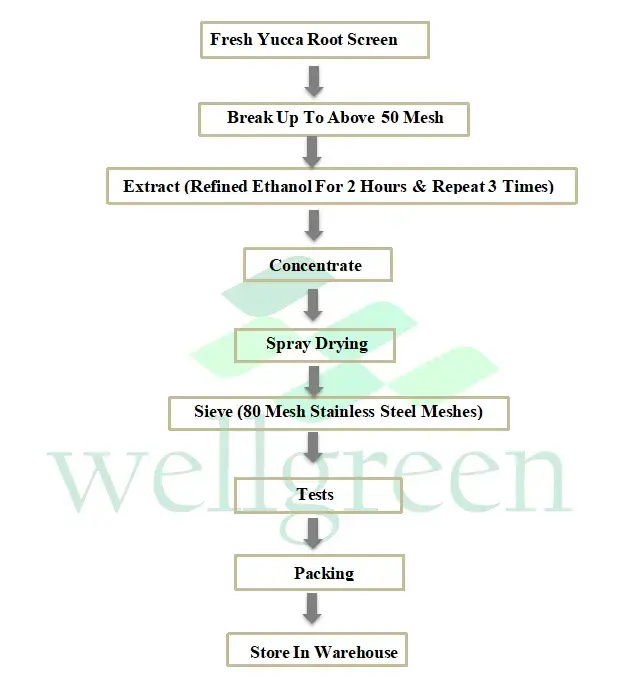

Standard Wellgreen process flow for OEM yucca extract powder — every agreed deviation is documented per batch.
Packaging and label options
- Powder: 1 kg aluminium foil bags for retail-service and sample programmes; 25 kg fibre drums with double PE liner for industrial volume; OEM outer printing and barcode placement available.
- Liquid: 25 L stacking drums as standard; 1,000 / 1,200 L IBCs for mills with dosing stations.
- Container planning: ~11 t per 20'GP and ~22 t per 40'HC for 25 kg bagged powder — useful when you compare landed cost against air-freighted small lots.
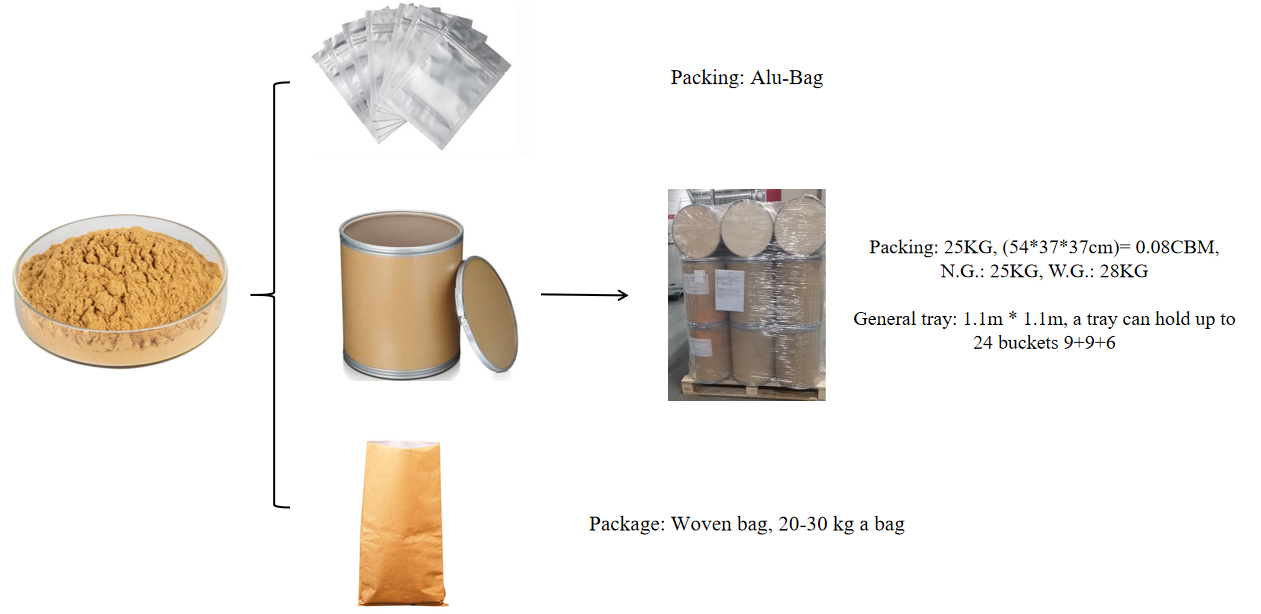
Packaging formats we keep in rotation — from 1 kg foil bags to drums and IBCs.
Best practices for integrating yucca into your product line
- Run a compatibility check with your probiotics, enzymes and organic acids for 60–90 days under your real storage conditions before full launch.
- Dissolve-solids route: add powder to the tank after pH adjustment; fully soluble lots clear in minutes without heat.
- Store cool, dry and dark; opened packs work best within three months, and drums re-seal with the inner PE liner taped.
- Keep one retention sample per incoming lot for the life of your claim cycle — mirror what your supplier keeps.
Ready to sketch your own spec? Send us your target sheet (or ours on request) and we complete it against your market's rules: open the OEM inquiry form.
13. How to Evaluate a Yucca Extract Supplier: the 10-Point Checklist
Evaluating suppliers for OEM procurement is where most sourcing cost is won or lost. Score every candidate — including us — on these ten points before your first paid order:
- Named, traceable origin. Which region, which botanical species (Yucca schidigera vs. mixed Yucca spp.)? Dual-origin suppliers (Mexico + southern China) absorb crop shocks.
- Declared saponin standard + method. 30%/60% by UV with B50 stated; a supplier who won't disclose the method is guessing.
- Batch-specific COA, not a generic one. Retained samples kept at least as long as shelf life. Ours: two years.
- Real manufacturing certifications. ISO 9001, ISO 22000, HACCP, FAMI-QS, cGMP, Halal, Kosher, organic scope — verify on the certificates page of their site: Wellgreen quality & certificates.
- Solubility proof. Ask for a live video or sample test: 1 g into 100 mL water, stir, read the sediment. This single test separates extract powder from raw powder impostors.
- MOQ and sample policy. Free 50–100 g sample and 1 kg trial MOQ let small brands validate before volume; suppliers who demand 25 kg just to test are filtering for price shoppers, not partners.
- Capacity and stock depth. Annual capacity vs. your volume needs; on-hand stock for replenishment (Wellgreen: 5,000 t annual capacity, ~5 t regular stock, 7–20 working-day lead time).
- Logistics competence. FOB / CIF / DDP quoting, container-load planning, standard export shipping documents, and local support — we added a US lab & warehouse plus offices in New Zealand, Indonesia and Vietnam for for exactly this (company profile).
- Application engineering. Can they hand you a dosing card for your species, your water system, your spray kit — or only a datasheet?
- Auditability. Third-party audit reports, factory video call, and willingness to sign a quality agreement. Ask for it; watch how they answer.
14. What Drives Yucca Extract Price (and How to Buy It Cheaper Without Buying Weaker)
Every "yucca powder price" enquiry eventually decomposes into the same eight variables:
- Active content: 60% saponin commands a premium over 30% — but compare cost per active unit, and the math often flips in favour of the stronger standard.
- Format: raw powder < extract powder < liquid on a per-kg basis, though liquid adds water weight to freight and powder adds spray-drying cost.
- Origin and crop year: Mexican vs. Chinese supply moves with desert harvests, provincial policy and sea-freight lanes.
- Customisation: colour standardisation, tight mesh and anti-caking service each add process steps.
- Certification scope: organic-certified lots and FAMI-QS feed-grade lines price above commodity food-grade.
- Order size and packaging: full-container 25 kg drum loads beat mixed small bags per kg; 1 kg foil retail bags carry labelling labour.
- Incoterms and lane: FOB vs. DDP can swing landed cost more than the factory price itself.
- Documentation depth: bilingual COAs, third-party tests (e.g. added salmonella/mould panels) and audit support are real line items — cheap suppliers skip them and pass the risk to you.
15. Frequently Asked Questions
The questions our sales engineers answer every week — short enough to use, complete enough to trust.
Is yucca extract safe for use in human dietary supplements?Yucca schidigera extract has a long history of use in animal feed and, in smaller volumes, in human supplements. It is generally well tolerated at labelled doses, but saponin-rich products can cause mild digestive discomfort in sensitive individuals at high intake. People who are pregnant, nursing, formulating products for children, or taking prescription medicines should consult a qualified healthcare professional first. Wellgreen supplies food- and supplement-grade yucca extract with batch COAs covering heavy metals and microbiology.
Commercial yucca extract powders standardised to 30–60% saponins are commonly dosed in the range of roughly 100–200 g per metric tonne of complete feed, and broiler trials have reported meaningful ammonia reduction when liquid extract is supplied at about 1 mL per 20 L of drinking water[2]. The correct rate depends on saponin content, house ventilation, stocking density and diet protein, so we recommend a controlled trial batch before full adoption, with a dosing card provided per species and specification.
In field use, yucca extract is routinely combined with probiotics, enzymes and organic acids without reported problems, and some suppliers position it as complementary to gut-health programmes. Saponins do show mild antimicrobial activity in vitro at high concentrations, so when you build a premix we recommend a stability and compatibility check (60–90 days at your storage conditions) before commercial-scale production.
Yes. Wellgreen provides a free 50–100 g sample of yucca extract powder and yucca raw powder (freight collect), and our standard MOQ starts at just 1 kg for trial orders, so small and mid-size brands can validate quality before placing bulk volumes in 25 kg drums or IBCs.
Yucca extract powder is extracted, concentrated and dried, standardised to 30% or 60% saponins (B50 4–8 mg) and fully water-soluble. Yucca raw powder (straight powder) is simply ground dried yucca plant with no extraction, so saponin content is lower and variable (B50 2–5 mg) and solubility is partial. Yucca liquid is the concentrated extract before drying: a brown-yellow, fully water-soluble liquid (pH 4.5–5.5) suited to dosing systems and wet applications.
Ask for: saponin content and test method (UV) plus B50 value; solubility (target ≥99%, 1 g/100 mL); particle size (98% through 80 mesh); loss on drying (≤5%); heavy-metal and microbiological limits; batch-specific COA; MSDS; and certificates such as ISO 9001, ISO 22000, HACCP, FAMI-QS, Halal and Kosher. Every one of these is available for Wellgreen yucca lines on request.
Our yucca extract powder is 100% water-soluble (≥99% dissolution, 1 g in 100 mL water), which makes it suitable for drinking-water lines, fertigation and direct water application in aquaculture. Yucca raw powder is only partially soluble and is better suited to dry premixes and soil applications.
Store yucca extract powder and raw powder in a cool, dry, ventilated place away from light and heat; shelf life is 24 months unopened, and we advise using opened packs within about 3 months. Yucca liquid has a 12-month shelf life, also about 3 months after opening. All three formats contain no added preservatives.
Yes. Wellgreen supports OEM/ODM on yucca extract powder: custom saponin specifications (30%, 60% or a target B50), custom colour, 1 kg aluminium-foil bags up to 25 kg fibre drums with double PE liners, and branded packaging programmes. Liquid yucca ships in 25 L drums as standard, with 1,000/1,200 L IBCs on request.
For yucca raw powder in 25 kg bags, a 20-foot container takes about 11 tonnes and a 40-foot high-cube about 22 tonnes; drum and IBC liquid quantities are quoted per destination. Samples and small orders ship by air or express, bulk by sea or rail, with a typical lead time of 7–20 working days after order confirmation under FOB, CIF or DDP terms.
16. References
- Evaluation of Yucca schidigera extract as feed additive on performance of broiler chicks. Veterinary World (PDF). e-sciencecentral.org
- Effect of Supplementation of Yucca schidigera Extract on Ammonia Gas Emission and Performance of Broiler Chickens. academia.edu/62777332
- Effect of Yucca schidigera Extract (Norponin-S) on Health of Broilers. Pakistan Journal of Biological Sciences. scialert.net
- Megan Koppen, Cargill. Effect of saponins from Yucca and Quillaja, added alone or in combination, on broiler performance and ammonia emissions. Engormix Poultry Industry. engormix.com
- The potential of Yucca schidigera extract to reduce ammonia pollution originating from shrimp farming. PubMed. pubmed.ncbi.nlm.nih.gov/22440573
- Estimating the effective level of Yucca schidigera extract (Aquaculture Reports). ScienceDirect. sciencedirect.com
- Yucca extract reduces ammonia concentrations in Mexico shrimp trial. Global Seafood Source Advocate (2003). globalseafood.org
- Effects of Yucca schidigera extract on the reduction of ammonia concentration in Lake Koumoundourou, Benin (journal article). jeeng.net
- Yucca Extract for Trees — saponins as wetting agents/surfactants. Ask an Expert, Cooperative Extension (2016). ask.extension.org
- U.S. FDA. GRAS Notices Inventory (searchable database of Generally Recognized As Safe filings). hfpappexternal.fda.gov
- Evaluation of Yucca schidigera extract as feed additive on performance of broiler chicks in winter season. academia.edu/128397652
Tell us your application (feed, aquaculture, pet, turf or formula), your target saponin standard and destination port. You will receive pricing, a completed specification sheet and a free 50–100 g sample plan within one working day.