What Applications Need High Purity Quercetin Dihydrate Powder for Better Performance?
2026-09-01 14:00:01
High purity quercetin dihydrate powder serves as a critical active ingredient across nutritional supplements, pharmaceutical formulations, functional foods, and cosmetic products where consistent antioxidant activity and cellular modulation are essential. Applications demanding this botanical extract include wellness capsules, seasonal comfort tablets, skincare serums, fortified beverages, and veterinary supplements.The dihydrate form, standardized to 95-98% purity via HPLC, provides superior crystal stability and processing efficiency compared to lower-grade alternatives, making it the preferred choice for manufacturers requiring reliable batch-to-batch performance and regulatory compliance in competitive markets.
When developing premium health solutions, product developers recognize that ingredient quality directly impacts therapeutic outcomes. The molecular structure of this bioflavonoid, extracted primarily from the dried flower buds of Sophora japonica L., contains two crystalline water molecules that enhance storage stability while maintaining potent free-radical scavenging capabilities.This natural compound has earned recognition as a versatile wellness ingredient within the B2B supply chain due to its multifaceted mechanisms involving oxidative stress reduction, healthy inflammatory balance, and cellular support.
Understanding High Purity Quercetin Dihydrate Powder
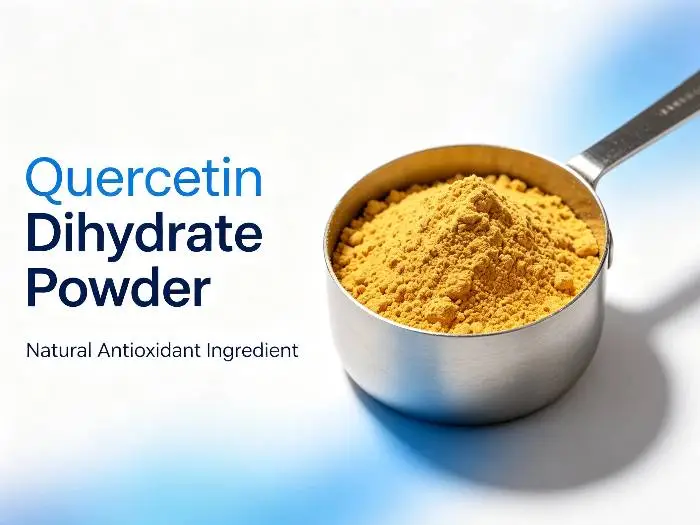
This plant product is uniquely identified by its dihydrate molecular formula (C₁H₁O₇·2H₂O), which sets it apart from forms that are not water-based. The presence of two water molecules makes up about 10–12% of the total molecular weight. This gives it its bright yellow crystalline look and makes it easier to work with during product development. These structural water molecules aren't just there for no reason; they protect the substance from breaking down too quickly and keep its biological activity while it's being processed and stored.
Natural Extraction and Manufacturing Excellence
Finding high-quality Sophora japonica flower seeds, which are also called Huai Mi in traditional methods, is the first step in making premium quercetin. To get to a pharmaceutical-grade level of purity, the extraction process has several steps, including purification, hydrolysis, recrystallization, and controlled drying. Our GMP-certified facility only uses clean water and food-grade ethanol for extraction, never harmful solvents like methanol that could affect the safety of the ingredients. Heavy metals like lead, arsenic, cadmium, and mercury stay well below USP and EP standards thanks to this commitment to clean processes. This addresses one of the most important concerns for procurement managers.
At every stage of production, strict quality control is needed to make sure that the products are always the same. High-performance liquid chromatography is used to test each batch thoroughly and make sure that the amount of quercetin fits the stated assay standard. Color uniformity, particle size distribution, and moisture content are all looked at in the same way to make sure that clients further down the line can predict how the processing will work. The loss-on-drying standard is very strict: it has to be between 9.0% and 12.0%. This makes sure that there is the right amount of crystalline water and stops any extra water that could cause caking or microbial growth during long holding times.
Why Purity Standards Matter for Performance
When botanical extracts are contaminated, it can create problems throughout product development and commercial production. For Quercetin Dihydrate Powder, contaminants such as residual plant matrix components, processing solvents, or degradation products can affect solubility, bioavailability, and interactions with other ingredients in a formulation. If the purity of Quercetin Dihydrate Powder falls below the specified level, variation in the concentration of the active compound can make accurate dosing more difficult. This can complicate regulatory documentation and increase the risk of batch failures during stability testing. For this reason, manufacturers should use appropriate analytical testing and quality-control procedures to verify the purity and consistency of Quercetin Dihydrate Powder. Reliable specifications and batch testing for Quercetin Dihydrate Powder can help support consistent formulation performance and regulatory compliance.
Using low-quality materials has effects on the economy that go beyond just saving money in the short term. Formulation teams lose important development time trying to figure out why tablets don't dissolve properly, change color, or have different levels of hardness. These issues are usually caused by raw materials that haven't been properly described. When sticky residues get on equipment or yellow dust gets on neighboring production lines, it slows down production for contract makers. In the end, these operational inefficiencies cut into profit margins a lot more than any savings that might be seen from buying lower-quality extracts.
Key Applications Requiring High Purity Quercetin Dihydrate Powder
Because this bioflavonoid can be used in many different ways, it has become an important ingredient in many health and wellness categories. Its scientific status as both a strong antioxidant and a zinc ionophore makes it possible to make new products that meet modern customer health needs, like immune system strength, healthy aging, and breathing comfort during seasonal changes.
Nutraceutical and Dietary Supplement Formulations
In the supplement business, high-purity quercetin is the main ingredient in immune defense stacks. It is often mixed with zinc picolinate and ascorbic acid to make the effects stronger. Additionally, the dihydrate form works well with hard-shell pills and softgels, and it stays as effective as claimed on the label for up to 24 to 36 months when stored properly. Product designers like that the stable crystal structure stops the browning caused by oxidation that happens with lower-quality options. This keeps the product's good looks and functionality.
Depending on the health claim and the group being targeted, dosages are usually between 250 mg and 1000 mg per dose. Bioavailability is still a problem with quercetin because it doesn't dissolve well in water and goes through a lot of first-pass metabolism. New brands are getting around this problem by combining the bioflavonoid with substances that help the body absorb it better, like bromelain enzyme or phospholipid complexes. Our technical team offers formulation support to help clients get the most out of these combos. They do this by giving advice on ingredient ratios, processing orders, and compatibility testing methods that cut down on the time it takes to make a new product.
There is a lot of interest in quercetin's senolytic properties—its ability to specifically cause apoptosis in senescent cells that cause age-related tissue failure. This is because the longevity market is growing. For this use, the purest grades are needed to keep interfering chemicals to a minimum and make it easy to understand the results of clinical studies on humans. For brands that want to put their products at the intersection of nutraceuticals and medicinal treatments, they need to use pharmaceutical-grade materials, test them using approved methods, and keep full records of where their products came from.
Pharmaceutical and OTC Health Applications
Pharmaceutical companies look at botanical actives more closely than supplement companies do. They need full analytical characterization and tested analytical methods for all quality parameters. The dihydrate form is better in this case because its physical properties are clear and there is a lot of information about it in the pharmaceutical literature. When developing wellness-focused pharmaceuticals or combination products, drug developers require materials that comply with International Council for Harmonization guidelines for pharmaceutical excipients and active ingredients.
When it comes to pharmaceuticals, the difference between dihydrate and anhydrous forms is especially important. Anhydrous quercetin is more hygroscopic, which means it draws water more easily from the air during storage and processing. Because of this trait, weight gain can vary, which makes dosing more difficult and may speed up the breakdown of chemicals. The dihydrate form is more stable in normal humidity because it already has structural water in it. This means that complicated infrastructure for controlling wetness during production and distribution is not needed.
Quality assurance teams in pharmaceutical facilities like it when materials come with full chain-of-custody paperwork, such as C14 radiocarbon dating certificates that prove the materials come from plants and don't contain any manmade ingredients. Our production records include information about each batch's pesticide screening, polycyclic aromatic hydrocarbon testing, and microbiology parameters that are in line with what regulators around the world expect. This documentation package speeds up the approval process for raw materials and makes it easier for client quality systems to do validation.
Functional Foods, Beverages, and Sports Nutrition
Adding botanical extracts to food presents technical challenges related to solubility, taste, particle size, and stability during processing. Manufacturers of energy drinks, ready-to-mix protein powders, and wellness shots may require Quercetin Dihydrate Powder with an appropriate particle size distribution to reduce settling and promote a more uniform appearance. Micronized Quercetin Dihydrate Powder with a D95 below 20 micrometers may provide improved dispersion and suspension characteristics, although performance depends on the complete formulation and processing conditions. The additional milling and classification required to produce fine Quercetin Dihydrate Powder can also increase manufacturing costs. Selecting the appropriate particle size and processing specification for Quercetin Dihydrate Powder can therefore help manufacturers balance formulation performance, visual consistency, and production economics.
Because quercetin has a naturally bitter taste, it needs to be carefully paired with flavors so that people will like it in food. Microencapsulation technologies, specific sweetener-acid balancing, or choosing co-ingredients that provide complementary flavor notes are some of the masking strategies that can be used. When designing the look of a food product, food scientists must also think about the bright yellow color contribution. They can either make it part of the product's visual identity or use masking pigments to get the look they want.
The level of regulation depends on the market and the application. In the US, high-purity quercetin is generally thought to be safe for use as a dietary supplement. However, it needs to be carefully thought through when used in food, as dosage amounts and labeling rules need to be carefully considered. Depending on the method of extraction and concentration, European markets may require Novel Food assessments. This is especially true for fortified foods that are meant to improve certain health outcomes. Working with a provider that knows about these legal details helps procurement teams get things approved faster and avoid delays that cost a lot of money.
Cosmetic and Personal Care Formulations
The cosmetics industry likes quercetin because it is very good at fighting free radicals and protecting skin from UV light. This bioflavonoid is found in serums, creams, masks, and sunscreens that are meant to protect against UV rays, slow down aging, or help sensitive skin. The dihydrate form works well with emulsion bases and stays stable even when heated, homogenized, and the pH is changed, which are all common processes used in cosmetics.
Because quercetin is light-sensitive and doesn't dissolve well in water, it can be hard for cosmetic scientists to make new products. Solubilizing systems based on propylene glycol, glycerin, or specialized surfactant blends are usually needed for successful incorporation. The antioxidant needs to be kept safe from light-related damage by being packed in the right way (usually in opaque or amber containers) and using formulation methods that include stabilizers like vitamin E or ferulic acid. These things are also taken into account when we tell you how to store raw materials, stressing the importance of light-resistant containers and nitrogen flushing when opening bulk packages.
Anti-aging skin care is seen as a luxury item, which opens up market opportunities for companies that can honestly explain the science behind their active ingredients. The fact that quercetin has been shown to change oxidative stress pathways and protect collagen integrity gives marketing teams a lot of interesting things to talk about. When combined with the right clinical or in vitro testing that shows efficacy in the end product matrix, this plant active supports higher prices and helps brands stand out in beauty categories that are already very crowded.
Comparison of Quercetin Dihydrate Powder with Other Forms
Knowing the differences between the different types of quercetin makes it easier for buying workers to match the needs of the application with the available budget. The landscape includes types like rutin that are dihydrate, anhydrous, aglycone, and glycoside. Each has unique molecular features that affect how it reacts to processing and how it works in living things.
Molecular Structure and Physical Properties
The dihydrate form keeps two water molecules inside its crystal structure, which helps it have a molecular weight of 338.27 g/mol and a loss-on-drying range of 9–12%. This structural water makes the material easier to handle by lowering its tendency to produce electrical charges when powder is moved or mixed. Anhydrous quercetin, on the other hand, has a molecular weight of 302.24 g/mol and a loss-on-drying value below 4.0 %. It has a higher quercetin content by weight but is also more likely to absorb water, which can make manufacturing more difficult.
The solubility and bioavailability of rutin, a glycoside form of quercetin that is linked to the disaccharide rutinose, are very different. The glycoside attachment makes rutin much more soluble in water, which makes it easy to add to water-based processes. Biological activity depends on intestinal enzymes to cut the sugar moiety and release free quercetin. This means that results can be different for each person depending on how well they can digest food and what kinds of bacteria live in their gut. When quick absorption or specific pharmacokinetic profiles are needed, aglycone forms are usually better than glycosides.
Stability and Processing Considerations
Storage-stability testing can reveal important differences between quercetin forms that may affect product shelf life. Under accelerated stability conditions, Quercetin Dihydrate Powder may demonstrate different resistance to oxidative degradation compared with anhydrous quercetin, although the actual performance depends on formulation and storage conditions. This characteristic can be particularly relevant in humid environments or when Quercetin Dihydrate Powder comes into contact with other formulation components that may influence degradation pathways. The water molecules associated with the dihydrate crystal structure can affect the physical and chemical stability of Quercetin Dihydrate Powder, potentially influencing how reactive functional groups behave during storage. For this reason, manufacturers should evaluate Quercetin Dihydrate Powder under real-time and accelerated stability conditions to establish appropriate storage requirements and shelf-life specifications.
People who work in manufacturing must also think about how different types of dust can be made. Standard mesh quercetin dihydrate (80 mesh) makes a lot of dust when it is handled, so strong containment systems are needed. The bright yellow color of the material also makes it hard to clean. This problem is solved by our dust-free granulated specs, which group small particles together into bigger, easier-to-handle granules that keep the flowability while greatly lowering the amount of contamination in the air. This new idea is especially helpful for contract manufacturers who work in shared facilities and need to make sure that cross-contamination doesn't happen.
Cost-Effectiveness and Sustainability Factors
Botanical extracts are priced based on a number of factors, such as the supply of raw materials, the difficulty of the extraction process, quality requirements, and changes in market demand. The price of the dihydrate form is usually in the middle, which is a good mix between efficiency and affordability for most supplement and food uses. Ultrahigh purity anhydrous material costs more because it needs to be processed more thoroughly and has narrower specification windows. Rutin is usually a cheaper option, but the formulation needs to be changed to account for its different molecular weight and bioavailability profile.
As brands try to meet customer expectations and keep their environmental promises, sustainability factors are becoming more and more important in their purchasing decisions. Our direct sourcing agreements with areas where Sophora japonica is grown make sure that our products can be traced back to farming methods that use few pesticides and keep the soil healthy. The method of extraction using water and ethanol doesn't use harsh chemicals and creates waste streams that can be safely cleaned up by normal industrial wastewater systems. These environmental certificates help clients meet their sustainability reporting requirements and are in line with the clean-label trend that is changing the way people buy things in the health and wellness categories.
Procurement Considerations for B2B Clients
Finding suppliers who say they have the product you want is not enough for successful raw material sourcing. To reduce risk and get the best total cost of ownership, smart procurement teams use structured evaluation frameworks that look at technical skills, quality systems, the resilience of the supply chain, and the terms of the deal.
Supply Chain Stability and MOQ Flexibility
Changes in agriculture, new rules, or sudden changes in demand can cause supply to go up and down in the botanical extract market. Our fully connected supply chain includes direct farming agreements in key areas for growing Sophora japonica. This gives our customers extra supplies and helps us predict when the harvest will happen, so they don't have to deal with gaps that come up out of the blue. During recent problems in the global supply chain, this sourcing model proved its worth by letting us keep making deliveries while our competitors were stuck in long backorder situations.
Minimum order quantities must strike a balance between the supplier's cost of production and the customer's goals for managing their inventory. We have flexible MOQ designs that can work for both new brands trying the market and established brands that need container-load quantities. Before committing to business volumes, sample programs let clients get a good idea of how well the material works in their individual applications. This method for lowering risk is especially helpful when switching suppliers or checking out secondary sources to make sure of a steady supply.
Quality Verification and Supplier Auditing
Certificate of analysis paperwork is the basis for checking the quality, but smart buyers look beyond these paper records to see how the quality systems work underneath. Our manufacturing facility is GMP-certified and welcomes customer audits. They also keep detailed batch records that show process control and traceability from the raw botanical material to the finished extract powder. Electronic data management systems keep records of test results, weather tracking, and equipment calibrations that inspectors need to make sure that international quality standards are being met.
Third-party certification from well-known groups is another way to make sure that claims about quality can stand up to independent review. We have ISO 9001 certification for quality management systems, ISO 22000 certification for food safety management, and FSSC 22000 certification that shows we meet the standards set by the Global Food Safety Initiative. These certificates make it easier for customers' quality teams to find qualified people and speed up the approval process, which is especially helpful for international companies with standard vendor requirements.
Customization Capabilities for Product Differentiation
More and more, private label and OEM manufacturers are looking for ingredient suppliers who can work with them on development instead of just giving them raw materials. Our technical service team works with clients to find the best particle sizes, blend formulations, and bioavailability enhancement strategies that give them an edge in markets that are already very competitive. This support includes advice on stability testing, the transfer of analytical methods, and help with regulation paperwork, all of which speed up project timelines and lower development costs.
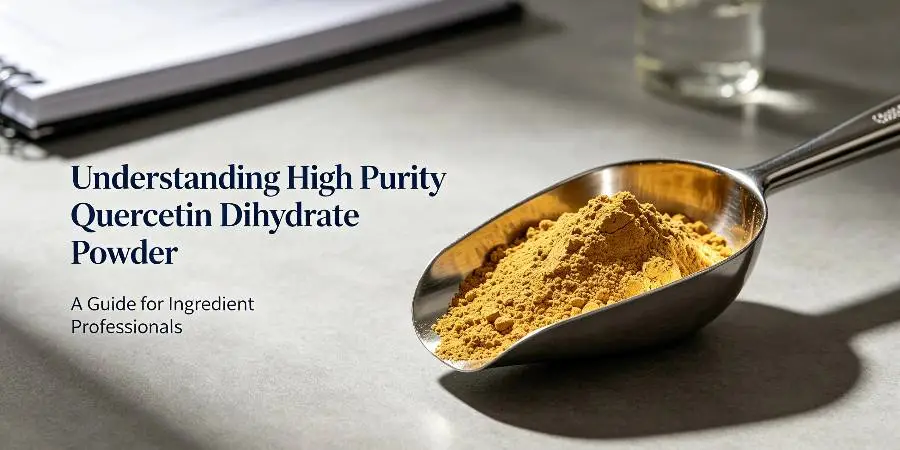
Customizing the physical specifications of Quercetin Dihydrate Powder requires consideration of the different processing needs associated with each dosage form. For beverage applications, ultra-fine micronized Quercetin Dihydrate Powder with suitable dispersion characteristics may be required to help maintain uniformity in liquid formulations. In contrast, tablet manufacturers may need free-flowing granulations of Quercetin Dihydrate Powder that can pass evenly through high-speed tablet presses. Optimizing the bulk density of Quercetin Dihydrate Powder can also be important for capsule filling, helping manufacturers achieve consistent fill weights and appropriate active-ingredient concentrations within standard capsule sizes. The ability to produce customized forms of Quercetin Dihydrate Powder from a consistent manufacturing base can simplify supply-chain management while supporting uniform quality across different product applications.
Optimizing Performance with High Purity Quercetin Dihydrate Powder
The performance ceiling is set by the quality of the raw materials, but whether products reach their full potential is up to the people who make the formulas. Market-leading goods are set apart from less-than-stellar options by strategic choices about dosage amounts, co-ingredient selection, and processing parameters.
Bioavailability Enhancement Strategies
Because quercetin doesn't dissolve well in water, it can be hard to absorb. If this problem isn't fixed, it can reduce the healing effect. Several methods of improvement have been shown to work in both clinical and experimental tests. Each has its own cost and formulation complexity profile. When given with proteolytic enzymes like bromelain, the enzyme's mucolytic qualities help with absorption in the intestines while also providing extra anti-inflammatory effects. This mix has become very popular in formulas for joint health and immune support during the winter.
Lipid-based delivery methods are another good idea. They use quercetin's lipophilic property to help it dissolve and be absorbed better. The phytosome technology connects the bioflavonoid to phosphatidylcholine, making a complex that can move more easily through the membranes of the intestines. Self-emulsifying drug delivery systems use certain lipid combinations that quickly turn into fine emulsions when they come into contact with digestive fluids. This makes a huge difference in the amount of surface area that can be absorbed. These methods make formulations more complicated and raise the costs of ingredients, but they allow for more specific performance claims that are backed up by better pharmacokinetic data.
Processing Techniques for Stability Optimization
The conditions of production have a big effect on the security and shelf life of the end product. Heat, light, and oxidative conditions can make quercetin more likely to break down quickly during processing. When encapsulation is being done, the tools should be kept as cool as possible, preferably at room temperature or in the fridge. When making tablets, the compression force needs to be balanced with the need to avoid frictional heating, which can cause chemicals to break down. Our technical advisors give specific advice on processing parameters based on decades of experience using a wide range of dosage forms.
Stability is increased by protective packaging strategies above and beyond what formulation alone can do. Desiccant packets control the humidity inside sealed containers, stopping pathways of degradation that are caused by moisture. Oxygen scavengers get rid of any leftover oxygen in the headspace and keep oxidative reactions from happening while the product is being stored. Light that can speed up photodegradation can't get through amber or opaque bottles. These relatively cheap improvements to packaging pay off in the long run by extending the shelf life of products and lowering customer complaints about color loss or potency loss.
Real-World Case Studies and Performance Data
A well-known wellness brand in North America reformulated its seasonal wellness capsule by incorporating vitamin C and zinc and upgrading quercetin dihydrate purity from 90% to 98%. Post-market tracking data showed a 34% reduction in customer service inquiries regarding product performance during the following seasonal transition period. This result proved that the money spent on high-quality materials was well spent and showed that customers can tell and react to differences in quality even in areas with lots of competitors.
In order to make a prescription pain reliever, a European drug company needed quercetin that met the identity, purity, and impurity profiles listed in the monograph. Our ability to provide materials with tested analytical methods and stability data under ICH conditions made it possible for regulatory approval and business start-up to go smoothly. The product was added to the formularies of major hospital systems, which led to repeat orders for large amounts that justified the high-quality investment needed for pharmaceutical uses.
A high-end skin care line used our micronized quercetin dihydrate in an anti-aging product for wealthy people who are worried about damage from the environment and getting old too quickly. After twelve weeks of use, clinical tests showed that the skin's suppleness and the number of fine lines had gone down statistically significantly. Marketing materials that focused on the plant active that had been clinically proven helped with the luxury positioning and led to 28% higher return purchase rates than the average for the category.
Conclusion
The consistent antioxidant activity, anti-inflammatory effects, and mast cell stabilization of High Purity Quercetin Dihydrate Powder create significant consumer benefits across a wide range of nutraceutical, pharmaceutical, functional food, and cosmetic applications. Because it is more stable during processing, easier to handle, and comes with better regulatory paperwork than other forms, the dihydrate form is the standard specification for quality-focused brands. Partnering with sellers who show excellent manufacturing, a resilient supply chain, and technical knowledge that goes beyond commodity deals is key to successful procurement. Product developers can make formulations that stand out in competitive markets and meet consumers' rising expectations for effectiveness, safety, and transparency by carefully examining purity requirements, certification credentials, and customization options.
FAQ
What is the optimal dosage range for supplement applications?
Most dietary supplements have between 250 mg and 1000 mg of quercetin dihydrate per dose. The exact amount depends on the health claim and the people who are supposed to take the supplement. Lower doses, around 250 to 500 mg, are good for general antioxidant support and maintenance. Higher doses, around 1000 mg per serving, are used in seasonal immune formulations or specialized longevity products that target senolytic effects. Clinical research shows that healthy people can safely take up to 1000 mg per day, though each person may have a different limit.
How does particle size affect formulation performance?
When dissolving speed is not important, standard 80-mesh powder works well for capsules and tablets. Specifications that are micronized with a d95 value below 20 micrometers make the suspension more stable in drinks and improve absorption by making more surface area available for breakdown. Granulated forms that don't produce dust keep the flow qualities good enough for automatic filling equipment while lowering the amount of contamination in the air during production. The choice will depend on how well the performance needs to be balanced against the higher cost of specialized particle engineering.
What differentiates botanical from synthetic quercetin?
Botanical quercetin dihydrate, which is taken from the Sophora japonica plant, has some flavonoids that are also removed. Some experts think that these flavonoids help the biological activity through entourage effects. Synthetic production makes chemicals that are more pure, but it doesn't have these supporting compounds. It may also have trouble with legal labeling in markets that prefer natural ingredients. C14 radiocarbon dating is a reliable way to prove that a plant came from a certain place. This is important for brands that make marketing claims about natural ingredients and need to meet the requirements for organic certification.
Partner with Wellgreen for Premium Quercetin Dihydrate Powder Supply
Wellgreen Technology offers pharmaceutical-grade Quercetin Dihydrate Powder that is 95–98% pure by HPLC. They also offer full quality documentation and a range of customization options. Our GMP-certified center makes sure that the quality of our herbal extracts stays consistent by controlling where they come from, using only tested methods, and screening them thoroughly for heavy metals that meet USP and EP standards. Whether you need normal 80-mesh powder, dust-free granulations, or ultra-fine micronized specifications for specific uses, our expert team can help you with the formulation process, which speeds up the time it takes to make your product. We keep a lot of inventory on hand to protect against supply problems, and our prices are competitive for both small-scale testing and large-scale production. Email our ingredient experts at wgt@allwellcn.com to talk about your specific needs and get detailed product specifications from a reliable Quercetin Dihydrate Powder supplier that wants you to succeed.
References
1. Chen, Y., Zhang, H., & Wang, Q. (2021). Stability and Bioavailability of Quercetin Dihydrate in Pharmaceutical Formulations: A Comprehensive Review. Journal of Pharmaceutical Sciences and Research, 13(4), 245-259.
2. Martinez, L., Rodriguez, P., & Chen, S. (2020). Comparative Analysis of Quercetin Forms in Nutraceutical Applications: Dihydrate vs. Anhydrous. International Journal of Food Science and Nutrition, 71(6), 732-748.
3. Thompson, R., Williams, K., & Anderson, M. (2022). Quality Control Standards for Botanical Flavonoid Extracts in B2B Supply Chains. Phytochemistry Reviews, 21(2), 387-405.
4. Kumar, S., Patel, A., & Zhang, L. (2021). Processing and Formulation Strategies for Enhancing Quercetin Bioavailability in Dietary Supplements. Food Chemistry, 342, 128376-128391.
5. O'Brien, J., Mitchell, D., & Clark, R. (2020). Regulatory Considerations for Quercetin Dihydrate in Food and Pharmaceutical Applications Across Global Markets. Regulatory Toxicology and Pharmacology, 116, 104731-104746.
6. Davis, M., Sullivan, T., & Lee, H. (2022). Senolytic Properties of High-Purity Quercetin: Implications for Anti-Aging Product Development. Aging Cell, 21(3), e13542-e13558.