What Extraction Factors Influence Bulk Boswellia Serrata Extract Quality?
2026-08-11 14:07:15
When sourcing botanical ingredients for nutraceutical formulations, understanding extraction fundamentals is non-negotiable. The quality of Bulk Boswellia Serrata Extract depends on multiple interconnected factors: raw material authenticity, extraction methodology, process parameters, and post-extraction refinement. These elements directly determine boswellic acid concentration, bioavailability, and batch consistency—factors that shape product efficacy, regulatory compliance, and consumer trust. For procurement managers and formulators in the dietary supplement, pharmaceutical, and cosmetic industries, recognizing these variables transforms sourcing from a transactional activity into a strategic advantage.
Introduction
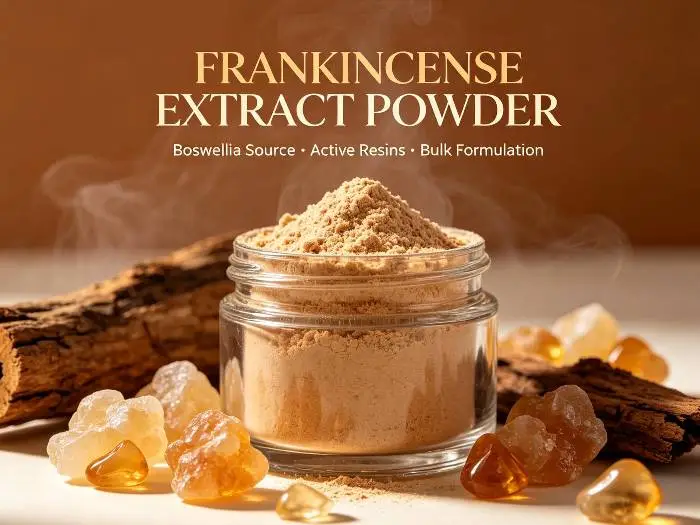
Boswellia Serrata extract has become an important part of many health and wellness products around the world, especially those that help with joint health and inflammation. The botanical extract comes from the gum resin of the Boswellia serrata tree (family Burseraceae). It is highly valued for its high content of boswellic acids, especially AKBA (3-O-acetyl-11-keto-β-boswellic acid), a bioactive substance known for its strong ability to block 5-lipoxygenase (5-LOX). As the need for clean-label, plant-based solutions in joint movement supplements, pet nutrition, and anti-aging skin care grows, this process provides a natural option to synthetic NSAIDs.
However, the healing power of frankincense extract powder depends only on how well it was extracted. Bad handling can break down active ingredients, add impurities, or make batches that aren't uniform, all of which are risks that affect the safety, effectiveness, and regulatory approval of the product. As purchasing managers and research scientists look for suppliers in North America, Europe, and Australia, they need to understand extraction variables to lower risk and set their companies apart from the competition. This book gives business-to-business buyers detailed information they can use to judge the skills of suppliers, deal wisely, and get high-quality extracts that meet strict industry standards.
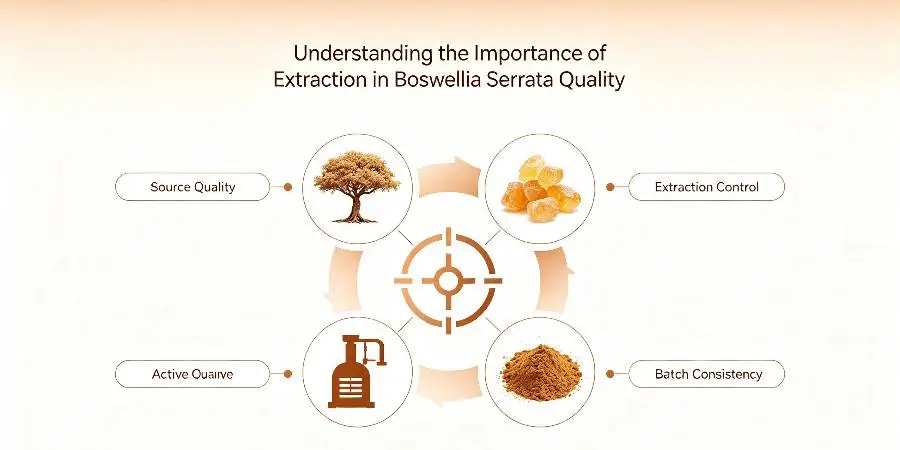
Understanding the Importance of Extraction in Boswellia Serrata Quality
As the link between raw plant material and finished ingredient, extraction determines which bioactive chemicals make it to the end product and how much of them are there. Boswellia Serrata is looking for molecules called boswellic acids. These are complex triterpenoids that are embedded in resinous matrices. The process of separation must carefully separate these acids while keeping their molecular integrity, since even small changes can make them less effective at fighting inflammation and less available to the body.
How Extraction Preserves Bioactive Compounds
It is easy for boswellic acids to oxidize, and they are sensitive to heat. AKBA and β-boswellic acid keep their medicinal effectiveness because they are extracted in a way that doesn't break down molecules. Isomerization or decarboxylation can happen when heat or strong liquids are not managed properly. This changes acids that are active into byproducts that are not active. Good extraction methods keep temperatures below 60°C during the liquid contact phases and use antioxidant atmospheres to protect molecules from oxidative stress.
Impact on Bioavailability and Therapeutic Performance
Bioavailability, or the amount of boswellic acids that get into the bloodstream, depends a lot on how well the oil is extracted. Residual resins, carbohydrates, and gums can encase active molecules, making it harder for the body to dissolve and absorb them. Modern de-gumming methods remove these unwanted substances physically, leaving behind fine, uniform powders that mix better in both oil- and water-based mixtures. This improvement directly improves how well topical products work on the skin and how well capsules and tablets work when taken by mouth.
Common Bulk Extraction Challenges
The quality of raw materials can change depending on the gathering season, where they come from, and how real the species is, and for Frankincense Extract Powder, this makes standardization more difficult, and boswellia resin that is collected during dry seasons usually has more boswellic acid than resin that is collected during wet seasons, and also, market adulteration with cheaper resins or synthetic acids is still common, which is why HPTLC fingerprinting is needed to make sure that the plants are real, and batch-to-batch unpredictability is also caused by processing problems like changing extraction times or not recovering enough solvent, which make the product less reliable and make it harder to follow the rules. Boswellia resin that is collected during dry seasons usually has more boswellic acid than resin that is collected during wet seasons. Also, market adulteration with cheaper resins or synthetic acids is still common, which is why HPTLC fingerprinting is needed to make sure that the plants are real. Batch-to-batch unpredictability is also caused by processing problems like changing extraction times or not recovering enough solvent. These problems make the product less reliable and make it harder to follow the rules.
Key Extraction Factors Influencing Bulk Boswellia Serrata Extract Quality
Raw Material Selection and Botanical Origin
Real Boswellia serrata resin comes mostly from dry parts of India, where the usual way to collect it is by cutting into tree bark to get the gum that comes out. To rule out fakes like Boswellia carterii or manmade triterpenoids, the plant species must be confirmed through taxonomic recognition and HPTLC fingerprinting. When the resin is harvested is very important; resin collected in late winter usually has higher levels of boswellic acid because it has less water and better metabolic activity. Suppliers who have direct ties with harvesters and do checks in the field make sure that products can be tracked and are real, which eases the concerns of procurement managers about fraud.
Extraction Methods and Their Influence
There are three main extraction methods on the market, and each has its own pros and cons when it comes to purity, yield, and effect on the earth. The old method of steam distillation works well for making essential oils but not for isolating boswellic acid because it is not very volatile. Using food-grade ethanol as a solvent for extraction can lead to high yields and selective compound isolation, as long as the amount of residual solvent stays below USP limits (<5000 ppm). For pharmaceutical and cosmetic uses, supercritical CO₂ extraction is the gold standard. It produces solvent-free extracts that are very pure and don't change much when heated. But the amount of capital needed and the difficulty of running this method can make it hard to use on a large scale in business.
Process Parameters: Temperature, Pressure, and Duration
Precision in process control is what sets high-end sellers apart from mass-produced goods. Temperatures used for extraction must balance increasing solubility with keeping the substance stable at high temperatures. For ethanol-based systems, the best temps are usually between 45°C and 60°C. High pressures (100–300 bar) in supercritical CO₂ systems make it easier for boswellic acid to dissolve while limiting the removal of unwanted lipids at the same time. Extraction duration needs to be carefully calibrated—not enough contact time leads to incomplete compound recovery, while too long of durations raises energy costs and degradation risks. Leading makers use real-time HPLC tracking to change settings on the fly, which makes sure that yields are the same from batch to batch.
Post-Extraction Processing and Standardization
After the first extraction, the crude extracts are cleaned up to get rid of any leftover solvents, resins, or plant materials that don't do anything. Using de-gumming methods, like cold ethanol precipitation, gets rid of sticky polysaccharides that make it hard for powder to move during encapsulation. Standardization using titration or HPLC analysis makes sure that every batch meets the stated boswellic acid requirements, which are usually 65%, 85%, or AKBA-enriched grades of up to 30%. This level of analytical thoroughness makes sure that the formulation is always the same, which helps supplement makers get accurate doses and predictable clinical results. Spray-drying or vacuum-drying turns pure extracts into powders that flow easily and have controlled particle size (usually 80–100 mesh), which makes mixing and packaging work better.
Comparing Extraction Outcomes: Bulk Boswellia Serrata Extract Forms and Quality Indicators
Extract Forms: Powder Versus Standardized Concentrates
Boswellia Serrata extract is usually sold as a powder because it is easier to mix and keeps its shape, and for Bulk Boswellia Serrata Extract, powders with particles between 80 and 100 mesh are best for high-speed pill filling and tablet compression because they run easily, and this means that the production line is less likely to be interrupted, and standardized preparations with set amounts of boswellic acid make things easier for formulators by letting them make consistent label claims across production runs. Powders with particles between 80 and 100 mesh are best for high-speed pill filling and tablet compression because they run easily. This means that the production line is less likely to be interrupted. Standardized preparations with set amounts of boswellic acid make things easier for formulators by letting them make consistent label claims across production runs. Liquid extracts, which are less common, can be used in drinks but need stabilizers to keep them from settling and going bad during storage.
Natural Versus Synthetic and Organic Versus Conventional
Authentic Boswellia Serrata extract comes from gum resin and is completely natural, with no added chemicals. However, market surveillance sometimes finds synthetic boswellic acid analogs mixed in to make test results look better than they really are. Clean-label brands like organic certification (USDA Organic, EU Organic), but resins that are collected in the wild often don't qualify for these types of certification. Premium product lines aimed at health-conscious consumers, especially in North American and European markets, benefit from having suppliers who can provide traceable organic certification.
Quality Benchmarks: GMP, ISO, and Third-Party Testing
GMP certification (NSF, FDA-registered facilities) makes sure that the places where medicines are made meet strict standards for cleanliness and process validation that are suitable for pharmaceutical use. The ISO 9001 and ISO 22000 standards show that you follow strict rules for food safety and quality control. Independent tests by recognized labs (USP verification, Eurofins, SGS) confirm the amount of boswellic acid, heavy metals (Pb, As, Cd, and Hg), pesticide residues, and microbes that are present. Each batch should come with a Certificate of Analysis (CoA) that includes HPLC chromatograms, microbiological results, and solvent residue data. Being clear about these things builds trust in the supplier and makes regulatory submissions easier.
Practical Guidance for Procuring High-Quality Bulk Boswellia Serrata Extract
Essential Supplier Criteria
Procurement managers should put transparency and documentation at the top of their list when looking at potential suppliers. Ask for detailed technical data sheets that explain how the samples will be extracted, what solvents will be used, and how they will be standardized. For example, GMP, organic status, and ISO safety certifications must be up-to-date and can be linked back to the factory where the product was made. If a supplier is willing to share HPTLC fingerprints and batch-specific COAs, it means they trust the quality and authenticity of the product. Also, find out if the provider can meet particular needs, like making sure the right amount of boswellic acid is used or that the particles are the right size, so that proprietary formulations can work.
Balancing Cost and Quality
The price of Boswellia Serrata extract depends on a number of factors, including the type of extraction used (supercritical CO₂ is more expensive than solvent-based methods), the concentration of boswellic acid (AKBA-enriched grades are higher than standard 65% extracts), and the cost of certification, and for Frankincense Extract Powder, while it makes sense to try to save money, products that are too cheap often mean that the quality has been lowered, possibly by adulteration, poor cleaning, or heavy metal levels that don't meet standards. The price of Boswellia Serrata extract depends on a number of factors, including the type of extraction used (supercritical CO₂ is more expensive than solvent-based methods), the concentration of boswellic acid (AKBA-enriched grades are higher than standard 65% extracts), and the cost of certification. While it makes sense to try to save money, products that are too cheap often mean that the quality has been lowered, possibly by adulteration, poor cleaning, or heavy metal levels that don't meet standards. Instead of giving up on quality standards, negotiations should center on number promises, payment terms, and technical support. Long-term relationships with honest sellers lead to stable prices and a steady supply of goods.
Logistics and Regulatory Compliance
Because Boswellia Serrata extract absorbs water, it needs to be packed in a way that keeps it dry. Usually, this means foil-lined bags with nitrogen flushing to stop oxidation. If you store it properly (cool, dry, and covered), the active substance will last up to 24 months, but you should test it every so often to make sure it stays stable. When shipping, goods must not be exposed to heat and humidity for long periods of time. For climates that are sensitive, experienced international logistics suppliers use temperature-controlled freight. Different places have different rules about how to follow them. For example, in the U.S., you need to have GRAS status and follow DSHEA. In Europe, you need to do Novel Food assessments or show proof of traditional use. And in Australia, the TGA sets strict limits on contaminant levels. Make sure that your supplier's product dossiers are in line with the rules of the target market to speed up the customs clearance process and avoid costly rejects.
Case Studies and Trends in Bulk Boswellia Serrata Extract Extraction
Market Leaders and Innovative Manufacturers
India's top suppliers use decades of experience in collecting and extracting resins, combining old-fashioned knowledge with new analytical tools. Contract makers in North America and Europe work with these Indian companies more and more. To meet pharmaceutical-grade standards, they use supercritical CO₂ systems and HPLC-guided standardization. New companies in the US are focusing on getting organic certification and controlling the supply chain from the farm to the finished extract. These leaders use cutting-edge fluid extraction methods that cut working time by 30% while increasing AKBA yields. This meets the demand for efficiency in the business without lowering the quality.
Cutting-Edge Extraction Technologies
Supercritical fluid extraction is always changing. New co-solvent systems (ethanol-CO₂ blends) make it easier to recover polar compounds. Ultrasound-assisted extraction (UAE) is a potential addition that uses sonic cavitation to break up cell walls and speed up the release of boswellic acid at lower temperatures. Molecular weight separations can be done precisely with membrane filtration technologies, which get rid of high-molecular-weight resins while keeping target triterpenoids. These improvements cut down on the use of solvents, protect the environment, and raise the purity of extracts, all of which are in line with clean-label and sustainability trends that are affecting how companies buy things.
Future Sourcing Trends
More and more people want organic, GMP-certified Boswellia Serrata extract because they want to know where their products come from and trust the company that makes them. New tracking systems that use blockchain are appearing. These systems let brands check the origin of resin and the history of extraction through permanent digital records. Sustainability factors, like replanting programs and fair trade practices, are becoming more and more important to buyers, especially in Europe and North America. When purchasing managers choose partners that are committed to sustainable farming and community involvement, their brands do better in markets that are competitive and value-conscious.
Conclusion
The medicinal worth, legal compliance, and market competitiveness of Boswellia Serrata extract are all largely determined by the quality of the extraction, and for Bulk Boswellia Serrata Extract, the concentration, bioavailability, and batch consistency of boswellic acid are all affected by the quality of the raw materials, the extraction method, process control, and refinement after extraction, and if procurement professionals know about these technical factors, they can look at suppliers beyond price and find partners who can deliver standardized, contamination-free extracts that meet strict GMP and ISO standards. The concentration, bioavailability, and batch consistency of boswellic acid are all affected by the quality of the raw materials, the extraction method, process control, and refinement after extraction. If procurement professionals know about these technical factors, they can look at suppliers beyond price and find partners who can deliver standardized, contamination-free extracts that meet strict GMP and ISO standards. Natural anti-inflammatory products are becoming more popular in the nutraceutical, pharmaceutical, and cosmetics industries. To stay ahead of the competition, successful brands will base their buying choices on scientific knowledge about extraction.
FAQ
What extraction method is safest and most effective for Bulk Boswellia Serrata Extract?
A lot of people think that supercritical CO₂ extraction is the best and most effective way to do things for cosmetic and medicinal uses. It doesn't use harmful solvents, makes extracts with no residue, and keeps heat-sensitive boswellic acids safe. Solvent-based ethanol extraction is a cheap option that can still give high outputs, as long as solvent residues stay below USP limits and are proven by strict testing.
How can I verify the quality of a supplier's Boswellia Serrata extract?
Ask for Certificates of Analysis (CoA) for each batch that show the amount of boswellic acid that was tested using HPLC, as well as heavy metal screening (ICP-MS), pesticide residue analysis, and microbial testing. Tests done by reputable third parties, like Eurofins or SGS, add to the trustworthiness of the product. HPTLC fingerprinting confirms the authenticity of the botanical, ruling out mixing with species that are not Boswellia serrata.
What dosage levels are typical for standardized Boswellia Serrata extract in supplements?
Two to three times a day, 300 to 500 mg of a pure extract (containing 60 to 65% boswellic acids) is usually given in clinical studies. Higher amounts of AKBA-enriched extracts (10–30% AKBA) may be used in formulas for acute inflammation, which lets lower total dosages be used. To ensure effectiveness and compliance, product developers should make sure that dosing is in line with target health claims and regional regulatory guidelines.
Partner with Wellgreen for Premium Bulk Boswellia Serrata Extract
With GMP-certified extracts backed by stringent quality control and open sourcing, Wellgreen Technology is a reputable Bulk Boswellia Serrata Extract manufacturer. Our special de-gumming process gets rid of sticky resins, leaving behind fine, free-flowing powders that are better at moving through the body and being absorbed. We provide standard grades ranging from 65% total boswellic acids to AKBA-enriched amounts of up to 30%. These grades are backed up by full COAs and HPLC analysis. Food-grade ethanol extraction reduces solvent leftovers to a minimum, and HPTLC fingerprinting confirms that the Boswellia serrata is 100% real. This meets the most important needs of formulators in the pharmaceutical, nutraceutical, and skincare industries. Our technical team gives you synergy data for complicated formulations and quick R&D help, which cuts down on the time it takes to make new products. Email us at wgt@allwellcn.com to get samples, talk about custom requirements, or find out how our extract solutions can improve the effectiveness and compliance standards of your brand.
References
1. Ammon, H. P. T. (2016). Boswellic Acids and Their Role in Chronic Inflammatory Diseases. Phytomedicine, 23(14), 1459-1470.
2. Siddiqui, M. Z. (2011). Boswellia serrata, A Potential Anti-inflammatory Agent: An Overview. Indian Journal of Pharmaceutical Sciences, 73(3), 255-261.
3. Sharma, S., Thawani, V., Hingorani, L., Shrivastava, M., Bhate, V. R., & Khiyani, R. (2004). Pharmacokinetic Study of 11-Keto-β-Boswellic Acid. Phytomedicine, 11(2-3), 255-260.
4. Krüger, P., Daneshfar, R., Eckert, G. P., Klein, J., Volmer, D. A., Bahr, U., ... & Hensel, A. (2008). Metabolism of Boswellic Acids in Vitro and in Vivo. Drug Metabolism and Disposition, 36(6), 1135-1142.
5. Bishnoi, M., Patil, C. S., Kumar, A., & Kulkarni, S. K. (2005). Protective Effects of Nimesulide, Rofecoxib and Boswellic Acid on Colitis. Pharmacology, 73(2), 59-64.
6. Roy, N. K., Deka, A., Bordoloi, D., Mishra, S., Kumar, A. P., Sethi, G., & Kunnumakkara, A. B. (2016). The Potential Role of Boswellic Acids in Cancer Prevention and Treatment. Cancer Letters, 377(1), 74-86.