What Should Buyers Know About Quillaja Extract for Feed Formulas?
2026-09-20 14:29:01
Quillaja Extract looks simple on a purchase order and turns complicated the moment quality assurance opens the first shipment. The material is sold on one headline figure — saponin content — and that figure means little on its own. It depends on which assay produced it, which reference standard was used, which grade was quoted, and whether the powder inside the liner is the powder that was sampled. Buyers who read the specification sheet, the certificate of analysis (COA) and the sample lot as one connected system rarely get surprised.
This article approaches the ingredient from the buyer’s side of the transaction: how to read a specification, how to interpret assay data, how to spot substitution, and which documents and supplier capabilities should be open to audit. For the other half of the picture — how quillaja saponins work inside the animal and why formulators use them — see our companion article on how quillaja saponins work in poultry and livestock feed; everything below stays on procurement and incoming-lot acceptance.
Why Quillaja Extract Is Harder to Buy Than Most Botanicals
The raw material is the inner bark of Quillaja saponaria Molina, an evergreen native to Chile, and the extract is not a single substance: it is a mixture of more than sixty triterpenoid saponins, predominantly glycosides of quillaic acid, along with polyphenols, tannins and simple sugars. That mixture is what the market standardises, so two suppliers can declare the same “saponin content” and still ship materially different products.
Production route drives most of the difference. An unpurified aqueous extract carries roughly 20% saponins on a solids basis; semi-purified powders made by ultrafiltration or affinity chromatography reach 75–80%; highly purified material can exceed 90%. Spray-drying then adds carriers such as maltodextrin or lactose to produce a free-flowing powder. Every step changes the assay result and the powder’s behaviour in your line, and bark from different regions and seasons differs in saponin profile — a switch of raw material origin changes your process.
What a Feed-Grade Quillaja Extract Specification Sheet Must State
A usable specification is a controlled document with a version number and a date, specific enough that two laboratories would agree on pass or fail.
The saponin figure and the grade behind it
Ask for the declared range, the assay method and the reference standard the method was calibrated against. Feed-grade material is normally standardised in the 10–30% band, concentrated grades sit around 60–80%, and high-purity grades reach the 90s. Those bands describe different products with different carrier loads, not better and worse versions of the same thing. Wellgreen’s published specification for Quillaja Extract runs from 10% to 98% with custom concentrations and liquid formats available — defined grade by grade, not as one blanket number.
The parameters that are not saponins
Carrier type and proportion, moisture, ash, particle size, solubility, heavy metals and the microbiological panel decide whether a lot can be released into your plant and whether the ingredient fits your process. A fine powder behaves differently in a premix line from a coarser granulated grade, and a water-dispersible grade may be the only workable option for a liquid application. Ask for the supplier’s limits and per-lot results against them, not for a statement that the material “meets specification”.
| Parameter | What the document should state | How the buyer should use it |
|---|---|---|
| Botanical identity | Quillaja saponaria Molina, plant part used, country of harvest | Must match the ingredient declaration in your registration or notification file for the destination market |
| Saponin content | A standardised figure plus the assay method and reference standard | A percentage without a method cannot be compared across suppliers or re-checked |
| Grade | The declared band, for example 10–30%, 60–80% or 90%+ | Sets carrier load and how much formulation space the ingredient consumes |
| Carrier or excipient | Carrier type and its proportion in the finished powder | Carriers bring their own labelling and allergen consequences |
| Appearance and particle size | Colour plus mesh size or a particle-size distribution | Governs mixing uniformity and the risk of segregation in premix |
| Moisture and ash | Declared maxima, tested per lot | Indicates free-flow behaviour and storage stability |
| Heavy metals | Limits for lead, arsenic, mercury and cadmium with results | Documents the contaminant profile for your feed safety plan |
| Microbiology | Total plate count, yeasts and moulds, and presence or absence statements for indicator organisms | Feeds supplier approval and any positive-release decision on receipt |
| Solubility or dispersibility | Whether the grade disperses in water, and at what temperature | Decides whether the grade suits a dry premix or a liquid line |
| Shelf life and storage | Retest or expiry basis and storage conditions | Sets receipt checks and hold time in your own system (the Wellgreen product page lists 24 months in a cool, dry place) |
Reading Saponin Assay Data: UV, HPLC and Confirmatory Testing
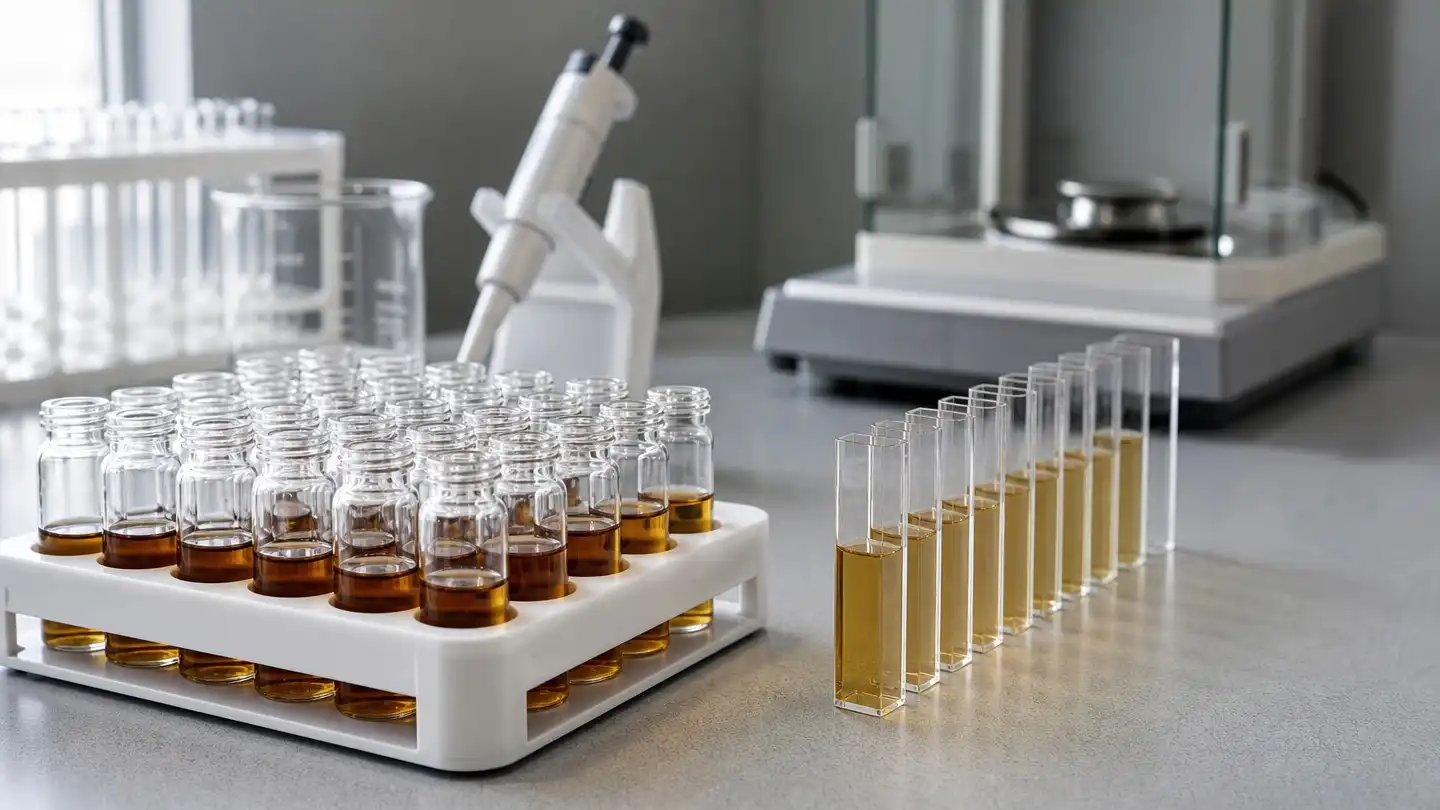

Most specification disputes trace back to one line in a COA: “saponins, HPLC” or “saponins, UV”. Those two lines describe different measurements and answer different questions. A UV or colorimetric assay reports how much UV-active or colour-forming material is present relative to a standard; chromatographic methods report which saponins are present, and only those can confirm that the material is actually Quillaja.
| Method | What it actually measures | Strength | Limitation | Where it belongs in your programme |
|---|---|---|---|---|
| Spectrophotometric (UV/Vis or colorimetric) total-saponin assay | Total response of the extract against a chosen reference standard | Fast and inexpensive; practical for routine standardisation of one production stream | Not specific to saponins; polyphenols, tannins, sugars and other glycosides can contribute, and botanical origin cannot be established | Routine release testing with a supplier you have already qualified |
| HPLC with UV detection | Separation and quantification of individual saponin peaks against authenticated standards | Produces a saponin fingerprint; allows grades and suppliers to be compared on the same basis | Depends on the quality of the standards; closely related saponins can co-elute; complex matrices interfere | Specification verification and supplier-to-supplier comparison |
| HPLC coupled to quadrupole time-of-flight mass spectrometry (HPLC–QToF-MS) | Molecular-mass confirmation of designated marker saponins | Confirmatory identity, and detection of non-Quillaja markers such as Madhuca saponins | Specialist laboratory, higher cost and slower turnaround | First-lot verification, dispute resolution and periodic audit of an approved supplier |
Why the 2026 Poultry Science confirmation study matters to buyers
The clearest public demonstration of that gap is a 2026 study by Thalhamer and colleagues in Poultry Science, which built a confirmation test for Quillaja saponin in poultry feed — a capability the authors noted was missing despite thousands of tonnes of saponin-containing feed produced each year. They analysed pelleted feed samples by HPLC coupled to quadrupole time-of-flight mass spectrometry in negative ionisation mode, targeting the principal saponin compounds as markers for both Quillaja and Madhuca. The method confirmed Quillaja in feed containing additives classified as flavourings or sensory additives, and also identified Madhuca in some samples, documenting adulteration of commercial feed for the first time. The paper adds a detail every buyer should read twice: additive suppliers often do not fully disclose the composition of saponin-containing additives.
Three consequences follow. When a supplier claims HPLC data, ask which detector and which marker compounds: an HPLC–UV profile and an HPLC–QToF confirmation are not interchangeable. Read a UV-only COA as evidence of standardisation, never of identity. Budget an independent confirmation test for the first lot, for any change of grade or production site, and periodically after that.
Adulteration and Substitution: What Verification Looks Like in Practice
Saponin extracts are a favourable target for substitution because a headline percentage is easy to reproduce from a cheaper source, and Madhuca saponins (Madhuca longifolia and related species) are the substitute repeatedly documented in the literature. This is not only a commercial question: EFSA’s Panel on Contaminants in the Food Chain assessed Madhuca saponins as undesirable substances in animal feed, so a lot extended with them raises a feed safety question, not just a pricing argument. Substitution also often happens upstream, where material is blended, labelled correctly by the trader who receives it, and shipped with a COA that faithfully describes an already adulterated lot. Watch the wider saponin raw-material market too: other botanical saponin sources carry their own specifications, and a buyer who cannot tell a triterpenoid Quillaja profile from a cheaper one is exposed to whichever is offered that week.
Sampling and lot consistency
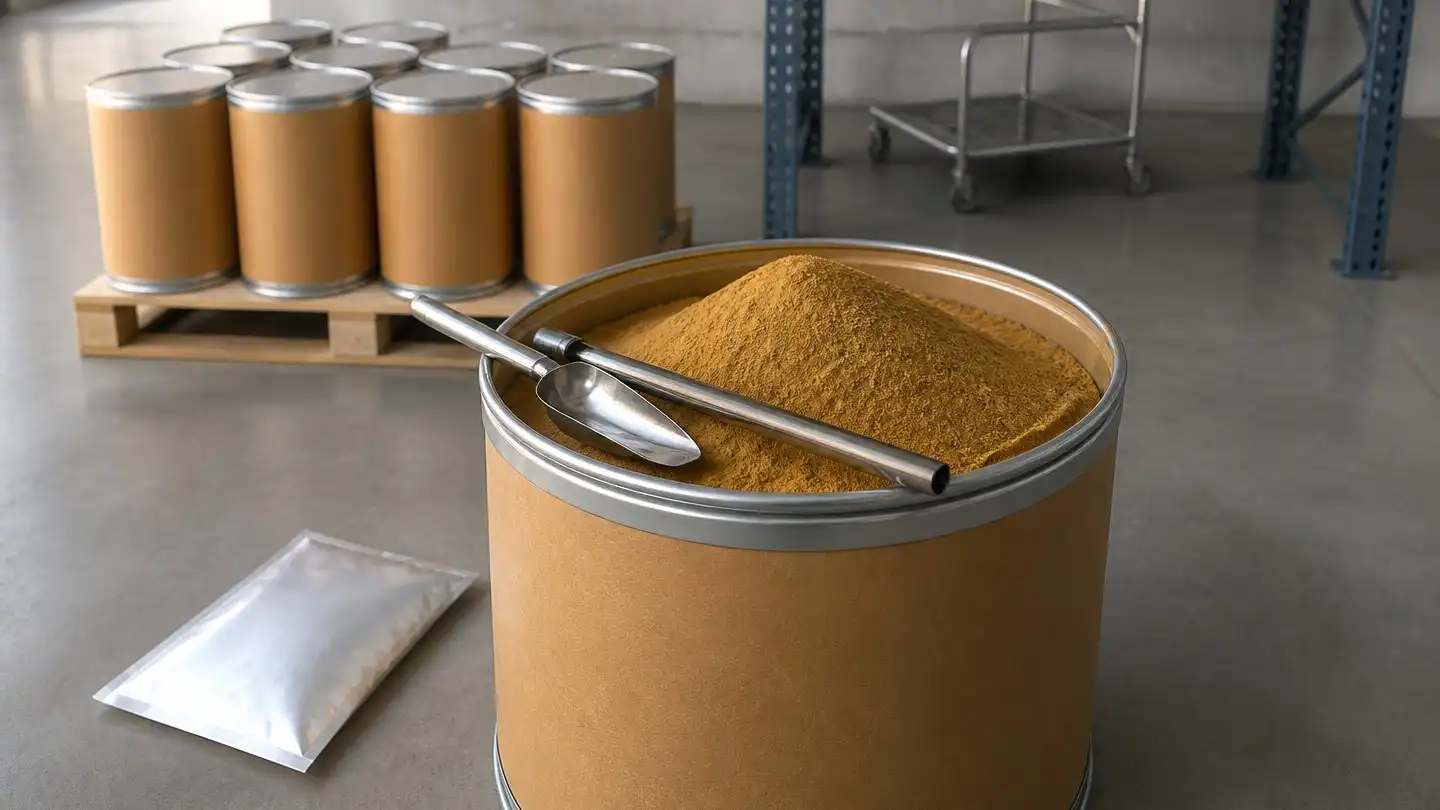
Sampling is where otherwise sound procurement programmes fail quietly. A scoop from the open top of a drum is not a lot sample, because powder segregates by particle size in transit and saponin-rich fines can separate from coarser carrier fractions. Ask for the supplier’s written sampling procedure, request a composite sample drawn across containers, and keep a sealed retained sample from each lot for the material’s shelf life. Compare each new COA against the retained sample before release, and hold any unexplained shift in appearance, flow or dispersibility as a deviation until it is explained.
Batch-to-batch consistency is a supplier capability, not a laboratory accident. It depends on how raw material is selected and blended, whether lots are homogenised before packing, and whether carrier and particle size stay constant between campaigns. When buyers say a supplier “runs consistent”, they usually mean there is a documented blending step and no mid-season change of carrier.
Regulatory Status and the Documents You Should Hold
In the European Union, additives used in animal nutrition fall under Regulation (EC) No 1831/2003. Only authorised additives may be placed on the market, used or processed, and authorisation is granted for a defined category, functional group and target species, with conditions of use attached. A document proving an ingredient exists is not the same as a document showing your product is authorised for your species in your market. Ask the supplier to name the authorisation, registration or notification covering the product, and put that obligation in the supply agreement rather than in an email.
EFSA’s FEEDAP Panel assessed a feed additive based on Quillaja saponaria and Yucca schidigera for all poultry species (EFSA Journal, 2024). Read that opinion as a benchmark: it shows the level of characterisation a regulator expects of a saponin-based additive, from source species and manufacturing description to the specification of active substances and supporting safety data. A supplier whose technical file cannot be described at that level will struggle in a serious audit.
One distinction causes repeated confusion. Quillaia extract also exists as an authorised food additive, E 999, evaluated by JECFA and re-evaluated by EFSA’s Panel on Food Additives and Flavourings in 2019. Those evaluations address food; they do not authorise feed use, and an acceptable daily intake for a food additive is not a feed inclusion reference. In the United States, feed ingredient status normally rests on an AAFCO definition or another FDA-notified pathway specific to that ingredient, so ask which applies and file the answer.
Keep documents in a folder that does not depend on one person’s inbox: the version-controlled specification sheet, the per-lot COA with method references, the safety data sheet, allergen and GMO statements, the certificate of origin, a stability statement and a signed change-control clause. Certification belongs there too: Wellgreen’s product page lists FAMI-QS, ISO 22000, HALAL and KOSHER for its quillaja extract, and claims like these should always be checked against the certificate rather than the sales sheet.
Supplier Capability Checks Before You Place a Volume Order
Supplier approval is mostly a list of uncomfortable questions asked early, while you still have leverage. Can the supplier run saponin assays in house — and if not, which accredited laboratory does? How is the specification window set, and what happens when a lot drifts towards its edge: reworked, downgraded or shipped? What is the written change-control commitment on raw material origin, carrier and process parameters? Can the supplier deliver, twelve months from now, the grade you piloted with the same carrier and particle size?
The sample stage is your best diagnostic. Ask for a pilot sample of the exact grade you intend to buy, split it, test one half in house or at a third-party laboratory and keep the other half as a reference. Then judge the technical team by how it handles follow-up questions on assay method, particle size and processing limits; suppliers who answer precisely during sampling tend to answer precisely during a deviation. The same logic applies to every saponin-based feed ingredient, including feed-grade yucca extract powder, so build one supplier questionnaire for the category.
Questions Buyers Ask Before Committing
Is a UV result enough to confirm that a lot is genuine Quillaja Extract?
No. Spectrophotometric total-saponin assays quantify the extract against a standard and can be influenced by non-saponin components, so they standardise a production stream but do not establish botanical origin. Identity confirmation requires chromatographic marker data — currently, HPLC with high-resolution mass spectrometry.
How do I protect a long-term contract against adulterated lots?
Use four mechanisms together: a named marker panel in the specification, sealed retained samples from every lot, periodic independent HPLC–QToF confirmation, and a change-control clause with a defined rejection route. A COA is a statement by the seller; the retained sample is what lets you test it later.
Sourcing Standardized Quillaja Extract from Wellgreen
Wellgreen supplies standardized Quillaja Extract from Quillaja saponaria for feed and premix applications, with saponin specifications from 10% to 98%, custom concentrations and liquid formats, and batch COA documentation covering saponin content, moisture, ash, heavy metals and microbiological purity, as listed on the product page. The same page lists FAMI-QS, ISO 22000, HALAL and KOSHER certification and a 1 kg sample option for evaluation. Send the grade, the assay method you work to and your destination market to wgt@allwellcn.com and the technical team will reply with a specification, sample plan and documentation set.
Disclaimer: this article is general technical and commercial guidance for procurement and quality professionals. It is not a regulatory determination, not an inclusion-rate recommendation, and not a substitute for your own incoming-goods testing. Nothing here authorises any feed additive in any jurisdiction. Specifications, certification claims and document lists attributed to Wellgreen reflect the company’s product page as published at the time of writing and should be confirmed against current certificates before use.
References
- EFSA Panel on Additives and Products or Substances used in Animal Feed (FEEDAP), Bampidis, V., Azimonti, G., Bastos, M. L., Christensen, H., Durjava, M., et al. (2024). Safety and efficacy of a feed additive consisting of Quillaja saponaria Molina and Yucca schidigera Roezl ex Ortgies (Magni-PHI®) for all poultry species (to slaughter age/weight, or to the point of lay) and ornamental birds (Phibro Animal Health Corporation). EFSA Journal, 22(7), e8849. https://doi.org/10.2903/j.efsa.2024.8849
- Thalhamer, B., Himmelsbach, M., Klampfl, C., & Buchberger, W. (2026). A confirmation test for the presence of Quillaja saponin and adulteration with Madhuca saponin in poultry feed using high-performance liquid chromatography and quadrupole time-of-flight mass spectrometry. Poultry Science, 105(9), 107177. https://doi.org/10.1016/j.psj.2026.107177
- EFSA Panel on Contaminants in the Food Chain (CONTAM) (2009). Saponins in Madhuca longifolia L. as undesirable substances in animal feed. EFSA Journal, 7(2), 979. https://doi.org/10.2903/j.efsa.2009.979
- European Parliament and Council of the European Union (2003). Regulation (EC) No 1831/2003 of 22 September 2003 on additives for use in animal nutrition. Official Journal of the European Union, L 268, 29–43. https://eur-lex.europa.eu/eli/reg/2003/1831/oj
- Joint FAO/WHO Expert Committee on Food Additives (JECFA). Quillaia extracts. WHO Food Additives Series 48: Safety Evaluation of Certain Food Additives and Contaminants. https://www.inchem.org/documents/jecfa/jecmono/v48je03.htm
- EFSA Panel on Food Additives and Flavourings (FAF) (2019). Re-evaluation of Quillaia extract (E 999) as a food additive and safety of the proposed extension of use. EFSA Journal, 17(3), e05622. https://doi.org/10.2903/j.efsa.2019.5622
- San Martín, R., & Briones, R. (1999). Industrial uses and sustainable supply of Quillaja saponaria (Rosaceae) saponins. Economic Botany, 53(3), 302–311. https://doi.org/10.1007/BF02866642
- Osbourn, A. (2026). The Cinderella tree, Quillaja saponaria – A soap story. Plants, People, Planet, 8(2), 439–451. https://doi.org/10.1002/ppp3.70108