
What to Check Before Buying Egg Yolk Lecithin for Industrial Use
2026-10-27 14:00:02
When a procurement team searches for egg yolk lecithin for industrial use, the question is rarely about chemistry. It is about whether a supplier can deliver the same light yellow powder, month after month, with paperwork that survives an audit. Industrial buyers are not choosing a flavour note; they are adding a line to an approved supplier list that will be re-ordered for years.
That changes the checklist. The material must arrive in commercial volume, against a fixed specification, with lot-matched documents and a traceable path back to the batch. How the powder behaves inside a particular emulsion is a separate, formulation-level discussion; the job here is narrower and more commercial.
This article is a buying gate, not a formulation guide.
Industrial Use Means Volume, Consistency, and Paperwork
In a food, nutraceutical or personal care plant, industrial use is shorthand for three operating realities. Consumption is continuous, so one rejected lot stops a line. The material is handled by people who did not choose it, so the specification must be readable by a receiving clerk. And the finished goods travel into markets where the file, not the drum, is what gets inspected.
None of that can be verified from a sample alone. A sample proves one batch can meet a specification; only a documentation system proves the next twenty will.
What the Buying Gate Has to Prove
Four questions decide whether a supplier belongs on the list. Can they hold a specification across lots? Can they document each lot against it? Can they trace a drum back to a production batch and forward to the customer? Can they keep doing all three when demand spikes?
Each maps to evidence you can request before the first purchase order: a specification sheet, historical COAs, batch records, a traceability walk-through and a written change-notification clause. Suppliers who answer readily already operate this way; the ones who answer with assurances are the ones you will chase later.
Incoming Inspection: The Tests That Decide Acceptance
The tests below are the working set for egg yolk lecithin as a purchased material. They are grouped by what they protect: identity, freshness, handling behaviour and safety. The methods are conventional and can be run in-house or at a contract laboratory.
Limits are deliberately absent. Every figure in your specification should be set against your own process and the rules of the market you sell into, not copied from another buyer's sheet.
| Test item | Why it is checked | Suggested method | Action on failure |
|---|---|---|---|
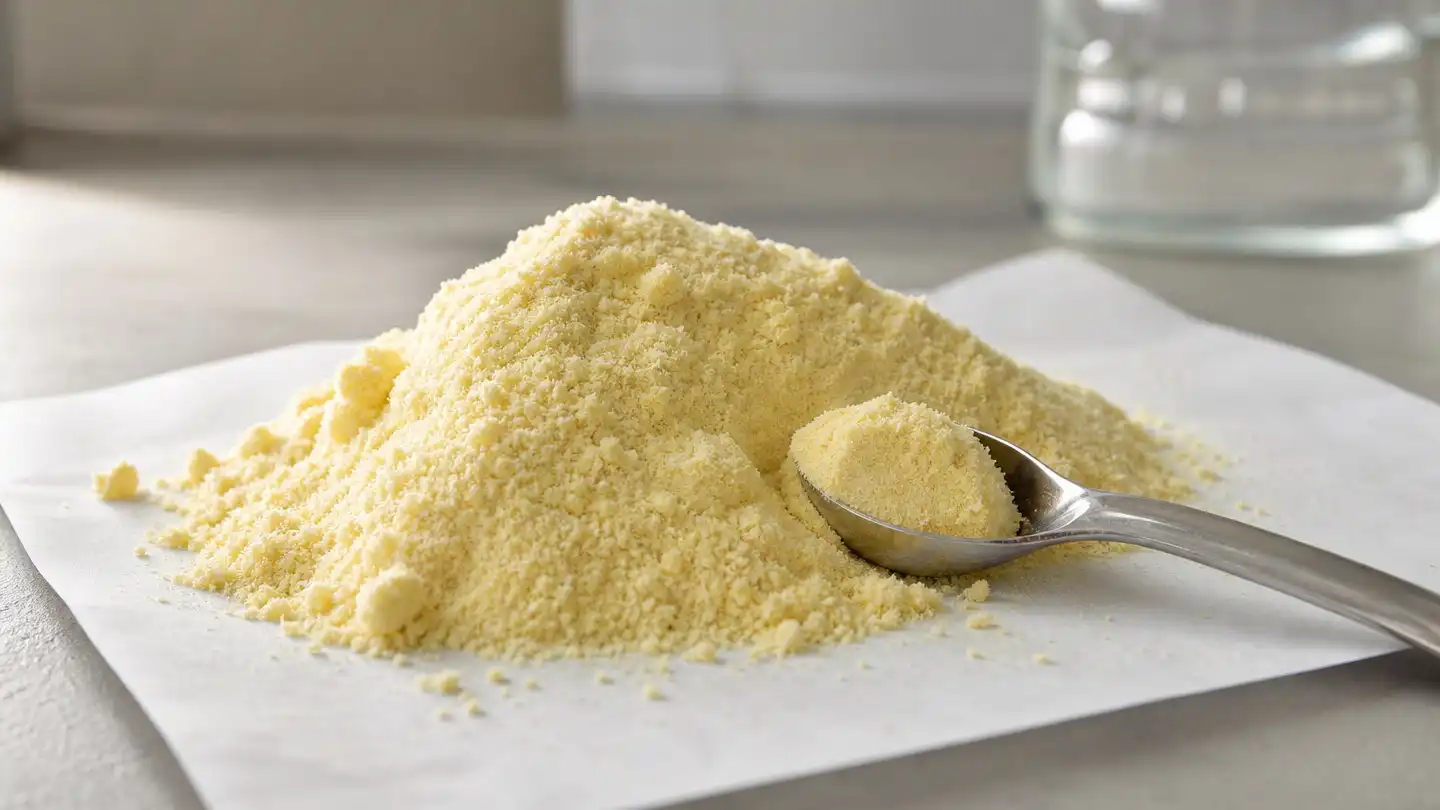
| Appearance and colour | Confirms identity and flags heat damage, oxidation or blending with another powder | Visual comparison against a retained physical reference standard under fixed lighting, with a photographic record per lot | Hold the lot, compare against the retained sample, and reject if the deviation is confirmed |
| Moisture | Drives caking, mould growth and phospholipid hydrolysis in storage | Loss on drying in a vacuum oven, or Karl Fischer titration where the specification names it | Reject, or accept only under a signed concession for immediate use |
| Acid value | Measures free fatty acid release, an early signal of hydrolysis during manufacture or storage | Titrimetric determination, reported as mg KOH/g on the stated basis | Reject and request the batch history; a rising trend across lots is a process signal |
| Peroxide value | Primary oxidation marker; predicts off-note development and colour drift | Iodometric titration with a stated solvent system and endpoint | Reject if above the agreed limit; quarantine the rest of the shipment |
| Anisidine value | Secondary oxidation marker, catches damage that peroxide value has already passed through | Spectrophotometric determination in a specified solvent | Reject, or concede with a shortened assigned retest date |
| Phosphatidylcholine, declared versus measured | Confirms the material matches the grade you paid for rather than a lower-phospholipid cut | UV and TLC as named on the specification, with HPLC as a cross-check where your laboratory has it | Investigate method basis first, then reject if the gap is confirmed on a referee method |
| Particle size | Controls flow, dusting, blend uniformity and mouthfeel in dry mixes | Sieve analysis against the 80 mesh requirement (100% pass 80 mesh) | Reject, or re-sieve only with written quality approval and a new lot number |
| Dispersibility | Indicates how the powder wets out in your carrier, which sieve data does not show | Bench dispersion at a fixed concentration, temperature and stirring time, scored against a reference sample | Flag for a process trial; reject if a second lot behaves the same way |
| Microbiological load | Protects finished goods and confirms the site controls hygiene and water | ISO 4833-1 for enumeration, ISO 6579-1 for Salmonella, ISO 21527-1 for yeasts and moulds | Reject; request a root-cause response before the next shipment |
| Residual solvents | Confirms extraction and drying leave no unacceptable carry-over | Headspace gas chromatography with a validated method | Reject; the result usually points to a specific process step |
| Heavy metals | Addresses environmental contamination and destination-market limits | ICP-MS or atomic absorption spectroscopy on a digested sample | Reject and request the supplier's incoming test data for the raw material |
Setting Limits Without Guessing
Start from the finished product, then work backwards. If your process is sensitive to moisture pickup during blending, moisture becomes a tight item; if the powder goes into an oil phase, dispersibility and particle size carry more weight. Regulatory limits in the destination market set the floor, and your process capability sets everything above it.
Write each limit with its method attached. A moisture limit without a method is not a specification, because vacuum oven and Karl Fischer results are not interchangeable. The same holds for acid value and peroxide value.
Method Equivalence Matters More Than Method Prestige
Our specification names UV and TLC for phosphatidylcholine; your laboratory may use HPLC. Neither is wrong, but comparing them needs a bridging study, not a direct number-to-number match.
Ask for the method against each parameter on the COA, then confirm once that your method reads the same material within an agreed tolerance.
Reading the PC Declaration Correctly
Phosphatidylcholine is the marker most buyers watch and the one most often misread. A declared figure should state whether it refers to phosphatidylcholine alone or to total phospholipids, which method produced it, and whether it is a committed minimum or a typical value.
Without those three pieces, comparing two quotations is meaningless. Two suppliers can quote the same headline number while measuring different things, and the gap surfaces only when your process behaves differently from the trial batch.
Read the declared PC as a specification item to be verified, not a marketing line. If the certificate shows a typical value, ask for the release specification the batch was judged against.
The Document Package That Must Arrive With the Pallet
Documents are part of the product. A drum without its file is a drum you cannot release. The third column below names the gap that most often holds a shipment at goods-in.
| Document | What it must show | Common gap |
|---|---|---|
| Specification sheet | Parameters, limits, units and the method for each parameter, with an issue date and version number | Unversioned PDF with no method column |
| Certificate of analysis | Lot number matching the drum, results against the specification, methods, release date and approver | Generic certificate covering a production period rather than the shipped lot |
| Material safety data sheet | Hazard classification, handling, storage and transport information in the required language | Outdated revision, or a sheet for a different grade |
| Allergen statement | Explicit declaration that the material is egg-derived, with the plant's allergen handling and cross-contact controls | Statement copied from a soy template |
| Non-GMO statement | Source declaration and the basis for the claim; essential if any soy-derived component is present | Claim without a named basis or signatory |
| Halal and Kosher certificates | Issuing body, certificate number, validity dates, and the site and product scope covered | Certificate valid for a different production site |
| Organic certificate (if claimed) | Certifier, standard, scope and validity, matched to the material shipped | Certificate expired or covering only part of the range |
| Certificate of origin | Country of manufacture, exporter, consignee and the tariff description used for customs | Origin stated for the trading company rather than the production site |
| Packaging declaration | Pack format, inner liner material, net weight and pallet configuration | Pack format that differs from the purchase order |
Two points matter most. The COA must carry the lot number printed on the drum, not a certificate covering a production window. And allergen and source statements must match the material shipped; an egg-derived powder travelling with a soy template is a labelling problem waiting to happen.
Where a certificate is claimed, check its scope rather than its logo. ISO 9001:2015, ISO 22000, Halal, Kosher and HACCP documentation is available for this product, and each should be read for the site and product category it covers.
Egg Yolk Versus Soy: What the Source Changes in Procurement
Soy lecithin dominates volume and price stability; egg yolk material occupies a narrower position, usually chosen where the source itself matters. The differences show up commercially long before they show up technically.
Allergen Labelling
Egg is a declarable allergen in most major markets, so every downstream label, recipe card and allergen matrix has to carry it. Soy carries its own declaration, and in some markets an additional bioengineering disclosure.
Regulatory Identity
The two materials are named and regulated separately, and permitted names differ by market. Confirm the name your label will use before artwork is approved; changing an ingredient name after printing costs far more than changing a supplier.
Flavour and Oxidation Sensitivity
Egg-derived phospholipids carry a characteristic note that shows in bland matrices, and soy material brings its own. Both oxidise, but the rate depends on residual oil, moisture and handling rather than source alone, which is why peroxide and anisidine values belong on every COA.
Price Volatility
Egg supply responds to laying flocks, feed costs and seasonal demand; soy responds to a global oilseed complex. They move for unrelated reasons, which argues for qualifying both where volume justifies it.
Buyers comparing the two can review the soybean lecithin specification and its document set alongside this one, using the same inspection table.
Sampling, Retention, and the Third-Party Cross-Check
Sampling is where paperwork meets physical reality. Use an AQL-based attribute sampling plan such as ISO 2859-1, agreed in advance, rather than an informal habit of taking one scoop. In a 25 kg drum, sample at more than one depth, because segregation in transit is real and a top sample can flatter a batch.
Retain samples from every accepted lot for the declared shelf life plus a margin set in your own procedure. The retained sample settles a dispute six months later, when neither party can reproduce the original condition.
Third-party testing and in-house testing answer different questions. In-house results tell you whether the lot meets your specification today; external results tell you whether the supplier's method and yours agree, and give you a record that stands up in a customer audit. Run the external check on a fixed frequency.
When the COA and Your Result Disagree
Disagreement is normal and should have a route. The first step is not rejection; it is confirmation. Check the sample, check the method, and check that both laboratories tested the same lot number.
Step One: Confirm the Comparison
Verify units, moisture basis and method. A peroxide value reported on a different basis, or a particle size result from a different sieve series, can look like a failure while being a reporting difference. Ask both laboratories for raw data before concluding.
Step Two: Joint Retest
If the difference survives, request a joint retest on a sealed retained sample, ideally at a laboratory named in the contract. This is where a quality system shows itself: a well-run site produces its retained sample and batch record within days.
Step Three: Concession or Rejection
If the lot is outside specification but usable, a documented concession is legitimate, provided quality signs it, the price reflects it and the event is logged in the supplier scorecard. If it is not usable, reject in writing with the test data attached.
Each step should already exist in the supplier agreement; improvising a rejection during a stock-out is how buyers pay for material they cannot use.
Packaging and Storage: The Cost-Risk Trade-off
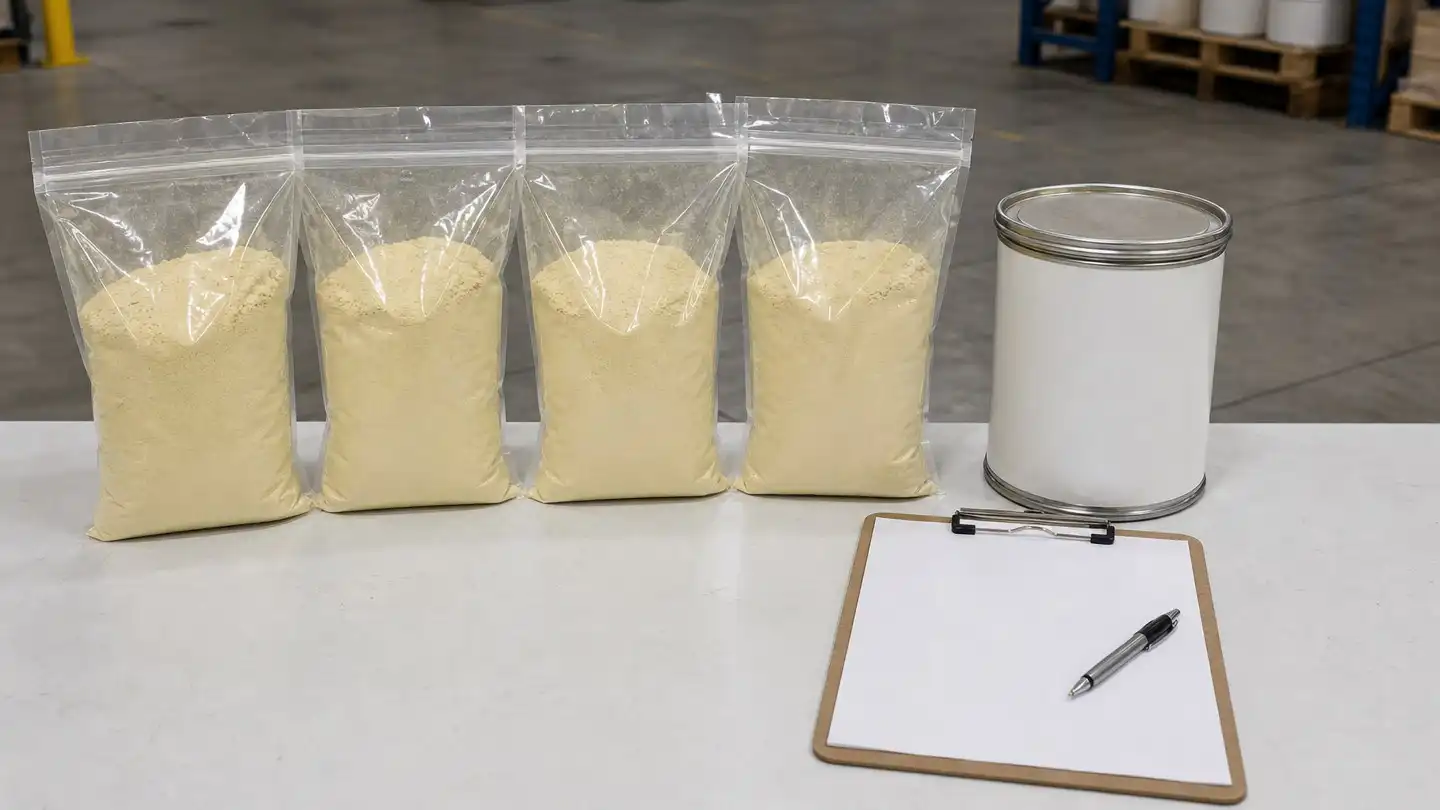
Egg yolk lecithin is supplied as a yellow powder in 1–5 kg aluminium foil bags, 25 kg drums or OEM formats. The choice is not cosmetic. Foil bags limit exposure per opening and suit smaller consumption rates; drums lower the cost per kilogram but expose the whole contents each time the lid comes off.
Storage is cool and dry, away from light, with the declared two-year shelf life running from the date of manufacture. Opening a container does not reset that clock. Repack into a smaller sealed container, label it with the original lot number and opening date, and keep it under the same conditions.
Bulk buying lowers unit cost but raises the cost of a failure, because a rejected drum ties up more capital and production time. At modest volumes, the 1–5 kg format with a shorter reorder cycle is often cheaper overall.
For the wider phospholipid range and pack formats across grades, see the pure extracts range.
Six Capability Checks Before You Qualify a Supplier
Certificates describe a system; capability describes a supplier. These six checks separate a trading desk from a production site.
- Line ownership. Ask which production line makes the material and who operates it. If the answer is a third party, ask for that site's identity and certificates.
- Certificate scope. Match each certificate to the site address and the product category, not just to the company name.
- Batch records and deviations. Request one complete batch record, redacted as needed, and ask how deviations are closed and by whom.
- Change notification. Confirm in writing how much notice you receive before a process, source or specification change.
- Retained samples and traceability. Ask for a walk-through from a drum number to a production batch and back again.
- Export documentation experience. Ask which markets the site ships to and who prepares origin, health and customs documents.
Our own certification file sits on the quality accreditation page, and it is a reasonable benchmark for what to request from any supplier.
Contract Terms Worth Locking Down Before the First Order
Most sourcing disputes trace back to a clause that was never written. Five terms do most of the work.
Specification lock. Attach the specification sheet and the sampling plan as annexes, and state that they change only by signed amendment.
Method and decision rule. Name the method for each parameter and say which result prevails when two laboratories differ, for example a named referee laboratory.
Failure handling. Define the notice period for a non-conformance claim, who pays return freight, and how replacement lots are prioritised.
MOQ and lead time. Fix the minimum order quantity, the production lead time and the tolerance for partial shipments, then size safety stock against the slower of the two.
Change notification period. Set a written notice period for changes to process, source, site or specification, with the right to re-qualify before the next shipment.
Then run the sequence in order: document review, a sample tested with your own methods, a first order with a pre-shipment sample hold, then a performance review after three lots.
Next Step
We supply egg yolk lecithin as a yellow powder tested by UV and TLC, 100% pass 80 mesh, with a two-year shelf life and packaging in 1–5 kg aluminium foil bags, 25 kg drums or OEM formats, supported by ISO 9001:2015, ISO 22000, Halal, Kosher and HACCP documentation. If you are building a buying gate, we can send the specification sheet, a lot-matched COA and a sample for your own testing. For private-label and custom packaging programmes, see our OEM and ODM services, or write to wgt@allwellcn.com with your target specification and destination market.
References
- U.S. FDA. 21 CFR Part 184 — Direct Food Substances Affirmed as Generally Recognized as Safe. 2024.
- U.S. FDA. 21 CFR Part 182 — Substances Generally Recognized as Safe. 2024.
- USP–NF. Lecithin Monograph. 2024.
- European Pharmacopoeia. Lecithin Monograph. 2024.
- ISO. ISO 4833-1 — Microbiology of the food chain: horizontal method for the enumeration of microorganisms. 2013.
- ISO. ISO 6579-1 — Microbiology of the food chain: horizontal method for the detection of Salmonella spp. 2017.
This article is intended for business-to-business ingredient sourcing and formulation discussion. It does not provide medical, nutritional, or regulatory advice for any specific product or market.