
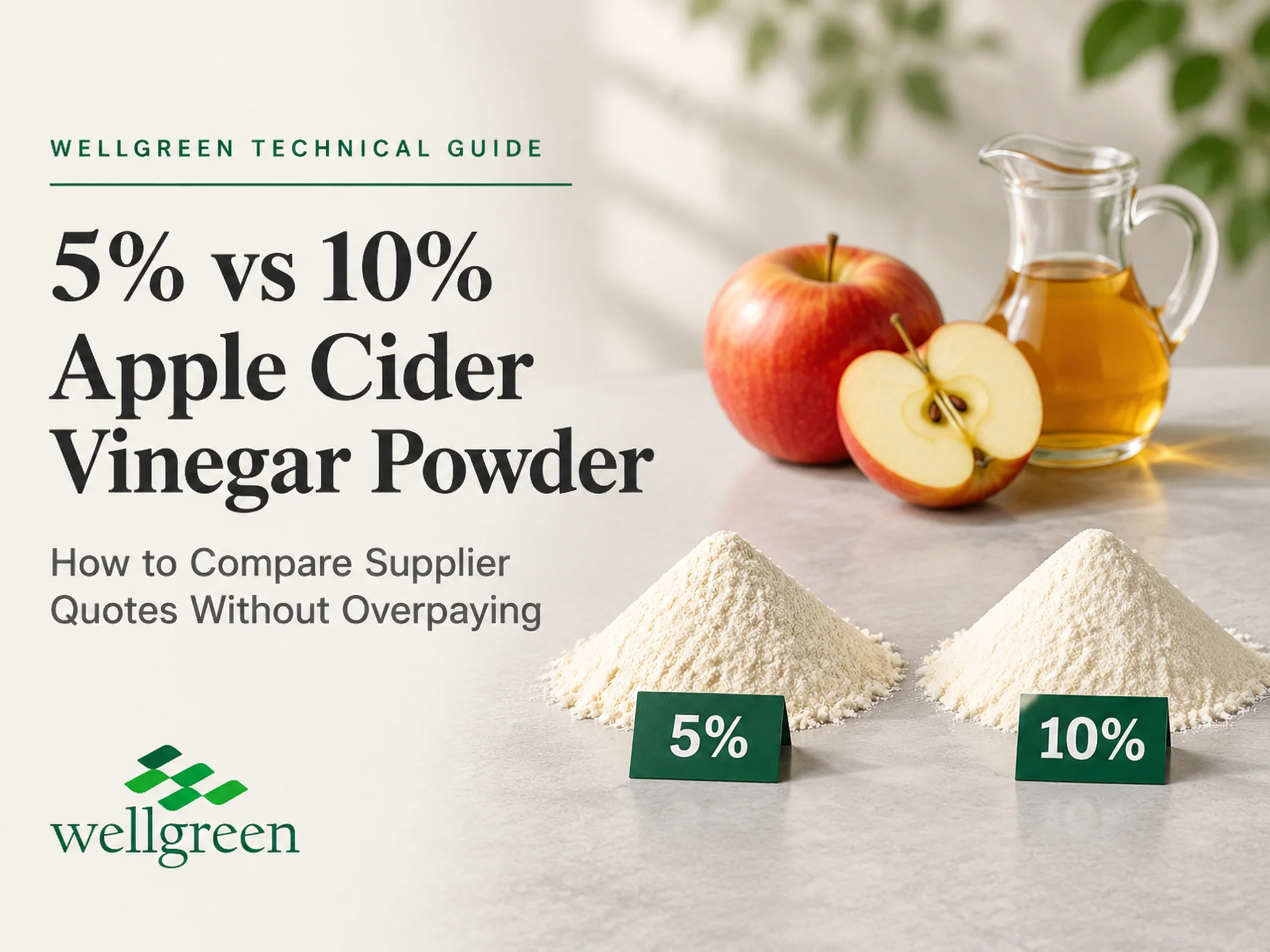
5% vs. 10% Total Acid Apple Cider Vinegar Powder: How to Compare Supplier Quotes Without Overpaying
2026-11-12 14:48:32
A 10% ACV powder quote looks twice as strong and often costs less per kilogram of actual acetic acid - until dosing, taste, caking and certification gaps change the math. This guide converts any 5% or 10% apple cider vinegar powder quote into one comparable number, and lists exactly what to verify before you sign.
Key takeaways
-
Total acidity is the only number that matters at quote stage. 5% powder carries ~5 g of acetic acid per 100 g; 10% carries ~10 g. Everything else - appearance, solubility, mesh - is usually identical between the two grades from one factory [5].
-
Convert every quote to cost per kg of acetic acid (price ÷ acidity as a decimal). In our worked example, a $2.60/kg quote on 5% powder actually costs more per unit of acid than a $4.30/kg quote on 10%.
-
But cheaper per unit of acid is not automatically cheaper overall. Lower fill weight, flavor load, hygroscopicity, gummy pH targets and rejected-lot risk all move the real number.
-
Apple-specific hazards are part of the price. Patulin (FDA action level 50 µg/kg in apple products) and inorganic arsenic (10 ppb guidance level in apple juice) must appear on the COA discussion before price does [1][2][3].
-
Ask three questions that expose weak quotes instantly: what is the carrier and its share, what method supports the acidity claim, and can you show patulin results for the actual lot?
The 30-second decision rule. Capsules, stick packs, tableting, feed premix — quote the 10% grade and negotiate on acid units. Drink mixes, seasonings, gentle sensory profiles, maximum label weight — quote the 5% grade. Then put both in the same unit-acid math and let landed cost, not headline price, decide [10].
1. What "Total Acidity" Actually Means on an ACV Powder Spec Sheet
Direct answer: "total acidity" is the acid content of the powder expressed as acetic acid, by weight. A 5% total-acid ACV powder contains approximately 5 g of acetic acid in every 100 g of powder; a 10% powder contains approximately 10 g. That single percentage is the quantity you are actually buying - the rest of the bag is carrier, apple solids, moisture and air.
The acid originates in fermentation. Yeast converts apple-juice sugars to alcohol; acetic-acid bacteria then convert the alcohol to acetic acid, which gives vinegar its sharp taste and smell. The liquid is dried onto a carrier and milled: our material is an off-white, free-flowing powder from Malus pumila Mill. apple cider vinegar, supplied at 5%, 8% and 10% acidity with customization on request [5].
Three conventions to keep straight when you read quotes:
-
Powder specs are weight-based. 5% means 5 g acid per 100 g powder (w/w).
-
Liquid vinegar is often sold in "grain." 100-grain vinegar is 10% acidity; a "50-grain" product is 5%. A supplier quoting you in grain and another in percent are not quoting different products - they are using different vocabularies for the same number.
-
"Acidity" in a COA is a titration result, not an opinion. The standard check is titration of a dissolved sample with sodium hydroxide to a phenolphthalein endpoint, reported as acetic acid. Ask for the method, not just the value.
Why does this matter commercially? Because between two grades from the same factory, almost every other line item is identical: same appearance, same 100% water solubility, same 95-99% through 80 mesh, same heavy-metal and microbiology limits [5]. If you compare quotes on those lines, every supplier "wins." The acid number is the differentiator that moves price, dose, and finished-product performance - which is exactly where careless buyers overpay.

2. The Real Differences Between 5% and 10% ACV Powder
Direct answer: the 10% grade delivers twice the acetic acid per gram of powder, so you ship, store and weigh half as much to hit the same acid target - but you also get twice the sour intensity per gram, which changes sensory and processing behavior in some finished products.
Here is the grade-by-grade arithmetic using our standard specifications (5% COA example: assay 5.23%, loss on drying 3.25%, bulk density 55 g/100 ml) [5]:
| Parameter | ACV Powder 5% | ACV Powder 8% | ACV Powder 10% |
|---|---|---|---|
| Acetic acid per 100 g powder | ~5 g | ~8 g | ~10 g |
| Powder needed for 500 mg acetic acid | 10 g | 6.25 g | 5 g |
| Acetic acid in one 500 mg capsule | ~25 mg | ~40 mg | ~50 mg |
| Relative carrier load per unit of acid | Highest | Mid | Lowest |
| Sour taste per gram of powder | Milder, easier to mask | Mid | Sharper - reformulate or re-blind |
| Freight and storage per acid unit | Highest | Mid | Lowest |
| Appearance | Off-white powder - effectively identical | ||
| Solubility / mesh / bulk density | 100% water soluble, 95-99% through 80 mesh, 50-60 g/100 ml - same spec lines for all grades | ||
| Hygroscopicity (caking tendency) | Carrier-heavy, generally forgiving | Mid | More free acid per gram - verify with a storage trial |
| Typical home use | Drink mixes, seasonings, mild-sensory foods | Balanced capsules and blends | Capsules, sticks, premixes, acidifier duty |
Two quiet observations from the table that decide most sourcing calls. First, the "8%" grade exists for a reason: when a brand wants to cut capsule count versus 5% but cannot afford the sensory punch of 10%, 8% is the engineering middle. Second, the caking question runs the other way from intuition: it is not simply "more acid = more caking." Lower-acid powders carry more solids, higher-acid powders expose more free acid - whichever carrier system a supplier uses determines which grade cakes first. That is precisely why a 7-day storage trial (Section 11) is worth more than any brochure.
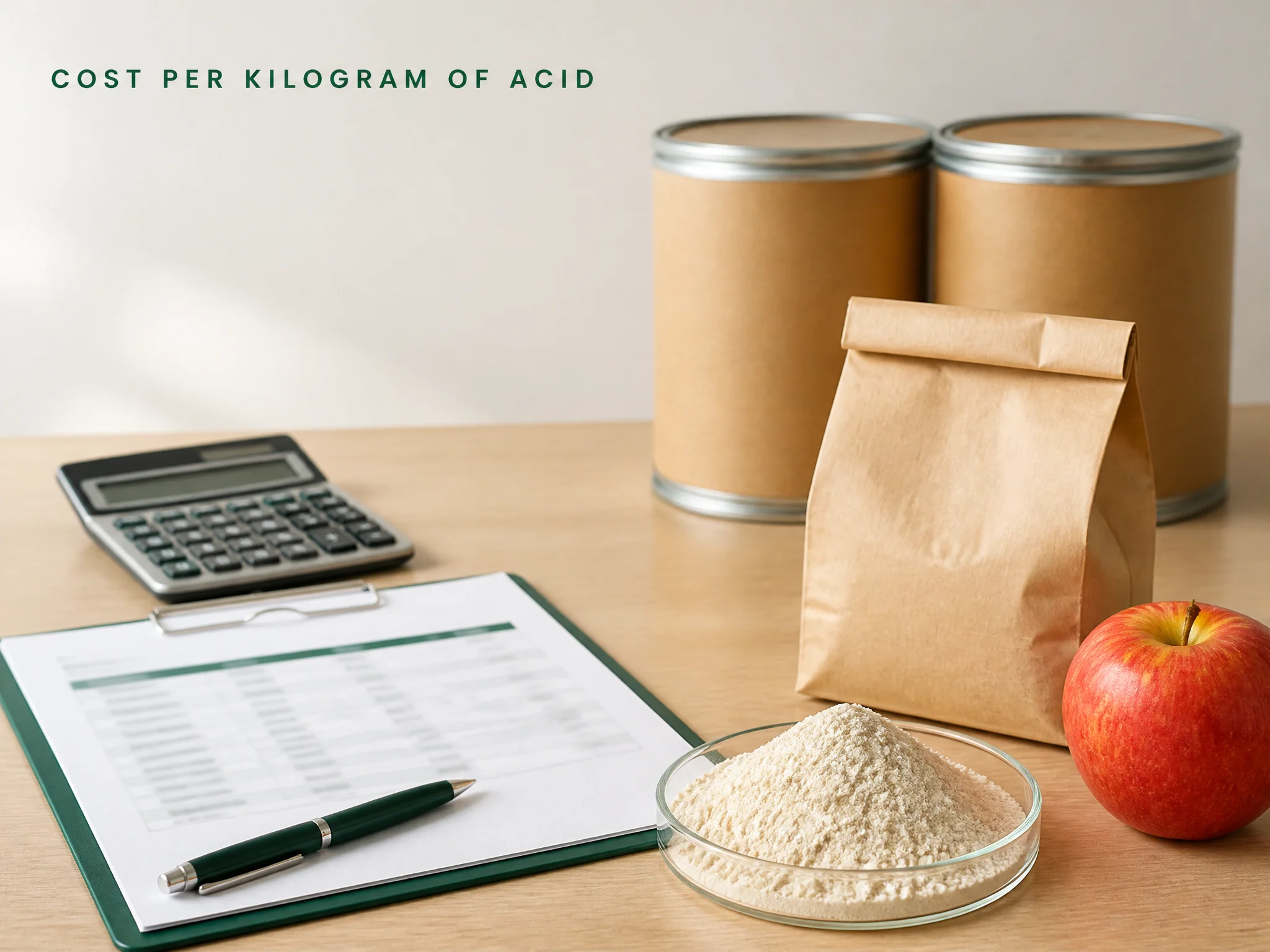
3. Cost per Kilogram of Acid: the Only Number That Makes Quotes Comparable
Direct answer: divide each quote's price per kilogram by its acidity as a decimal, and you get cost per kg of actual acetic acid - the one column where 5% and 10% quotes can be compared honestly.
The formula:
Cost per kg of acid = price per kg of powder ÷ acidity (as a decimal)
Example: $4.30 per kg at 10% = $4.30 ÷ 0.10 = $43.00 per kg of acetic acid. Same math: $2.60 ÷ 0.05 = $52.00.
Worked example with four hypothetical quotes - the prices are illustrative, the arithmetic is the point:
| Supplier | Grade | Quote ($/kg) | Cost per kg of acid | What the headline hides |
|---|---|---|---|---|
| A | 5% | 2.60 | 52.00 | "Cheapest per kg" - most expensive per acid unit; also carrier-heavy label |
| B | 10% | 4.30 | 43.00 | Looks 65% pricier per kg; actually cheapest per acid unit |
| C | 10% | 4.90 (DDP) | 49.00 | Highest sticker, but freight, customs and batch testing included - closest to landed cost |
| D | 8% | 3.60 | 45.00 | Middle grade lands near B once sensory savings are counted |
Then, and only then, adjust for the four numbers that turn "cheapest per acid unit" into "most expensive delivered":
-
Freight and packaging per unit of acid. Buying 5% to save $1.70/kg means shipping double the bags for the same acid. At 25 kg per fibre drum, halving tonnage halves drum count, pallet positions and customs paperwork too.
-
Dose-dependent excipient cost. In a capsule, 10% powder delivers the same acid in half the fill - that is excipient, capsule size, and sometimes line-speed savings that never appear on the ingredient quote.
-
Rejection risk. One lot that fails patulin or acidity re-test costs the price of the lot, the testing, the production downtime and the customer conversation. A supplier's COA discipline is part of your cost structure.
-
Payment and Incoterm mismatch. A FOB quote and a DDP quote are different products: FOB excludes ocean freight, insurance and destination customs; DDP bakes them in. Compare delivered-cost columns, never term-mixed headline prices.
4. When the 10% Grade Does NOT Save You Money
Direct answer: the 10% grade stops being the economical choice when your finished product pays to hide its sharpness, fight its pH, or rebuild around its density - three situations that swallow the unit-acid savings within one production quarter.
Four scenarios where the "cheaper per acid unit" grade costs more overall:
-
Gummies and strong-sensory foods. Acidity is the flavor you are trying to calibrate, not maximize. Pushing tartness up per gram means more sweetener, coating or flavor masking to keep the product edible - reformulation and flavor costs that dwarf the raw-material saving. Many gummy co-packagers standardize on the 5% grade for exactly this control reason.
-
pH-sensitive systems. Gel strength in pectin and gelatin systems, color stability in anthocyanin drinks, and shelf-stability targets all key on finished pH. A denser acid source forces buffer retuning across every batch - engineering time nobody budgets.
-
Label-mass positioning. Retail brands that market "1,000 mg apple cider vinegar blend" per serving are selling powder mass, not acid. The 5% grade fills the claim with fewer milligrams of a sharper ingredient and often a friendlier mouthfeel in stick-pack reconstitution.
-
Cosmetic and personal-care bases. Fruit-acid load on skin is a formulation variable; mildness wins. The 5% grade (and even lower customities) is the practical choice for leave-on concepts - our material is already used as a skin- and hair-care raw material for its carried-over fruit acids and antioxidants [10].
The professional takeaway: run the unit-acid math first, then ask what your finished product does with every extra milligram of acid. If the answer is "spends money to neutralize it," the 5% quote was never overpriced.
5. What an Honest COA Must Show for Either Grade
Direct answer: for ACV powder, a usable batch COA shows the acidity value with its test method, plus loss on drying, ash, particle size, bulk density, solubility statement, the four heavy metals, a full microbiology panel, batch identity and dates - and for apple-derived ingredients, patulin. Anything less is a certificate of existence, not quality.
| Item | Typical spec line (our standard) | COA reality check |
|---|---|---|
| Acidity (as acetic acid) | 5% / 8% / 10%, customized on request | Actual assay value - our 5% batch example: 5.23% against a ≥5.00% spec [5] |
| Appearance / odor / taste | Off-white powder; characteristic | "Conforms" - fine, but sample for yourself |
| Loss on drying | ≤5.0% | Example batch 3.25% - high moisture means caking and micro risk later |
| Ash | ≤5.0% | Example batch 2.65% - proxy for mineral carrier load |
| Particle size / bulk density | 95-99% through 80 mesh; 50-60 g/100 ml | Drives capsule fill and dissolution; verify it matches your line |
| Solubility | 100% water soluble | Ask for the test condition (concentration, water temperature) |
| Heavy metals | Total ≤10 ppm; Pb ≤2, As ≤2, Cd ≤1, Hg ≤1 ppm | Should be values or "conforms" with method named (e.g., ICP-MS) |
| Microbiology | TPC ≤1,000 cfu/g; mould & yeast ≤25 cfu/g; E. coli ≤40 cfu/g; Salmonella negative | Ours adds S. aureus, Shigella, haemolytic streptococcus: negative [5] |
| Patulin | ≤50 µg/kg - our ACV spec records not-detected results | Must be batch-specific for apple-derived powder (Section 6) |
| Identity | Batch/lot, manufacture and expiry dates | No batch number = no traceability = no COA |
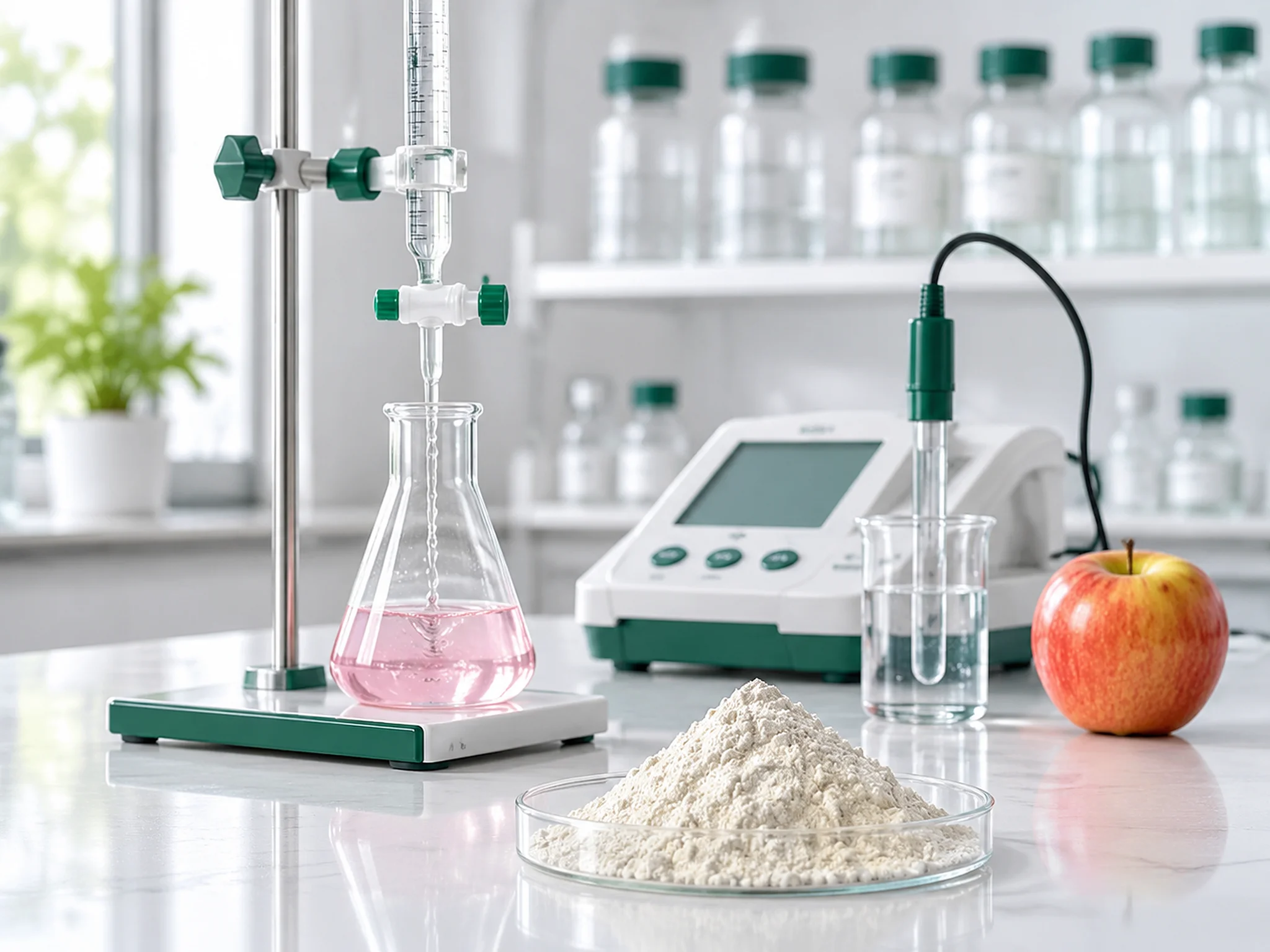
Two verification habits separate experienced ingredient buyers from the rest. First, re-test the acidity of the pre-shipment sample yourself or via a third-party lab and compare with the shipment COA - a pattern of small under-assays is a process problem, not a typo. Second, ask what happens after the COA: we retain a sample from every batch for two years, which makes any later dispute resolvable against actual material [5].
6. Patulin, Arsenic and Apple-Specific Hazards to Put in Your RFQ
Direct answer: because ACV powder is concentrated apple cider vinegar, its two apple-specific hazards are patulin (a heat-stable mycotoxin from moldy fruit) and inorganic arsenic (a historical juice concern). Both have published U.S. FDA limits, and both belong in your RFQ as batch-tested COA items - not as supplier assurances.
-
Patulin. The FDA has established an action level of 50 micrograms per kilogram (ppb) for patulin in apple juice and apple products [1][2]. Patulin survives processing - drying a vinegar into powder does not make it disappear. A 10% grade concentrates everything from the apples, so the patulin conversation matters more, not less, at higher acidity.
-
Inorganic arsenic. FDA guidance sets a 10 ppb action level for inorganic arsenic in apple juice [3]. Apple-based powders inherit scrutiny here; ask for the spec, the method and the batch value.
What good looks like: our ACV spec sheet caps patulin at ≤50 µg/kg with not-detected batch results, and keeps a heavy-metal panel (Pb, As, Cd, Hg) with defined per-element limits [5]. If your incumbent vendor's COA has no patulin row for an apple-derived powder, that is not a paperwork gap - it is a sourcing risk being transferred to you.

7. Maltodextrin, Carriers and the "Without Maltodextrin" Question
Direct answer: nearly every spray-dried ACV powder - at any acidity - is dried onto a carrier, most commonly food-grade maltodextrin, which is GRAS-listed in the U.S. under 21 CFR 184.1444; "maltodextrin-free" grades exist but trade away flow, yield and price for a label benefit.
Why a carrier is used at all: apple cider vinegar liquids are mostly water and volatile acetic acid; a carrier forms the solid shell around the acid during spray drying, keeps the powder free-flowing and protects the aroma. Remove it and you get a sticky, hygroscopic, hard-to-standardise material. The honest buyer questions are therefore not "is there carrier" but three practical ones [4]:
-
What is the carrier? Maltodextrin is standard; alternatives include apple juice solids, acacia gum and modified starches. Get it declared on the spec, not "natural ingredients."
-
How much? Ask for carrier share or, practically, compare the grade's ash and organic-solids picture. A higher-acidity grade delivers more acid per gram of carrier - one real reason premium buyers drift up-market.
-
What does it do to my label? Maltodextrin contributes digestible carbohydrate calories; keto, low-glycemic and "clean-label" positioning is exactly where maltodextrin-free demand comes from - and where the price surcharge is legitimate rather than padding.
Watch the inverse scam as well: a quote that claims "100% apple cider vinegar, no carrier" at a price below the maltodextrin market is drying something you have not been told about. Carrier disclosure is a trust signal - make it a mandatory field in your scorecard (Section 8), and treat "we will confirm later" as an answer.
8. The 10-Point Quote Comparison Scorecard
Direct answer: score every ACV powder quote on the same ten fields - unit-acid price, method-backed assay, carrier disclosure, patulin and arsenic lines, mesh and bulk density, MOQ and sample terms, packaging and Incoterm, lead time and capacity, certificates that match your market, and COA granularity. Weight price at half, the other nine at half; the "cheapest" quote usually loses.
| # | Field | What good looks like | Red-flag answer |
|---|---|---|---|
| 1 | Cost per kg of acid | Computed yourself from price ÷ assay % | Refuses to state assay %, "price negotiable" |
| 2 | Acidity method | Named titration method on COA | "We follow the customer's spec" with no method |
| 3 | Carrier declared | Carrier identity + share on spec sheet | "100% vinegar, no carrier" below carrier market price |
| 4 | Patulin + arsenic | Batch values, limits ≤50 µg/kg / ≤10 ppb logic | Absent from COA for an apple-derived powder |
| 5 | Physical spec fit | 80 mesh, bulk density 50-60 g/100 ml - matched to your line | No particle-size or bulk-density data |
| 6 | MOQ and sample | Trial qty near 1 kg; free 10-20 g sample, courier collect | MOQ one ton before any sample |
| 7 | Packaging + Incoterm | 25 kg fibre drum, double PE liner; stated FOB/CIF/DDP | "Standard packing" undefined; mixed terms in one comparison |
| 8 | Lead time + capacity | 7-20 working days; capacity documented (ours: 50,000 kg/month) | Promise of 3 days stock on an off-season item |
| 9 | Certificates | ISO 9001/22000, HACCP + Halal/Kosher where sold; FSSC 22000, cGMP, NOP/EU organic for the organic line | Photos of certificates, no certificate numbers |
| 10 | COA granularity | Batch-specific values; 2-year retained sample policy | One generic "type" COA for all lots |
Run the scorecard before you negotiate price. Price talk with a supplier who fails fields 2-4 is wasted: you are not comparing the same product, and the discount is compensation for risk you will underwrite.
9. Dose Conversion: Capsules, Sticks, Gummies and Drink Mixes
Direct answer: design from the acetic acid on your label claim backwards to powder weight - 5% powder needs twice the grams of 10% powder for the same acid, and human research doses translate into double-digit capsules fast.
The reference point most buyers reach for: the randomized trial behind most "vinegar and body fat" claims used 30 ml of household vinegar per day [6]. At roughly 5% acidity, 30 ml of vinegar carries about 1.5 g of acetic acid. Now convert that to powder per day:
| Target acetic acid / day | 5% powder needed | 10% powder needed | What that means on your pack |
|---|---|---|---|
| 300 mg | 6.0 g | 3.0 g | 12 x 500 mg capsules at 5%; 6 at 10% |
| 750 mg (a 15 ml tbsp of 5% vinegar) | 15.0 g | 7.5 g | Most single-capsule "ACV" products deliver 25-50 mg acid - a fraction of this |
| 1,500 mg (the 30 ml trial dose) | 30.0 g | 15.0 g | Impossible in capsules at 5%; a drink-mix territory - dose by acid, market honestly |
This table is also your shelf-truthfulness check when comparing contract manufacturers: a "1,000 mg apple cider vinegar" capsule at 5% powder carries only 50 mg of acetic acid. If two suppliers quote the same claim at very different prices, the real difference may be grade, carrier, or honesty - find out which before you accept either.
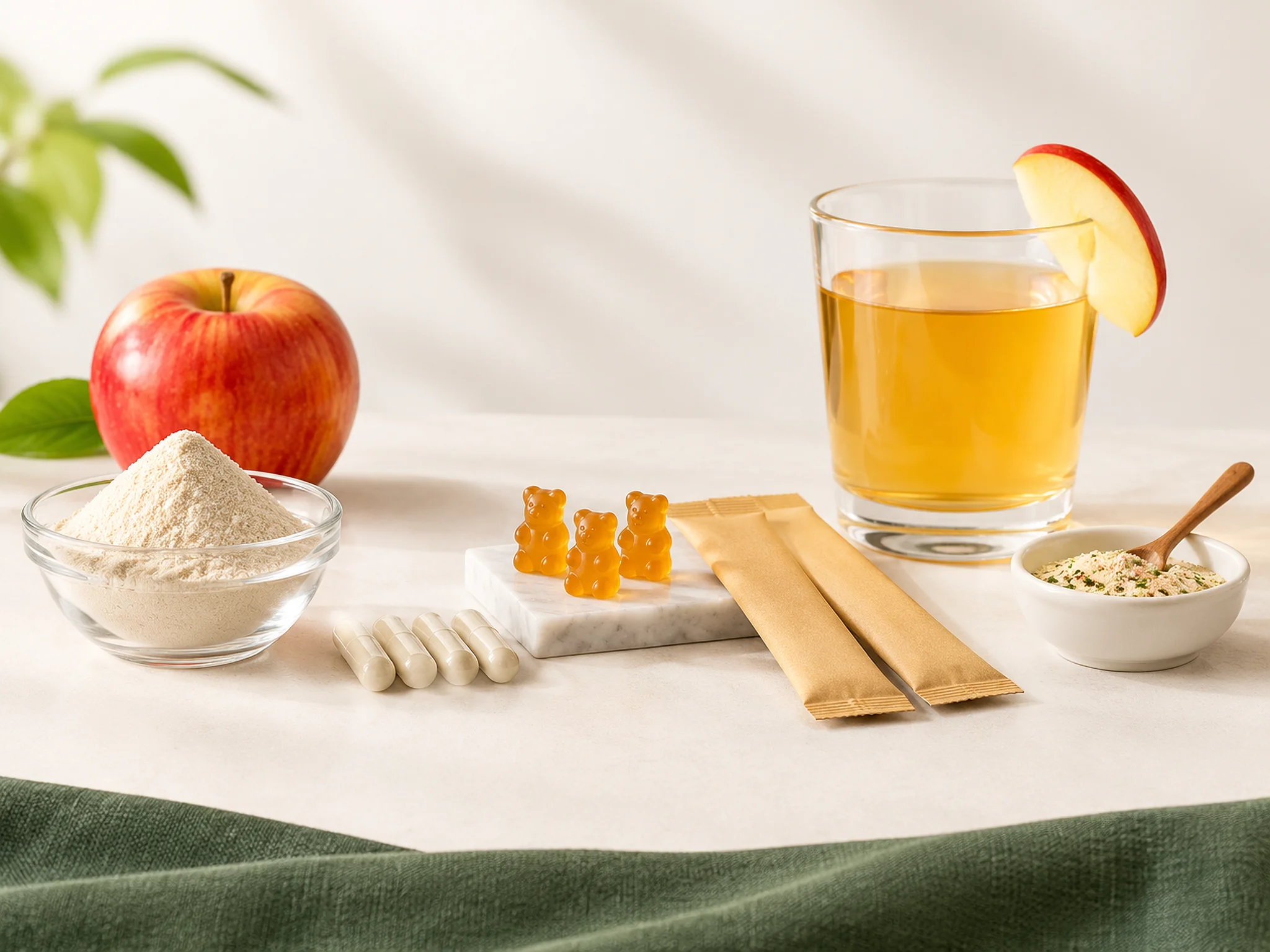
10. Which Grade for Which Application
Direct answer: 10% for anything constrained by fill weight (capsules, sticks, tableting, feed premix); 5% for anything constrained by sensory impact or mass-per-serving (drink mixes, seasonings, gummies, skin-care bases); 8% when you want the middle.
| Application | Default grade | Why |
|---|---|---|
| Capsules / tablets | 10% | Same acid in half the fill; smaller capsule size; less excipient |
| Stick packs / sachets | 10% or 8% | Portion mass is the limit; verify taste masking at these loads |
| Drink mixes (clear RTD powders) | 5% | 100% water solubility plus gentler tartness; easier pH trim at the filler |
| Gummies | 5% | Acidity is the calibration variable; pectin/gelatin pH windows reward a milder acid source |
| Seasonings and snack dusts | 5% | Apple-vinegar note without sharp edges; blends like a carrier-friendly powder |
| Feed and pet-food acidifier duty | 10% | Acid per ton is the purchasing unit; freight per acid unit dominates - often premixed with botanicals such as yucca extract powder for ammonia control |
| Skin and hair care bases | 5% | Fruit-acid load is a mildness variable; carried-over polyphenols are the appeal |
11. A 7-Day Sample Trial Before You Commit
Direct answer: before signing any ACV powder contract, run one week on the free or low-cost sample covering re-assay, solubility, pH, bulk behavior, a finished-product pilot and a storage stress test - five checks that predict 90% of post-shipment disputes.
-
Re-assay the acidity (or pay a lab to). Compare to the sample COA. Accept ±0.3 points; question a pattern.
-
Solubility under your conditions. 1 g into 99 ml of your water temperature and hardness; time to clear, residue, aroma. "100% water soluble" should look like tap water with a scent, not a suspension.
-
pH check. A 1% solution of our powder sits between pH 2.5 and 4.5 by spec - confirm yours lands in the window your process expects.
-
Finished-product pilot. Ten capsules, one gummy batch, one drink-mix beaker: acid per serving, taste panel of three people, no surprises.
-
Storage stress. Sealed glass jar, warm spot (not freezer), seven days, check free-flow with a spoon every morning. Early hardening predicts drum-caking complaints in month five.
We ship 10-20 g free samples with buyer-paid courier precisely so this trial happens [5]. A supplier who cannot send a representative sample is asking you to buy an abstraction.
12. What Actually Drives ACV Powder Prices in 2026
Direct answer: five cost stacks sit under every quote - apple harvest and vinegar base, carrier prices, spray-drying energy and yield, standardisation grade (8% and 10% cost more to make honestly), and freight/packaging terms. Understanding which stack moved explains why the same supplier's quote changed 15% between quarters.
-
Vinegar base and harvest. Acid supply is agricultural: a short apple crop lifts both conventional and organic ACV powder; organic moves hardest because certified orchards are the bottleneck.
-
Carrier markets. Maltodextrin tracks corn and potato starch pricing; "without maltodextrin" systems track acacia and modified-starch markets instead.
-
Standardisation grade. True 10% powder uses more vinegar-derived solids per kg and tighter drying control than 5% - a 10% quote 40% above a 5% quote is normal arithmetic, not padding.
-
Energy and yield. Spray drying evaporates water; energy price and powder yield move the conversion cost that is 20-30% of the invoice in a typical structure.
-
Terms. FOB vs CIF vs DDP, express vs sea, 1 kg trial vs 25 kg drum pricing: the same material legitimately prices three ways [5]. Market demand itself keeps growing mid-single-digits (our tracking pegs ACV powder demand growth around 6.7% CAGR through 2030), so capacity, not demand, is the price lever in most quarters.
13. Red Flags That Should End a Quote Negotiation
Direct answer: seven answers should stop a negotiation - no named assay method, no patulin row for apple-derived powder, carrier evasion, mixed Incoterms presented as one price, a generic COA shared for all lots, sample material that does not match the shipment, and pricing that beats the carrier market on a "pure" claim.
-
"The acidity is typical." Typical is not a number with a method. Demand the batch value.
-
Patulin missing from the COA. For a concentrated apple ingredient, silence here transfers a food-safety liability to your brand [1].
-
Carrier "confidential." The carrier is a declared ingredient in your finished product's spec file - your regulator will not accept trade-secret packaging.
-
One COA for every lot since 2023. Batch-specific or nothing [5].
-
Sample-to-bulk drift. Run your re-assay on each intake against the retained sample results - the pattern shows up within three shipments.
-
Price below input cost. If the quote undercuts maltodextrin plus vinegar solids at prevailing markets, you are buying someone else's cost-cutting decision.
-
Certificates without numbers. Ask for certificate ID, issuer and expiry; verify on the issuer's public register before the first paid order.
14. How a Transparent Supplier Quotes ACV Powder (What to Expect From Us)
Direct answer: a clean Wellgreen quote arrives with the grade (5%, 8% or 10%, customized on request), the assay method, carrier declaration, batch-level COA template, packaging (25 kg fibre drum with double PE liner; foil bags for small quantities), stated Incoterm, 7-20 working-day lead time, and the capacity note - 50,000 kg per month - so you can plan, not hope.
Concretely, what accompanies every offer [5]:
-
Testing discipline: every batch leaves against the full panel - acidity, appearance, particle size, bulk density, loss on drying, ash, heavy metals (Pb, As, Cd, Hg) and a microbiology set including E. coli, Salmonella, S. aureus, Shigella and haemolytic streptococcus - with a batch-specific COA and a retained sample kept for two years [5].
-
Certification that matches your route to market: ISO 9001:2015, ISO 22000, HACCP, Halal and Kosher as standard documentation, backed by third-party audit reports; FSSC 22000, cGMP and NOP/EU organic coverage for programs that need them.
-
An organic line, priced honestly: certified organic apple cider vinegar powder at 5% total acid - our COA example reads 5.24% against ≥5.00% - for buyers whose retail story requires certification, with the understanding that organic costs more because the orchard chain does, not because the label does.
-
Trial-friendly commercial terms: 1 kg trial orders, free 10-20 g samples (courier at buyer), FOB/CIF/DDP quoting per destination, and full-container logistics by sea or express for small lots [about Wellgreen].


15. Frequently Asked Questions
Is 10% ACV powder always cheaper than 5% ACV powder?
No. On a cost-per-kilogram-of-acetic-acid basis, the 10% grade is almost always cheaper, but reformulation, taste targets, caking behavior and certification gaps can flip the total cost. Always convert both quotes to cost per kg of actual acid, then adjust for dosing, freight, packaging and the cost of a rejected lot.
What does "total acidity" mean on an ACV powder specification?
Total acidity is the acid content of the powder expressed as acetic acid by weight. A 5% total-acid powder contains approximately 5 g of acetic acid per 100 g of powder, and it is measured by titration with sodium hydroxide to a phenolphthalein endpoint.
How do I convert supplier prices into cost per kg of acetic acid?
Divide the price per kilogram by the acidity expressed as a decimal. $4.30 per kg for a 10% powder is $43.00 per kg of acetic acid; $2.60 per kg for a 5% powder is $52.00 per kg of acetic acid. Every quote on the table then becomes comparable regardless of grade, carrier and packaging.
What is a realistic dose of ACV powder in capsules?
A standard 500 mg capsule filled with 5% powder delivers about 25 mg of acetic acid; with 10% powder, about 50 mg. Match capsule count to the acetic acid on your label claim, not to the total fill weight.
Does apple cider vinegar powder contain maltodextrin?
Most spray-dried ACV powders use a carrier such as maltodextrin, which is GRAS-listed in the United States under 21 CFR 184.1444. Higher acidity grades carry proportionally less carrier per unit of acid, while lower-acid powders can contain more apple juice solids, so ask suppliers to declare the carrier and its share.
What is patulin and why should ACV powder buyers care?
Patulin is a heat-stable mycotoxin that forms in moldy apples. The U.S. FDA has set an action level of 50 micrograms per kilogram in apple juice and apple products, so ask every ACV powder supplier for batch-specific patulin results, not just a general safety statement.
What should a complete ACV powder COA include?
Batch and lot number, manufacture and expiry dates, acidity with test method, appearance, odor, taste, loss on drying, ash, particle size, bulk density, pH of a 1% solution, heavy metals (lead, arsenic, cadmium, mercury), a full microbiology panel, and for apple-derived material, patulin and inorganic arsenic where applicable.
What are typical MOQ, sample and lead time terms for bulk ACV powder?
At Wellgreen, standard terms are 1 kg for trials, 25 kg fibre drums for regular supply, free 10-20 g samples with buyer-paid courier, 7-20 working days lead time after order confirmation, and a monthly capacity of 50,000 kg with batch-specific COAs.
Which acidity grade suits gummies and drink mixes?
The 5% grade is the default starting point for drink mixes because 100% water solubility and lower tartness load make it easy to disperse and dose. Gummies can use either grade: set the target by finished-product pH and flavor. 10% powder is most common in capsules and stick packs where fill weight is constrained.
Can I buy organic ACV powder?
Yes. Wellgreen supplies organic apple cider vinegar powder at 5% total acidity with NOP and EU organic certificates. Certification covers the farm origin, not the titration result, so verify the actual acidity on the batch COA exactly as you would for conventional material.
16. References
-
U.S. FDA, Guidance for Industry: Juice HACCP Hazards and Controls Guidance (patulin action level 50 µg/kg in apple juice). fda.gov
-
U.S. FDA, Compliance Policy Guide - Adulteration with Patulin (50 ppb upper limit for apple juice and apple products). fda.gov/media/83656
-
U.S. FDA, Action Level for Inorganic Arsenic in Apple Juice (10 ppb guidance). hhs.gov
-
eCFR, 21 CFR 184.1444 Maltodextrin (GRAS status). ecfr.gov
-
Wellgreen, Apple Cider Vinegar Powder - product specification and batch COA. wellgreenherb.com
-
Kondo, T. et al., Vinegar intake reduces body weight, body fat mass, and serum triglyceride levels in obese Japanese subjects, Bioscience, Biotechnology, and Biochemistry (2009). pubmed
W
Wellgreen Technical Sales Team - reviewed by the application-development group behind our ACV powder production line. Wellgreen has manufactured and exported standardized plant extracts and food ingredients since 2011, with ISO 9001, ISO 22000, HACCP, FSSC 22000, cGMP, Halal, Kosher and organic-certified programs. Editorial policy: external claims carry citations, internal claims link to the batch data behind them.
Compare Your Quotes Before You Sign
Send us two or three ACV powder offers - we will normalise them to cost per kilogram of acetic acid, landed, and flag what the papers do not show. Or start with a free 10-20 g sample and the 7-day trial protocol from Section 11.