
ACV Powder Caking: Moisture, Shelf Life & Fixes
2026-11-16 17:11:48
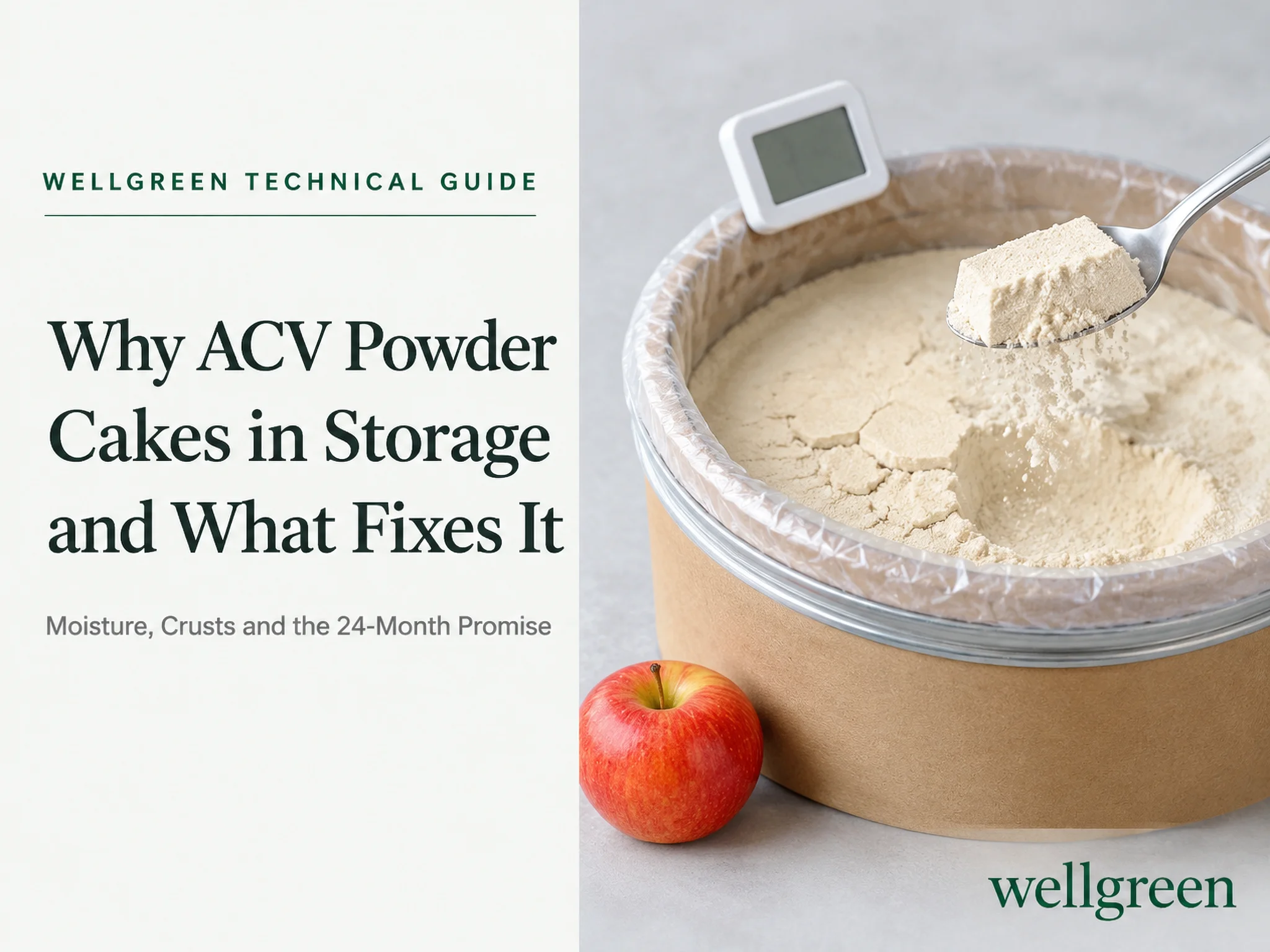
A drum of apple cider vinegar powder that poured like cream in March and needs a mallet in August has not gone bad - it has been doing exactly what spray-dried organic-acid powders do when the environment gets ahead of the packaging. This guide explains the three caking mechanisms, why ACV powder is unusually susceptible, what the moisture number on the COA really controls, and hands you a storage spec, a rescue decision table and an incoming-QC protocol you can run this week.
Key takeaways
Caking is humidity physics, not age. Above the powder's critical humidity, surface acids and carrier sugars dissolve into liquid bridges that recrystallize into solid bonds[1][2][7]. Time under pallet load simply adds contact points[2].
ACV powder carries a triple handicap: deliquescent acetic and malic acids, a hygroscopic maltodextrin carrier, and a fine light spray-dried particle[1][9] - it deserves tighter storage control than, say, vitamin C powder, not looser.
The COA number you must watch is loss on drying - 5 percent ceiling, typical result near 3.25 on our lots[8]. Every absorbed gram spends the same budget that keeps the powder flowing.
Prevention is three habits: keep the room under about 60 percent RH[4], seal the liner between draws, and buy pack sizes your line empties within days, not months[5][6].
Most caked drums are rescuable - the decision table in Section 8 separates a moisture event from a genuine reject, with tests your QC can run in twenty minutes.
1. The Direct Answer: It Is Humidity, Not the Expiration Date
Direct answer: apple cider vinegar powder cakes because it absorbed water vapour from air that was too humid for it, not because it aged past its date. The absorbed moisture dissolves the most soluble material on each particle's surface, and when the air dries again that solution recrystallizes into solid bridges that weld the particles together[1][2][7]. Everything else in this guide - specs, packaging, rescue tables - follows from that single sentence.
Two facts make ACV powder behave worse than the dry ingredient your team already trusts. First, a meaningful share of its soluble solids are organic acids - acetic and malic among them[8] - and organic acids do not merely absorb moisture; they deliquesce, meaning at enough humidity they keep dissolving into a solution of their own. Second, the spray-drying carrier that turns liquid vinegar into a powder - typically maltodextrin-type dextrins[9] - is itself hygroscopic, and the amorphous sugar matrix it forms softens as it takes up water until particle surfaces go sticky, a process the powder literature tracks as the glass transition falling toward room temperature[1][2][3]. Sticky surfaces plus pallet weight equal fused blocks that no date on a label can undo.
The practical reframe for your plant: stop treating the expiry date as the control and start treating the humidity history of every drum as the control. A 24-month lot stored badly is dead in three months; a three-month lot stored by the spec in Section 6 will still pour on the last day.
2. What Is Happening Inside the Lump: Three Caking Mechanisms
Direct answer: three mechanisms do almost all food-powder caking - capillary bridging, viscous sticky deformation, and dissolution-recrystallization - and ACV powder experiences all three, which is why it hardens faster than most extracts.
| Mechanism | What happens between particles | ACV powder's exposure |
|---|---|---|
| Capillary bridging | Condensed moisture forms tiny liquid menisci between particles; surface tension pulls them together[2][7] | Warm-sealed drums condensing on cool lids; cold drums met by warm dock air |
| Viscous / sticky deformation | Absorbed water lowers the glass transition of the amorphous carrier; the surface softens, particles flatten and fuse under load[1][3] | Maltodextrin-type carrier is exactly the amorphous sugar matrix this mechanism attacks |
| Dissolution-recrystallization | Deliquescent components (organic acids, short sugars) dissolve above their critical humidity, then recrystallize as bridges when air dries[1][2] | Declared total acidity is the point of the ingredient - and the first thing that starts moving water |
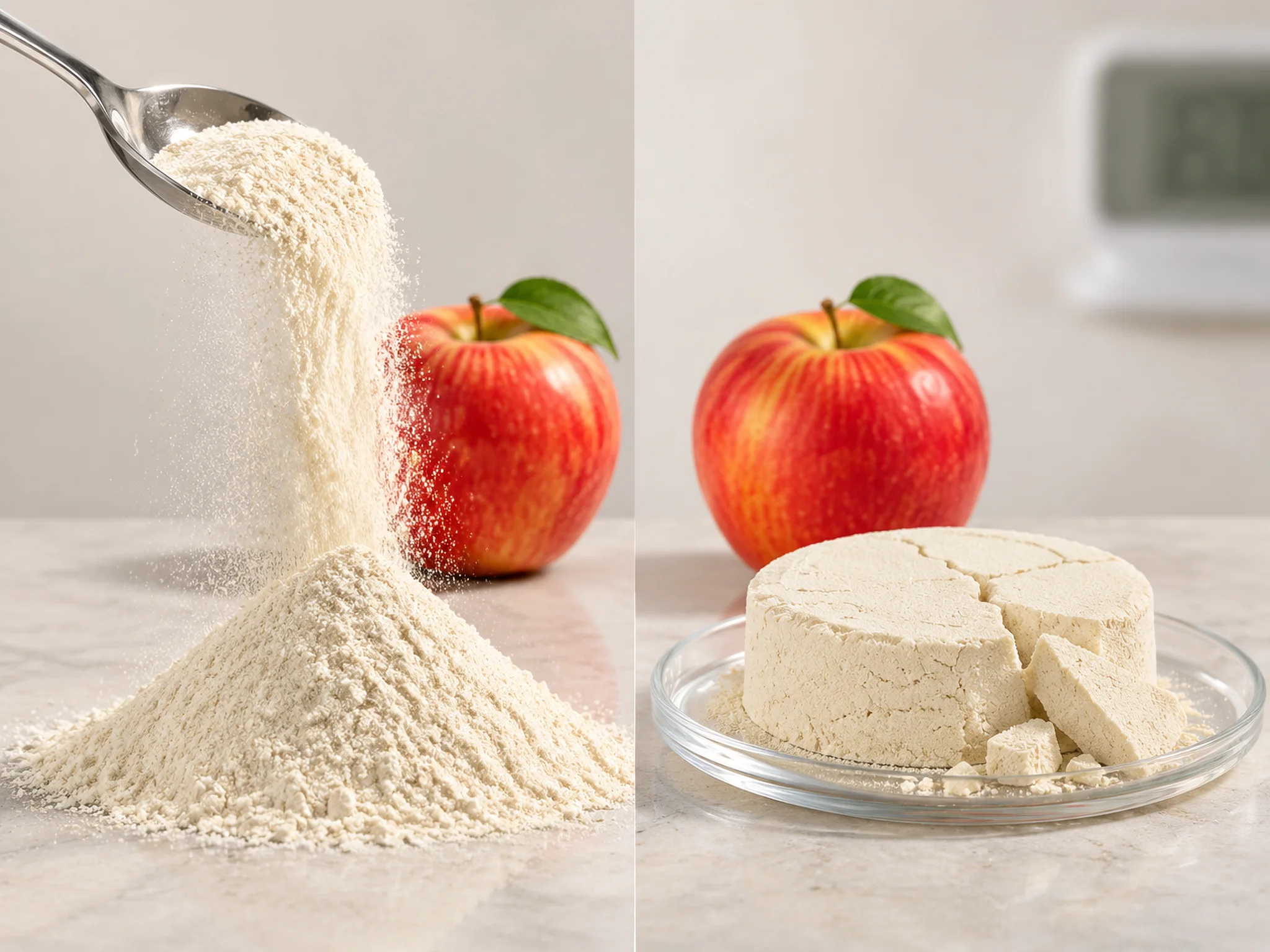
Notice what is not on the list: microbes, chemical degradation, vinegar going off. Those live at much higher moisture levels. Caking is the first warning a powder gives - the physical tripwire that says water entered your packaging. Treat it as an alarm about your storage chain, not as a judgement about the ingredient.
3. Why ACV Powder Is More Hygroscopic Than Most Dry Extracts
Direct answer: three of the ingredient's defining features - acid content, carrier chemistry and particle structure - are the same three features powder technology lists as caking accelerants. ACV powder is not defective; it is simply unapologetically thirsty.
The acids are the product. Buyers specify 5 or 10 percent total acidity[8] - the higher the acid standard, the more deliquescent material per gram. Our own guidance for formulators says it plainly, that the powder "is inherently hygroscopic and can clump" - quoted in full in the formulation handbook.
The carrier is sugar chemistry. Spray-drying fruit liquids needs a carbohydrate wall; maltodextrins and related dextrins set the glass transition and the sorption curve of every such powder on the market[1][3]. Higher-DE carriers absorb faster; your supplier's carrier choice is a humidity question disguised as a flowability question.
The particle is fine and light. A 95-99 percent-through-80-mesh powder with a bulk density around 50-60 grams per 100 millilitres[8] is a lot of surface and air space per kilogram: more contact points under load and more headspace vapour to lose into the product.
None of this argues against ACV powder. It argues for buying it the way you would buy a sensitive ingredient: known carrier, measured moisture, barrier packaging, and a storage rule your warehouse actually follows.
4. What the Moisture Number on Your COA Really Controls
Direct answer: loss on drying is the powder's remaining flowability budget. Our specification ceiling is 5 percent, with released lots typically reporting about 3.25 percent[8]; the number matters less for the 3.25 itself and entirely for the headroom between it and the level where the bridges in Section 2 start forming.
Two refinements your incoming specs should copy:
Demand measured values, not "typical." A COA line reading Moisture max 5 percent with a reported result of 3.25 is auditable; "typical 4" is folkore. Ask for the test method (oven loss on drying), the sample mass and the batch number the result belongs to.
Pair moisture with the micro panel. Water that enters a drum does two jobs: it builds bridges and it lifts water activity toward microbial territory. A specification that holds total heavy metals at 10 milligrams per kilogram or less, plate counts at 1,000 CFU/g or less, yeast and mould at 100 or less and E. coli at 10 or less[8] is only true of the sealed powder; your incoming check after a hard summer re-tests it.

5. Where the Water Got In: Mapping the Chain from Spray Tower to Scoop
Direct answer: caking almost always traces to one of six handoffs - warm filling, container sweat at sea, a hot receiving dock, an unconditioned warehouse, a liner left open on the line, or a drum parked against cold concrete. Audit the handoffs, not the supplier's sincerity.
Filling warm. Powder sealed straight off a hot dryer or after a hot truck ride carries humid headspace air; condition it to storage temperature before the lid goes on, or the drum makes its own weather - condensation on the inner lid, then rain on the crust[2].
Ocean transit breathing. Container temperatures swing daily; even foil bags exchange some vapour through seams and ports if the liner is thin or the valve is left unclamped. Ask what liner your supplier runs - ours ship double polyethylene liners in fiber drums[8].
The dock shock. Cold drums unloaded into warm humid air sweat on the outside - harmless - but if pallets are opened and pulled wet into a warm room, moisture walks straight into the headspace you are about to draw from.
Warehouse swings. A room without a humidity budget (see Section 6) lets every non-hygroscopic product coast and every hygroscopic one cake; the warehouse that is "fine for the citric bags" is not fine for open ACV drums.
Open-drum dwell. The single most common cause in customer photos: a 25-kilo drum feeding a line that eats three kilos a day, living open for a working week. Every draw exchanges dry headspace for room air[4][6].
Cold-floor condensation. Drums directly on slab: the floor is the coldest surface in the room, and condensation forms exactly where the liner meets the drum bottom[6].

6. The Storage Specification That Prevents Caking
Direct answer: write four lines into your SOP and the caking problem becomes a paperwork problem: a room-humidity ceiling, an open-drum time limit, a liner-sealing rule and a floor-and-wall clearance rule.
| Control | Set point | Why / basis |
|---|---|---|
| Room relative humidity | Target below about 60 percent; alarm above 65 | Common industry threshold for dry-goods stability; hygroscopic botanical powders want the low half of that band[4][6] |
| Temperature | Stable and cool; dark; avoid daily swings | Swings drive repeated condensation-evaporation cycles inside headspace[2] |
| Open-drum time | Liner and lid closed at every shift end; on slow lines switch to pack sizes emptied in days | Every open hour exchanges dry headspace for room air[4] |
| Stacking and placement | Plastic pallets, off the floor, away from exterior walls and dock doors; shrink-wrap until day of use | Floor condensation and dock climate spikes hit the bottom rows first[2][6] |
| Desiccant use | Food-contact desiccant, sized to headspace, for opened bins and repacks in humid sites only | A repair aid, not a substitute for sealing[5] |
| Rotation | FIFO, with a 12-month review flag on any lot still sealed | Shelf life is conditional; rotation keeps the condition true[8] |
Two details separate a living SOP from a laminated wish: measure, do not narrate - one data-logging hygrometer per room, reviewed weekly, beats three opinions; and alarm the trend - caking starts in the corner the sensor cannot see, beside the dock door, behind the rack. Dehumidification capacity is cheap next to one rejected production batch[6].
7. Packaging Sized to Your Line Speed
Direct answer: the best moisture barrier is one that stays closed, so buy the pack size your line finishes inside a single production day. Our three standard formats exist exactly for this decision: 1-kilo foil bags, 5-kilo tins, 25-kilo fiber drums with polyethylene liners[8].
1 kg foil bag - single-shift consumption: R&D kitchens, small gummy runs, sampling campaigns, capsule fillers doing one SKU a week. Zero open-drum dwell by design.
5 kg tin - mid-scale: a weekend of gummy batches or a week of drink-mix production, lid back on between uses.
25 kg drum - committed lines drawing daily; at roughly 0.06 cubic metres and 28 kilos gross it palletizes cleanly, and the double PE liner carries the whole moisture defence - fold it shut and clamp it, do not tie a knot that leaves a chimney of room air inside.

For customers in persistently humid import markets, discuss agglomerated grades at order stage: granulation reduces fines, lifts bulk density and measurably improves flow margin - the first-line answer our formulation team gives to exactly your climate question[9]. It is a specification decision, not a warehouse trick, and it is free to request before the first drum ships.
8. Caked Inventory: Rescue or Reject Decision Table
Direct answer: caking alone is not a reject. Run the table below in order - history, senses, then bench tests - and twenty minutes separates rescuable stock from a supplier claim.
| Observation | Reading | Action |
|---|---|---|
| Crust breaks under thumb pressure; interior powders | Early capillary crust; classic liner-open or condensation event | Rescue - break, screen to your process mesh, verify solubility and assay |
| Solid shard, sharp fracture faces | Dissolution-recrystallization matured; chemistry intact, flow gone | Rescue with milling - gentle impact size reduction; recalibrate the feeder and re-run the flow test before it doses product |
| Musty, fermented or chemical odour | A water event mature enough for biology or chemistry | Reject - quarantine, run the incoming micro panel, notify the supplier with photos and the lot COA |
| Pink, grey or dark specks; web-like crust texture | Mould growth signature on a botanical powder | Reject - do not sieve it, do not repeatedly sniff it; sample for the lab, seal the drum |
| Sandy insoluble specks in the dissolve test | Carrier recrystallization haze versus possible grit - distinguish before deciding | One-percent solution, 20 degrees C, two minutes of stirring: fully clear passes; residue gets documented and compared to the retained sample |
| Every bottom drum of the container identically caked | A transit or fill-temperature event, not line handling | Document and claim with the bill of lading, liner and COA photos; renegotiate the liner spec before the next booking |
The rescue discipline that protects your label: a rescued lot is re-assayed and re-flow-tested under a new lot identity - new tag, new line log, traceable back to the original batch. Triage without paperwork turns rescued inventory into invisible inventory, and invisible inventory is what an audit finds first. The triage and requalification logic mirrors what we do with retained samples before anything re-ships[8].
9. The Hidden Cost: Dosing Drift and Your Label Claim
Direct answer: even fully rescuable caking costs money the moment it reaches a hopper - bridged powder feeds inconsistently, fill weights spread, and the milligrams of acetic acid printed on your label stop matching the milligrams inside the gummy.
The acetic acid itself is stable through a caking event - nothing evaporates - but your dosing system meters volume per stroke, and a half-bridged bulk does not fill that volume the same way twice[2]. The chain is unforgiving: wider fill-weight variation leads straight to under- and over-filled units against a label claim such as the 25-50 mg per gummy we built in the gummy formulation guide, and eventually a market complaint opens an assay investigation that finds a caking history instead of a blender fault. Three controls close the loop: re-flow-test any rescued lot before it meets a feeder, verify the composite assay on the first production hour after a swap, and log drum-open hours in the batch record so the trail exists before anyone needs it. The same paper discipline is why our COAs bind every acidity figure to a measured lot and method[8].
10. Humid-Climate Playbook: Fighting Eight Months of Summer
Direct answer: if your plant sits where summer RH runs 75 percent and up, stop improvising - stack four defences: conditioned staging, matched pack sizes, liner-clamp discipline and an agglomerated grade bought on purpose.
Conditioned staging beats spot cooling. A small sealed room with one properly sized dehumidifier held under about 60 percent RH costs less than one blocked production day and works every hour you are not watching[4][6]. Open drums live in this room, nowhere else.
Match pack size to consumption. The Section 7 logic compounds in the tropics: an opened 25-kilo drum on a line that eats 30 kilos a week should not exist. Order the 5-kilo tin and close it every shift.
Clamp, fold, lid - pick one liner habit and train it. The failure looks identical everywhere: liner rolled open like a collar, lid resting on top, room air cycling through the headspace all shift. Fold the liner flat across the surface, clamp the skirt, replace the lid.
Buy the granule, not just the grade. Agglomerated ACV powder - our R&D team's stated strategy for exactly this problem[9] - trades surface area for dramatically slower water pickup and better flow under load. It is specified on the purchase order, not wished for in the warehouse.
One thing not to do: store ACV drums in a fridge or cold room as a humidity shortcut. Every time a cold drum meets warm room air, its surfaces become a condensation tray - you would be manufacturing the Section 5 mechanism by hand. Cool and dry is a temperature ceiling and a humidity ceiling, with gentle transitions between them.
11. Incoming QC Protocol: Five Checks, Twenty Minutes a Lot
Direct answer: caking complaints die when receiving stops signing for weight alone. Five checks at the dock separate a good lot in bad transit from a bad lot with good paperwork - before it ever enters your staging room.
Heft the drums, not just the count. Shake two drums from different pallet tiers; a solid thud where powder should whisper is a transit-event flag. Photograph before accepting.
Verify the COA against the pallet, not the catalogue. Batch numbers match the drums; loss on drying is a measured value under your 5-percent spec ceiling; acidity, mesh, micro panel and the patulin line are all present with methods named[8].
Open one drum per lot under dry conditions and read the surface. Mirror-smooth means the powder never saw a condensation cycle; crazing (fine surface cracks) means it saw at least one and you sample deeper before release.
Run the twenty-minute function trio: pour test from 20 centimetres onto clean glass (free flow, no rat-tracks); one-percent solution at room temperature, two minutes of stirring (clear, no residue); sniff test (clean, tart apple-vinegar; no must). Three passes release the lot to staging; any fail quarantines it and routes to the Section 8 table.
Log the day's weather. One line in the receiving record - dock RH and temperature - turns your own twelve-month dataset into the argument for dehumidifier budget, or the evidence in a freight claim[6].
12. What 24 Months of Shelf Life Actually Promises
Direct answer: "24 months" is a conditional - powder in its sealed moisture-barrier packaging, stored cool, dark and dry, unopened. The date promises the chemistry; your warehouse controls the physics. The chemistry is slow and the physics is fast, which is why some lots die young and others outlive their dates.
What the calendar protects: the acidity stays where the COA says it is, the micro panel stays true, aroma fades gently and colour drifts slightly under proper conditions. What the calendar ignores: every open-drum hour, every swing that condenses a drum lid, every summer a container spent crossing an ocean[2][6]. Two operating rules make the promise real: treat twelve months as the review point rather than the deadline - pull a retained sample, run the Section 11 trio, extend in writing if it passes; and treat any lot that survived an unconditioned summer as evidence, not inventory. Our released-lot condition - low loss on drying at fill, double-lined drums, per-lot COA with patulin tested by LC at 10 ppb or less[8] - is the supplier's half of the 24-month promise; receiving and staging are the buyer's half.
13. Frequently Asked Questions
Why did my apple cider vinegar powder turn into a solid block?
Almost always humidity, never age. When storage humidity passes the powder's critical relative humidity, the most soluble surface components - acetic and malic acids plus short-chain sugars in the carrier - dissolve into microscopic liquid bridges between particles[1][2][7]. When humidity falls again those bridges recrystallize, welding particles together. Long storage under pallet weight multiplies the contact points, so bottom drums cake first[2].
What moisture content is safe for ACV powder?
Wellgreen releases every lot at 5 percent loss-on-drying or less - typical COA results sit near 3.25 percent[8]. Below that ceiling the powder keeps its free-flow margin; every gram absorbed from humid air spends that budget and moves the powder toward the sticky glass-transition zone where caking begins[1][3]. Ask for the measured value per batch, not a typical statement.
How should apple cider vinegar powder be stored?
Cool, dark, under about 60 percent relative humidity[4], on plastic pallets clear of the floor and away from dock doors and exterior walls[6]. Reseal the inner liner after every draw and replace the lid; keep drums off cold concrete that sweats when room air warms. A conditioned small room beats a big draughty warehouse for opened stock.
Is caked ACV powder still safe to use?
Usually yes, if the change is purely physical. Caking alone is a moisture event, not a spoilage event: the acidity and low water activity of properly stored powder do not support pathogens. Break a piece, smell for a clean tart apple-vinegar note and confirm it dissolves clear in room-temperature water. Reject on musty odour, off colour or a failed incoming micro test - Table 3 walks the whole decision.
How do I break up caked powder safely?
Gentle mechanical force: flex the bag, tap the drum side with a rubber mallet, break chunks on a clean plate and screen through your process mesh; short blender pulses for small quantities. Do not heat it to drive moisture off - ovens oxidise aroma and case-harden chunks unevenly, and without a balance you cannot verify the result[2].
Does caking mean the powder is expired?
No. Sealed in its moisture-barrier packaging and stored cool and dry, the powder holds its 24-month shelf life[8]; caking before that date is a packaging or storage failure upstream, not the calendar. Repeated caking from one supplier is a packaging-discipline signal worth escalating.
What is the difference between moisture content and water activity?
Moisture is how much water the powder holds; water activity is how free that water is to do work - dissolve acids, plasticise the carrier, support microbes. Two powders at the same moisture percent can cake and spoil very differently depending on how bound the water is. Serious specifications pair a loss-on-drying ceiling with a microbiological panel and low water activity as the reality[1][8].
Should I add desiccant packets to opened drums?
In opened drums and repacked bins at humid plants, correctly sized food-contact desiccant meaningfully cuts headspace humidity[5] - follow the desiccant supplier's volume guidance. For unopened properly lined drums from a disciplined supplier it is unnecessary; sealing the liner does the same job for free.
How do I stop caking in a humid-climate warehouse?
Four stacked defences (Section 10): conditioned staging held under about 60 percent RH[4][6], pack sizes your line empties within a shift or a week, a trained fold-and-clamp liner habit, and agglomerated ACV granules specified on the purchase order where fines are the weakness[9].
The drum looked dry outside but the powder inside was caked - how?
The water was already inside as vapour. Drums sealed warm - after summer freight or a warm fill - carry humid headspace air that condenses on the cool inner lid in cold storage and rains on the surface crust[2]. The same physics as a chilled drink sweating; the fixes are conditioned fill temperature and low-permeability liners.
Does caking change the acidity or my label claim?
The acetic acid does not leave; the accuracy does. Bridged powder feeds unevenly through hoppers and augers, fill weights spread and the printed milligrams per unit drift from the delivered milligrams. Restore flow, re-assay a milled composite of the lot and requalify feeder settings before production dosing counts.
What packaging and terms does Wellgreen ship ACV powder in?
1-kilo foil bags, 5-kilo tins and 25-kilo fiber drums with polyethylene liners - about 0.06 cubic metres, 28 kilos gross per drum - every lot with a COA including measured loss on drying, MSDS, specification, Non-GMO verification and contaminant analysis with patulin at 10 ppb or less by liquid chromatography[8]. Lead time 7-20 days from 5,000 tons of annual capacity; evaluation samples for qualified enquiries - see the bulk ACV powder page.
14. Sources and Further Reading
Moisture-Induced Caking of Beverage Powders - the classic sorption-isotherm study of exactly this failure in sugar-and-acid powder systems. academia.edu
Powder Technology. Powder Caking Prevention: Causes, Tests and Fixes (Nov 2025) - condensation, storage-under-load and bridging mechanisms with bench tests. powdertechnology.info
Fitzpatrick J.J. Characterization of the Caking Behaviour of Food Powders (2020, Springer chapter, DOI 10.1007/978-3-030-48908-3_4). crossref DOI record
Giraffeypack. How Storage Environment Impacts Ingredient Stability (Jan 2026) - dry goods stored below about 60 percent relative humidity. giraffyco.com
Multisorb. How to Maximize Your Shelf Life With Desiccants (Jul 2025) - headspace sizing for food powders. multisorb.com
PREAIR. How to Keep the Warehouse in a Dry Environment (Aug 2025) - dehumidification, moisture barriers and storage layout. preair.com
Mehos G. Caking of powders - how to deal with it (2017) - capillary condensation and liquid bridging in practice. linkedin.com
Wellgreen. Bulk Apple Cider Vinegar Powder - specifications, COA and documentation. wellgreenxa.com
Wellgreen R&D (Emily Green). How to Formulate with Apple Cider Vinegar Powder: Dosage, Solubility and Taste Tips - the hygroscopicity and clumping strategy section. wellgreenxa.com/info
W
About Wellgreen Technology Co., Ltd.
Since 2011 Wellgreen has manufactured plant-extract and fermentation-derived ingredients for food, nutrition and cosmetic formulators in 60+ countries, including spray-dried apple cider vinegar powder at 5-10 percent declared total acidity, released at 5 percent maximum loss on drying with per-lot COA, patulin tested by LC at 10 ppb or less and moisture-barrier packaging from 1-kg foil bags to 25-kg lined drums. This guide was prepared by the Wellgreen QA and R&D team from batch records, retained-sample protocols and published powder-technology literature.
Stop Buying Caking Risk
Tell us your climate, line speed and current pack size. We will quote the format that stays closed - matched to your released-lot moisture record, with the liner specification sheet and the full per-lot document set - and send evaluation material so your receiving team can run the twenty-minute trio before any container books.