
Why Apple Cider Vinegar Powder Is Replacing Liquid ACV in Gummy and Effervescent Formulations
2026-11-13 16:05:57
Liquid apple cider vinegar built the category - and then hit two manufacturing walls: gummies that cannot absorb its water, and effervescent tablets that cannot meet its moisture. This guide shows the process math behind the switch to spray-dried ACV powder, where the trade-off genuinely favors liquid, and how to pilot the swap on your own line. Every claim below is tied to a published source or a batch document we can hand you.
Two formats, two chemistries - both hostile to water. That single fact drives the switch from liquid to spray-dried ACV powder.
- Gummies are a water-budget product. Finished gummies hold roughly 9-18% moisture under controlled pH and water activity[1][4]. A functional acetic-acid dose from liquid vinegar would pour in ~14 g of process water per serving - more than the whole gummy can carry. Powder delivers the same acid dry.
- Effervescents are an anhydrous product. The acid-bicarbonate reaction needs water to run[5]; a liquid acid source fires it in the mixer, stealing CO2, caking the blend and bloating tablets in the pack[6].
- Dose honestly by acid, not by format. 500 mg of 5% powder in a gummy carries ~25 mg acetic acid; 10% carries ~50 mg. Build label math from declared total acidity by titration[7].
- Powder is not always the answer. Clear RTD drinks, shots and traditionalist retail stories can still justify liquid - Section 10 gives the honest split.
- Specify it like a process engineer. Grade, carrier, mesh, bulk density, moisture, patulin at batch level, soluble without residue - the purchasing checklist is Section 12, the bench protocol is Section 13.
1. The Direct Answer: What Changed in Gummy and Effervescent Manufacturing
Direct answer: gummies and effervescent tablets are both precision-controlled dry systems - one measured in moisture and water activity, the other in millilitres of water deliberately kept out. Liquid apple cider vinegar is roughly 95% water carrying 5% acetic acid, so it attacks both systems at their weakest variable. Spray-dried ACV powder keeps the same declared acidity, the same apple-vinegar identity and the same titratable marker - acetic acid - while adding no water to the process at all.
That is the whole mechanism of the switch, and it explains why it started exactly in these two categories rather than across the board. A stick pack or a RTD drink can absorb liquid vinegar without arguing. A 6 g pectin gummy with a target water activity of about 0.55 cannot. A 4 g effervescent tablet whose entire function is to react instantly with 200 ml of water must not even smell humidity. The formats with the least tolerance for water are the formats where the powder displaced the liquid first - and the gummy category's explosive growth through the 2020s put that tolerance problem in front of every major contract manufacturer.
There is a second, quieter driver: dose honesty. When a brand wants to print "600 mg ACV" on a gummy pouch, the label has to survive an audit against the batch COA. Powder bought to a declared total-acidity standard - 5% or 10% as acetic acid, verified by acid-base titration - makes that audit trivial. A liquid addition logged in millilitres at "5% acidity, typical" makes it an argument. Formulators are conservative people on paper; paper chose powder.
This guide covers the process math (Sections 3-5), the format trade-offs stated fairly (Section 10), the purchasing specification (Section 12) and a pilot protocol you can run without buying a truckload (Section 13). If you are also evaluating price across grades, our companion piece How to Formulate With Apple Cider Vinegar Powder covers dosage, solubility and taste-masking foundations that this article assumes as background.
2. One Ingredient, Two Behaviors - Liquid and Powder in a Dry System
Direct answer: liquid ACV behaves as a solvent, reactant and microbial substrate all at once; ACV powder behaves as just another dry ingredient. The chemistry you are buying - acetic acid on a carrier - is identical; the water that ships with it is not.
Spray-dried ACV powder is made by fermenting apple juice through the same two stages as the liquid - yeast converting sugars to alcohol, acetic acid bacteria converting alcohol to acetic acid - and then atomising the concentrated vinegar onto a food-grade carrier in a hot-air chamber, in our case to an off-white, free-flowing, completely water-soluble powder[11]. The carrier is the part buyers underestimate: it is why 1 kg of 5% powder contains 1 kg of powder but only ~50 g of acetic acid, and it is also why the powder pours, blends and presses like every other dry ingredient on your line. Our own guidance on reading carrier and acidity together is in the product specification.
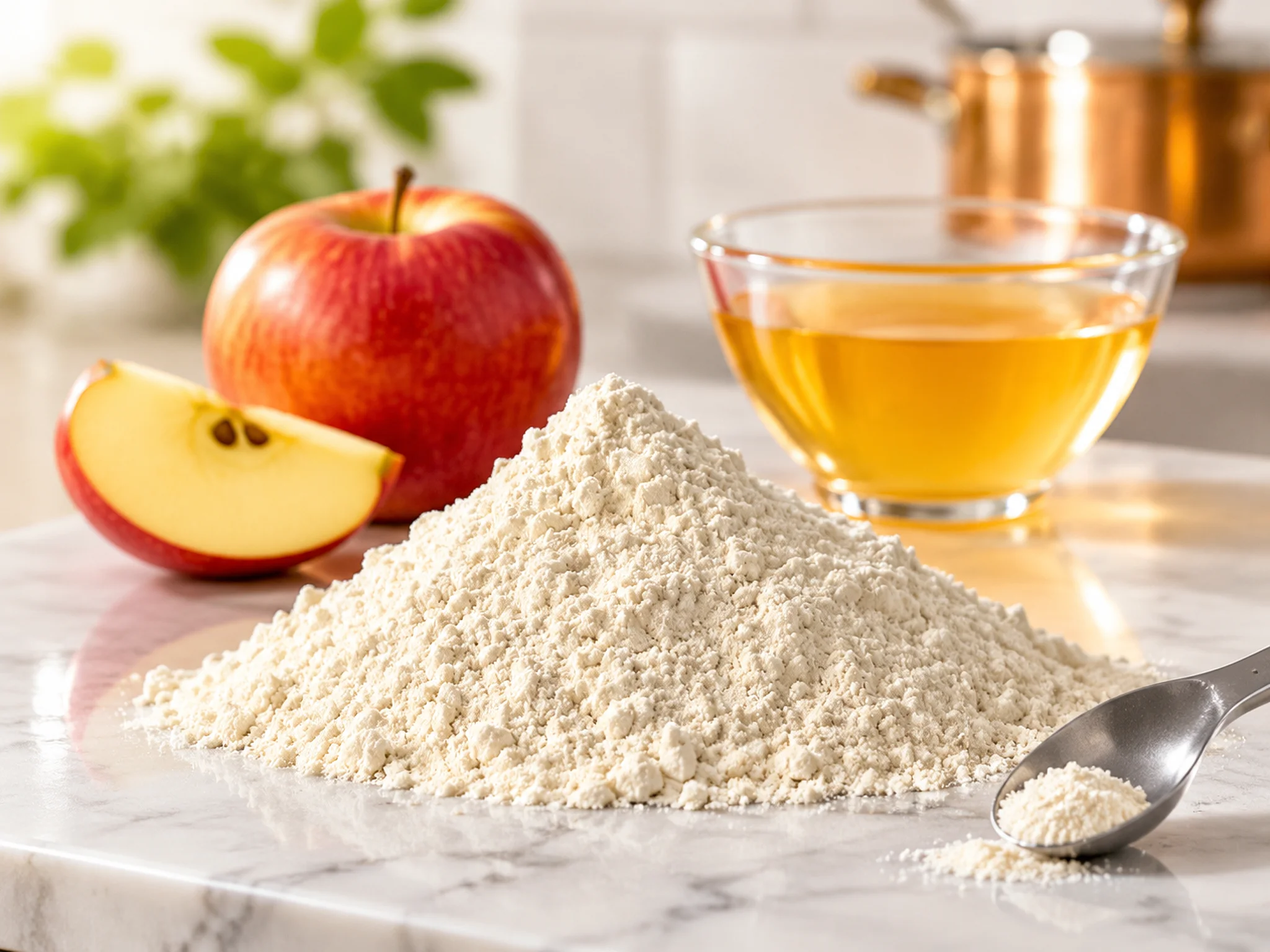
Same declared acidity, opposite process behaviour: the bowl on the right is ~95% water; the mound on the left is under 5% moisture - every gram of which you would otherwise have to boil, blot or blame.
Three practical consequences follow from that difference, and they organise the rest of this article:
- Water moves your critical process parameters. In gummies, added water moves cook time, finished moisture, water activity and set (Section 3). In effervescent, it triggers the reaction itself (Section 5).
- Water is where the risks live. Microbial margin, caking, tablet hardening, sediment, oxidation - water activity, not acetic acid, is the hazard variable in both categories[1].
- Water is expensive freight and storage. You pay to ship, receive, pump, meter and clean water you then spend energy removing. Section 11 prices the logic.
3. The Gummy Water Budget - Why 15 g of Vinegar Does Not Fit in a Gummy
Direct answer: a functional ACV dose carried by liquid vinegar introduces an order of magnitude more water than a gummy's finished-moisture budget can hold, so the water must be boiled off before the gel sets - which costs production time and damages the gel. The spray-dried route adds the same dose in about half a gram of dry solid.
Do the arithmetic once, decide forever
Commercial gummy candies finish at roughly 9-18% moisture, set at pH 3.0-4.2, and are dried down to a water activity typically near 0.5-0.65 for shelf stability and chew[1][4]. Take a 7 g gummy: the whole piece may hold 1.3 g of water at the top of that moisture range, and a two-piece serving 2.6 g.
Now ask the liquid for a serious dose. At 5% acidity, 750 mg of acetic acid - a modest step toward the doses used in the human research - needs 15 g of liquid vinegar, of which about 14.3 g is water[3]. That is roughly five times the entire water budget of the two-piece serving, before counting the water in the gelatin or pectin syrup itself. The math admits exactly three exits, and none of them is free:
- Boil longer and hotter. Extra water means longer vacuum cook, more sucrose inversion, more caramel notes, more energy, lower throughput - and the acid you paid for partially flashes off with the steam, so the declared dose drifts.
- Accept the water. Finished moisture and water activity climb above spec: the gummy sweats, deforms, sticks, and its mould margin shrinks - the one failure mode every confectionery QC programme is built to prevent[1].
- Dose under. Keep liquid at trace flavour level and quietly print a pill-count claim the serving cannot support. Regulators and marketplaces are increasingly checking exactly this.
The powder exit
The same 750 mg of acetic acid from a 10% standard is 7.5 g of powder spread across the batch - at 500 mg per gummy of 5% powder you carry 25 mg of declared acid per piece and a fractional-gram dry addition that the starch or protein matrix swallows without changing cook time at all. Published gummy studies land in the same place: the optimised commercial window is already tight - pectin and gelatin blends tuned to ~17% moisture and pH 3.4 in a representative 2022 formulation study[2] - and every gram of extraneous water has to be paid for from that window.
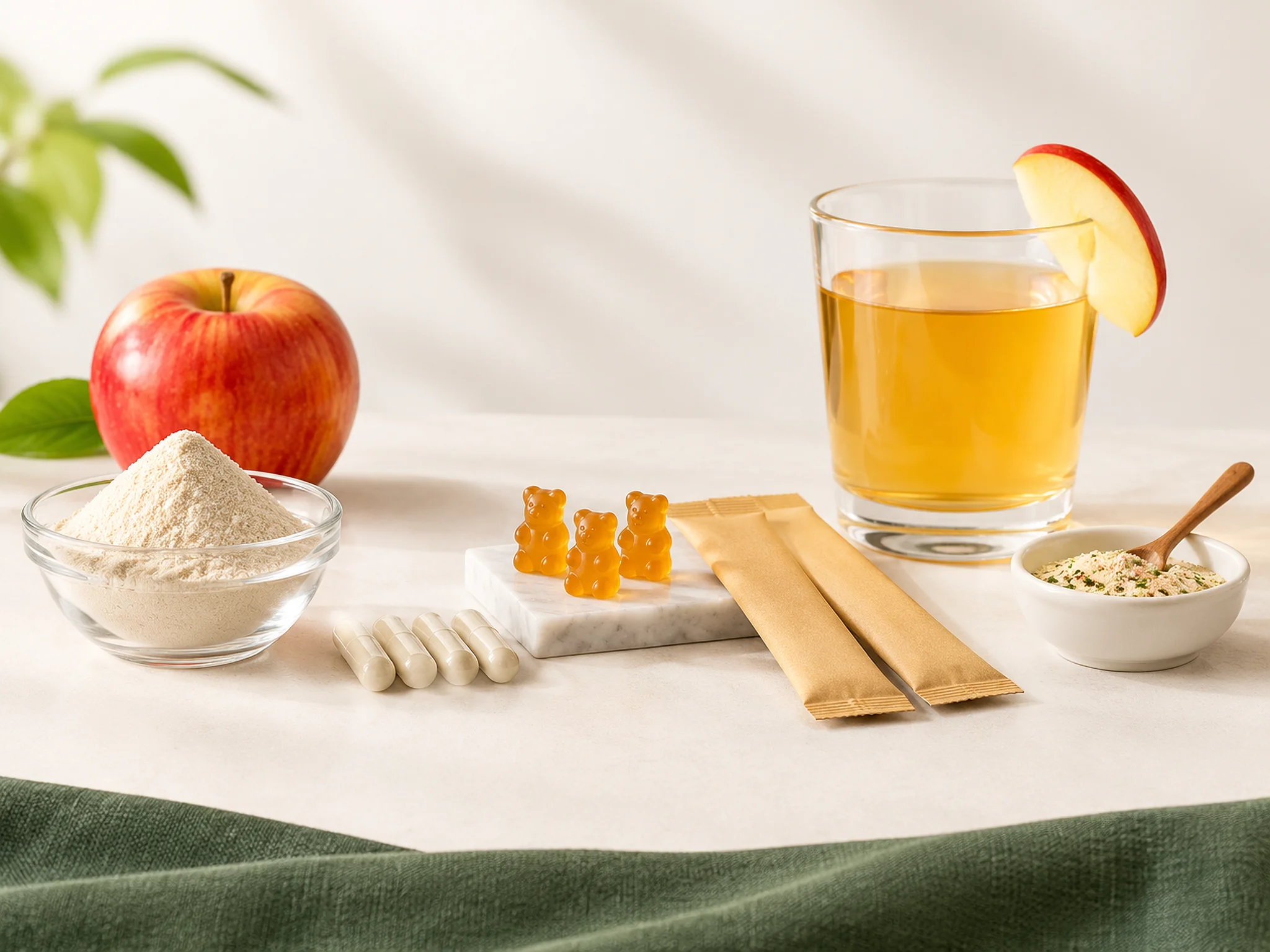
One ingredient SKU feeding four formats - gummies, capsules, stick powders and drink mixes - without splitting your ACV inventory by water content.
4. Acidity, Gel Systems and the pH Window You Cannot Negotiate
Direct answer: acidity does double duty in a gummy - it sets the gel and it flavours the piece - and both jobs have windows. Liquid ACV floods the system with acid and water together; powder lets you meter the acid and leave the water out.
The three mainstream gelling systems each guard their pH door differently:
- Gelatin. Tolerant, but acid load changes set time and bite; heavy free-acid addition during the hot mix degrades the protein network and leaves a short, sticky gel instead of a clean bite[4].
- High-methoxyl pectin (the standard vegan gummy). Gels only in a narrow band of soluble-solids, pH and temperature - industry process guidance describes the window as "narrower and more sensitive" than gelatin's, with pH control treated as a core process variable for repeatability[2][10]. Dump in vinegar by feel and your first-shift and third-shift batches stop matching.
- Starch (traditional molded candy). Acid thins the starch gel over storage; localized acid pockets from an incompletely mixed liquid become soft spots and weeping in the finished bin.
With powder, the acetic acid arrives as a dry solid you can pre-blend with sugars, acids and colors into a homogeneous premix, then fold into the cooled mass with the flavor and color phase - the same dosing discipline used for every other high-intensity dry ingredient. The result is acid where you put it and pH you can log: one of the reasons pectin-gummy specialists building active-laden lines standardise their acidulants in dry form in the first place[2]. For ACV specifically, our R&D article details the workable dose ranges and taste-masking partners in dosage, solubility and taste guidance.
5. Effervescent Chemistry - Anhydrous Until the Consumer's Glass
Direct answer: an effervescent tablet is a dry mixture of acid and bicarbonate that is only allowed to meet through the consumer's water. Every formulation and processing rule in the category descends from that sentence - and liquid ACV breaks it at the ingredient level.
The reaction is textbook: citric acid plus sodium bicarbonate yields sodium citrate, water and carbon dioxide - and it proceeds only in the presence of water, which is why the literature describes moisture control as the central manufacturing challenge of the dosage form[5]. Patent claims for effervescent compositions likewise specify dry, granulated acid and alkali phases kept apart from any aqueous contact until packaging[6]. Now picture the liquid alternative: even a "small" vinegar addition wets the bicarbonate surface inside the blender. CO2 starts leaving before compression, tablet porosity and hardness drift, the punch faces stick up, and finished tablets arrive at the consumer either flat, bloated, or fused to their foil.
ACV powder slots into the same architecture as any other dry acidulant - with three category-specific points of attention:
- Its acetic acid is only 5-10% of the powder weight. The main acidulant load still sits with citric or fumaric; ACV powder contributes the label identity, the sensory note and a slice of the acidity budget, not the CO2 engine.
- It is hygroscopic. So are citric acid and bicarbonate - which is why the whole category runs dehumidified rooms and sealed tooling. Specify ACV powder in moisture-barrier foil, keep open time short and treat the drum like the citric bin is treated.
- Dissolution is a spec, not an accident. Our standard grades are completely water-soluble with no precipitation or suspended matter, which is exactly what an effervescent system needs so the glass finishes clear instead of dropping carrier haze[11].
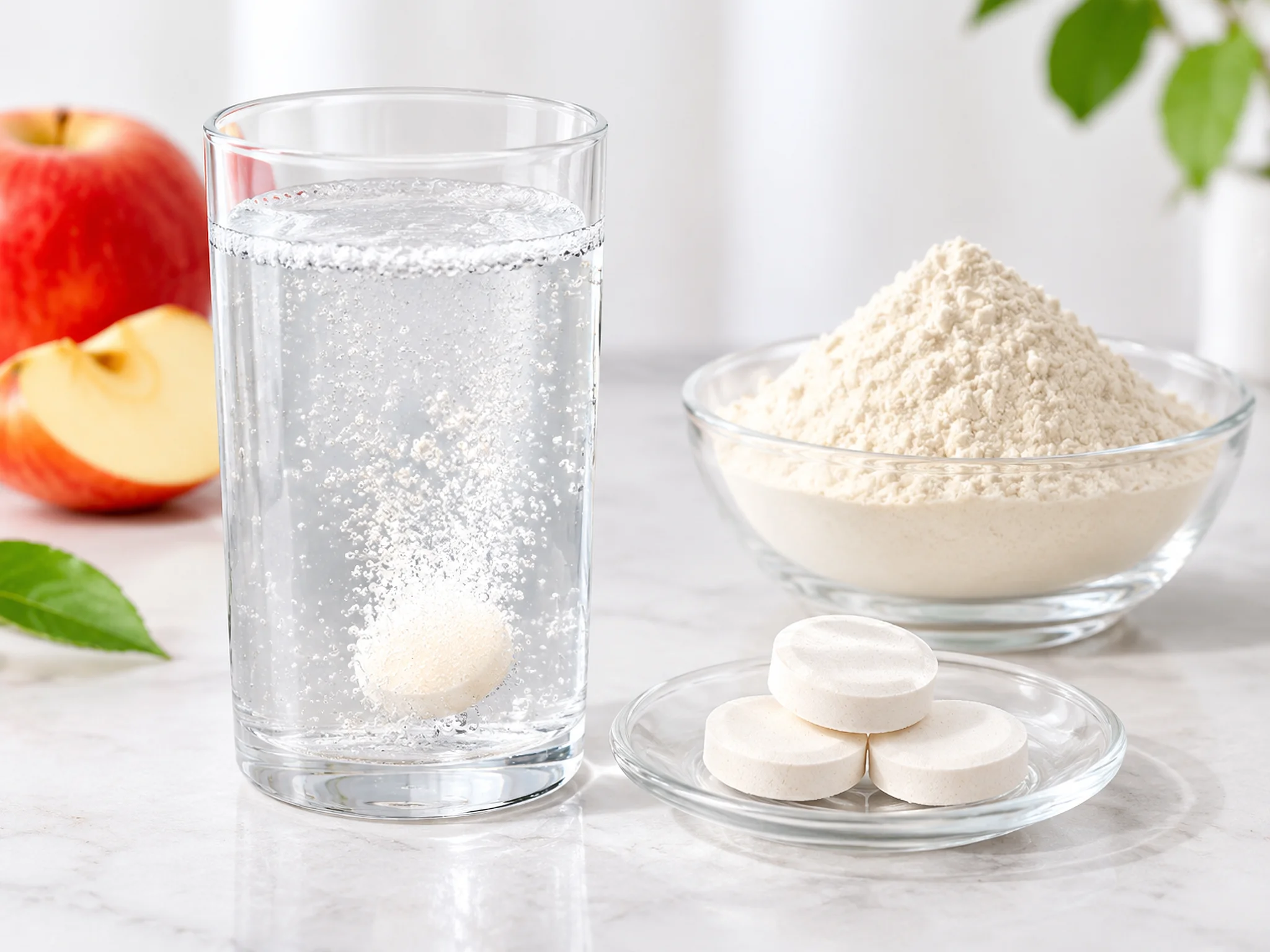
The only meeting water and tablet should ever have: in the glass, in front of the consumer.
6. Dose Density and Label Honesty - Milligrams of Acetic Acid per Unit
Direct answer: whichever format you build, the auditable number is milligrams of acetic acid per serving, taken from the batch COA titration - not "contains ACV". Powder makes that number printable; liquid makes it a narrative.
The table below shows how the same target dose lands in each format at the two standard powder grades. Liquid figures assume typical 5% brewing-strength ACV.
| Label target (per serving) | Liquid ACV 5% | Powder 5% | Powder 10% |
|---|---|---|---|
| 25 mg acetic acid (flavour-led gummy) | 0.5 g liquid | 0.5 g powder (~1 gummy) | 0.25 g powder |
| 100 mg acetic acid (standard gummy serving) | 2.0 g liquid - already 1.9 g water | 2.0 g powder - split over 4 pieces | 1.0 g powder - 2 x 500 mg pieces |
| 300 mg acetic acid (serious gummy claim) | 6.0 g liquid - 5.7 g water, un-buildable in-chew | 6.0 g powder - 12 x 500 mg pieces | 3.0 g powder - 6 x 500 mg pieces |
| 1,000 mg acetic acid (research-adjacent dose[3]) | 20 g liquid - 19 g water | 20 g powder - stick-pack territory | 10 g powder - one generous stick |
Two honest observations. First, no gummy format should pretend to fully replicate the liquid doses used in the clinical literature - the studies behind the acetic-acid interest used gram-level vinegar intakes[3], and a structure-function product should say what it does deliver, in milligrams, and market it accordingly. Second, the 10% grade doubles your dose density without touching piece weight - which is why, in the ongoing 5% versus 10% decision, dry-format buyers trend to the higher standard once the label gets ambitious; the unit-economics method for pricing that choice is covered in the companion quote-comparison guide.
If your compliance team is drafting claims, keep the language on the studied marker - "delivers X mg acetic acid", "supports healthy metabolism" style structure-function wording - and leave disease language out of the artwork entirely. The same discipline we recommend in our formulation notes.
7. Line Practicality - Metering, Blending, Cleaning, Warehouse
Direct answer: powders meter on the same equipment that already weighs your other dry ingredients; liquids need pumps, heated lines or metering nozzles, wash-down at every stop, and a cleaning validation at every changeover. In dry-format plants, the liquid is the odd SKU in the utility map.
- Dosing accuracy. A loss-in-weight powder feeder at 0.1 g precision is a commodity; liquid micro-dosing at the gram scale needed per gummy batch drags viscosity, temperature and foaming behind it.
- Blend uniformity. A dry pre-blend of ACV powder with sugar, acidulant and color distributes homogeneously by design; a viscous inclusion in a 200 kg kettle needs validated fold time and per-zone sampling to prove the same content-uniformity story.
- Cleaning and allergen logic. Sticky acid lines mean clean-in-place cycles, and every residue is a cross-contamination question at the next campaign. Bags and drums close and leave.
- Warehouse. 25 kg drums of powder at 24-month shelf life on a pallet versus IBCs of liquid with a decanting pump, spill kits and FIFO urgency. Section 11 puts numbers near the freight.

Dry-format buyers audit documents the way liquid buyers audit tanks. Every lot ships with COA, MSDS, specification and contaminant analysis under the same management systems shown here.
8. Sensory Reality - Volatile Top Notes and Masked Finishes
Direct answer: the switch to powder also changes what the consumer tastes, and formulators should plan for it. Liquid vinegar delivers a volatile acetic top-note the moment it opens; powder dosed after the cook delivers a rounder, apples-forward acidity that finishes clean.
Acetic acid is volatile; a long boil carrying liquid vinegar strips part of the aroma you added it for and leaves behind flat sourness[3]. Powder folded into the mass at deposit temperature keeps its apple-and-vinegar signature because it never sees the cook. The practical consequences for your brief:
- Sourness design becomes independent of dose. Because the acid arrives dry, you can pair it with the buffer system (buffers, coating, fat, sweetener) that your flavour house recommends rather than compensating for a hot acid addition. Stevia and monk-fruit partners, and apple/berry flavour bridges, are the usual toolkit - covered in depth in our taste-masking section.
- Surface treatments matter. A dusted sour-shell gummy masks the first hit; a panned glossy shell delays it. The two rows in your pilot (Section 13) should each get both finishes before you conclude anything about the ingredient.
- The mother question, honestly. The unfiltered "mother" is a cellulose biofilm suspended in raw vinegar; it is not what survives spray drying and clarification. Position the powder on its measurable identity - declared acetic acid on a documented apple-juice fermentation - and let the mother story stay where it is true.
9. Stability and Safety Margins - Water Activity, Patulin, Sediment
Direct answer: the safety architecture of both categories is built around water, and powder simply declines to participate. Finished-product water activity stays where the recipe put it, the effervescent pack stays anhydrous, and the ACV-specific contaminant conversation moves to a piece of paper you control: the batch COA.
Water activity in gummies. Stability studies on gummy confectionery track dry matter, water activity and pH across storage precisely because mould risk is an aw story, not a preservative story[1]. Liquid vinegar addition is an aw intervention; powder is not. One more consequence from the same literature: pectin gummies hold their texture at higher moisture than gelatin but remain aw-limited - the acidulant choice should never be what pushes you past the line.
Patulin, the apple-specific contaminant. Patulin is a mycotoxin associated with mouldy apple fruit; FDA's apple-juice guidance sets a 50 ppb level of concern[8], and any buyer who takes apple-derived dry ingredients seriously should ask for it by name. We hold ourselves to a dedicated patulin limit of 10 ppb or less per batch, tested by liquid chromatography - five times tighter than the juice benchmark - alongside heavy-metal, moisture and microbiological panels listed on every COA. When you compare suppliers on this line, compare method and frequency, not promises.
Sediment and drift in liquid systems. Unfiltered liquid continues to change in the tank: colour deepens, the mother flocculates, brix reads drift with ambient temperature. A powder lot, sealed in foil at under 5% moisture, reads the same at month eighteen as on the COA - which is what "traceable dose" means on an audit form.
10. When Liquid ACV Is Still the Right Call
Direct answer: three product families still earn their water - ready-to-drink acidulates, chillers and shots, and brands whose entire retail story is the raw unfiltered pour. Outside those lanes, the dry format's list of advantages simply gets longer.
- RTD drinks and drink shots. Water is already the product; the liquid doses cleanly, blends instantly and the "made with raw ACV" claim is literally true on the hot-fill line.
- Refrigerated and short-shelf premium lines where the sensory top-note of real vinegar is the differentiator and cold chain absorbs the microbial question.
- Culinary and food-service SKUs - dressings, marinades, functional foods - where the liquid is the format, not an ingredient decision.
Notice what these share: in each case the water you add was going to be there anyway. That is the honest boundary of the switch - powder replaces liquid wherever the process was fighting the water, and nowhere else. A guide that told you otherwise would be a sales sheet.
11. The Switched-Cost Math - Where Powder Earns Its Price
Direct answer: liquid vinegar wins on price per kilogram of incoming material almost every day of the week; powder wins on cost per unit of declared acetic acid delivered into a finished dry format once cook energy, line losses, rework, cleaning and freight of water are priced. Compare the two on your numbers, not ours - the checklist below is the one we use with OEM customers.
- Acid-unit price, as always. Take every quote - liquid or powder - to cost per kilogram of acetic acid using declared acidity. Our 10% standard roughly doubles dose density versus 5% for less than double the price at most volume tiers; the same normalisation kills bad liquid quotes too (a "5% typical, unverified" liquid is worth a discount, not a contract).
- Boil-off energy. In gummy work, every gram of water delivered by liquid must leave through the vacuum kettle. Price the steam, the cycle time and the batch slots it consumes, then compare with powder's zero.
- Line losses. Liquid hold-up in pumps and hoses at changeover is a few percent of an inclusion you paid for and cannot recover; powder bags empty. Effervescent rework - the caked bin, the bloated blister run - is pure liquid-attributed scrap cost.
- Freight and cube. Liquid ships and stores like water. Our powder arrives in 25 kg drums at 0.06 CBM each - a pallet of declared acidity versus a IBC of declared water.
- Quality overhead. Per-lot COA with titration, patulin and micro panels comes with the powder contract; replicating that evidence chain on a liquid tank farm is your lab's problem at your cost.
Run the five lines on one real quote sheet and the category answer writes itself - which is exactly why gummy and effervescent spec sheets in our inbox increasingly arrive pre-normalised to acid units. The same normalisation we use in the product documentation can be applied to any supplier's paper.
12. Specifying ACV Powder for Gummy and Effervescent Use
Direct answer: write the spec like the pilot depends on it, because it does. Below is the purchasing language we print on our own bulk sheet - use it verbatim against any supplier.
| Parameter | Standard | Why it matters in gummies / effervescent |
|---|---|---|
| Total acidity | Standard 10% or higher; customisable 5-10%, as acetic acid | Dose density per piece; drives Table 1 label math |
| Test method | Acid-base titration with pH indicator, reported as total acidity | The only comparable basis between suppliers; demand the method be printed on the COA |
| Appearance / solubility | Off-white free-flowing powder; completely water-soluble, no precipitation | Clear dissolution in effervescent glasses; no specks in gummy mass |
| Moisture | 5% or less (loss on drying) | Hygroscopic load; in effervescent, every point is premature-reaction risk |
| Carrier disclosure | Food-grade carrier system stated on spec; carrier and acidity read together | Determines true active delivery per gram; label/allergen input |
| Patulin | 10 ppb or less, LC, every batch | Apple-specific mycotoxin; benchmark is FDA's 50 ppb for juice[8] |
| Heavy metals / micro | Total heavy metals 10 mg/kg or less, Pb 1 mg/kg or less; TPC 1,000 CFU/g or less, yeast-mould 100 or less, E. coli 10 or less, Salmonella negative | Dry-format products skip the kill-step a drink gets from hot-fill; the powder must arrive clean[9] |
| Packaging | 1 kg foil, 5 kg tin, 25 kg drum (~0.06 CBM, 28 kg gross); barrier liner standard | Moisture defence from factory to hopper |
| Documents | COA, MSDS, spec sheet, Non-GMO verification, allergen and vegan statements, contaminant analysis; NOP/EOS organic where applicable | Market access paperwork for gummy and tablet exports |
| Supply | Lead time 7-20 days; annual capacity 5,000 tons; 5-10% and custom grades on one line | Grade flexibility without dual-supplier risk |
Two format footnotes. For gummies, add a mesh and bulk-density target so the powder disperses in your flavour phase without mill lumps (our standard grade screens at 80 mesh with 95-99% passage - the same discipline as the bulk specification page). For effervescent, request the low-moisture end of spec and schedule blending time and room humidity to your citric/bicarbonate routine; if your current ACV powder arrives free-flowing in July and bridged in the hopper in August, the problem is packaging or warehouse dew point, not the fermentation.

Traceability in one frame: the double-fermentation path runs from declared apple juice to the titrated acid on your COA - the chain dry-format auditors increasingly ask to see.
13. A 3-Week Pilot Protocol to Prove the Swap on Your Line
Direct answer: you can decide the powder-versus-liquid question with two 5 kg evaluations, one gummy kettle and one tablet press, in three weeks - without committing a commercial batch.
Week 0 - paper. Request evaluation samples (Wellgreen supplies them for qualified enquiries[6]) plus batch COAs from your two finalist suppliers. Normalise both to cost per kilogram of acetic acid (Section 11) and log titration method, moisture, mesh, bulk density, patulin result and carrier. Eliminate any bid without a named assay method or patulin line.
Week 1 - gummy bench. Run one control recipe and two ACV variants (5% and 10% grade), each at your intended mg-acetic-acid-per-piece, dosed with the flavour phase after the cook. Measure: mass loss on drying, finished moisture and aw, pH of the molten mass and set piece, firmness by texture analyzer or the honest thumb test, and a 6-person triangle sensory panel. Track one liquid reference batch if your team insists - the water-budget table will be validated or refuted on your own kettle, which is the only kettle that counts.
Week 2 - effervescent bench. Blend ACV powder at 2-5% of tablet weight into your standard citric/bicarbonate architecture under your normal humidity limits. Press target hardness; run dissolution (complete in 200 ml at 20 degrees C within your house spec, clear solution), and store accelerated samples at 40 degrees C/75% RH in sealed and open packs for fourteen days. Pass condition: no caking, no CO2 loss on re-test, no hardness drift beyond house range. The open-pack sample is your humidity-education poster for the plant.
Week 3 - decision. Score both formats on dose accuracy against COA, process deviation versus control, sensory acceptance, and cost per serving (not per kilogram). If the gummy variants hold finished aw within control limits and the tablets survive the accelerated week, the switch is a purchasing decision - not a science project any more.
Our technical team runs this protocol with OEM customers weekly - bring your recipe constraints and we will bring the batch paperwork: start the conversation here.
14. Frequently Asked Questions - answered for the shop floor
Why use apple cider vinegar powder instead of liquid ACV in gummies?Because gummies run on a fixed water and acid budget. Commercial gummies finish at roughly 9-18% moisture under a narrow pH and water-activity window[1][4]; delivering a functional acetic-acid dose from 5% liquid vinegar would add about fourteen times more water than a gummy serving can hold, forcing longer boils or a weaker gel. Spray-dried powder delivers the same acetic acid with no process water, no gel interference and precise dosing.
Only at trace, flavoring levels. At 5% acidity, 750 mg of acetic acid requires about 15 g of liquid - roughly 14.3 g of water - for a serving that typically weighs 12-14 g in total[3]. Above trace levels the water either has to be boiled off (energy, acid-driven gel breakdown, sticky product) or it destabilizes the set and lifts water activity toward the microbial risk zone[1].
A practical starting point is 500 mg of powder per gummy, consistent with the dosing guidance in our formulation article. At 5% total acidity that is ~25 mg acetic acid per piece; at 10%, ~50 mg. Build the label claim from milligrams of acetic acid per serving, then work backward to grade and piece count.
Treat the mother claim as a liquid-vinegar story. The mother is a cellulose biofilm carried in raw unfiltered vinegar; spray drying and the clarification required for a fully water-soluble powder alter or remove it. Honest dry labels describe standardized total acidity by titration - not mother content.
Because the citric-acid-plus-bicarbonate reaction needs water as its medium - that is what releases CO2[5]. A liquid acid source starts the reaction in the mixer or under the punch: CO2 potential escapes before packaging, the blend cakes, punches gume up, and tablets arrive swollen or hardened in the blister[6]. ACV powder keeps the blend anhydrous until the consumer's glass supplies the water.
Fill-weight-constrained formats (gummies, tablets, capsules) usually favour 10%: double the acetic acid per gram keeps carrier load and piece weight down, and it is typically the cheaper format-level cost even at a higher bag price. Where taste is the binding constraint - drink mixes, mild gummies - 5%, which mirrors liquid vinegar acidity, is easier to balance. Many lines standardise on 10% with 5% as the flavour exception.
At typical inclusion rates the change is small - the powder replaces water you would otherwise boil off. Texture problems come from mis-managed free acid pushing the mass below the gel's setting window (soft set, syneresis)[2][10]. Dose the powder with the post-cook flavour phase, disperse it well, and log pH per batch.
Yes. The bulk powder holds 24 months in sealed foil or drum away from heat; in gummies it adds no water, so your water-activity margin stays exactly where the recipe put it[1]; in effervescent tablets it stays dry and inert until reconstitution. Liquid vinegar, by contrast, keeps darkening and dropping sediment, and imports the moisture problem at source.
Compare chemistry, not folklore: the most-studied marker in vinegar research is acetic acid[3], and powder delivers it to a declared, titrated standard. Judge any product - liquid, gummy, powder - on milligrams of acetic acid per serving on the label, and treat undeclared formats as unverified either way.
Wellgreen supplies evaluation samples for qualified enquiries; packaging in 1 kg foil bags, 5 kg tins and 25 kg drums (~0.06 CBM, 28 kg gross); lead time 7-20 days against 5,000 tons annual capacity. The standard grade is 10% total acidity or higher, customisable from 5%, shipped with COA, MSDS, specification, Non-GMO verification and contaminant analysis - including a dedicated patulin limit of 10 ppb or less tested by liquid chromatography every batch. Details and current paperwork: bulk ACV powder specification.
15. Sources and Further Reading
External scientific and regulatory sources, and our own primary documentation:
- Physicochemical and Sensory Stability Evaluation of Gummy Candies. PMC (PubMed Central). pmc.ncbi.nlm.nih.gov/articles/PMC10818720
- Physicochemical, textural, and sensory qualities of pectin-gelatin gummy jelly (optimised formulation at pectin 1.42% / gelatin 8.58%, moisture <20%, pH ~3.4). Food Biosciences, ScienceDirect. sciencedirect.com (abstract)
- Baker Perkins. Stabilise Active Ingredients in Pectin Gummies for Functional Products - Baker Perkins process guidance on the narrow pectin gel window of sugar, pH and temperature, and protecting actives from over-boiling; indexed in the confectionery news section. bakerperkins.com
- Japanese Patent JP2016036305A. High moisture-containing gummy candy - states the industry norm of ~9-18% moisture and pH 4.0 or below for gummy confectionery. patents.google.com
- Concept, Manufacturing and Characterization of Effervescent Tablets. SunText Reviews - citric-acid/bicarbonate reaction requires water as the reaction medium; moisture control as the central process variable. suntextreviews.org
- US Patent US6544557B2. Effervescent tablet compositions - dry acid and alkali phases with effervescing alkali (sodium bicarbonate), anhydrous until reconstitution. patents.google.com
- Kondo T, Kishi M, Fushimi T, et al. Vinegar intake reduces body weight, body fat mass, and serum triglyceride levels in obese Japanese subjects. Bioscience Biotechnology Biochemistry (2009). pubmed.ncbi.nlm.nih.gov
- U.S. Food and Drug Administration. Guidance for Industry: Juice HACCP Hazards and Controls Guidance (First Edition) - 50 ppb patulin action level for apple juice. fda.gov
- U.S. eCFR. 21 CFR 184.1444 - Maltodextrin (GRAS carrier). ecfr.gov
- GummyMolds. pH in Gummy Making: Pectin, Gelatin & Process Control - industry process note on acidity as a repeatability variable. gummymolds.com
- Wellgreen. Bulk Apple Cider Vinegar Powder - product specification, batch COA and documents. wellgreenxa.com
- Wellgreen R&D (Emily Green). How to Formulate with Apple Cider Vinegar Powder: Dosage, Solubility, And Taste Tips. wellgreenxa.com/info
Pilot the Swap on Your Own Line
Send your gummy or effervescent architecture - gelatin, pectin or starch; pressed or stick - and we will return a matched ACV powder spec (5% or 10%), batch COA with patulin-by-LC, and the week-one bench sheet from Section 13. Samples ship for qualified enquiries; bulk lead time is 7-20 days.