
ACV Powder + Green Tea Extract vs. ACV Powder + Turmeric: Which Metabolic Health Combo Is Worth Formulating in 2026?
2026-11-17 14:42:22
Apple cider vinegar powder rarely ships alone any more. Two pairings dominate metabolic-health briefs from supplement and functional-food brands: ACV powder with green tea extract, and ACV powder with turmeric. This guide compares them the way a formulation team must - what the human evidence supports, what a COA lets you verify, what survives a gummy kettle or an effervescent table at low pH, what the dose math costs per unit, and which regulatory wall your label hits in the US and EU in 2026 - so the decision ends in a pilot run, not a debate.
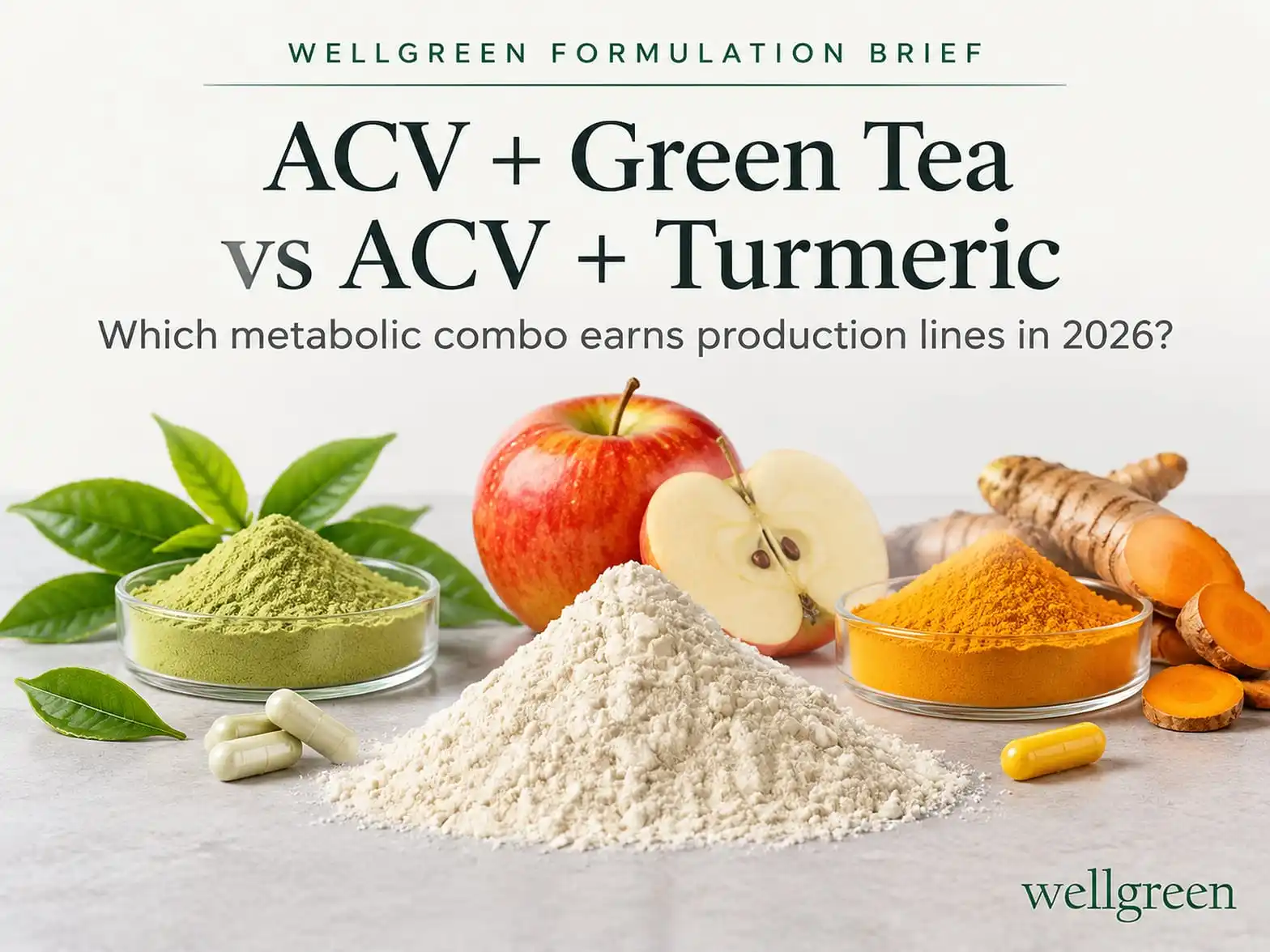
Key takeaways
There is no universal winner - there is a winner per archetype. ACV + green tea fits energy and thermogenic positioning and processes cleanly in most formats; ACV + turmeric fits daily-wellness and antioxidant positioning but hits a delivery wall in chews and gummies.
The evidence is real but modest on both sides. Meta-analysis ties green tea catechins with caffeine to small rises in 24-hour energy expenditure[1]; vinegar acetic acid shows small, consistent RCT effects on weight and triglycerides[3]; curcuminoid effects depend on beating the absorption problem first[10][11].
Dose math decides honesty. A 400 mg EGCG serving rides on ~408 mg of 98% extract[13], but the ~750 mg of acetic acid used in the classic vinegar RCT equals roughly 7.5 g of 10% ACV powder per day[3][15] - no gummy delivers that, and neither should pretend to.
Chemistry splits the formats. Green tea disperses in water, likes acidic pH and brings astringency; curcuminoids are only sparingly water-soluble per the COA[14], stain orange and need lipid or enhancer technology in any chewable.
Regulatory reality, 2026: US structure-function wording is workable for both; the EU list authorises neither green tea weight claims nor curcumin metabolic claims - the caffeine line is the only authorised wording pillar in this space.
1. The Direct Answer: Which Combo Earns a Production Line in 2026
Direct answer: ACV powder + green tea extract is the combo to formulate first if your product must deliver a functional dose, fit a gummy, effervescent or stick pack, and tell an energy/metabolic story with the largest human-evidence base behind it. ACV powder + turmeric is the better bet when the brand is built on daily inflammation-adjacent wellness, the format is a capsule or softgel, and you can fund an absorption-enhanced delivery system. If you can only fund one pilot in 2026, run the green tea pairing - it fails less in the kettle.
Three buyer-side realities decide the matchup before any clinical debate starts:
Processability. Green tea extract and ACV powder both disperse in water-based systems; curcuminoids are declared "sparingly soluble in water" on our own COA[14]. That single line decides whether turmeric belongs in your gummy line or your capsule line.
Evidence symmetry. Both partners have human trial support, but green tea carries the thermogenic meta-analytic data[1][2] while curcumin's metabolic-syndrome meta-analysis, though encouraging, flags high heterogeneity[12]. A claims-sensitive brand wants the steadier base.
Regulatory drift. The EU has moved to restrict green tea extract with EGCG in foods after EFSA's liver opinion[7][8], and Canada now manages GTE under conditions on its supplemental-ingredient list[9]. If the EU is your lead market, the turmeric pairing carries less dose-related regulatory heat - and neither pairing carries an authorised EU metabolic claim.
The rest of this brief prices those trade-offs the way a formulation meeting needs them: doses in milligrams, chemistry in the kettle, cost levers, and a decision matrix you can paste into the range-review deck.
2. Why Anchor Either Combo on ACV Powder at All
Direct answer: acetic acid - not apple flavour - is the reason ACV has any metabolic literature at all, and a standardised 10% powder is the only practical way to put a measured amount of it into dry formats. The powder contributes the dose floor, the tart flavour cue that tells consumers "vinegar," and a food-matrix story the isolated acid never gets.
What the clinical literature actually used: small randomised trials dosed vinegar at 15-30 mL per day in beverages over 12 weeks and reported modest drops in body weight, BMI and serum triglycerides in the vinegar arms[3]; a 2024 RCT covering 5, 10 and 15 mL daily doses reported improved anthropometric and metabolic parameters versus placebo[5]; and a 2025 meta-analysis pooled daily ACV intake to a small but statistically significant reduction in body weight (standardised mean difference -0.39)[4]. Two honesty notes this segment of the market needs: effects are modest and diets were not fully controlled, and at least one heavily publicised apple cider vinegar weight-loss RCT from a BMJ journal was retracted, a reminder that this literature is young and your claims should be written as if every headline is provisional[6].
Why the dose floor matters: the classic trials delivered roughly 750 mg of acetic acid per day[3]. On a 10% declared-total-acidity powder - our standard food-grade spec[15] - that is 7.5 g of ACV powder daily. No gummy carries that; a capsule stack or a twice-daily drink mix can. Formulators who skip this math end up printing an apple-vinegar story the tablet cannot fund.
Everything else about ACV powder is an execution advantage: water-soluble, off-white, free-flowing, naturally tart, and shelf-stable at 24 months in lined drums when moisture is kept at or below the 5% loss-on-drying ceiling[15]. Our formulation handbook covers the dosing, solubility and taste-masking mechanics in depth - including why the powder "is inherently hygroscopic and can clump"[16] - in the ACV powder formulation guide.

3. Case A: What Green Tea Extract Brings, Grade by Grade
Direct answer: green tea extract contributes catechins - led by EGCG - that, typically alongside their native caffeine, produced a pooled 24-hour energy-expenditure lift of roughly 428 kJ (about 4.7%) in meta-analysis, and reduced waist circumference by 1.37 cm and triglycerides by 0.18 mmol/L across eleven RCTs in overweight adults[1][2]. The effect is real, modest and doseable - which is exactly what a formulation programme wants.
The evidence worth quoting to your marketing team, and its practical limits:
Thermogenesis. The classic meta-analysis of catechin-rich teas and caffeine found 24-hour energy expenditure rose about 428 kJ (4.7%) with catechin-caffeine mixtures - but note that caffeine-only arms also moved, so the honest positioning is "catechins extend what caffeine starts," not catechins alone[1]. Your decaf decision (Section 4) rides on this fact.
Body-composition markers. A 2023 meta-analysis of 11 randomised trials (613 overweight or obese adults) attributed to green tea catechins a pooled waist-circumference reduction of 1.37 cm, triglyceride reduction of 0.18 mmol/L and HDL-cholesterol increase of 0.07 mmol/L[2]. Centimetres, not transformations - brief the claims writer accordingly.
Where the data is thinner. Blood-pressure endpoints were inconsistent across the same meta-analysis, and most trials used catechin doses delivered in capsule form, not gummies[2]. Format transfer is your burden to carry, not the literature's.
What the ingredient side looks like when you actually standardise it - our released green tea grades and a representative COA[13]:
| Grade tier | Declared marker | Typical use | Caffeine handling |
|---|---|---|---|
| Polyphenol standard | Tea polyphenols 40-98% | Fortified foods, beverage colour + function | Mostly the native level; spec it explicitly |
| Catechin standard | Catechins 80% | The workhorse capsule/stick-pack grade | Native caffeine contributes to the thermogenic story[1] |
| EGCG 50 | EGCG 50% | High-dose metabolic stacks at lower pill burden | Spec per batch; ranges with process route |
| EGCG 98 (decaf tier) | EGCG 98% (COA result 98.2%) | Evening products; caffeine-free positioning[13] | Declared 0.5% max; released COA verified 0.0% |
The supporting COA rows that matter to your incoming QC: 80-mesh fineness for even blend distribution, bulk density about 0.49 g/mL (low - dose by weight, never by volume scoop), loss on drying 4.0% against a 5% ceiling, heavy metals at or under 10 mg/kg total, three-year shelf life, and Non-GMO / non-irradiated status under ISO 9001 and ISO 22000 sites[13].
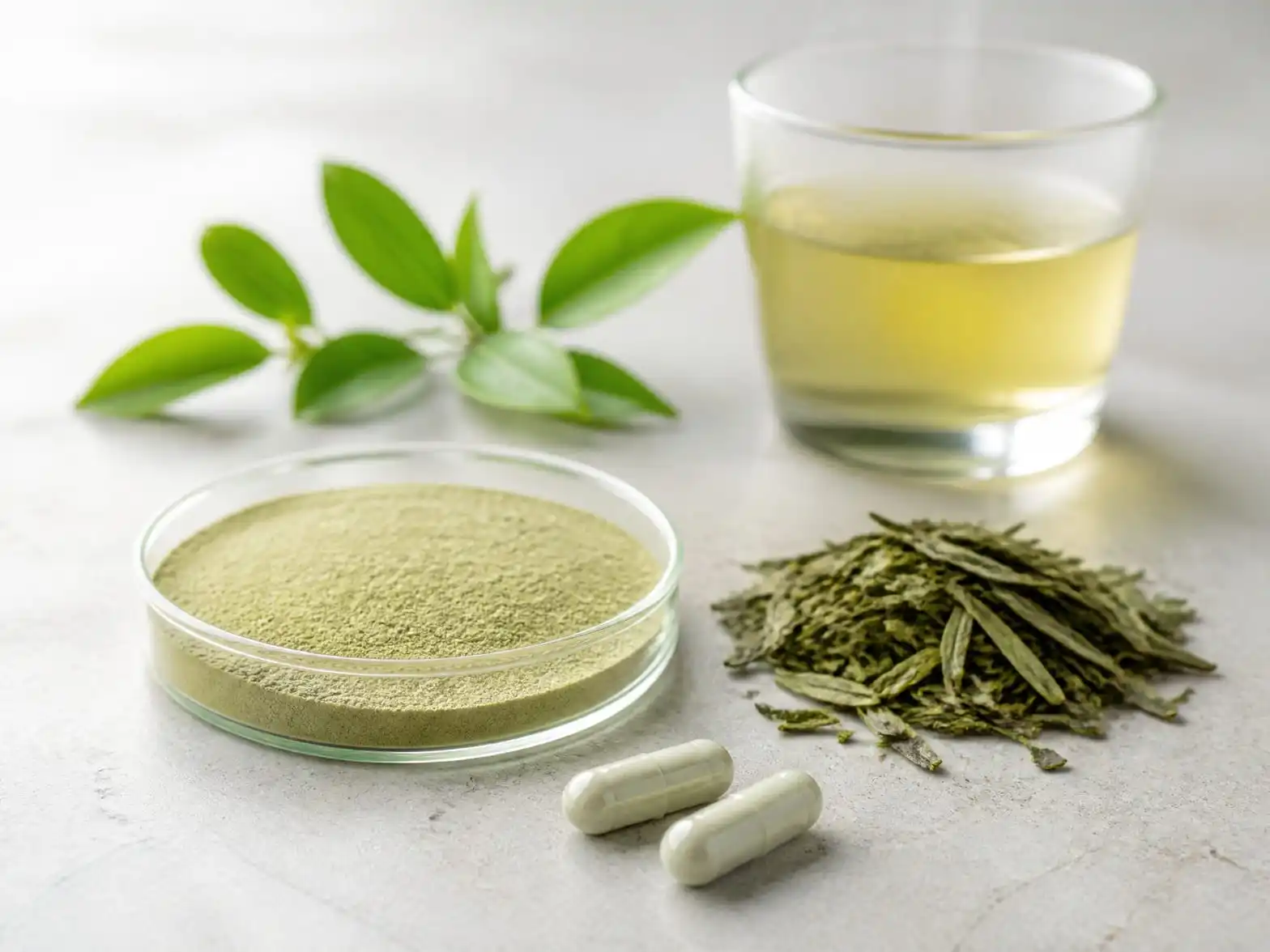
4. Case A Guardrails: The EGCG Ceiling, Caffeine and the Liver-Safety Conversation
Direct answer: EFSA's 2018 scientific opinion is the document your green tea gummy will be judged by. It found that food supplements delivering 800 mg or more of EGCG per day produced a statistically significant increase in serum transaminases, saw no evidence of hepatotoxicity below 800 mg/day for up to 12 months - and still declined to name a universally safe supplement dose because one 80% ethanolic extract product caused injury at the equivalent of 375 mg EGCG/day[7]. Formulate at or below half that ceiling, disclose caffeine, and read the tea leaf, not just the extract.
Four guardrails turn that opinion into purchasing and label decisions:
Dose ceiling by design. Many brands cap the daily serving at 300-400 mg EGCG - inside the EFSA "no signal" zone with margin for a customer who takes the product alongside tea[7]. At our 98% EGCG tier, a 400 mg label claim rides on about 408 mg of extract; the maths is trivial, the discipline is resisting marketing's request for 600.
Process route disclosure. EFSA's outlier case involved an 80% ethanolic extract[7]. Ask every supplier, in writing, for the extraction solvent and process - and keep the answer in your technical file. A water/ethyl-acetate route versus an ethanolic route is a product-safety fact, not a trade secret.
Market gates. The EU has moved to restrict green tea extracts containing EGCG in foods following the Article 8(2) procedure that produced the opinion[7][8], and Health Canada manages GTE in supplemental ingredients under liver-toxicity conditions[9]. For EU-facing SKUs, get regulatory sign-off on the exact dose and format before you buy a single drum.
Caffeine honesty. The thermogenic evidence leaned on caffeine-containing arms[1]; the evening-safe route is the decaf EGCG tier that verifies 0.0% caffeine on the COA[13]. Pick the tier by moment of use, then print the caffeine milligrams per serving on the panel either way.
One more line worth borrowing from the EFSA review even though it never reaches a label: rare liver-injury cases on rechallenge were judged idiosyncratic - meaning not purely dose-driven[7]. A "consult your physician" line for anyone with liver history or on medication is cheap insurance that sophisticated retailers increasingly expect.
5. Case B: Curcuminoids and the Bioavailability Wall
Direct answer: the turmeric pairing brings genuinely promising metabolic-syndrome data - a 2023 meta-analysis of 13 randomised trials (785 participants, 4-12 week interventions) found curcumin supplementation improve waist circumference, fasting glucose, diastolic blood pressure and HDL cholesterol, and lower inflammatory and oxidative markers (TNF-alpha, CRP, MDA), versus control - while warning that heterogeneity is high and more trials are needed[12]. The catch is not the evidence. The catch is that plain curcuminoids barely reach the bloodstream at all.
Read the COA, then read the pharmacology, in that order. Our 95% curcuminoids standard declares curcumin I 50.8%, curcumin II 18.6% and curcumin III 25.7% (total 95.16% by HPLC), a loose bulk density of 0.37 g/mL, and the solubility line that haunts food formulators: sparingly soluble in water[14]. That line is the ingredient honestly describing its own absorption problem - curcumin's oral bioavailability is notoriously low because of poor solubility, rapid metabolism and fast clearance[10][11].
What the meta-analysis can and cannot support in a 2026 brief:
Can: a daily wellness / inflammation-adjacent positioning on the antioxidant-and-inflammatory-marker side - TNF-alpha and CRP moved in the pooled data[12] - and HDL support. Most trials in that pool used enhanced-absorption or phytosome-type curcumin forms, not raw turmeric root powder.
Cannot: a triglyceride or blood-pressure story - those endpoints were not significant in the same analysis[12] - and no weight-loss claim anywhere, in any market, without drug-level evidence. Also note the pattern from the ACV literature next door: young metabolic-supplement literatures produce retractions; build claims that survive a headline[6].
The practical consequence for this comparison: the turmeric side of the decision is rarely an evidence problem. It is a delivery-system procurement problem, and it is priced in Section 11.
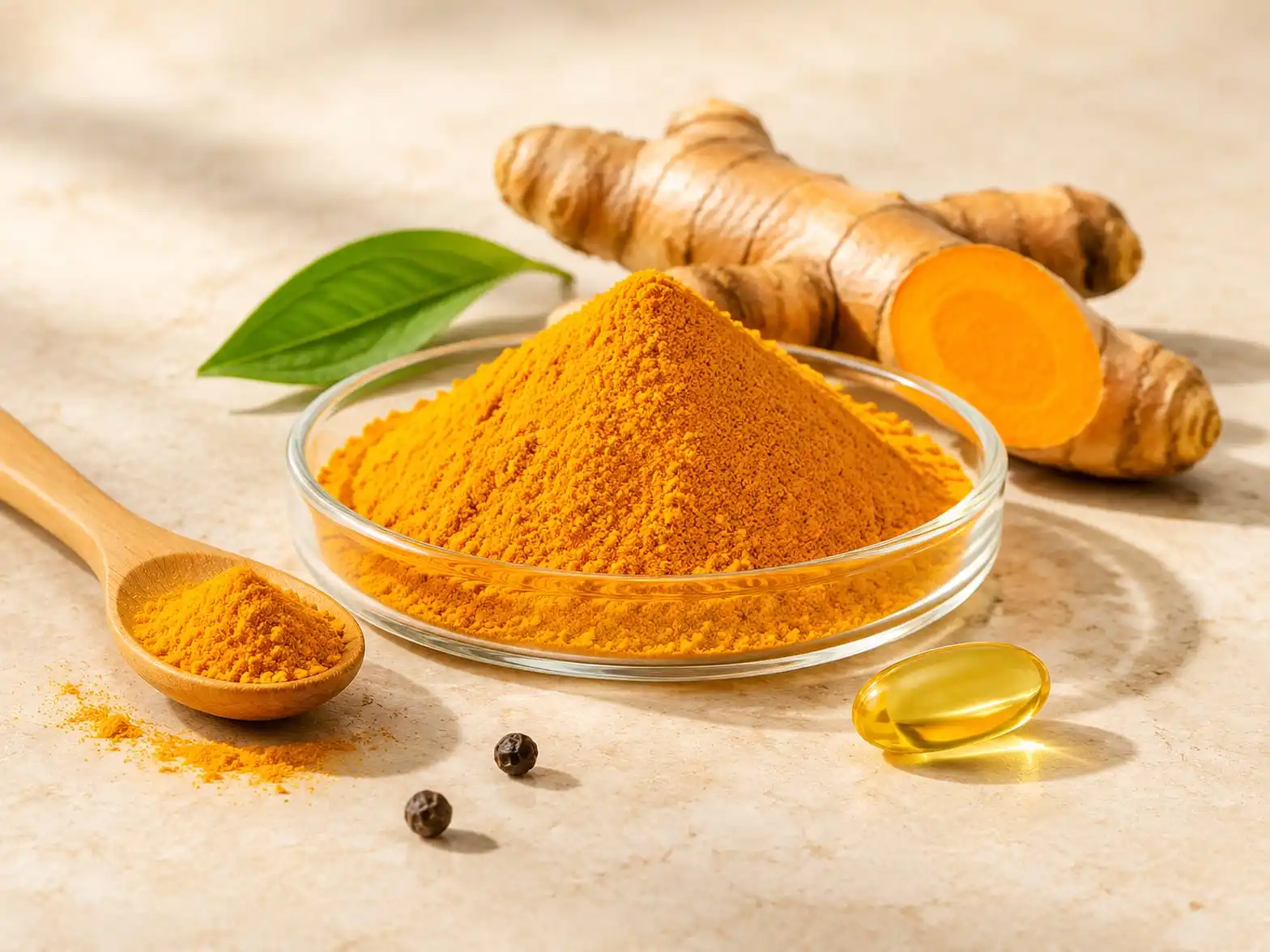
6. Making Curcumin Work: Piperine, Lipids and the Dose Math Behind the Wall
Direct answer: three engineering answers to the bioavailability wall exist in 2026 - piperine co-dosing, lipid/lecithin or phytosome delivery, and high-surface nanosuspensions - and each changes your label, your format options and your unit cost. The classic human crossover study found piperine co-administration raised curcumin blood levels by roughly 2,000% by slowing its clearance, not by making it soluble[10][11].
Walk the three routes as a purchaser would:
Piperine (black-pepper extract, typically 95% piperine at 5-15 mg per dose). Cheapest, most familiar, well-documented boost[10]. Costs: it inhibits drug-metabolising enzymes - a real interaction flag your label lawyer will price[10]; some EU markets scrutinise it; and a small minority of clean-label brands ban it outright. The mechanism to understand: piperine slows glucuronidation in the liver and gut, keeping curcumin circulating longer[11].
Lipid delivery (lecithin complexes, phytosomes, turmeric oleoresin). Curcumin is fat-soluble; dispersing it in a phospholipid or oil matrix fits softgels, lipid-based gummies and paste-in-premix systems. Costs: a processing step, a declared allergen question if soy lecithin is used (choose sunflower), and a higher unit price.
Plain 95% powder with a fatty meal instruction. The honest minimum - the "take with food" line on the panel. Acceptable for capsules; indefensible in a 2-gummy serving.
The dose math nobody puts on the concept card: the trials behind the promising pooled effects commonly dosed in the hundreds-of-milligrams-to-gram range of curcuminoids per day[12]. Our 95% standard turns a 500 mg curcuminoids claim into roughly 526 mg of extract - one modest capsule[14] - but the same 500 mg in a gummy means a 20-25% of mass active-plus-fat system, colour you cannot hide and orange deposit in the mould cavities by Friday. Decide the format first; the delivery route prices itself from there.
7. Head-to-Head: Evidence, Dosing, Stability, Cost and Rules
Direct answer: scored line by line, the green tea pairing wins evidence strength, format breadth and process simplicity; the turmeric pairing wins regulatory calm in the EU, anti-inflammatory positioning and per-serve ingredient cost in capsules. Nobody wins on the acetic-acid dose floor - both combos still have to be honest about how much vinegar powder actually fits.
| Dimension | ACV powder + green tea extract | ACV powder + turmeric (curcuminoids) |
|---|---|---|
| Human evidence | Meta-analytic 24-h energy-expenditure lift of about 428 kJ (4.7%) with catechin-caffeine mixtures[1]; 11 RCTs, 613 adults: waist -1.37 cm, triglycerides -0.18 mmol/L[2] | 13 RCTs, 785 MetS patients: improved waist, fasting glucose, diastolic blood pressure, HDL, TNF-alpha and CRP; authors flag high heterogeneity[12] |
| Anchor dose floor | Identical: ~750 mg acetic acid/day in the classic trial equals ~7.5 g of 10% ACV powder[3][15] - capsule/drink territory, never a 2-gummy serving | |
| Per-serve marker dose | 300-400 mg EGCG = 306-408 mg of 98% extract[13] | 500 mg curcuminoids = ~526 mg of 95% extract[14] |
| Absorption reality | Catechins absorbed at supplement doses; effects plateau and safety sharpens above 800 mg EGCG[7] | Poorly absorbed unaided; piperine boosts blood levels ~2,000% by slowing clearance; lipid/phytosome routes cost more[10][11] |
| Water behaviour | Disperses; drink and effervescent friendly[13] | "Sparingly soluble in water" per COA[14] - suspensions, sediment, staining |
| Sensory footprint | Green-khaki colour; tannic astringency; pairs with the apple-tart story | Intense orange; earthy-peppery; fights the vinegar-tart story visually and on flavour |
| Stability profile | Catechins hold better at acidic pH - the ACV matrix is friendly; oxygen and light still darken solutions[7][16] | Curcumin stable in acid, degrades faster at neutral-alkaline pH; strongly light-sensitive - foil and opaque packs only[14] |
| Regulatory temperature | EU restricts EGCG-bearing green tea extract in foods; Canada lists conditions; label at 300-400 mg EGCG/day or below[7][8][9] | No EU dose restriction, but no authorised metabolic claim either; piperine adds interaction wording; phytosome forms need form-by-form checks |
| Ingredient economics | Premium grade at the top tier: 98% EGCG is a fractionation product, priced accordingly[13] | 95% curcuminoids is a deep, competitive commodity grade; enhancer tech is the cost driver, not the powder[14] |
Two observations from scoring it this way. First, the turmeric column loses almost every engineering round but the regulatory round - in a 2026 where EFSA-driven GTE limits are reshaping EU gummy menus[8], that single row can decide a market entry. Second, the green tea column's advantage evaporates the moment marketing asks for 600 mg EGCG per serving in a product sold overnight - dose discipline is the price of picking it.
8. What Happens in the Kettle: Colour, Taste, pH and Water
Direct answer: in every shared format, the ACV half pushes pH down - which catechins tolerate and curcumin colour follows - while the water and light budget of the format decides whether each partner stays honest on the label through the shelf life.
pH is the scoreboard. ACV powder contributes real acidity - a 10% acid spec means every gram of powder delivers about 100 mg of titratable acid[15]. In drink powders and effervescents that lets ACV replace part of the conventional acidulant, with the tartness doing marketing work the citric acid never did. Catechins are at their most stable in that acidic band; curcumin is chemically fine in acid but its colour is a pH indicator - keep the system below pH ~5 and it stays the yellow consumers expect, let an alkaline rinse or a neutral-water system creep in and it reddens.
Water activity writes the expiry date. Gummy masses at 12-18 percent moisture and stick powders that cake - our own formulation team flags ACV's hygroscopic nature as the core handling constraint[16] - both interact with the extract carrier. Dose every premix by weight, keep open drums closed, and treat the storage rules from the formulation handbook as part of the stability plan, not warehouse trivia.
Light and oxygen. The curcuminoid molecule is the least light-tolerant active in either combo; the catechin fraction browns in solution. Foil laminates, opaque bottles and nitrogen-flushed headspace are cheap relative to a returns storm.
Protein tannins. Catechins bind milk proteins - EFSA's review notes the interaction explicitly[7]. If the combo is headed for a protein bar or RTD shake, that is a different matrix study, not a sprinkle-on decision.
Flavour marriage. Apple-tart plus green tea astringency reads as one flavour story (think iced tea). Apple-tart plus earthy turmeric reads as two arguments - the turmeric combo usually needs a spice or honey frame to feel intentional.
9. Does the Dose Fit the Format? Gummy, Capsule, Effervescent, Stick Pack
Direct answer: the capsule funds every claim either combo can honestly make; the gummy funds the marketing dose, not the trial dose; the effervescent and stick pack are the only formats where the ACV anchor gets close to the milligrams the vinegar literature actually used - and the turmeric combo is a non-starter in clear-dissolve systems.
| Format (daily serving) | ACV + green tea: what fits | ACV + turmeric: what fits |
|---|---|---|
| Gummy x 2 (4.5 g each) | ACV 1.5-2 g (150-200 mg acid) + EGCG 100-200 mg from 80% catechin or 98% EGCG grade; astringency masking required[16] | Feasible only as emulsified/oleoresin curcumin 100-150 mg - orange mass, mould staining, dose below trial range[12][14] |
| Capsule x 2 | ACV 2 g (200 mg acid) + EGCG 300-400 mg (306-408 mg of 98% extract) - full label honesty available[13] | ACV 2 g + curcuminoids 500 mg + piperine 5-10 mg - matches the classic enhancer pairing[10][14] |
| Effervescent tablet 5 g | ACV doubles as acidulant: 4 g powder (400 mg acid) + 250 mg catechins dissolves clean-ish in 200 mL | Undissolved curcumin specks and ring-staining; only lipid dispersion technology rescues it |
| Stick drink mix 10 g | 3 g ACV (300 mg acid) + 200 mg EGCG tier + apple/citrus flavour - the closest everyday format to the trial beverage[3][5] | 150 mg curcuminoids as spray-dried lipid dispersion - acceptable; plain 95% powder - sediment and streak |
Reading Table 3 honestly: only the capsule funds the EFSA-comfortable EGCG dose and the trial-grade curcuminoid dose at once. That is why "gummy first" brands should buy the capsule line as the clinical-strength SKU of the family and let the gummy carry habit and acquisition, with the label telling the milligram truth in both cases.
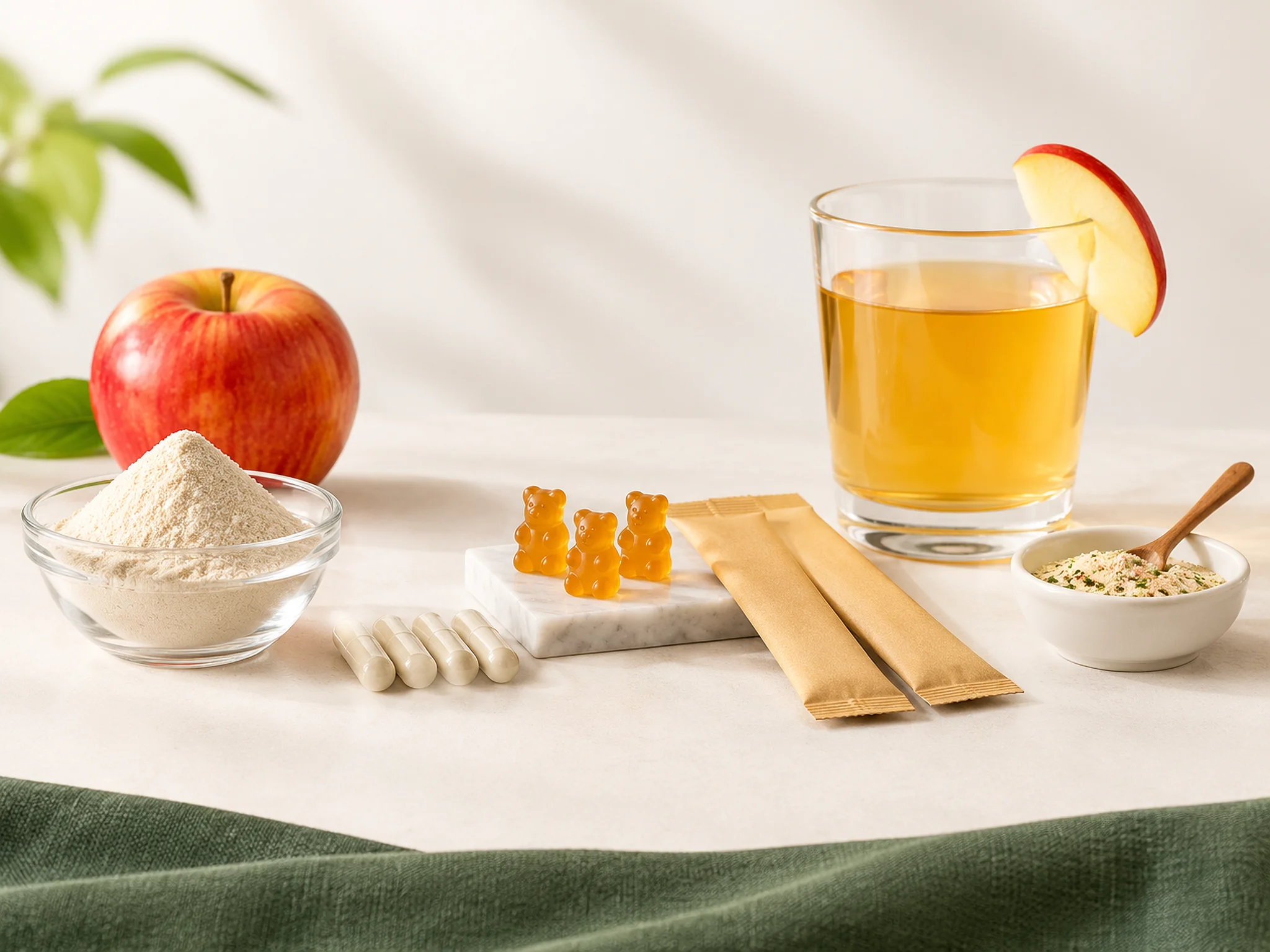
10. What the Label May Say in 2026: US and EU Reality
Direct answer: in the US both combos can carry structure-function language ("supports healthy metabolism*", "antioxidant support for cellular health*") under DSHEA with the standard disclaimer; in the EU neither combo has an authorised metabolic or weight claim, caffeine is the only authorised wording pillar in the green tea combo, and green tea extract itself now sails under a food-restriction flag - so the 2026 playbook is two artworks, one story, and dose sheets that respect the strictest market in the distribution plan.
United States. Function wording, not disease wording: no treatment, prevention or diagnosis of metabolic syndrome, no "clinically proven to lower cholesterol". Asterisk-and-disclaimer discipline, caffeine declared in milligrams per serving when it is a feature - or when it is a liability at evening doses. Turmeric with piperine invites interaction questions from large retailers' compliance teams; carry the piperine pharmacology summary in your supplier file[10].
European Union. The authorised claims list contains no green-tea weight-management claim and no curcuminoid metabolic claim; EFSA itself noted it assesses benefits separately from safety, and the green tea extract food restrictions ride on the Article 8(2) procedure[7][8]. The green tea combo's only authorised wording pillar is caffeine's (attention, alertness, physical performance) - so an EU-facing "metabolic" story is really a general-wellness and sensory story, sold as food, dosed under the GTE limits. Check the community register entry by entry before printing anything.
Canada and the anglosphere. Health Canada now manages green tea extract in supplemental ingredients under conditions driven by the liver signal[9]; UK, Australia and Gulf tend to track EFSA posture with a lag. Write the EU-compliant dose into the global spec and the other markets ride free.
The GLP-1 adjacency trap. Every 2026 metabolic brief mentions the injectable category. Adjacency marketing ("nutrition support companion") is a distribution conversation; any wording implying equivalence, synergy with medication or withdrawal mitigation is an enforcement magnet in every market on earth. Keep the drug name off the artwork.
11. Which Combo Costs Less to Buy, Hold and Run
Direct answer: at equal label ambition, the turmeric combo usually wins the input-price sheet and loses the production floor; the green tea combo wins the floor and loses the input price only at the 98% EGCG tier. The biggest cost line, though, is not in either extract - it is format cleaning, rejects and artwork.
Input structure. Green tea extract is a Chinese-origin crop with a fractionation ladder - price steps up steeply with each marker tier, and 98% EGCG sits at the top as an isolation-adjacent product[13]. Curcuminoids at 95% are a deep Indian-origin commodity with multiple qualified suppliers, which disciplines price[14]. Piperine is cheap per dose; lipid/phytosome systems are what make turmeric the more expensive capsule.
Holding costs. Green tea extract carries a three-year shelf life against turmeric's two[13][14], and both are light-and-moisture sensitive enough that foil and rotation discipline are non-optional; ACV powder's hygroscopy (see the storage guidance) applies doubly when it is pre-blended with a partner extract in a custom premix.
Running costs. Turmeric's orange is a validated-cleanout problem: dedicated moulds or scheduled changeovers, swab verification, and consumer-facing staining disclaimers. Green tea's astringency buys flavour-mask chemistry instead - citric-apple systems, cooling agents - a flavourist hour rather than a maintenance day.
Testing bills. Budget two HPLC methods, not one: EGCG/catechin profiling on every green tea lot, curcumin I/II/III on every turmeric lot - and demand the individual heavy-metal rows the turmeric literature keeps in the news, the way our own COA reports lead 5 mg/kg, arsenic 1, mercury 1, cadmium 0.5 maximums[14]. ACV's patulin at 10 ppb or less by LC closes the three-ingredient test panel[15].

12. Decision Matrix and a 30-Day Pilot Plan
Direct answer: route the brief through this matrix, then run the four-week pilot below before committing tooling. One pilot answers more questions than another quarter of slide debate.
| Product archetype | Pick | Decisive reason |
|---|---|---|
| Morning-energy gummy (US/CA) | ACV + green tea, standard caffeine tier | Catechin-caffeine synergy is the evidenced lever[1]; the flavour story is coherent |
| Evening metabolic gummy | ACV + green tea, decaf 98% EGCG tier | 0.0% caffeine verified on COA keeps the PM SKU honest[13] |
| Clinical-strength capsule stack | Either; pick by positioning | Thermogenic story takes green tea; inflammation-marker story takes curcumin + piperine[1][12] |
| Effervescent / stick drink mix | ACV + green tea | Acidulant synergy, clear-dissolve systems; turmeric suspends and stains[14] |
| EU-market wellness SKU | ACV + turmeric (capsule/softgel) | Avoids the GTE restriction file and the 800 mg conversation entirely[7][8] |
| Softgel / liquid shot line | ACV + turmeric lipid system | Fat-soluble actives are at home in oil; no water chemistry, no sediment risk[14] |
| First gummy SKU from an emerging brand | ACV + green tea, add turmeric in year two | One kettle, one cleanout habit, one claims file - expand after the SKU pays |
Week 1 - Samples and specs. Request two tiers of each partner (catechin 80 / EGCG 98; curcuminoids 95 with and without enhancer route) plus 10% ACV powder, each with sample COA - our teams quote from released lot data, so the paper you pilot with is the paper you buy with[13][14][15].
Week 2 - Dose sheet before bench. Fix the daily-serving milligrams for marker and acetic acid, then reverse-engineer pack count, gummy weight or capsule size from Table 3. Marketing gets veto power over claims, not over physics.
Week 3 - Pilot kettles. One batch per combo in the target format; photograph mould staining, measure dissolve and colour at day 0, pull sensory against the flavour frame.
Week 4 - Accelerated peek and claims pass. Two weeks at 40 C / 75 percent RH in the finished pack, plus a written claims check against the strictest market in the plan. Only formats that pass both get the tooling quote.
That is the whole decision: green tea when the format is the hard part, turmeric when the regulator is. Wellgreen supplies all three ingredients from one document pack - marker-assayed extracts and 5-10% ACV powder with per-lot COA - and the pilot programme exists to make this paragraph the last one you need to read.
13. Frequently Asked Questions
Which combo has stronger human evidence for metabolic health - ACV + green tea or ACV + turmeric?
The green tea pairing, on volume and design. Meta-analysis links catechin-caffeine mixtures to a pooled 24-hour energy-expenditure rise of about 428 kJ (4.7%)[1], and eleven RCTs in 613 overweight adults give waist-circumference and triglyceride effects with confidence intervals attached[2]. The curcuminoid meta-analysis moves similar markers in metabolic-syndrome patients but says the loudest word in its own abstract is "heterogeneity"[12]. Both are modest; brief both that way.
How much EGCG per day is considered safe in a green tea combo?
EFSA's 2018 opinion found supplement intakes at or above 800 mg EGCG per day significantly raised serum transaminases, saw no hepatotoxicity signal below 800 mg/day up to 12 months - and still declined to certify any supplement dose as universally safe after one product caused injury at a 375 mg EGCG equivalent[7]. The 2026 commercial convention: 300-400 mg EGCG per daily serving, disclosed caffeine, process route in the technical file, and regulatory sign-off for EU-facing SKUs[8][9].
Can apple cider vinegar powder and green tea extract go in the same gummy?
Yes - they are the easier gummy pair, since both disperse in the hot mass and the acidic system suits catechin stability[7][16]. The work is sensory, not chemical: astringency needs an apple-citrus mask, colour is green-khaki (an asset for "green tea" positioning), and the formula now carries two acid systems, so pectin set time and buffer get re-verified. The honest constraint is dose: a two-gummy serving funds 100-200 mg EGCG and 150-200 mg acetic acid, not trial doses[3][16].
Is turmeric the reason curcumin combos fail in gummies and chewables?
Usually. Curcuminoids are only sparingly soluble in water - our COA says it verbatim[14] - so a 95% powder suspends instead of dissolving, settles in the hopper, streaks the mass and stains tooling orange. Working chewables buy emulsified curcumin or oleoresin premixes and accept cleaning downtime; disciplined brands simply move the turmeric story to capsules and softgels[10][11].
Should I formulate with decaf or standard green tea extract?
By moment of use. The energy-expenditure evidence was built on catechins delivered with caffeine, and caffeine-only arms moved too - if thermogenesis is the story, keep the standard tier and declare the caffeine milligrams[1]. Evening SKUs and caffeine-stack markets take the decaf 98% EGCG grade - declared at 0.5% caffeine max, verified 0.0% on the released COA[13].
Do I need piperine (black pepper extract) in the turmeric combo?
Unless you buy lipid or phytosome delivery, something has to bridge the absorption gap. The classic human crossover trial raised curcumin blood levels roughly 2,000% with piperine co-dosing - by slowing hepatic and intestinal clearance, not by solubilising anything[10][11]. Costs: enzyme-inhibition interaction wording, extra scrutiny in some EU markets, and clean-label bans at a few retailers. Typical co-dose is 5-15 mg per serve.
Do acetic acid and catechins or curcuminoids stay stable together?
In the dry drum, yes - neither pairing is a reactivity problem at low water activity. Formats tell the truth: catechins prefer the acidic pH ACV creates (watch oxygen and light in solutions), while curcumin holds in acid, fades and shifts colour as pH climbs toward neutral and is strongly light-sensitive[7][14]. Run forced storage - 40 degrees C, 75 percent RH, finished pack, your light conditions - before signing any 24-month claim.
Which combo costs less per 10,000 finished units?
Capsules: turmeric usually wins the input sheet - 95% curcuminoids is a deep commodity grade while 98% EGCG is priced like the fractionation product it is[13][14]. Gummies: turmeric pays twice - emulsified delivery plus orange cleanout - so the green tea combo's premium tier can still be the cheaper line. Quote both partners at two tiers each before the meeting; the grade tier moves COGS more than the pairing does.
What can the label claim in 2026 - US versus EU?
US: DSHEA structure-function wording with disclaimer - "supports healthy metabolism*" is workable; disease and drug-adjacency wording is not. EU: neither combo holds an authorised metabolic or weight claim; the green tea SKU's only authorised pillar is caffeine's attention/alertness/physical-performance wording, and GTE in foods now carries restriction history from the EFSA procedure[7][8]. Two artworks, one spec, doses written to the strictest market.
What documents should I require before approving either extract?
Per lot: HPLC marker assay (EGCG or catechin profile; curcumin I/II/III), loss on drying, individual heavy metals (lead, arsenic, mercury, cadmium - the rows turmeric headlines keep making mandatory), micro panel, pesticide screen, mesh and bulk density, extraction solvent statement, Non-GMO and irradiation status, shelf-life basis[13][14]. For the ACV anchor add titratable acidity and patulin at 10 ppb or less by LC[15]. Whatever you cannot see per lot, you are buying on faith.
14. Sources and Further Reading
Hursel R, et al. The effects of catechin rich teas and caffeine on energy expenditure and fat oxidation: a meta-analysis (Obesity Reviews, 2011) - 24-h energy expenditure +428 kJ (4.7%) with catechin-caffeine mixtures. pubmed.ncbi.nlm.nih.gov
Effects of green tea catechin on the blood pressure and lipids in overweight and obese people (Heliyon, 2023) - 11 RCTs, 613 subjects; waist -1.37 cm, TG -0.18 mmol/L. pmc.ncbi.nlm.nih.gov
Kondo T, et al. Vinegar intake prevents accumulation of body fat in obese subjects (J Agric Food Chem, 2009) - 12-week RCT, 15-30 mL vinegar beverages. pubmed.ncbi.nlm.nih.gov
Effect of apple cider vinegar intake on body composition (meta-analysis, 2025) - daily ACV reduced body weight, SMD -0.39. pmc.ncbi.nlm.nih.gov
ObG Project. RCT results: does apple cider vinegar improve weight loss metrics? (Apr 2024) - 5/10/15 mL daily vs placebo. obgproject.com
BMJ Group. BMJ Group retracts trial on apple cider vinegar and weight loss - retraction notice on the 2024 ACV RCT. bmjgroup.com
EFSA ANS Panel. Scientific opinion on the safety of green tea catechins (EFSA Journal, 2018) - transaminase rise at >=800 mg EGCG/day; no signal below 800 mg up to 12 months. pmc.ncbi.nlm.nih.gov
Food Safety Magazine. Due to risk of liver damage, EU limits green tea extract with EGCG in foods (Dec 2022). food-safety.com
Health Canada. Summary of the safety assessment of green tea extract / EGCG - modification of the permitted supplemental ingredients list. canada.ca
A systematic review of piperine as a bioavailability enhancer (Journal of Drug Delivery and Therapeutics) - human curcumin bioavailability +2,000% with piperine. jddtonline.info
Nutraceutical Business Review. Why is piperine added to curcumin? (Jul 2026) - clearance-slowing mechanism explainer. nutraceuticalbusinessreview.com
Qiu L, et al. Effects of dietary polyphenol curcumin supplementation on metabolic, inflammatory, and oxidative stress indices in patients with metabolic syndrome (Frontiers in Endocrinology, 2023) - 13 RCTs, 785 participants. pmc.ncbi.nlm.nih.gov
Wellgreen. Green tea extract powder - grades, specifications and sample COA. wellgreenherb.com
Wellgreen. Curcuma longa root extract - 95% curcuminoids, specifications and sample COA. wellgreenherb.com
Wellgreen. Bulk apple cider vinegar powder - specification, testing and documentation. wellgreenxa.com
Wellgreen R&D (Emily Green). How to formulate with apple cider vinegar powder: dosage, solubility and taste tips. wellgreenxa.com/info
W
About Wellgreen Technology Co., Ltd.
Since 2011 Wellgreen has manufactured plant-extract and fermentation-derived ingredients for food, nutrition and cosmetic formulators in 60+ countries - including spray-dried apple cider vinegar powder at 5-10% declared total acidity, green tea extract from 40% polyphenols to 98% EGCG (decaf tier verified at 0.0% caffeine) and 95% curcuminoids from Curcuma longa, each released with per-lot COA under ISO 9001, ISO 22000, HACCP, Halal and Kosher systems. This brief was prepared by the Wellgreen R&D and Regulatory team from released-lot COAs, pilot-kettle records and the cited public literature; it is formulation guidance, not medical advice.
Pilot the Combo Your Format Can Actually Deliver
Send your target format, daily-serving milligrams and lead market. You will get a dose-math sheet like Table 3, tier-matched sample COAs for ACV powder plus green tea or turmeric extract, an extraction-solvent and process statement for every botanical, and a pilot quote that respects the strictest claim regime in your plan.