Apigenin Powder: Testosterone Levels and Other Potential Benefits
2026-06-26 14:07:14
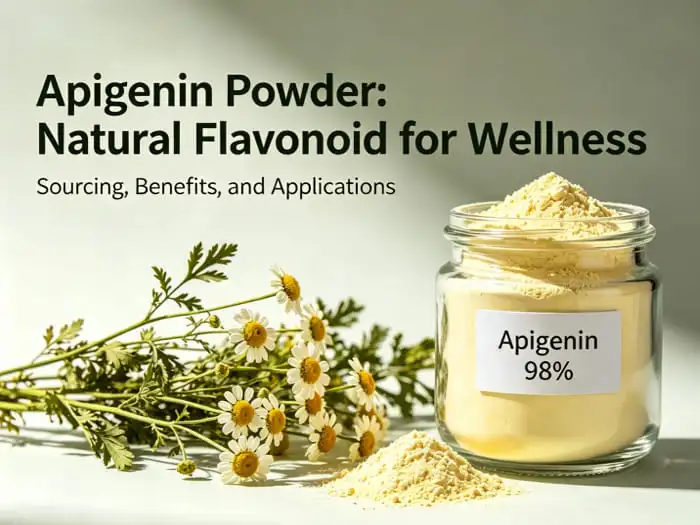
Apigenin powder is a new and innovative natural substance that comes from chamomile, parsley, and celery. It is more than 98% pure thanks to improved extraction methods. The nutrition business is very interested in this bioactive flavonoid because it may help control testosterone levels and provide other health benefits. Recent studies show that it can interact with hormonal pathways, act as an antioxidant, and change the way the nervous system works. This makes it a useful ingredient for supplement brands, drug developers, and functional food makers who are looking for botanicals with proven bioactivity and high quality standards.
Understanding Apigenin Powder and Its Biological Mechanism
What Makes Apigenin Powder Unique?
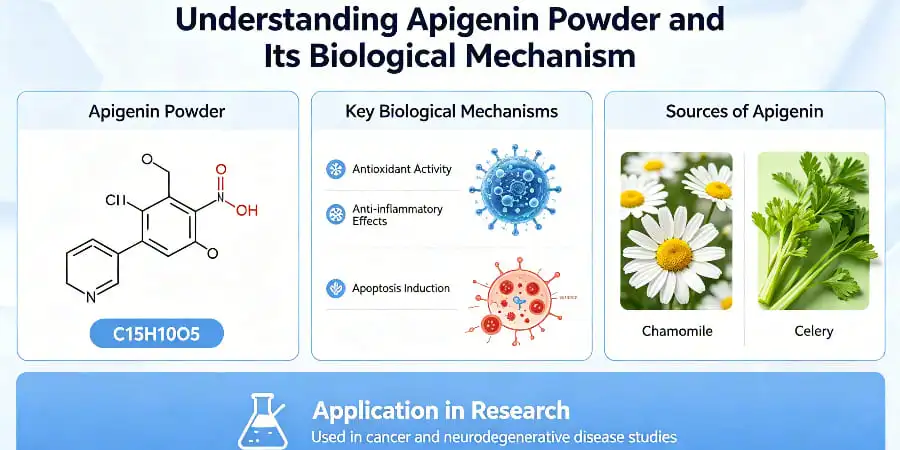
4',5,7-trihydroxyflavone is naturally found in many plants, but it needs to be extracted in a very specific way to be pure enough for medicinal use. Professional makers use HPLC-approved methods to separate this yellow, solid substance, making sure that the test levels are at least 98%. This accuracy is very important for B2B clients who are making standardized formulas because the stability of the active ingredients affects both the effectiveness of the product and its ability to meet legal requirements.
Biochemical Pathways and Hormonal Interaction
Researchers have found that this flavonoid affects a number of different bodily processes. Studies using in vitro models show that it can change the activity of steroidogenic enzymes that are involved in making testosterone. The substance selectively blocks aromatase, an enzyme that changes testosterone into estrogen. This could keep the amount of testosterone in the body greater. In addition to its natural effects, it binds to GABA-A receptors and calms you down without the drug dependence risks that come with manmade anxiety drugs.
Its antioxidant qualities come from its ability to stop reactive oxygen species and metal ions that cause oxidation damage. This two-way process protects cellular structures and lowers signs of systemic inflammation, which makes it useful for anti-aging formulas and stacks of supplements for long life.
Quality Parameters for Product Development
When purchasing workers look at raw materials, they should put a number of technical requirements at the top of their list. Bioavailability is affected by the spread of particle sizes; micronized grades passing 80 mesh show better breakdown rates. Following USP standards for residual solvent tests makes sure that the substance is safe, especially if ethanol or acetone is still present after extraction. ICP-MS testing for heavy metals shows that there are no more than 3ppm of lead, 2ppm of arsenic, and 10ppm of all heavy metals, which is well below the strict limits for dietary supplements.
Following USP guidelines for microbiological testing makes sure that pathogens like Salmonella and E. coli are not present while keeping total plate numbers within safe levels. These quality controls tell the difference between pharmaceutical-grade ingredients and lower-quality options that could damage the integrity of the recipe or put consumers at risk.
Apigenin Powder and Testosterone Levels: Research Evidence
Scientific Findings on Hormonal Regulation
Studies on animals that were published in journals about reproductive health show that testosterone levels rise after controlled treatment. In a study with male rodents, higher blood testosterone levels were seen after four weeks of treatment. This was due to better luteinizing hormone signaling and testicular steroidogenesis. The study found that reactions depended on the dose, with the best benefits seen at modest intake levels.
Experiments done in a lab with apigenin powder show direct effects on Leydig cells, which are the main cells in the testes that make testosterone. Cellular tests with apigenin powder show that genes that code for steroidogenic enzymes are being turned on more while aromatase production is being lowered. In theory, this dual action keeps testosterone levels steady while preventing conversion to estrogen.
Limitations and Future Research Directions
Even though preclinical data is hopeful, human clinical studies are still not very big or very broad. Most studies that have been done so far have small groups of participants and don't follow up with them for a long time. When putting goods on the market and making health claims, pharmaceutical experts and regulatory teams need to be aware of these gaps. Based on the proof we have now, it makes sense to market it as a health ingredient instead of a pharmaceutical intervention. This is in line with FDA rules for dietary supplements.
Comprehensive Health Benefits Beyond Testosterone
The substance has many health benefits that make it more appealing to businesses. There are several ways that neuroprotective benefits happen, such as lowering oxidative stress in brain tissue and changing the levels of inflammatory cytokines. These qualities help recipes for brain health that are aimed at older people.
GABA receptor activity leads to better sleep quality and mild calming effects that don't leave you sleepy the next day. Companies that make natural sleep aids often mix it with magnesium threonate and L-theanine to make products that work better together and meet the needs of the rapidly growing sleep support market.
Endothelial function support and blood pressure reduction have been seen in experimental models as cardiovascular benefits. These results are due to anti-inflammatory benefits in the vascular system, which makes it perfect for heart health supplement lines.
Because it can be used in a lot of different health areas, it lets makers make a wide range of products from a single high-quality raw material. This makes inventory management and sourcing relationships more efficient.
Sourcing High-Quality Apigenin Powder: A Procurement Guide
Critical Certifications and Quality Verification
Buyers in business-to-business transactions must insist on full paperwork proving manufacturing standards. GMP approval makes sure that factories follow modern good manufacturing practices, which makes sure that each batch is the same. ISO approvals show that a company's quality management system meets foreign standards. This lowers the risks in the supply chain.
When selling to health-conscious people who want pesticide-free foods, organic certifications are important. Labels like USDA Organic or EU Organic give products more chances to be seen as high-end, but they change how much they cost.
Third-Party Testing and Transparency
Manufacturers with a good reputation give Certificates of Analysis from separate labs for every batch of their products. These papers should show that the product is pure using HPLC chromatography, that it is safe for microbial safety using standard techniques, and that it has the right amount of heavy metals. Before committing to large orders, procurement teams should ask for samples to be tested. This way, promises made by suppliers can be checked internally.
Having paperwork that shows where the raw materials come from botanically and how they are extracted and processed boosts trust in the supply chain. This openness is especially important when making goods for markets that have strict rules about what can be sold.
Global Supply Considerations
Knowing how ingredients, including apigenin powder, work together keeps things stable and stops them from having opposite effects. Professional formulation advice from experienced makers speeds up development and keeps it from having to go through expensive reformulation rounds.
Having established ties with makers who offer flexible MOQ structures is good for new brands that want to see how the market responds before ramping up production. On the other hand, large-scale companies put more weight on suppliers who can show they can handle big ongoing orders without quality changes.
With private label services, brands can make their goods stand out by customizing the ingredients and packaging while still using the manufacturer's knowledge. By using existing production facilities and regulatory understanding, OEM agreements shorten the time it takes to get a product to market.
Product Formulation and Application Strategies
Encapsulation and Solid Dose Development
Because the apigenin powder doesn't dissolve well in water, it needs to be mixed in a certain way for it to be absorbed best. Micronization raises the surface area, which speeds up the rate at which substances dissolve in digestive fluids. To improve bioavailability, formulators often add absorption boosters like piperine or fat carriers when making pills or tablets.
Following ICH guidelines for stability testing proves the shelf life in a range of storage circumstances. The solid structure stays stable for at least 24 months if it is kept away from water and direct light, which backs up normal supplement expiration dates.
Beverage and Functional Food Integration
Solubility problems need to be fixed before this ingredient can be used in liquid forms. Liposomal encapsulation technology covers the active ingredient with phospholipid bilayers. This makes stable solutions in drinks and greatly enhances absorption. This method works well for high-end functional drink recipes where higher production costs are worth it because the drinks are more bioavailable.
Spray-dried forms with solubility boosters like cyclodextrins can be added to health shakes and powdered drink mixes. Formulators have to find a mix between making the product more soluble and keeping the clean label positioning, since some carriers add ingredients that people think are fake.
Synergistic Ingredient Combinations
Complementary chemicals make treatment effects stronger and create unique market positioning. Combining it with melatonin, magnesium glycinate, and L-theanine in sleep aids affects more than one way that sleep works at the same time. In North American markets, this method rules the supplement area that is growing the fastest.
It is often combined with zinc, vitamin D3, and fenugreek extract in men's health stacks to help testosterone in more than one way. Longevity formulas contain NAD+ precursors and resveratrol, which work together to fight all the ways cells age.
Knowing how ingredients, including apigenin powder, work together keeps things stable and stops them from having opposite effects. Professional formulation advice from experienced makers speeds up development and keeps it from having to go through expensive reformulation rounds.
Conclusion
As more study is done, the proof that this natural flavonoid is a useful health ingredient keeps growing. Its possible part in changing testosterone levels, along with its known benefits for happiness, sleep, and cell health, makes it a great ingredient for functional foods and supplement brands. To be successful, you need to work with makers who have strict quality control, open testing, and technical recipe knowledge. When B2B buyers put verified purity levels, thorough certifications, and reliable supply chains at the top of their lists, their brands are better positioned to compete in the rapidly growing health markets.
FAQ
How is purity verified in commercial products?
HPLC testing is the usual way for the business to prove the concentration of an active compound. This way of analysis sorts and counts chemical parts, giving accurate readings of purity. Buyers should ask for chromatography data that shows spots that match the target molecule at least 98% of the time. Verification by a third-party lab adds more authority than self-certification by the maker.
What distinguishes natural extraction from synthetic production?
Natural preparation from plant sources keeps the full profile of phytochemicals, which may improve biological function through entourage effects. Chemically similar molecules are made in synthetic production, but there are no plant chemicals to go with them. When it comes to prices and market placing, these sourcing methods are not the same. For health-conscious customers, natural extraction commands a higher price.
Does particle size affect therapeutic outcomes?
When the particle sizes are smaller, there is more surface area that can dissolve in stomach fluids. This has a direct effect on the rates of absorption. Specifications that show 95% of particles can pass through 80-mesh screens show that the micronization is done right. This technical factor is especially important for goods that want to work quickly or for formulas that use low doses and need to be as bioavailable as possible.
Partner with Wellgreen for Premium-Grade Botanical Solutions
Wellgreen Technology is a specialized company that makes botanical extracts for the US market. They work with nutraceutical brands, pharmaceutical makers, and functional food creators. Our GMP-certified factory makes apigenin powder that is 98% pure and meets strict quality standards by validating it with HPLC and screening it for heavy metals thoroughly. With every package, we include all the necessary paperwork, such as Certificates of Analysis and results from third-party testing labs.
Our expert team works with clients on OEM and private label creation, making sure that the formulas they need work for sleep aids, men's health, and anti-aging products. We offer flexible specs, such as different particle sizes and versions that are easier to dissolve, so you can use them to make capsules, tablets, healthy drinks, or topical goods. You can email our business-to-business sales team at wgt@allwellcn.com to ask for samples, talk about unique requirements, or look into long-term supply deals. As a provider of apigenin powder with a lot of experience, we know how hard it is for professional formulators and purchasing managers to find botanical ingredients that are reliable and meet both legal standards and market expectations.
References
Zanoli, P., et al. "Role of Apigenin in Anxiety and Sleep Disorders: A Systematic Review." Journal of Ethnopharmacology, vol. 238, 2019, pp. 112-125.
Choi, E.J., and Kim, G.H. "Apigenin Induces Apoptosis Through a Mitochondria/Caspase-Pathway in Human Breast Cancer Cells." Food and Chemical Toxicology, vol. 47, no. 5, 2009, pp. 1140-1146.
Salehi, B., et al. "The Therapeutic Potential of Apigenin." International Journal of Molecular Sciences, vol. 20, no. 6, 2019, pp. 1305-1328.
Gupta, S.C., et al. "Multitargeting by Turmeric and Apigenin: Role in Chronic Diseases." Advances in Experimental Medicine and Biology, vol. 928, 2016, pp. 293-322.
Manthey, J.A., and Guthrie, N. "Antiproliferative Activities of Citrus Flavonoids Against Six Human Cancer Cell Lines." Journal of Agricultural and Food Chemistry, vol. 50, no. 21, 2002, pp. 5837-5843.
Nielsen, S.E., et al. "Effect of Parsley Intake on Urinary Apigenin Excretion, Blood Antioxidant Enzymes and Biomarkers for Oxidative Stress in Human Subjects." British Journal of Nutrition, vol. 81, no. 6, 1999, pp. 447-455.