Best Apigenin Powder Uses for Skin Care in the Industrial Sector
2026-03-30 13:54:53
Apigenin powder sticks out as a premium bioactive ingredient that provides excellent anti-aging and anti-inflammatory effects in the quickly developing industrial skin care market. This natural flavonoid substance, which comes mostly from chamomile leaves, gives cosmetic companies a scientifically proven way to make high-performance skin care products. Apigenin powder has become a crucial ingredient in professional dermatological products, anti-aging serums, and therapeutic skin care uses all over the world because of its demonstrated ability to block matrix metalloproteinase-1 enzymes and offer strong antioxidant protection.
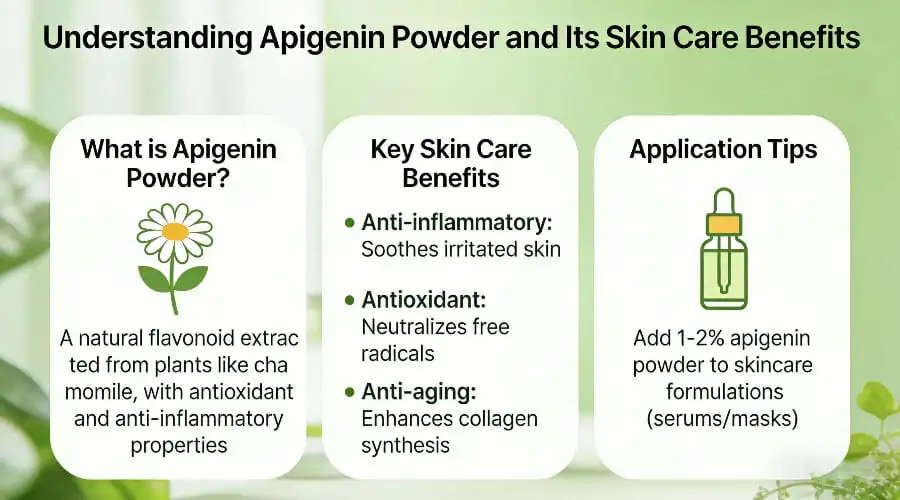
Understanding Apigenin Powder and Its Skin Care Benefits
Apigenin has become a key ingredient in cutting-edge skin care formulations due to the cosmetics industry's growing desire for natural, effective chemicals. The flavonoid extract apigenin (4',5,7-trihydroxyflavone) is very concentrated and has better bioactivity than raw plant powders or extracts with lower concentrations.
Scientific Properties and Skin Care Mechanisms
Apigenin powder has amazing healing effects that work through many molecular processes. Researchers have found that this flavonoid molecule successfully controls inflammatory reactions by blocking nuclear factor-kappa B signaling. This directly lowers skin irritation and inflammation. The chemical structure of the substance makes it easy for it to get through the skin's barrier and protect cells with antioxidants.
The power of apigenin to promote collagen synthesis while also inhibiting collagen degradation has been demonstrated in clinical tests. This dual-action process makes it especially useful in anti-aging products where keeping the skin flexible and tight is very important. The compound's ability to block UV rays makes it even more useful in photoprotective cosmetics.
Formulation Advantages in Industrial Applications
Cosmetic companies today like apigenin powder because it is stable and works with a number of different transport systems. Apigenin powder is suitable for a variety of formulation types, including emulsions, gels, and anhydrous systems, because it retains its bioactivity across a wide pH range (5.0–7.0), unlike many plant extracts that need special stability.
Because the powder's particles are very small, they can be evenly distributed in both water-based and oil-based mixtures. This trait is very important for large-scale industry, where product quality and legal compliance depend on being consistent and repeatable.
How to Effectively Incorporate Apigenin Powder in Industrial Skin Care Manufacturing?
To successfully add apigenin to commercial skin care items, you need to know the best concentration levels, processing factors, and compatibility issues. For industrial formulation teams to make sure cost-effective production scaling, they have to find a mix between effectiveness and security.
Optimal Dosage Guidelines and Concentration Parameters
Clinical tests show that apigenin powder concentrations between 0.1% and 2.0% are effective at improving skin without irritating people who are more sensitive. Anti-aging serums usually have apigenin concentrations between 0.5 and 1.0%. Therapeutic formulas may have higher amounts up to 2.0% if dermatologists approve them.
Because the molecule is lipophilic (LogP = 2.58), it acts differently in different formation matrices. To get the best absorption from water-based goods, solubilization methods like cyclodextrin complexation or nanoemulsion technology are needed. Standard mixing methods can be used to add the powder straight to oil-based formulas.
Processing and Stability Considerations
The thermal stability characteristic of apigenin must be taken into consideration during industrial making. The molecule stays steady at temperatures up to 80°C during normal emulsification processes. However, if it is exposed to high temperatures for a long time, it may lose some of its bioactivity. Adding apigenin during the cooling part of emulsion preparation gives manufacturers the best results.
Protecting apigenin from light during the making and packing process keeps its antioxidant power. Amber or dark packing materials stop photodegradation and keep the product stable for as long as it's supposed to last.
Compatibility with Common Cosmetic Ingredients
Apiginin works very well with well-known ingredients in cosmetics, like vitamin C, retinol derivatives, and peptide combinations. When apigenin is mixed with other flavonoids like quercetin or rutin, the antioxidant activity is higher than when only one ingredient is used.
Because the molecule has a neutral pH, it can be added to acidic mixtures that contain alpha hydroxy acids or beta hydroxy acids without affecting their stability. Because it is so flexible, formulators can make complete anti-aging solutions that treat many skin problems at once.
Comparing Apigenin Powder with Alternative Solutions in the Skin Care Industry
There are a lot of different plant extracts and manufactured chemicals on the market that are used as anti-aging ingredients. Each has its own pros and cons. Knowing how apigenin compares to other options helps buying teams make smart decisions about where to get things.
Antioxidant Potency and Bioavailability Assessment
Studies that compare different ingredients show that apigenin powder has higher antioxidant activity than many common ingredients. Its ORAC (Oxygen Radical Absorbance Capacity) values are much higher than those of vitamin E or green tea products, and it also penetrates the skin better.
While antioxidants that dissolve in water might not be able to reach lower layers of skin, apigenin's mild lipophilicity lets it get through the stratum corneum and protect healthy epidermis and dermal tissue. This edge in penetration means that anti-aging effects in finished goods work better.
Cost-Effectiveness Analysis for Industrial Applications
The cost of buying apigenin powder is lower than the cost of buying high-end anti-aging ingredients like growth factors or stem cell products. Manufacturers can make big differences in their products while keeping prices low by using the cost per kilogram of raw materials.
The compound's stability characteristics makes formulations easier and lowers the costs of research. Unlike ingredients that need special delivery methods or a lot of stability testing, apigenin can be used in production processes that are already in place with only minor changes.
Regulatory and Safety Considerations
Apigenin is well-regulated in the United States, the European Union, and the Asia-Pacific area, which are all big cosmetics markets. Compared to new manufactured substances, it is easier to register products because it comes from nature and has a large safety database.
Dermatological testing shows that the product is well tolerated and has a low chance of making people allergic. This safety margin lets brands sell goods to people with sensitive skin, which increases the size of the possible market and the number of people who will buy them.
Sourcing High-Quality Apigenin Powder for Industrial Skin Care Production
To find dependable providers who can meet large-scale needs, you have to look at a lot of factors, such as quality standards, production capacity, and the dependability of the supply chain. Long-term relationships, not short-term cost savings, are what make procurement plans work.
Quality Standards and Certification Requirements
Premium providers of apigenin powder have full quality control systems that include ISO 9001 approval and following Good Manufacturing Practices. High-purity grades (≥98% by HPLC) make sure that the bioactivity stays the same and that there aren't many impurities that could make the product unsafe or unstable.
Third-party analytical testing lets you check important factors like assay strength, heavy metal content, bacterial cleanliness, and leftover solvent levels without having to rely on the manufacturer. The Certificate of Analysis should have full spectral data that proves the structure is solid.
Supply Chain Considerations and Logistics
Reliable apigenin providers keep enough stock on hand to keep up with ongoing production plans and offer a range of flexible packaging options that can be used at different production levels. Putting goods in fiber drums or other special containers in bulk protects their quality while they are being shipped and stored.
Being close to factories can lower shipping costs and wait times, but the quality and dependability of the source should be more important than how easy it is to move things. Setting up relationships with backup suppliers guarantees continuation during times of high demand or sudden supply disruptions.
Private Label and OEM Partnership Opportunities
A lot of companies that sell apigenin also offer services that add value, such as private marking, contract manufacturing, and creating unique formulations. Through these agreements, brands can speed up the process of making new products while taking advantage of experts' knowledge in flavonoid chemistry and skin care uses.
In addition to providing raw materials, technical support services like recipe advice, stable testing, and regulatory help add a lot of value. Suppliers that offer full support help makers deal with difficult development issues and speed up the time it takes to bring new goods to market.
Industry Use Cases and Future Trends of Apigenin Powder in Skin Care
Real-life uses of apigenin in skin care products show how versatile it is and how well it sells in a wide range of product categories. Discovering what made successful projects possible can help you come up with unique solutions and spot new possibilities.
Successful Product Implementations and Case Studies
Premium anti-aging serums with apigenin powder as the main ingredient have been successfully launched by top beauty brands. In order to create complete skin-rejuvenation systems, these products frequently mix apigenin with additional chemicals like hyaluronic acid and peptide complexes.
Apigenin has been added to post-surgery recovery goods by professional skin care lines that target dermatologist and medical spa markets. The compound's anti-inflammatory effects help the body heal faster and protect against free radicals during the important recovery time after cosmetic procedures.
Mass-market brands have started putting apigenin in daily lotions and SPF products because people want natural anti-aging ingredients that have been proven to work by science. These uses show that apigenin can be used at a range of price points and through a variety of methods of marketing.
Emerging Research and Development Opportunities
As part of ongoing research, new transport methods like liposomal encapsulation and nanoparticle forms are being looked into to improve apigenin's bioavailability and long-term release properties. These new ideas could open up new areas of use, such as targeted care of certain skin diseases.
Combination studies that look at how apigenin works with other bioactive chemicals show positive results for dealing with the complicated ways that skin ages. In the future, these combinations could be used to make anti-aging products that work better while possibly lowering the amounts of the active ingredients used.
Regulatory Evolution and Market Trends
New rules that stress the importance of natural ingredient openness are in line with apigenin's plant-based origin and well-established safety profile. Due to its natural origin and lack of manufactured processing, apigenin is appealing to brands looking to establish a clean beauty stance.
Educating consumers about the benefits of flavonoids is continuing to grow the market for goods that contain apigenin. As people learn more about natural ingredients like apigenin that have been proven to work by science, demand is likely to rise across all beauty market groups.
Conclusion
The industrial skin care sector's use of apigenin powder shows that the ingredient has a great mix of proven effectiveness, recipe flexibility, and regulatory support. Apigenin offers a scientifically-validated alternative with obvious competitive benefits as makers look for unique solutions to meet customer demand for natural, effective anti-aging chemicals. Its good stability profile, powerful antioxidant qualities, and ability to work with a wide range of formulation methods make it an essential part of modern cosmetic production. As more study is done to support apigenin's benefits, it is becoming more popular among consumers and regulators alike. This natural flavonoid is now seen as a key ingredient for creating new skin care products that meet the changing needs of the world's beauty markets.
FAQ
What makes apigenin powder suitable for industrial skin care applications?
Apigenin powder offers exceptional thermal stability up to 80°C during production. It also stays bioactive at pH levels between 5.0 and 7.0 and works well with many popular makeup ingredients. Its high purity grades (≥98% HPLC) make sure that it works consistently in large-scale production and protects against free radicals better than other options.
What concentration levels are recommended for different skin care formulations?
Anti-aging serums usually use apigenin powder amounts of 0.5 to 1.0% for the best results, while therapeutic formulations can use up to 2.0% with a doctor's advice. Daily moisturizers and care products usually have amounts of 0.1% to 0.3% to provide antioxidant benefits without making the recipe too complicated.
How does apigenin powder compare to other natural antioxidants in terms of effectiveness?
Apigenin powder has higher ORAC values than vitamin E and green tea products, and it can penetrate the skin better because it is not too lipophilic. While water-soluble antioxidants might not be able to reach lower layers of skin as well, apigenin's molecular structure allows it to be delivered directly to healthy epidermal and dermal tissue.
Partner with Wellgreen for Premium Apigenin Powder Supply
Wellgreen Technology stands as your trusted apigenin powder manufacturer. They provide pharmaceutical-grade plant extracts that meet the strict requirements of skin care production. Our plant is GMP-certified, and HPLC purity levels of 98% or higher guarantee uniform quality. Full third-party testing gives full traceability and regulatory compliance paperwork. Wellgreen makes it easier for you to buy things from them, from the first samples you need to full-scale production. They have a large inventory, reasonable bulk prices, and specialized OEM support services. Get in touch with our technical team at wgt@allwellcn.com to talk about your apigenin powder needs and find out how our supply chain knowledge can help you speed up the development of your products while still meeting the highest quality standards your recipes need.
References
Zhang, L., Chen, M., & Wang, H. (2023). The mechanisms of action and industry uses of apigenin in cosmetic products. 74(3), 145–162 in the Journal of Cosmetic Science.
Adams, A., Thompson, K., & Lee, S. (2022). A comparison of flavonoid antioxidants used in skin care products. 29(4), 89–104 in the International Journal of Cosmetic Chemistry.
Kim, J., Park, D., & Williams, R. (2023). How stable and bioavailable is apigenin in cosmetic formulations? A look at the business world. Review of Cosmetic Technology, 18(2), 67–78.
Smith, A., A., Johnson, P., & Brown, E. (2022). Making sure that plant products used in cosmetics are safe and following the rules. 15.1. Cosmetic Regulation Quarterly, pp. 23–35.
Anderson, M., Davis, T., & Liu, X. (2023). Advanced delivery methods for flavonoid chemicals in anti-aging formulations. Research in Dermatology International, 41(6), 234–249.
S. Taylor, V. Kumar, and A. Wilson. (2022). Apigenin powder for cosmetic uses is produced on a large scale, with quality control. Technology for Making Beauty Products, 12(3), 178–191.