Can Bitter Melon Extract Powder Fit Botanical Blends and Functional Food Formulations?
2026-10-06 14:00:02
Bitter Melon Extract Powder can fit a botanical blend or a functional food formulation, but only on the same terms as any other bitter, finely milled, hygroscopic botanical: the extract has to pass through blending, filling and storage without changing the product it joins. Wellgreen's Bitter Melon Extract Powder is a workable reference point for that discussion, because its published specification states what a formulator can actually measure — a yellow-brown fine powder, characterised at 10–20% bitter gourd extract and 10% saponins by UV, TLC and HPLC. This article answers the compatibility question on formulation grounds alone: specification, taste, blend engineering, process fit and scale-up.
What the Specification Has to Pin Down
Blend compatibility is largely settled before a purchase order exists. Two materials sold as "bitter melon extract" can behave as two different powders in the same blender, and the difference is usually invisible on a marketing sheet. Four specification items do the heavy lifting.
Characterisation basis: ratio or standardisation
A ratio extract such as 10:1 describes how much raw fruit was fed into the process; it does not describe what came out. A standardised or otherwise characterised grade fixes a measurable reference point instead. In Wellgreen's case that reference is bitter gourd extract at 10–20% together with 10% saponins, assayed by UV, TLC and HPLC. For blending, the characterised route is easier to work with: QA gets a number to release against, and R&D gets a defensible basis for the ingredient list and for any label statement that survives regulatory review.
The chemistry behind that characterisation is documented. Cucurbitane-type triterpenoids and steroidal glycosides are among the compounds isolated from Momordica charantia, and they are the kinds of structures a marker method is built to detect [4]. Where a supplier cannot name the marker basis, the buyer cannot compare two quotations at all.
Mesh, particle-size distribution and dust load
Wellgreen's certificate of analysis states that 95% of the powder passes an 80 mesh sieve. That figure is a useful floor rather than a complete picture. Two lots can both pass 80 mesh and still separate inside a blend, because segregation is driven by the width of the distribution, not by the cut point [1]. A formulator should therefore ask for D10, D50 and D90 alongside the mesh statement, and should treat the fines fraction as a dust-control question, not only a uniformity question.
Moisture, water activity, density and flow
Loss on drying of 5.0% or below and ash of 8.0% or below appear on the same certificate. Moisture alone, however, is a weak predictor of how a hygroscopic powder will run: water activity describes the effect of water content on flow more usefully, and moisture uptake raises cohesion long before a powder looks wet [5]. Bulk density, tapped density, the derived Hausner ratio, angle of repose and a shear-cell or ring-shear flow function complete the picture, and they should be quoted the same way on every lot so that trends are visible [3].
Table 1. Blend-compatibility reference: what each specification item changes in a blend.
| Specification item | Typical figure on the Wellgreen product page / COA | Why it matters in a blend | What to request from the supplier |
|---|---|---|---|
| Appearance | Yellow-brown fine powder | Sets the colour a blend will drift towards; pale matrices pick up a visible tint | Colour description plus a photo per lot, if colour is a selling point |
| Characterisation basis | 10–20% bitter gourd extract; 10% saponins | Gives QA a release number instead of a ratio claim | Named marker, method and validated range |
| Test method | UV, TLC, HPLC | Methods are not interchangeable; results must be comparable lot to lot | The method used per marker, and whether a reference standard is used |
| Particle size | 95% pass 80 mesh | A cut point does not prevent segregation; distribution width does | D10 / D50 / D90 and sieve-fraction data |
| Loss on drying | ≤5.0% | Drives caking and flow loss during blending and filling | Water activity in addition to LOD |
| Ash | ≤8.0% | Indicates the mineral / inert load carried into the blend | Consistency across lots |
| Heavy metals and microbiology | Heavy metals <10 ppm; Pb, As, Hg, Cd <1 ppm each; total count ≤1000 cfu/g; yeast and mould ≤100 cfu/g; E. coli, Salmonella, Staphylococcus negative | Limits how much of the blend can be a single botanical before the finished product's own limits are approached | Full COA per lot, plus third-party verification for high-inclusion work |
| Packaging and shelf life | 1–5 kg aluminium foil bag or 25 kg drum; 2 years, cool and dry, away from strong light and heat | Determines in-house handling, dispensing and storage discipline | Stability data behind the assigned shelf life |
Bitterness Is the Binding Constraint
Everything else on this list can be engineered around. Bitterness sets the ceiling. A bitter botanical carries both an immediate bitter intensity and a lingering aftertaste that grows more noticeable in the second half of the sip or the chew, and that aftertaste is what usually kills a repeat purchase. It also decides where the extract can go at all: inside a swallowed capsule the taste is largely irrelevant, while in a dry-mix sachet, an instant powder or a ready-to-mix beverage the entire bitter load is exposed to the consumer in the first three seconds.
Worse, bitterness is a function of the finished matrix, not of the extract alone. A sweet, dairy-based matrix masks differently from an acidic fruit matrix or a plain aqueous one, and the perceived ceiling moves with temperature, sweetness and total dissolved solids. There is no universal inclusion rate; there is only the rate that passes your own panel in your own matrix.
The masking toolkit a formulator actually has
Five levers are available, and in practice they are used in combination.
- Flavour systems. Warm spice and citrus notes are the conventional counterweights to a bitter, green-vegetable character. Spices already established in functional food formulations, such as organic ginger powder, also bring their own pungency, which changes how the bitter note is perceived even when the bitterant concentration is unchanged.
- Sweetener choice. Bulk sweeteners do more masking work than high-intensity sweeteners, because they add body and viscosity alongside sweetness. A high-intensity sweetener on its own often sharpens the aftertaste instead of covering it, so the two are normally paired.
- Encapsulation. Spray-dried microencapsulation with a wall material such as maltodextrin or gum arabic physically separates the bitter principle from the taste receptors, and the same wall material can carry a bitter blocker with it [7]. Wall-material choice is a real formulation decision: polysaccharide and protein walls differ in encapsulation efficiency, particle size and mouth behaviour.
- Bitter blockers and complexation. Physical approaches aim to bind the bitterant in the saliva so that less of it reaches the receptor, which makes the ratio of binder to bitterant — not the absolute amount of blocker — the variable that matters [2]. Cyclodextrin complexation follows the same logic.
- Carrier dilution. Raising the carrier fraction lowers bitterant concentration per serving and, just as importantly, spreads the bitterant through more particles. This is the cheapest lever and the one that most often collides with label and cost targets.
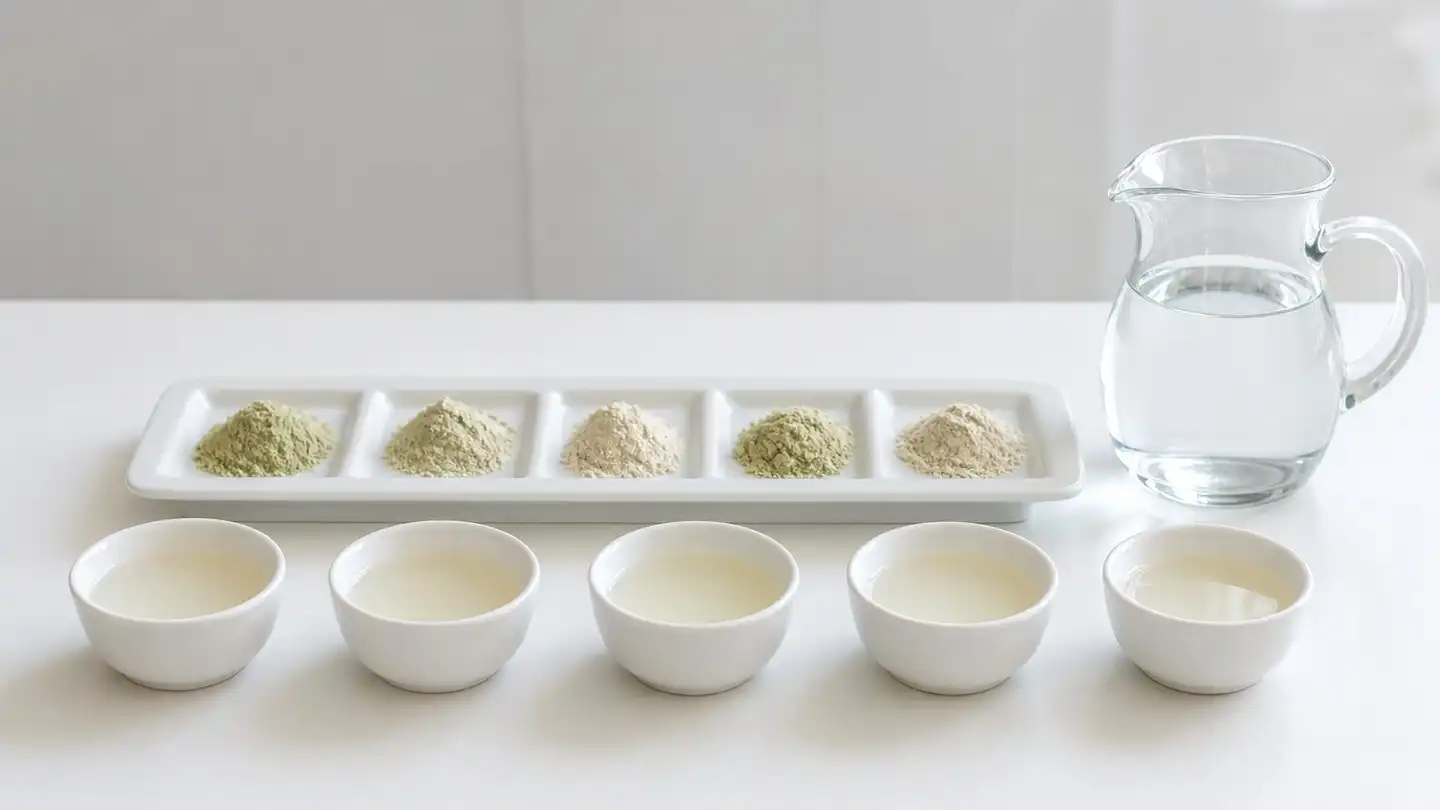
Running a Tasting Panel to Find the Ceiling
A blend-compatibility decision needs a defensible number, and the only defensible number comes from a controlled panel. Descriptive sensory work starts with trained assessors quantifying defined attributes on intensity scales, which is what turns "too bitter" into an inclusion limit a specification can reference [6].
Table 2. Tasting-panel design for locating the bitterness ceiling in a target matrix.
| Design element | Recommendation | Reason |
|---|---|---|
| Panel type | Trained descriptive panel, screened for bitter sensitivity | Consumer panels measure liking, not intensity; they cannot locate an inclusion ceiling |
| Panel size | 8–12 assessors per session | Enough replication for attribute means to stabilise without exhausting resources |
| Attributes scored | Immediate bitter intensity, lingering aftertaste at 30 s and 60 s, overall flavour balance, mouthfeel / chalkiness, aroma intensity | Aftertaste and mouthfeel are usually the failing attributes, not peak bitterness |
| Scale | 15-point category or 100 mm unstructured line scale, anchored at both ends | Anchored scales are needed for a usable ceiling |
| Sample set | The finished matrix at zero inclusion plus at least three escalation levels of the extract, all otherwise identical | Isolates the extract as the only variable |
| Sample preparation | Fixed dose weight, fixed liquid volume and temperature, standardised stirring and rest time | Powder dispersion behaviour changes perceived bitterness sharply |
| Presentation | Blind, randomised, balanced order, coded with three-digit numbers, water and plain carrier rinse between samples | Removes order and carry-over bias |
| Acceptance rule | Highest level that stays below the pre-agreed intensity threshold for both immediate bitterness and 60-second aftertaste | Sets the ceiling before commercial pressure is applied |
Note on study conditions: any inclusion level evaluated in a panel is an experimental condition specific to that matrix and that panel. It is not a recommended use level, and it should never be transferred to a different product without re-testing.
Blend Engineering: Keeping the Mixture Uniform
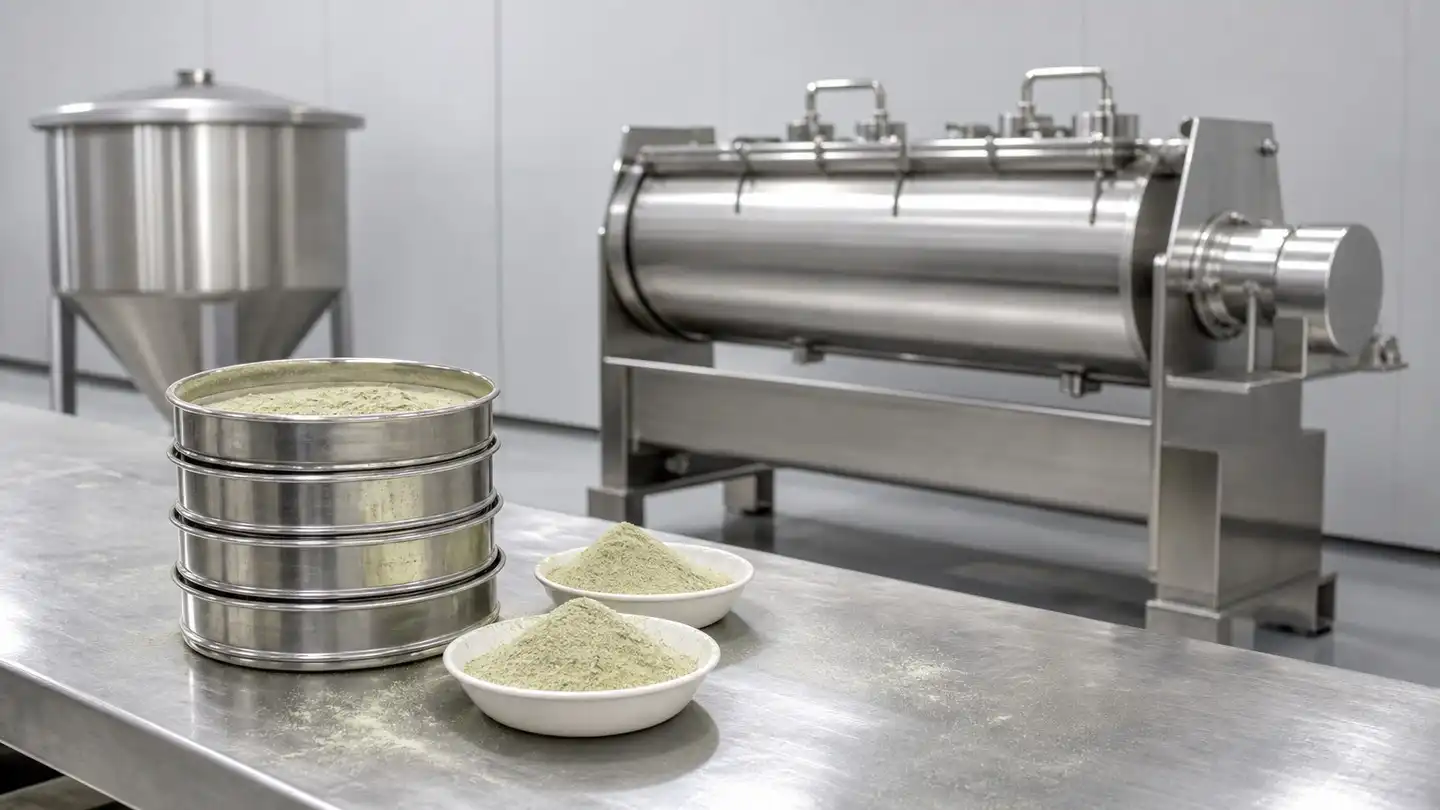
Once the ceiling is known, the engineering question becomes whether the blend will still meet its own specification after transfer, transport and filling. Content uniformity is a blend property, not a mixer property: losses come from segregation during storage, transfer and hopper discharge as much as from under-mixing at the start [1].
Matching particle sizes
Segregation is driven by differences in particle size, shape and density between the extract and its co-ingredients, and it appears as soon as the powder is in motion — during discharge, vibration or filling [1]. A coarse crystalline carrier and a fine extract will separate even after a perfect mix. The practical fix is to align the extract's D50 with that of the dominant carrier, or to pre-blend the extract with a portion of the carrier before the final mix.
Dusting and dust control
Fines travel: they stick to blender walls, transfer chutes and sachet-forming heads, and they preferentially leave with the exhaust air. A fine hygroscopic botanical in a low-inclusion formula is a dust and housekeeping problem before it is an analytical one. Closed transfers, local extraction at the filling head, and a documented clean-out between products all reduce both losses and cross-contamination risk. Green superfood style blends based on barley grass powder are a common carrier context here, because they already run with a fine, dusty, high-surface-area powder fraction.
Low-inclusion-rate uniformity
Uniformity risk rises as the extract's share of the formula falls. Good practice is a geometric or pre-blend dilution stage, a defined mix time validated against uniformity data rather than against habit, and sampling from multiple locations in the blender and from the first, middle and last portions of the fill run.
Carrier and diluent choice
The carrier is not filler; it is the material that decides whether the extract stays dispersed. A carrier whose particle-size band overlaps the extract's, that is free-flowing, and that is not itself strongly hygroscopic, will hold the blend together better than an inert material chosen purely on cost. Where the carrier contributes flavour or colour — a green powder, a spice, a fruit powder — that contribution should be evaluated in the panel alongside the extract's bitterness.
Hygroscopicity and caking between blending and filling
This is the most under-specified stage of the process. A blend that flows cleanly out of the mixer can cake in a hopper over a shift or fail completely over a weekend. Water activity, not absolute moisture, predicts that behaviour [5], and where agglomeration is the problem, powder processing approaches such as controlled granulation or the use of anti-caking co-processed carriers are the standard remedies [3].
Process Fit Across Product Formats
The same powder meets very different requirements in different formats, and the failure mode changes with each.
Table 3. Process fit by delivery format.
| Format | What the extract must deliver | Main risk | Practical safeguard |
|---|---|---|---|
| Hard capsule | Dense, free-flowing, low dust, consistent fill weight | Fill-weight variation from poor flow; dust loss at the dosing station | Tapped-density and flow data per lot; in-process fill-weight checks |
| Dry-mix sachet / stick pack | Full dispersion in a small water volume; taste control | Clumping and floaters; bitterness and aftertaste at full exposure | Granulation or carrier pre-blend; validated panel ceiling |
| Ready-to-mix powder | Rapid wetting with no persistent lumps | Poor hydration behaviour; colour contribution to a clear or pale drink | Carrier choice, dose-level hydration testing, colour check against the target standard |
| Functional food matrix (bars, bites, baked, dairy-style) | Thermal and shear tolerance; no moisture migration into the matrix | Moisture transfer between components; taste drift over shelf life | Water-activity matching of all components; accelerated storage checks |
Hydration behaviour deserves its own test. A fine botanical powder that wets slowly will form surface-agglomerated lumps that never fully disperse, and the same particle-level phenomena that limit dissolution in simple powder blends also drive caking and dispersion behaviour in more complex ones, as work on quercetin dihydrate in powder blends illustrates. Colour is the second quiet variable: a yellow-brown powder shifts a green blend towards olive and tints a white or clear matrix visibly, so colour standards should be agreed between R&D, QA and the customer before scale-up, not after.
Storage, Packaging and Light / Moisture Protection
Wellgreen's specification assigns a two-year shelf life and states that the material should be held cool and dry, away from strong light and heat, in 1–5 kg aluminium foil bags or 25 kg drums. That is the right starting frame, and it translates into four operating rules. Keep the powder in its sealed foil or drum until dispensing. Control the dispensing area's relative humidity, because a hygroscopic powder picks up moisture every time it is opened. Protect against light during both storage and in-process residence. And bring the extract into the blend last, so its exposure to open air is measured in minutes rather than hours. Where the finished format is itself moisture-sensitive, matching the water activity of every component is more effective than adding desiccant and hoping.
Scale-Up Checklist
- Lock the specification basis — marker, method and range — before any formulation work begins.
- Obtain D10 / D50 / D90, water activity, bulk and tapped density, and a flow measurement for the exact lot you will scale on.
- Run the panel in the finished matrix, and record the ceiling as an internal specification with its test conditions.
- Validate mix time, pre-blend dilution and sampling plan against content-uniformity data, not against a previous product.
- Check flow at the filling head, not only in the laboratory, and re-check after a full hopper residence time.
- Agree colour standards and appearance criteria in writing before the first commercial batch.
- Confirm regulatory status and permitted label wording for every target market with your own regulatory team.
Wellgreen supplies Bitter Melon Extract Powder against this kind of specification. The product page lists ISO 9001:2015, ISO 22000, HACCP, Halal and Kosher certification, a batch COA, and packaging from 1–5 kg foil bags to 25 kg drums or OEM formats. For sample requests, specification sheets or blend-compatibility questions, contact wgt@allwellcn.com or review the Bitter Melon Extract Powder specification directly.
This article provides technical and commercial information for industry professionals; it is not medical advice, and use levels, regulatory status and label claims must be confirmed against the rules of each target market and against your own product data.
References
- Jakubowska, E., Ciepluch, N. (2021). Blend Segregation in Tablets Manufacturing and Its Effect on Drug Content Uniformity — A Review. Pharmaceutics, 13(11), 1909. https://doi.org/10.3390/pharmaceutics13111909
- Coupland, J. N., Hayes, J. E. (2014). Physical Approaches to Masking Bitter Taste: Lessons from Food and Pharmaceuticals. Pharmaceutical Research, 31(11), 2921–2939. https://doi.org/10.1007/s11095-014-1480-6
- Shah, D. S., Moravkar, K. K., Jha, D. K., Lonkar, V., Amin, P. D., Chalikwar, S. S. (2023). A concise summary of powder processing methodologies for flow enhancement. Heliyon, 9(6), e16498. https://doi.org/10.1016/j.heliyon.2023.e16498
- Liu, J. Q., Chen, J. C., Wang, C. F., Qiu, M. H. (2009). New cucurbitane triterpenoids and steroidal glycoside from Momordica charantia. Molecules, 14(12), 4804–4813. https://doi.org/10.3390/molecules14124804
- Suhag, R., Kellil, A., Razem, M. (2024). Factors Influencing Food Powder Flowability. Powders, 3(1), 65–76. https://doi.org/10.3390/powders3010006
- Marques, C., Correia, E., Dinis, L. T., Vilela, A. (2022). An Overview of Sensory Characterization Techniques: From Classical Descriptive Analysis to the Emergence of Novel Profiling Methods. Foods, 11(3), 255. https://doi.org/10.3390/foods11030255
- Pudžiuvelytė, L., Petrauskaitė, E., Stabrauskienė, J., Bernatonienė, J. (2025). Spray-Drying Microencapsulation of Natural Bioactives: Advances in Sustainable Wall Materials. Pharmaceuticals, 18(7), 963. https://doi.org/10.3390/ph18070963
- U.S. Food and Drug Administration. 21 CFR Part 111 — Current Good Manufacturing Practice in Manufacturing, Packaging, Labeling, or Holding Operations for Dietary Supplements. Electronic Code of Federal Regulations. https://www.ecfr.gov/current/title-21/chapter-I/subchapter-B/part-111
- Regulation (EC) No 1924/2006 of the European Parliament and of the Council of 20 December 2006 on nutrition and health claims made on foods. EUR-Lex. https://eur-lex.europa.eu/legal-content/EN/TXT/?uri=CELEX%3A32006R1924