Oat Beta Glucan Powder for Bakery, Yogurt, Beverage, and Functional Food Formulations
2026-10-08 15:35:47
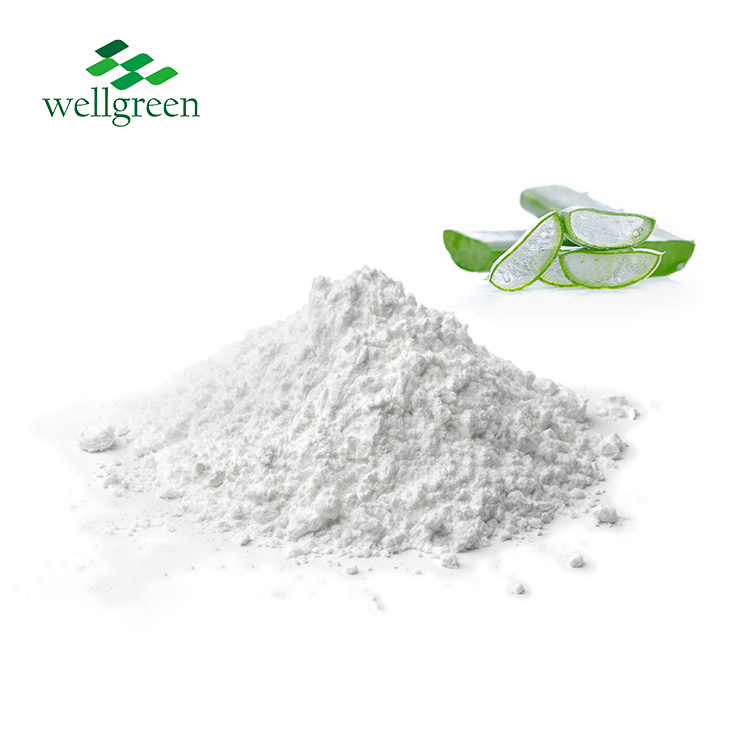
Oat Beta Glucan Powder is not one interchangeable commodity but a family of water-soluble, mixed-linkage (1→3)(1→4)-β-D-glucan fractions from the endosperm cell walls of Avena sativa, and the grade a developer buys largely decides which formats are practical. The concentrate Wellgreen lists on its oat beta glucan powder product page is specified at 80%–90% β-glucan by HPLC as a white powder — a specification that suits concentrated formats better than a lightly enriched bakery flour. This format-by-format map covers what to control in bakery, yogurt and fermented dairy, beverages, and functional-food and powder formats.
The Two Variables That Drive Every Format Decision
Two parameters explain most of the behaviour across all four families. The β-glucan content sets how much material must be hydrated to reach a target fibre declaration, and therefore how much carrier, colour and mouthfeel the formula inherits. Molecular weight (Mw) sets the viscosity generated once hydrated. The two are independent: the same assay at different Mw behaves nothing alike in a dough, gel or drink. The chemistry is summarised in Wellgreen's explainer on what oat beta-glucan is; Wood (2010) reviews the rheology and treats viscosity as the central functional variable.
Content and Purity: What the Assay Fixes
Assay determines the dose burden. A 20% grade needs several times the mass of an 80% grade to deliver the same β-glucan, so lower-assay material brings proportionally more of its own starch, protein, colour and flavour into the mix. The specification should also name the method behind the number, because different enzymatic and instrumental routes do not return identical values on one lot.
Molecular Weight and Viscosity: The Real Constraint
Mw usually decides whether a format is feasible at all. Rosa-Sibakov et al. (2022) demonstrated this in an oat bran concentrate: enzymatic hydrolysis and microfluidisation lowered β-glucan Mw from 2748 kDa to 893 kDa and 350 kDa respectively, the viscosity of a heated suspension fell with it, and colloidal stability improved. In bread, Hu et al. (2022) used a low-Mw β-glucan (about 5300 Da) at a study level of 0.858% of flour and reported higher specific volume and moisture. Native high-Mw fractions thicken far more aggressively at the same solids, so grade selection is a viscosity decision before it is a declaration decision.
Regulatory Context: How Oat Beta-Glucan Claims Are Written
Regulators attach β-glucan claims to a finished food, not to an ingredient, and the two major regimes differ in construction. In the United States, 21 CFR 101.81 authorises a health claim for soluble fibre from certain foods and the risk of coronary heart disease. It defines the eligible oat sources, requires qualifying wording such as “may” or “might”, imposes saturated-fat and cholesterol criteria on the food itself, and ties the claim to a daily intake of 3 g or more of β-glucan soluble fibre.
In the European Union, Regulation (EC) No 1924/2006 governs claims and Commission Regulation (EU) No 432/2012 holds the list of permitted non-disease-risk claims. The EFSA NDA Panel opinion published as EFSA Journal 9(6):2207 assessed β-glucans from oats and barley, covering several authorised areas with their own intake and per-portion conditions. The practical consequence is that one powder can support a claim in one format and not in another, because the claim depends on how much β-glucan reaches a serving and on the rest of the matrix; whether a specific finished product may carry a claim must be confirmed against the target market's rules and the brand's own substantiation file.
Bakery: Dough Hydration, Gluten Interaction, and Bake and Freeze–Thaw Stability
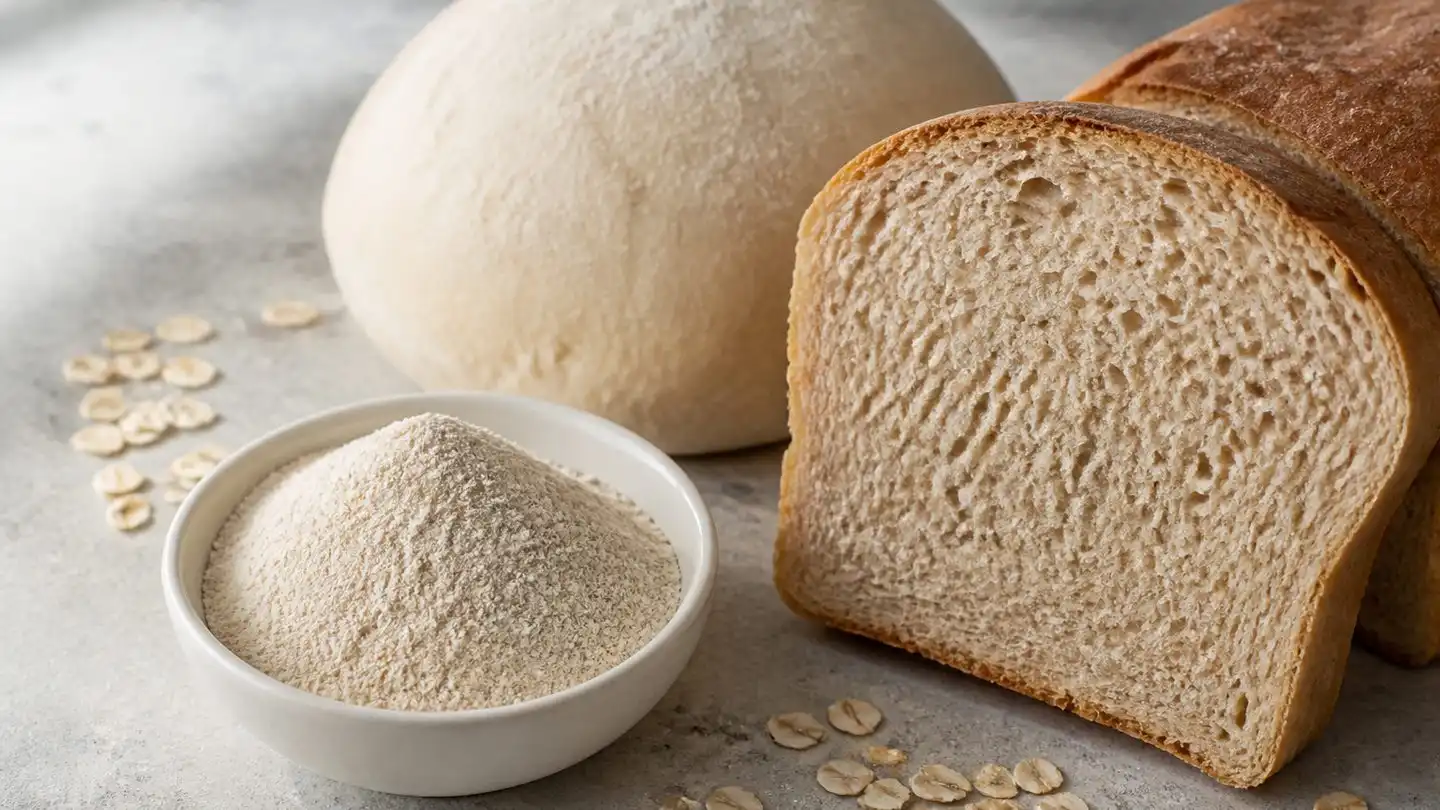
Bakery is where β-glucan competes with the flour for water, so the first task is to rebalance hydration. Both the hydrocolloid and the flour it displaces are thirsty; unchanged water addition tends to give a stiff, under-hydrated dough, while over-correcting gives slack dough that cannot hold gas. Establish absorption on the actual flour stream. A related question is whether to use the purified, high-assay oat extract line or a fibre-rich carrier fraction that also contributes bulk.
Gluten-Network Interaction and Crumb Structure
Interaction with gluten is the second lever. Soluble β-glucan acts as a hydrophilic colloid and can reinforce the gluten network — Hu et al. (2022) describe that reinforcement alongside higher moisture retention and a softer crumb — whereas coarse insoluble bran particles interrupt the gluten film, lower dough resistance and depress loaf volume. A finely divided β-glucan fraction and a coarse bran-rich stream are therefore not interchangeable inputs in a bread.
Bake and Freeze–Thaw Stability of the Hydrocolloid
Thermal and cold-chain history act on the hydrocolloid itself. Bake temperature and time, and the number of freeze–thaw cycles a dough or part-baked product sees, both affect the polysaccharide and its water distribution; where a product is frozen, the dough stage — not the finished crumb — decides its cold stability. Lv et al. (2025) found a laboratory oat β-glucan of about 1.1 × 10⁵ Da, at a study level of 0.85% flour replacement, raised bread specific volume and moisture and delayed crumb ageing by inhibiting starch recrystallisation. Those are published experimental conditions, not recommended use levels; the transferable point is that Mw and the surrounding ingredients, not the assay alone, drive crumb outcome.
Yogurt and Fermented Dairy: Viscosity, Water Binding, and Shelf-Life Texture
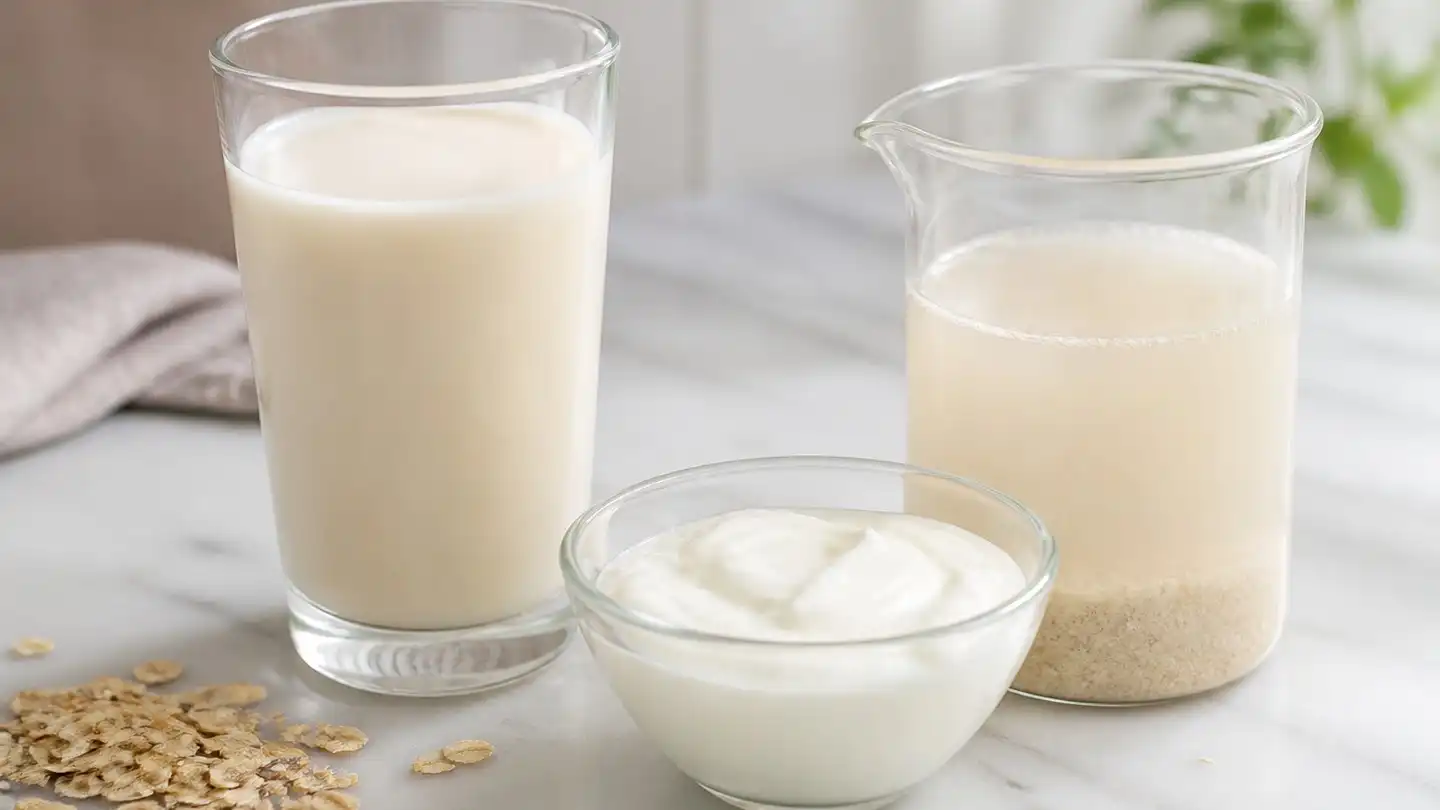
In set and stirred yoghurt the decisive question is how the polysaccharide interacts with the casein network. β-Glucan can interfere with gel formation and yield weaker gels, or compensate by forming a water-entrapping secondary structure among the casein micelles; which dominates depends on the source, the extraction route, and the Mw and concentration of the preparation. Rosa-Sibakov et al. (2022) found oat-bran concentrate added to acid milk gels decreased syneresis, improved water-holding capacity and softened texture — a reminder that water binding and firmness move independently, so appearance must be assessed alongside texture.
Fermentation adds a second variable: the ingredient is present during acidification, so it can influence the rate of pH decline and the texture developed over shelf life. A sibling review in this series covers fermented-dairy and beverage texture in depth, so this map keeps those two families brief.
Beverages: Hydration, Dispersion, and Suspension Over Shelf Life
Beverages invert the bakery problem: there is no flour to absorb water and no bake step to set structure. The powder must hydrate cleanly, must not build more viscosity than the mouthfeel can carry, and must stay suspended for the whole of the shelf life.
Getting the Powder into Water Without Lumping
Dispersion is a unit operation before it is a formulation question: adding a hygroscopic hydrocolloid too quickly forms a gel layer around dry particles and traps the rest in lumps. Dry-blending the β-glucan with sugar, maltodextrin, acid or flavour before hydration, and controlling the point of addition and the shear there, are standard countermeasures. Particle size is the other: a coarse, agglomerated grade wets more evenly, while an ultra-fine grade disperses quickly but dusts and gels at the surface — so particle size belongs on the COA.
Viscosity Build Versus Mouthfeel
Viscosity build is where Mw is felt most sharply. There is a working window between a drink thin enough to be pleasant and one dosed high enough to carry a fibre declaration; high-Mw material can close that window, which is why commercial oat drinks are typically depleted in β-glucan and why lowering Mw by enzymatic or high-pressure treatment is a recognised route to a pourable suspension. Rosa-Sibakov et al. (2022) measured a heated oat-bran suspension at 969 mPa·s.
Heat and Shear History, Then Settling
Pasteurisation and homogenisation impose a heat and shear history that can change the effective size of the polysaccharide and therefore its viscosity and suspending power, so the processing sequence belongs in the trial design. Settling is then the long-term risk: too little structure and the powder sediments, too much and the product gels. Measure viscosity and phase separation at fill and at end of shelf life.
Functional Food and Powder Formats: Dry Blends, Particle Size, and the Sensory Ceiling
Powder and dry-blend formats — drink mixes, meal-replacement sachets, protein blends, bars and capsules — are where high-assay grades earn their place. In a blend the β-glucan must match the particle-size and bulk-density profile of its neighbours so the mix does not segregate in the hopper, sachet or filling line and each scoop carries a representative dose. Wellgreen's product page lists a white powder in 1–5 kg foil bags, 25 kg drums or OEM packaging. The article on pumpkin powder in functional foods and beverages sets out the same logic from a different ingredient class.
Reconstitution behaviour and the sensory ceiling set the practical upper load. An agglomerated or partially hydrolysed grade dissolves readily in cold water but arrives at lower Mw; a native grade dissolves with more difficulty but delivers more structure. Above a certain load a product reads as gummy or slimy rather than merely thick — the sliminess and coarse mouthfeel that Rosa-Sibakov et al. (2022) identify as the reason oat bran is under-used in semi-moist and liquid foods. That ceiling, not the assay, usually caps the load in a powder or bar application.
| Format | Critical stage | What the formulator controls | Failure mode if uncontrolled |
|---|---|---|---|
| Bakery — bread, biscuits, snacks | Mixing, hydration and proving | Water addition against the flour's own absorption; mixing time; dough temperature; particle size of the β-glucan stream | Stiff, under-hydrated dough; depressed loaf volume; coarse or tight crumb |
| Bakery — frozen dough and part-baked | Freezing, frozen storage and bake-off | Number of freeze–thaw cycles; dough moisture; Mw of the hydrocolloid | Ice-crystal damage to the gluten film; uneven bake; variable crumb |
| Yogurt and fermented dairy | Heat treatment, inoculation, acidification, cold storage | Order of addition; heat treatment before inoculation; fermentation temperature and end pH; Mw and concentration | Weak gel; whey separation; phase separation with milk protein; texture drift over shelf life |
| Beverages — RTD and protein drinks | Hydration, pasteurisation and homogenisation | Pre-blending of powders; point and rate of addition; shear at hydration; heat and shear load through the process | Lumping; over-viscosity; sedimentation; gelling on storage |
| Functional food and powder formats | Dry blending, filling, reconstitution | Particle-size and bulk-density matching; blend order; moisture control; agitation during reconstitution | Segregation; dose non-uniformity; caking; gummy or slimy mouthfeel |
Which Format Suits Which Grade?
The decision follows from the two governing variables. Where per-serving mass is tight — capsules, shots, stick packs, concentrated blends — a high-assay grade is efficient, delivering the β-glucan with the least carrier. Where the format accepts a bulk fibre fraction — bread, biscuits, bars, snacks — a mid-range or carrier-rich grade can be easier to handle and contributes to total dietary fibre alongside the β-glucan. Wellgreen's 80%–90% HPLC specification, customisable, sits at the concentrated end.
| Variable | Bakery | Yogurt and fermented dairy | Beverages | Functional food and powder formats |
|---|---|---|---|---|
| β-Glucan content (assay and method) | Fixes the fibre contributed per serving after bake loss | Fixes the fibre per portion of the finished gel | Fixes the fibre per serve and the mass that must dissolve | Fixes the dose per scoop, sachet or capsule fill |
| Molecular weight and viscosity | Drives dough water demand and crumb structure | Drives gel strength, water binding and syneresis | Drives viscosity build, mouthfeel and suspending power | Drives reconstitution behaviour and gumminess |
| Particle size and distribution | Sets hydration rate and crumb evenness | Sets dispersion in the milk base | Sets wetting behaviour, dusting and settling rate | Sets blend uniformity and resistance to segregation |
| Hydration behaviour | Competing water demand against the flour | Dispersion before heat treatment and inoculation | Dispersion without surface gelation or lumps | Cold-water dispersibility on reconstitution |
| Interaction with the matrix | Gluten-network reinforcement or disruption | Casein network and secondary water-entrapping structure | Compatibility with protein, acid and minerals | Compatibility with carrier powders and other actives |
| Process sensitivity | Bake temperature and time; freeze–thaw cycles | Heat treatment, fermentation and cold storage | Pasteurisation and homogenisation heat and shear | Moisture ingress during blending and storage |
Molecular weight then fine-tunes the match. Bakery and powder formats tolerate — and for structure often prefer — a higher-Mw fraction, provided hydration is managed and the sensory ceiling respected. Beverages and fine powder blends need the opposite: controlled Mw or an agglomerated presentation to disperse cleanly and stay pourable. Buying on assay alone leaves the most consequential variable unpinned; requesting solution-viscosity data at the intended concentration, particle-size distribution and the assay method turns a purchase into an engineering decision.
Conclusion
Oat Beta Glucan Powder rewards formulators who treat it as a specified hydrocolloid rather than a generic fibre. Bakery asks about hydration and gluten; fermented dairy about casein interaction and shelf-life texture; beverages about dispersion, viscosity and suspension through heat and shear; powder formats about blend uniformity, reconstitution and the sensory ceiling. Every answer is governed by the same two numbers — β-glucan content and molecular weight — and the process parameters around them. Match the grade to the format, define the analytical basis of the specification, and treat regulatory claims as conditions the finished food must satisfy rather than properties of the ingredient.
Wellgreen supplies Oat Beta Glucan Powder standardized to 80%–90% β-glucan by HPLC, white powder, with custom specification options. The product page lists ISO 9001:2015, ISO 22000, Halal, Kosher and HACCP certificates; confirm their scope against the exact material and site. To discuss a grade for a specific format, or to request a sample, specification and COA package, contact the technical team at wgt@allwellcn.com or review the data on the Oat Beta Glucan Powder product page.
This article provides technical and commercial information for industry professionals evaluating ingredients; it is not medical advice, and use levels, regulatory status and permitted label claims must be confirmed against the rules of the target market and the reader's own product data.
References
- U.S. Food and Drug Administration. 21 CFR 101.81 — Health claims: Soluble fiber from certain foods and risk of coronary heart disease (CHD). Electronic Code of Federal Regulations. https://www.ecfr.gov/current/title-21/chapter-I/subchapter-B/part-101/subpart-E/section-101.81
- EFSA Panel on Dietetic Products, Nutrition and Allergies (NDA). (2011). Scientific Opinion on the substantiation of health claims related to beta-glucans from oats and barley … pursuant to Article 13(1) of Regulation (EC) No 1924/2006. EFSA Journal, 9(6), 2207. https://doi.org/10.2903/j.efsa.2011.2207
- Commission Regulation (EU) No 432/2012 of 16 May 2012 establishing a list of permitted health claims made on foods, other than those referring to the reduction of disease risk and to children's development and health. OJ L 136, 25.5.2012, p. 1–40. EUR-Lex. https://eur-lex.europa.eu/legal-content/EN/TXT/?uri=CELEX:32012R0432
- Wood, P. J. (2010). REVIEW: Oat and Rye β-Glucan: Properties and Function. Cereal Chemistry, 87(4), 315–330. https://doi.org/10.1094/CCHEM-87-4-0315
- Rosa-Sibakov, N., de Oliveira Carvalho, M. J., Lille, M., & Nordlund, E. (2022). Impact of Enzymatic Hydrolysis and Microfluidization on the Techno-Functionality of Oat Bran in Suspension and Acid Milk Gel Models. Foods, 11(2), 228. https://doi.org/10.3390/foods11020228
- Lv, S., Wang, Y., Zhang, S., Wu, S., Feng, X., Xu, S., Li, B., Li, T., Su, W., & Wang, Y. (2025). Ameliorative impact of oat β-glucan on quality of wheat bread: Insight into structural characteristics, textural properties and storage stability. Food Chemistry: X, 30, 102940. https://doi.org/10.1016/j.fochx.2025.102940
- Hu, H., Su, X., Liu, L., & Sang, S. (2022). Impact of Native Form Oat β-Glucan on the Physical and Starch Digestive Properties of Whole Oat Bread. Foods, 11(17), 2622. https://doi.org/10.3390/foods11172622