
Organic Ginger Extract Powder for Sauces, Marinades, and Seasonings
2026-11-06 09:35:53
Organic ginger extract powder is usually bought as a flavour ingredient and then judged on the wrong metric. Buyers compare it with ground ginger root on price per kilo; formulators discover months later that the sauce has gone sweet and woody, or that the marinade has dropped a pale sediment in the bottle. Both outcomes trace back to the same two engineering problems: how the pungent gingerol fraction survives acid and heat, and how a light, partly insoluble powder distributes through a continuous phase. The organic ginger extract powder specification sets the starting conditions; the process around it decides the result.
Pungency Is a Moving Target in Sauce Systems
In a dry spice blend, ginger sits still; in a sauce or a brine it does not. Ginger pungency is a family of related molecules that convert into one another under heat, acidity, and time, and each member of the family reads differently on the palate. A formulator who handles the ingredient as a fixed flavour load will see intensity drift between the pilot batch and the third production run.
Three Compounds, One Conversion Ladder
Fresh ginger is dominated by gingerols, the sharp, clean, front-of-mouth heat. Drying and moderate heating dehydrate gingerol to shogaol, which is more pungent by weight, darker in character, and noticeably less water-soluble. Stronger acid and heat push the same molecule further, cleaving it to zingerone, the sweet, woody, cooked-ginger note that consumers read as "the ginger has gone off". The ladder runs one way in practice, and how gingerol is extracted and standardised determines where on that ladder a commercial powder starts. Zingerone does not convert back, so the loss is permanent for that batch.
The Loss Window: Acid, Heat, and Time
The three variables interact rather than add up. Acid alone at chill temperature is a slow actor: a vinegar marinade held at 4 °C changes its gingerol profile gradually over days, and most of the loss is acceptable within a normal shelf life. Heat alone, at near-neutral pH, is also survivable within a short hold. Acid and heat together are where the curve steepens, because the dehydration step is acid-catalysed and the cleavage step is thermally driven.
The practical consequence is that the dosing point matters more than the dose: powder added before the heat exchanger absorbs the full thermal load, and powder added downstream of cooling absorbs almost none. A rule of thumb from reaction kinetics is that the rate roughly doubles to triples for every 10 °C rise, so a two-minute hold at 90 °C is far heavier than thirty seconds at 72 °C. Use that as a screening tool and confirm it in your own matrix.
Why Acid Alone Is Not the Enemy
Low pH also brings benefits that are easy to overlook. A pH below 4.6 suppresses the non-enzymatic browning that dulls the powder's yellow colour, and it slows microbial growth, which lets you shorten the thermal process. The design goal is not to avoid acid but to separate acid from heat: acidify early, heat late and briefly, and dose the ginger where the product is already cool.
What the Specification Sheet Actually Controls
A specification sheet is a risk document, not a marketing page, and for standardised ginger extract powder it is the only document that constrains lot-to-lot variation. The parameters below change how the powder behaves in a wet system; anything absent is an assumption made on the supplier's behalf. All values are the declared limits for this grade and should be confirmed on the lot COA.
| Parameter | Declared limit | Why it matters in a sauce or marinade |
|---|---|---|
| Appearance | Yellow fine powder | Colour contribution and visual consistency between lots |
| Moisture | ≤ 8% | Free water drives caking, and adds to the water activity of dry blends |
| Solubility | ≥ 78% | The balance is insoluble carrier and fibre, which is the fraction that settles |
| Particle size | 85% through 80 mesh | Controls wetting speed, dusting loss, and mouthfeel grit |
| Bulk density | 40–70 g/100 ml | Low density means high occluded air, which promotes floating and fisheye clumps |
| Acid-insoluble ash | ≤ 12% | Indicates the mineral and soil load carried through the extraction |
| Heavy metals | ≤ 10 ppm total; Pb ≤ 1, As ≤ 2, Hg ≤ 1, Cd ≤ 0.1 ppm | Release criterion for most retail and foodservice customers |
| Total plate count | ≤ 1000 cfu/g | Headroom for products that receive no post-fill lethality step |
| Yeast and mould | ≤ 100 cfu/g | Relevant for low-acid and reduced-sugar systems |
| E. coli / Salmonella | Not detected | Non-negotiable for cold-filled and ready-to-use formats |
| Shelf life | 2 years | Starts from the packaging date, not the purchase order |
Dispersion in the Oil Phase
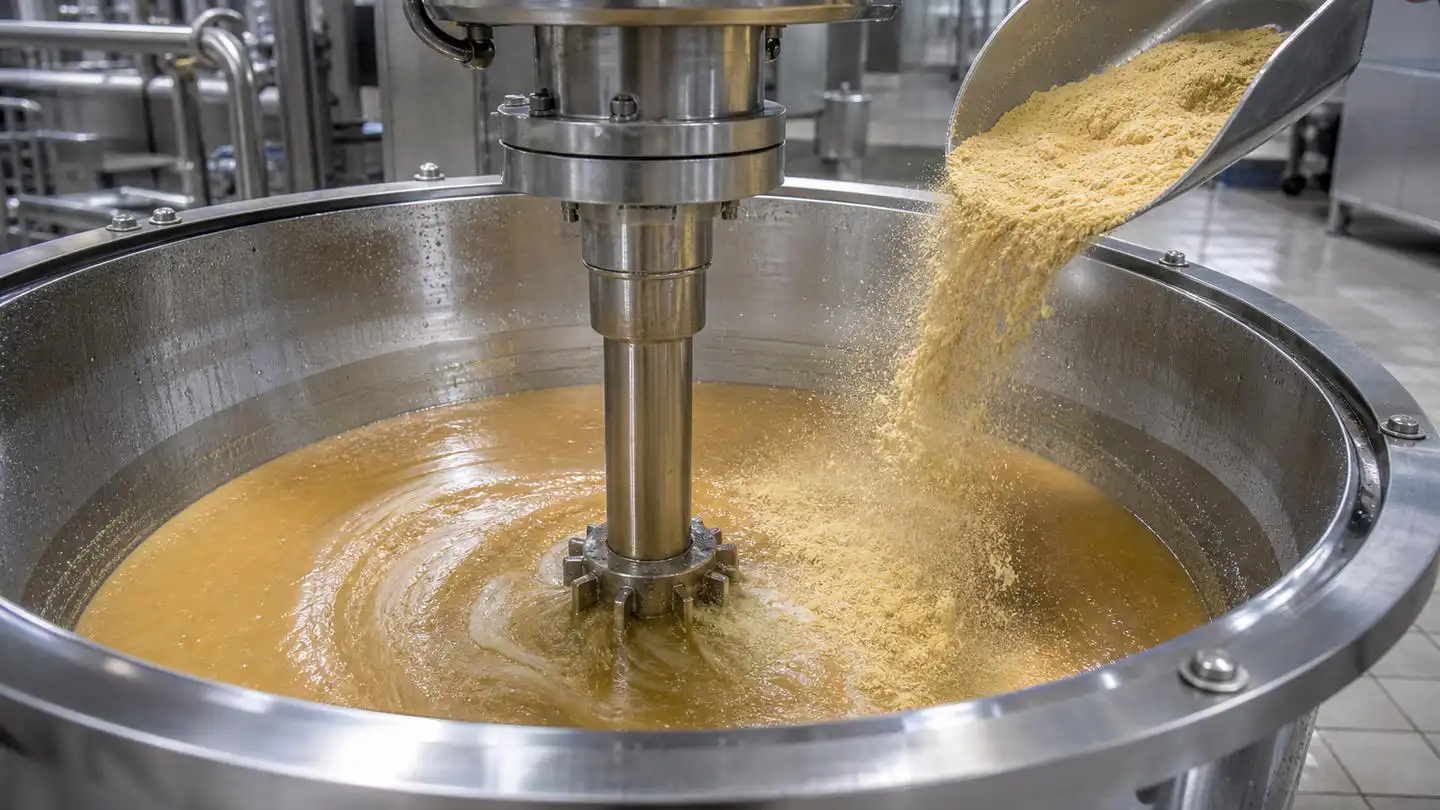
Ginger pungency is lipophilic, so an oil phase is chemically the friendliest place to put it and physically the most awkward. A dry powder dropped into ambient oil wets poorly: particles clump, the surfaces stay dry inside the agglomerate, and the batch ends up with hot spots that survive homogenisation. The fix is mechanical. Pre-mix the powder into a small portion of the oil at 50–60 °C under high shear until the dispersion is uniform, then add that pre-mix to the bulk oil. Verify with top, middle, and bottom pull samples.
Where the oil phase is a minor component, as in a dressing, the reverse problem appears: the gingerol concentrates in the dispersed droplets, so pungency arrives in bursts rather than evenly, and the oil ring at the bottle neck tastes far hotter than the body. Dispersing the powder in the aqueous phase first, then emulsifying, gives a more even distribution at the cost of some intensity.
Dispersion in the Water Phase
Water is where the solubility figure earns its place. At ≥78% soluble, roughly one fifth of the powder is insoluble carrier and plant fibre, and no amount of shear will convert it. That fraction is both the body a marinade gains and the sediment a retailer notices on the shelf.
Sedimentation: Doing the Stokes Arithmetic
Settling velocity rises with the square of particle diameter and with the density difference between particle and fluid. An 80-mesh cut still contains particles in the 100–180 µm range, and in a brine of roughly 1.05 g/cm³ the density gap is small but the diameter term dominates, so settling is visible within days rather than months. Three levers exist: reduce the diameter with a colloid mill or homogeniser, raise the continuous-phase viscosity with a hydrocolloid that has a yield stress, or design the pack around agitation. The third option is legitimate for a pouch that the consumer kneads, and indefensible for a clear glass bottle.
Compatibility with Soy Sauce, Vinegar, Sugar, and Salt
Each of the four base ingredients attacks the powder through a different mechanism, and the combination is usually worse than any single one. Soy sauce brings salt, free amino acids, and reducing sugars into the same solution; vinegar brings the acid that catalyses conversion; sugar lowers available water and inhibits complete hydration; salt screens charges and can flocculate the carrier fraction.
| System | Typical pH | Dominant stress | What to monitor | Countermeasure |
|---|---|---|---|---|
| Vinegar or citrus marinade | 2.4–3.6 | Acid-catalysed conversion, accelerated by any heat step | Gingerol retention after hot fill; sharpness on day 0 versus day 30 | Dose after cooling; keep the heat hold short |
| Soy-based sauce or glaze | 4.5–5.4 | Salt load plus Maillard substrates | Sediment volume; ΔE colour shift | Pre-disperse in a water slip; add citrate; use 316L contact surfaces |
| Sweet chilli or high-solids glaze | 3.2–4.0 | Water activity near 0.80–0.88 limits hydration | Clumping and grit; dull surface colour | Hydrate in the water phase before sugar is added |
| Emulsified dressing | 3.4–4.2 | Partitioning into the oil droplets | Uneven intensity between phases | Disperse in the aqueous phase, then emulsify |
| Dry rub or seasoning blend | Not applicable | Oxygen, light, and surface exposure | Surface colour fade over 6–12 months | Opaque laminate; low headspace oxygen |
Colour: Where the Browning Comes From
Yellow is the least forgiving colour to hold in a savoury system, and three pathways move it: Maillard reactions between reducing sugars and amino compounds, which soy sauce supplies in abundance; metal-catalysed oxidation, typically from iron or copper surfaces and from dissolved oxygen; and alkaline drift, since browning accelerates sharply as pH climbs above 5.5.
None of these can be eliminated, but each can be bounded. Keep the finished pH at or below 4.6 where the product allows it. Specify 316L stainless for contact surfaces and avoid iron fittings downstream of the dosing point. Flush headspace with nitrogen on high-value lines, and choose packaging that blocks UV rather than merely blocking visible light. Measure the result in CIELAB rather than by eye, tracking L* and b* against a retained reference sample, because a trained panel will disagree about "slightly darker" long before an instrument does.
Pungency Intensity and Masking
Perceived heat is not linear with concentration, and it is strongly modified by the matrix. Fat suppresses the up-front sharpness and lengthens the tail; sucrose and other bulk sweeteners flatten the peak; salt sharpens the attack but shortens the finish; acid adds a competing edge that many panels read as extra heat even when the gingerol load is unchanged. A marinade that tastes correct in the lab can taste flat once sugar is raised for a retail brief.
Masking is a formulation decision with a cost: every gram of dairy fat or starch used to soften the pungency also dilutes the ginger note that justified the ingredient. A more efficient route is to hold the dose constant and adjust the thermal load, since a shorter, cooler process preserves the volatile top notes that carry the fresh-ginger impression.
Use Level and Cost per Unit
Use levels for sauces and marinades generally sit between 0.05% and 0.5% of finished mass, with most savoury applications landing near 0.1–0.2% and confectionery-style glazes at the low end to avoid bitterness. These are starting points to be validated in your matrix: the required level depends on target intensity, thermal load, and the specification of the lot in hand.
The cost arithmetic is unusually forgiving. At 0.2%, a 25 g single-serve sachet carries 0.05 g of powder, so the ingredient cost per unit is a fraction of the packaging cost. That changes the sourcing conversation, and it is the main argument for organic rather than regular ginger powder: the number worth optimising is not the price per kilo but the reject rate and the reformulation hours caused by lot-to-lot drift. A supplier who holds the specification tightly is cheaper than a supplier who does not, even at a visible price premium.
Designing the Retention Trial
A retention trial answers one question: how much of the pungency you paid for is still there after your process. Run it as a factorial rather than a single-point test, with pH and thermal load as the two factors, and include an unheated control at each pH so that acid-only loss is separated from heat-driven loss. Six to eight cells are enough to see the interaction.
| Run | pH | Process | Hold | Endpoints to record |
|---|---|---|---|---|
| R1 | 3.2 | Unheated control, 25 °C | 24 h | Baseline profile at low pH |
| R2 | 4.6 | Unheated control, 25 °C | 24 h | Baseline profile at sauce pH |
| R3 | 3.2 | 72 °C, 30 s | Immediate chill | Gingerol retention; shogaol gain |
| R4 | 4.6 | 72 °C, 30 s | Immediate chill | Gingerol retention; shogaol gain |
| R5 | 3.2 | 90 °C, 2 min | Immediate chill | Zingerone formation; sensory drift |
| R6 | 4.6 | 90 °C, 2 min | Immediate chill | Zingerone formation; sensory drift |
| R7 | 3.2 | 121 °C, 15 min retort | Cool in pack | Total loss ceiling; ΔE; viscosity |
| R8 | 4.6 | 121 °C, 15 min retort | Cool in pack | Total loss ceiling; ΔE; viscosity |
Measure gingerol and its conversion products chromatographically against a retained standard, pair that with a trained panel scoring intensity on a labelled scale, and record ΔE, pH, and water activity on the same samples. Set the pass line yourself; a common working target is 80% retention of the unheated control, but the useful output is the shape of the curve, which tells you where to move the dosing point.
Flavour Decay on the Shelf
A two-year shelf life on the powder is a statement about the ingredient in its packaging, not about your finished sauce. Once dispersed, the powder is exposed to water activity, oxygen, and the catalytic effect of the surrounding matrix, and the flavour will drift even when the microbiology is sound. The drift is usually one-directional: less sharpness, more sweetness, a flatter top note.
Design the stability study around chemistry rather than counting microbes. Hold samples at 30 °C and at 40 °C, pull at 0, 1, 2, 3, and 6 months, and track gingerol, ΔE, and panel intensity alongside pH. The two-temperature design estimates the ambient rate and usually shows that colour moves before flavour does, which makes colour a cheap early-warning indicator for a line that cannot run HPLC weekly.
Supplier Qualification: What to Ask For
Ask for the documents that let you release a lot without retesting everything. A lot-specific COA covering moisture, solubility, mesh, bulk density, heavy metals, and the microbiological limits above is the floor. An organic transaction certificate tying the lot back to a certified farm is the difference between an organic claim you can defend and one you cannot. Beyond that, request a residual solvent statement, an allergen and GMO declaration, a retention sample policy, and written change control covering mesh and carrier.
Documentation depth is a reasonable proxy for how a supplier runs its process, so review the quality and accreditation documentation before the first purchase order, not after the first complaint. A supplier who answers these questions in writing on the first request is usually the one who can hold a specification across a harvest year.
Request a Sample and Specification Pack
Wellgreen supplies Organic Ginger Extract Powder with a lot-specific COA, a full specification sheet, and samples sized for bench trials, so the retention trial above can be replicated in your own system rather than in a generic model. Formulation support is available for dispersion, dosing point, and compatibility questions in soy, vinegar, and high-solids systems. Write to wgt@allwellcn.com with your target pH, process, and use level, or review the product page before the first call.
References
U.S. FDA. 21 CFR Part 182 — Substances Generally Recognized as Safe. 2024.
U.S. FDA. 21 CFR Part 184 — Direct Food Substances Affirmed as Generally Recognized as Safe. 2024.
ISO 6571 — Spices, condiments and herbs: determination of volatile oil content. 2008.
ISO 4833-1 — Microbiology of the food chain: horizontal method for the enumeration of microorganisms, colony count at 30 °C. 2013.
ISO 6579-1 — Microbiology of the food chain: horizontal method for the detection of Salmonella spp. 2017.
ISO 21527-1 — Microbiology of food and animal feeding stuffs: horizontal method for the enumeration of yeasts and moulds. 2008.
This article is intended for business-to-business ingredient sourcing and formulation discussion. It does not provide medical, nutritional, or regulatory advice for any specific product or market.