
Organic Turmeric Powder for Dairy-Free Drinks and Soup Mixes
2026-11-16 09:07:43
Turmeric sells a colour before it sells a flavour. In a plant-based milk or an instant soup base, the first thing a consumer registers is the warm yellow, and the first thing a formulator discovers is that the same powder that colours beautifully in one matrix turns dull in another, drops to the bottom of a bottle, or turns bitter when the dose is raised to reach the shade the brief asked for. Sourcing organic turmeric powder for these applications is therefore a colour and dispersion problem wearing a spice label.
Two Very Different Jobs: A Drink and a Soup Base
A dairy-free drink is a dilute, low-viscosity system that has to stay uniform for months in a bottle and look appetising through clear packaging. A soup mix is a dry blend that has to disperse in hot water in front of the consumer and deliver flavour and colour in one step. The same turmeric lot can pass one brief and fail the other.
Separating the two briefs before sampling saves months. The drink needs fine, well-dispersed particles and a suspension strategy; the soup needs a powder that wets out quickly, hydrates in hot water and does not settle into a sludge in the bowl. Both need a colour that survives heat, and both need a flavour that does not dominate.
Why Water and Plant Milk Behave Differently with Turmeric
Turmeric powder is largely insoluble in water. In a simple aqueous system the particles stay suspended only while agitation continues, then settle at a rate governed by Stokes' law: larger particles and lower viscosity both accelerate it. In a plant milk the picture changes because the continuous phase is no longer plain water.
Protein interaction in plant milks
Oat, soy, almond and coconut beverages all carry dispersed protein, fat droplets and hydrocolloids. Turmeric particles can associate with protein at the droplet surface, which can help keep the colour distributed or can produce visible speckling, depending on the particle size and the homogenisation pressure. Two otherwise similar bases can therefore behave quite differently with the same turmeric.
Sedimentation in a ready-to-drink product
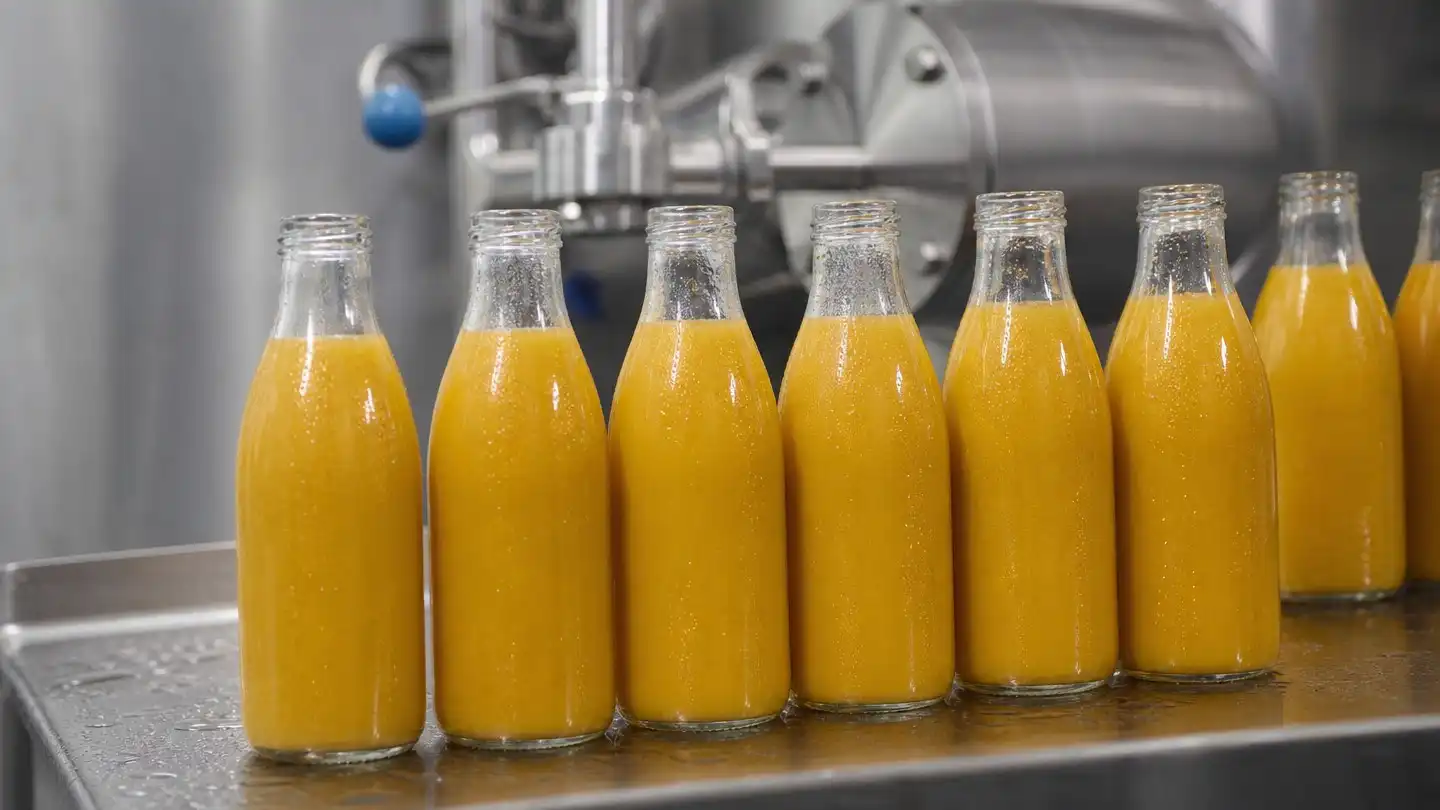
Sediment is the most common complaint in turmeric beverages, and it is almost always a specification problem dressed as a formulation problem. A powder milled to a fine cut with a controlled top size settles slowly enough for a suspension system to hold it. A coarser powder forces the formulator to add hydrocolloid until the mouthfeel suffers, which is the point at which the project usually loses its budget.
Colour Is a Specification, Not a Bonus
The colour of a turmeric system is pH dependent, and curcuminoids are also sensitive to light and to prolonged heat. A shade matched at neutral pH will shift in an acidic beverage; a product in clear packaging will fade faster than the same product in an opaque carton.
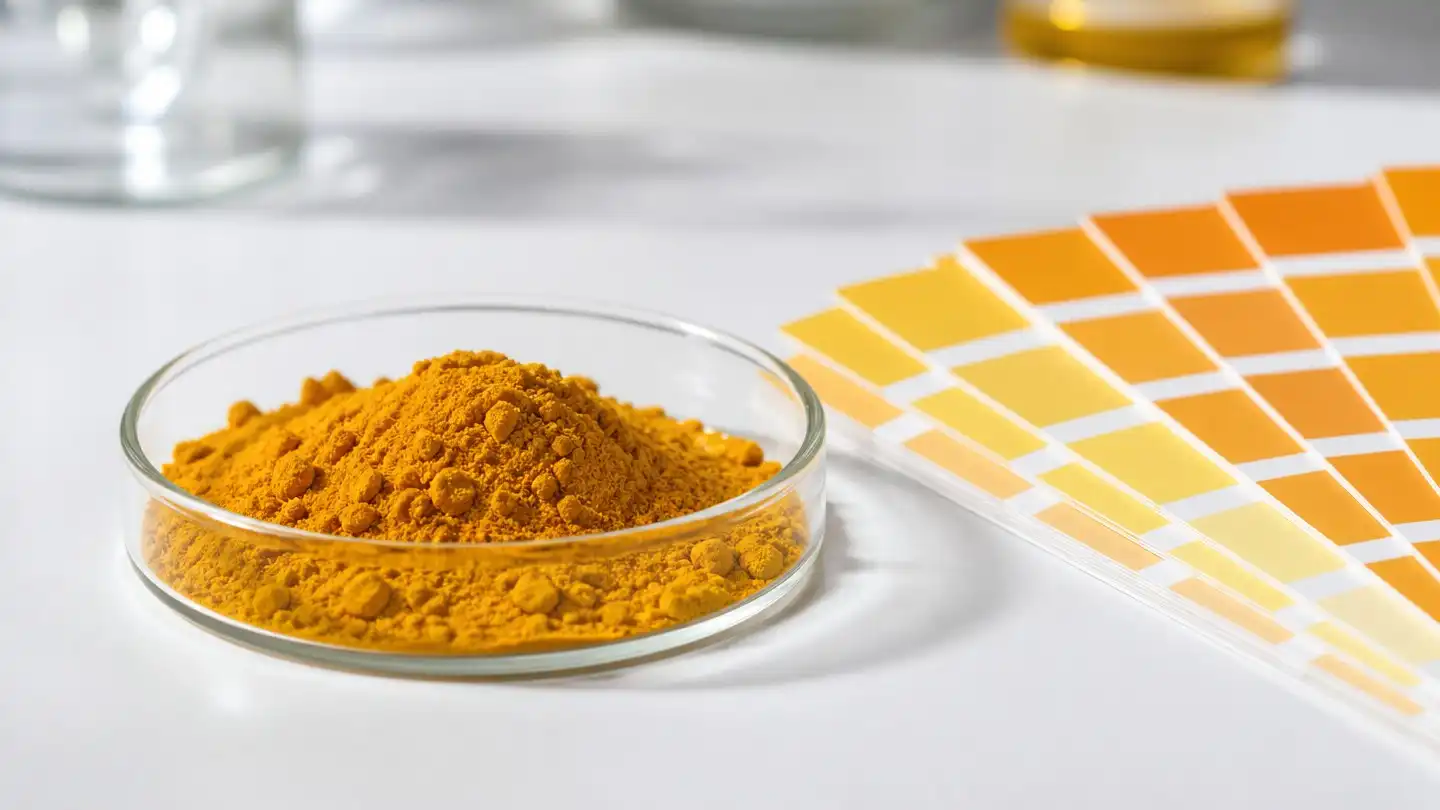
Two consequences follow for the specification. First, colour should be measured instrumentally at the pH and dilution of the finished product rather than described in words. Second, the light-protection decision belongs to packaging, not to the ingredient: no turmeric grade will hold a shade that the pack is actively destroying. Colorimetric readings taken at day zero, day thirty and day ninety, in the actual pack, are the only defensible record.
Flavour: Earthy, Bitter, and Easy to Overdo
Turmeric brings an earthy, slightly bitter note that becomes harsh as the dose rises. In a dairy-free drink the dose is usually set by colour, which means the flavour is a consequence rather than a choice. That is why product teams end up adding sweetness, vanilla or a masking flavour to a drink whose original brief was a short ingredient list.
The alternative is to separate the two functions. A colour-standardized grade carries the shade with less powder, which reduces the bitterness load. Where the flavour is part of the proposition, as in a golden-style beverage, the powder carries both and the dose is set by taste instead. Deciding which of the two the product needs is a marketing question that has a specification answer.
Curcuminoid Content and What It Means on a Specification
Curcuminoid content is the headline number on a turmeric certificate, and on its own it is close to useless for a beverage project. The items below are the ones that predict behaviour in a dairy-free drink or a soup mix.
| Specification item | What it predicts | How to verify |
|---|---|---|
| Curcuminoid content | Colour intensity per unit weight, and the dose needed to reach a shade | Spectrophotometric method stated on the COA, per lot |
| Particle size distribution | Settling rate, speckling, and mouthfeel in a ready-to-drink product | Sieve analysis or laser diffraction to a declared cut |
| Volatile oil content | Aromatic intensity, which is what distinguishes spice from colour | Distillation per the declared method |
| Moisture and water activity | Caking in a dry soup blend and mould risk in storage | Loss on drying per lot |
| Ash and acid-insoluble ash | Soil and sand load carried through washing | Gravimetric, per the declared method |
| Heavy metals, including lead | Market eligibility; turmeric is a known target for adulteration | Accredited laboratory report per lot |
| Pesticide residues | Organic claim integrity and retail programme acceptance | Multi-residue screen at an accredited laboratory |
The particle size line is the one to negotiate hardest for a beverage, because it cannot be corrected downstream without changing the mouthfeel. The curcuminoid line is the one to negotiate hardest for cost, because it sets how much powder the recipe needs.
Organic Status and the Paper Trail
An organic turmeric claim rests on documents rather than on a description. The two that matter at shipment level are the organic certificate covering the operator and the transaction certificate covering the specific consignment. A certificate that names the processor but not the grower group is common in this trade, and a buyer should know which of the two links is being certified before writing the claim onto a pack.
The schemes most often encountered are the National Organic Program in the United States and the EU organic regime, both of which are listed among the programmes on the quality and accreditation page. Ask for the scope statement, not only the certificate number, and check that the scope covers milling as well as growing if the material is supplied as a finished powder.
Contaminants: The Adulteration Risk Specific to Turmeric
Turmeric is one of the few botanicals where adulteration has historically targeted appearance rather than weight. Lead-based colourants have been used to brighten dull root, and the practice has been documented in several producing regions by public health authorities. The consequence for buyers is that a lead result is not a formality on the certificate.
Three controls are worth insisting on. A lead result from an accredited laboratory, reported per lot rather than per campaign. A specification that states the limit and the method, so that a marginal result can be argued about with data. And a supplier that can describe its incoming raw material inspection, because a powder blended from many small lots is only as clean as the weakest one.
Soup Mixes: Dispersion and Rehydration
The salt interface in a sachet
In a dry soup blend, turmeric has to survive two environments: months in a sachet beside salt, sugar and hydrolysed protein, and thirty seconds in hot water in a bowl. Salt accelerates moisture uptake, and a hygroscopic powder in contact with salt will cake at the interface. A moisture limit that looks generous in a drum specification can be inadequate in a soup sachet.
On rehydration, the behaviour to test is wetting and dispersion rather than solubility, because the material does not dissolve. A simple test — a fixed dose into hot water, stirred for a fixed time, poured through a sieve — shows whether the powder disperses or forms floating islands, and it takes ten minutes to run.
Ready-to-Drink Formats: Homogenisation and Stability
| Risk in a dairy-free drink | Where it appears | Control to agree with the supplier |
|---|---|---|
| Sediment over shelf life | Bottom of the bottle, visible through clear packaging | Declared particle size with a top cut, plus a settling test at your viscosity |
| Speckling | Visible dark particles against a pale base | Finer cut, or a colour-standardized grade, trialled at your homogenisation pressure |
| Colour fade | Loss of shade under light or over time | Colorimetric data at day zero and after storage, in the intended pack |
| Flavour drift between lots | Bitterness increasing without a recipe change | Volatile oil and curcuminoid ranges per lot, with retained samples |
| Microbiological load | Compromised shelf life in a low-acid drink | Lot micro data with methods; pasteurisation validation on your line |
Most of these risks are cheaper to manage in the purchase specification than in the formulation. The ingredient choices available in this category, including purified colour-focused derivatives, are described in this note on tetrahydrocurcumin, which is useful when a brief calls for shade stability rather than spice character.
Trial Design for a Dairy-Free Matrix
Run the trial in the finished base, at the finished pH, in the finished pack. Three doses around the target, three time points, one panel. Record colour instrumentally, sediment height after standing, and bitterness on a defined scale. Keep the same batch of plant milk across all samples, because base variation will otherwise be mistaken for ingredient variation.
The single most useful output is a settled photograph of the bottles at day seven. It ends the discussion faster than any analytical table, and it becomes the retained reference for the next lot.
Sourcing Questions to Settle Early
- Is the grade sold on colour, on curcuminoid content, or on flavour
- What is the declared particle size and top cut
- Which organic scheme, and does the transaction certificate cover this consignment
- Lead and multi-residue pesticide results per lot, from which laboratory
- What is the moisture limit, and is it appropriate for a sachet with salt
- Which market's labelling rules apply to the finished product
The broader context on grades, trading practice and specification language is covered in this guide to what organic turmeric powder is, and the supplier-evaluation side in this note on choosing trusted turmeric suppliers. Application notes for recipe-level use sit alongside them in this review of turmeric in recipes.
Conclusion
Turmeric in a dairy-free drink or a soup mix is a dispersion and colour question first, a flavour question second, and a compliance question throughout. The specification items that matter most — particle size, curcuminoid content, moisture, lead and organic documentation — are all negotiable before the first order and expensive to correct afterwards.
If you are developing a golden plant-based beverage or an instant soup base, we can supply the specification sheet, the current lot certificate with the heavy metal and pesticide reports, and samples at two particle sizes so the settling behaviour can be compared in your own base. Write to wgt@allwellcn.com with the target shade, the base composition and the pack format, and the technical team will respond with the grade that matches the brief.
References
- Codex Alimentarius Commission. General Standard for Contaminants and Toxins in Food and Feed (CXS 193-1995, as amended). FAO/WHO.
- Codex Alimentarius Commission. General Standard for Food Additives (CXS 192-1995, as amended). FAO/WHO.
- United States Department of Agriculture. National Organic Program, 7 CFR Part 205. Current edition.
- International Organization for Standardization. ISO 6571 — Spices, condiments and herbs: determination of volatile oil content. 2008.
- International Organization for Standardization. ISO 4833-1 — Microbiology of the food chain: colony count at 30 °C. 2013.
- U.S. Food and Drug Administration. 21 CFR Part 182 — Substances Generally Recognized as Safe. Current edition.
This article is intended for business-to-business ingredient sourcing and formulation discussion. It does not provide medical, nutritional, or regulatory advice for any specific product or market.