
Organic Turmeric Powder for Plant-Based Sauces and Seasonings
2026-11-05 18:17:59
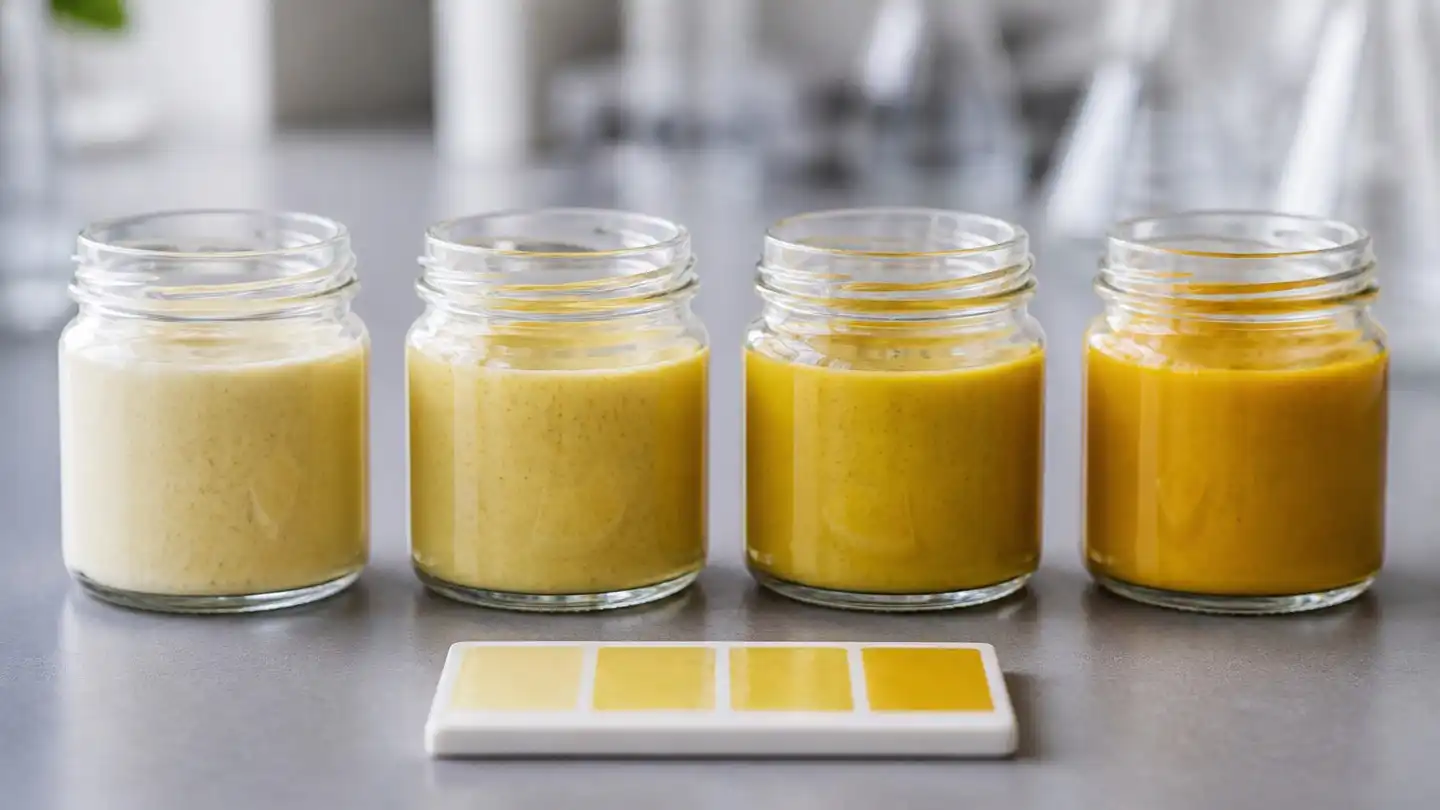
Colour is the first specification a plant-based sauce has to clear, and often the last one to hold. Turmeric does the work in the yellow-to-golden range: a small addition of organic turmeric powder moves a pale oat, coconut or cashew base into a convincing curry, cheese or broth tone without a certified colour. The difficulty is that "golden" is not a number, and a supplier quoting only a curcumin percentage has not told you what the powder will do in your kettle. This article approaches colour as an engineering problem: converting a target shade into a dose, finding where that dose fails, and proving it before a batch is released.
Why Colour Is a Formulation Specification, Not a Marketing Claim
Most buyers inherit a colour standard as a physical sample or a printed chip, and neither survives contact with a sauce line. Before a shade can enter a purchase specification it has to become instrumental coordinates: L* for lightness, a* for red-green, b* for yellow-blue, read under a stated illuminant, normally D65 with a 10° observer.
Tolerance becomes arguable once the standard is in L*a*b*. A ΔE*ab near 1 sits at the edge of what a trained eye resolves, 2 to 3 is visible side by side but acceptable in most retail sauces, and above 5 reads as a different product. Fix that number before choosing a grade, because it sets the dose and the cost.
Three Forms on the Specification Sheet
Three organic forms sit on the specification sheet, and they are not interchangeable on cost per kilogram. Organic turmeric root powder carries the whole rhizome matrix; the 95% and 98% standardized extracts are built for colour tolerance and low sensory load. All three are listed as an orange-yellow fine powder, assayed by HPLC or UV, and stored cool and dry.
What separates them in a sauce is colour delivered per kilogram against everything else the powder brings. Root powder contributes body, earthiness and fibre along with colour; an extract contributes mostly colour, letting you reach a tight ΔE with less powder and less resinous note. The organic versus conventional comparison covers the residue and traceability half of the choice.
| Parameter | Organic turmeric root powder | Standardized extract, 95% | Standardized extract, 98% |
|---|---|---|---|
| Appearance, as listed | Orange-yellow fine powder | Orange-yellow fine powder | Orange-yellow fine powder |
| Curcuminoid content | Lot-specific, declared on the COA | Standardized to 95% | Standardized to 98% |
| Assay method | HPLC or UV, as stated on the COA | HPLC or UV, as stated on the COA | HPLC or UV, as stated on the COA |
| Colour per kg of powder | Lower; the full root matrix dilutes it | High | Highest |
| Non-colour load | Fibre, starch and mineral retained | Largely removed | Largely removed |
| Typical role | Rustic rubs, simmer sauces, broth bases | Colour-standardized systems with moderate flavour load | Tight colour windows, minimum powder mass |
| Label declaration | Organic turmeric | Organic turmeric extract | Organic turmeric extract |
| Storage | Cool, dry, away from light | Cool, dry, away from light | Cool, dry, away from light |
Read the assay method before comparing suppliers' figures. A UV-vis assay reads total absorbance at the curcuminoid maximum and usually reports higher than an HPLC assay that separates the individual curcuminoids. The two cannot be set against each other; specify the method, not only the percentage.
From Target ΔE to a Working Dose
Building the Ladder
Convert the target into a dose with a three-point ladder on your own base, never on water. Measure the uncoloured sauce, then dose at roughly half, one and two times the expected level and measure each. Hold base, process and fill temperature constant: colour in a starch-thickened sauce depends as much on the cook as on the powder.
The Sensitivity Constant
From those points, take the sensitivity S: the ΔE*ab gained per 0.10% of powder by mass. While the response stays close to linear, the working dose follows directly:
dose (%) = (target ΔE*ab ÷ S) × 0.10
The matrix below is that arithmetic; replace S with your own result.
| Measured sensitivity S (ΔE*ab per 0.10%) | Dose for target ΔE 3 | Dose for target ΔE 5 | Dose for target ΔE 7 | Dose for target ΔE 9 |
|---|---|---|---|---|
| 0.8 | 0.375% | 0.625% | 0.875% | 1.125% |
| 1.2 | 0.250% | 0.417% | 0.583% | 0.750% |
| 1.6 | 0.188% | 0.313% | 0.438% | 0.563% |
| 2.0 | 0.150% | 0.250% | 0.350% | 0.450% |
| 2.4 | 0.125% | 0.208% | 0.292% | 0.375% |
Where Linearity Ends
Linearity has a ceiling. As the dose climbs the sauce stops behaving like a clear medium and starts to hide the base, so each further addition buys less ΔE. In Kubelka-Munk terms you move from K/S scaling with concentration into saturating opacity, and the 0.188% cell above under-delivers in an already-opaque base.
Two guards keep the calculation honest: cap the dose where bitterness first becomes measurable by your panel, and re-run the ladder whenever fat content, starch type or protein source changes. A ladder built on a 5% fat base does not transfer to a 20% fat one.
Where the Colour Goes Wrong: pH, Heat, Light and Oxygen
Curcuminoids are pH-sensitive phenols. Between roughly pH 3 and pH 7 the hue is stable and reads as familiar yellow. As the system turns alkaline the molecule deprotonates, the hue swings orange-red and absorbance decays quickly; above about pH 8 a turmeric yellow should not be expected to hold. That rules out most alkaline plant-protein systems, and it is the first thing to check when a golden sauce turns ochre.
Thermal load is the second lever. Absorbance loss scales with time at temperature, so a short high-temperature hold is kinder than a long simmer at lower temperature for the same lethality. Add the powder late where the process allows, and after the acid.
Light and oxygen are the slow ones. A clear PET bottle on a lit shelf is the harshest environment in the chain; amber glass, an opaque sleeve or a carton removes most of that exposure without touching the formula. Dissolved and headspace oxygen both drive oxidative fading, so deaeration and a nitrogen headspace are worth more than a higher dose. High ascorbic acid in the same phase can also bleach the colour.
Oil–Water Partitioning in Emulsified Sauces
Curcuminoids are lipophilic. In an oil-in-water emulsion they migrate into the dispersed oil, so colour per gram depends on how much oil is present and how finely it is divided. The same dose looks deeper in a 20% fat coconut base than a 3% fat broth, and deeper again when droplets are small.
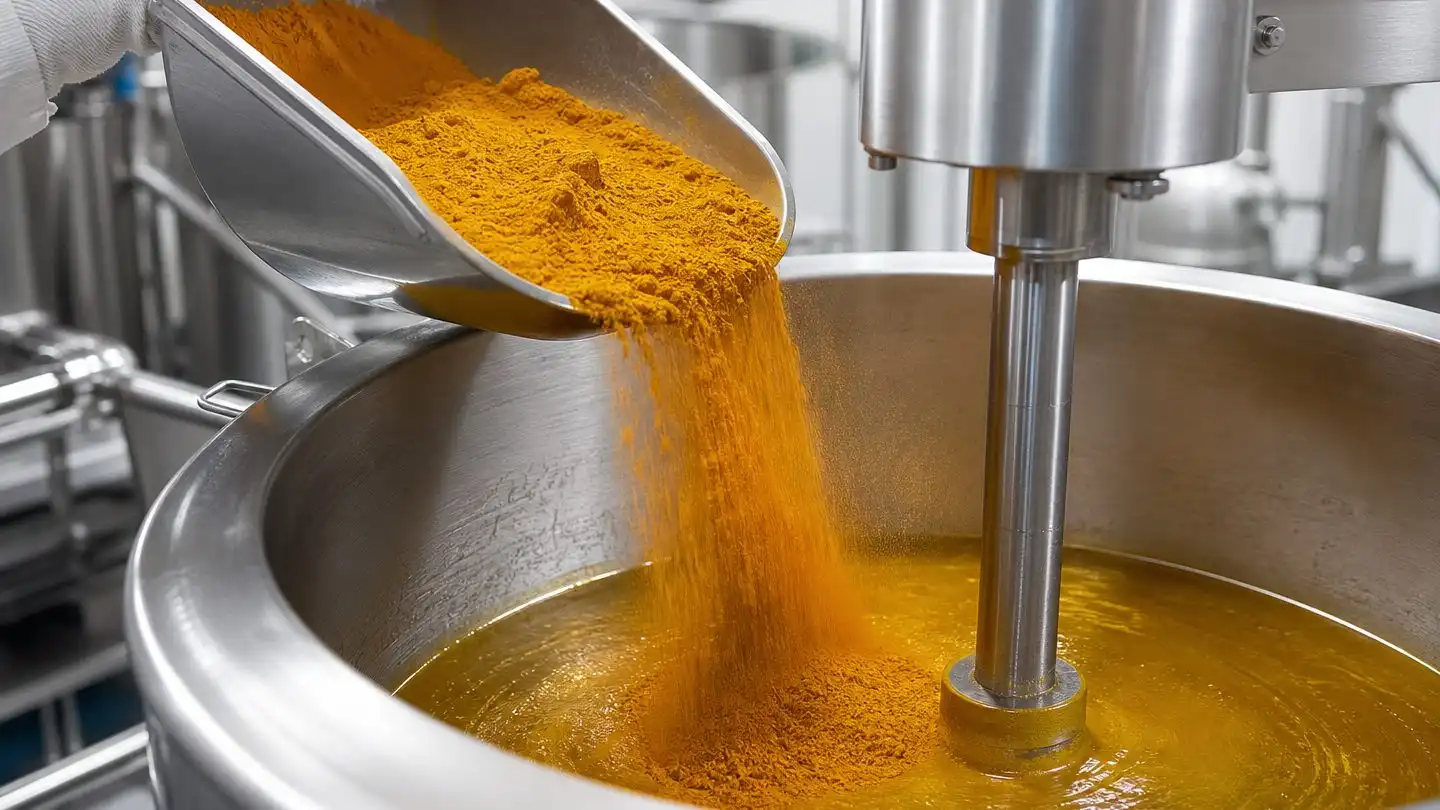
That argues for adding the powder to the oil, or the oil-and-emulsifier premix, at 60–70 °C with agitation until no specks remain, then homogenising. Powder added to the aqueous phase afterwards colours unevenly and keeps drifting as it partitions.
In fat-free systems no oil phase carries the pigment, so colour sits on the dispersed solids and reads weaker and greyer at the same dose. Expect a higher dose, or a paler target.
Dispersion, Wetting and Sediment Control
Fine turmeric powder is cohesive and slow to wet. Dumped into water it forms skins and lumps that survive shear and show up later as dark specks in a pale sauce. The fix is a premix: dry-blend with maltodextrin or part of the starch, or slurry into oil, before it meets the bulk of the water.
Settling follows Stokes' relationship: rate scales with the square of particle diameter and with the density difference between particle and continuous phase, and falls as viscosity rises. Fine particles and a structured continuous phase address both terms. Xanthan at 0.05–0.3% w/w, or a modified starch at its stated use level, usually does the work; validate against your own viscosity target, since over-structuring reads gluey in a pouch sauce.
Watch the metal. Curcuminoids chelate iron, and iron from worn pipework or an unpassivated vessel shifts the colour towards brown-green. Specify 316L stainless for contact surfaces and compare a retained sample against the standard after any line change.
Bitterness and Earthiness Are Dosing Problems
The bitter note in turmeric comes largely from the curcuminoids, the earthy and resinous note from the volatile fraction. Both scale with the quantity of powder, which is why most bitterness complaints trace back to over-dosing rather than to a bad lot.
Over-dosing has predictable causes: a shade set by eye on an opaque base where the colour never quite arrives, a base that has moved from white to wholemeal, or a specification written on curcumin content alone with no ΔE test.
The levers run in order of cost. Set the lowest ΔE that meets the brand standard rather than the highest that photographs well. Use a standardized 95% or 98% extract where the base is delicate, so colour arrives with less non-colour load. Then mask what remains with fat, salt, acid and roasted spice notes; coconut fat and a little yeast extract do more than any additive sold for the purpose.
Compatibility with Starch, Hydrocolloid and Plant Protein
Starch-thickened sauces drift in colour for a reason unrelated to the pigment. As amylose retrogrades the gel turns more opaque and scatters more light back to the eye, so a sauce holding a fixed curcuminoid content reads lighter at month three than at day one. Measure ΔE on the aged sample, not only the fresh one, and expect to correct the dose upward.
Plant proteins behave similarly near their isoelectric point. Close to the pI the protein aggregates, scattering rises sharply, and the sauce both lightens and greys; protein binding of the curcuminoid shifts hue slightly as well. Re-run the ladder whenever the protein source or base pH changes.
Hydrocolloids are mostly neutral for hue but not for appearance. Xanthan suspends well and reads slightly dull, gellan forms a fluid gel that keeps colour even through a retort cycle, and emulsifiers such as lecithin improve distribution in the oil phase but can foam if over-sheared.
Designing an Accelerated Stability Study You Can Defend
Run the study on the finished sauce, in the pack you intend to sell, with the headspace you intend to have. A study on powder alone shows the raw material is sound; it says nothing about whether the sauce holds colour on a lit shelf.
Measure three things at every point: ΔE*ab against the t0 sample, curcuminoid content by HPLC, and hue angle. ΔE captures the total shift, curcuminoid content separates pigment loss from matrix change, and hue angle flags alkaline drift before it becomes visible.
| Condition | Question it answers | Timepoints | Measurements | Suggested acceptance |
|---|---|---|---|---|
| 40 °C / 75% RH, dark, sealed jar with production headspace | Accelerated thermal and chemical fade | 0, 2, 4, 8, 12 weeks | ΔE*ab vs t0, curcuminoid by HPLC, pH, viscosity, water activity | ΔE ≤ 3 at 12 weeks |
| 30 °C / 65% RH, dark | Warm-climate warehouse reality | 0, 1, 2, 3, 6 months | ΔE*ab, curcuminoid, viscosity | ΔE ≤ 2 at 6 months |
| 25 °C / 60% RH, dark, control | Baseline and lot-to-lot reference | 0, 3, 6, 9, 12 months | ΔE*ab, curcuminoid, sensory | ΔE ≤ 1.5 at 12 months |
| 6,000 lux continuous, clear container against amber control | Retail display fade | 0, 1, 2, 4, 8 weeks | ΔE*ab, hue angle, surface colour vs bulk | Hue angle drift ≤ 2° at 8 weeks |
| 45 °C, dark, elevated headspace oxygen | Worst-case distribution and e-commerce transit | 0, 1, 2, 4 weeks | ΔE*ab, peroxide value where an oil phase is present | ΔE ≤ 4 at 4 weeks |
| Three freeze–thaw cycles, −18 °C to 25 °C | Physical separation after temperature abuse | After each cycle | ΔE*ab, sediment volume, viscosity, droplet size | No visible sediment layer |
Two details separate a study that survives an audit from one that does not: a t0 retention sample at −18 °C for every batch, re-measured whenever a comparator is needed, and a record of fill temperature and headspace oxygen, because the light and oxygen rows mean nothing without them.
What Belongs on the Purchase Specification
A colour-driven specification is short but specific. Include declared curcuminoid content and assay method; organic certificate number, scope and validity date; heavy metals, microbiology and pesticide residues against the destination market's list; moisture; particle size or mesh; packaging format; and measurement geometry, since transmission and reflectance readings do not agree.
Ask for a colour reference with the first commercial lot — a retained sample or an instrument reading on a defined dispersion — and state the tolerance explicitly. The paperwork behind a supplier review is set out in our guide to choosing trusted suppliers of organic turmeric powder; the question is not whether certificates exist but whether the lot you receive is covered by them.
Buying Against a Colour Standard, Not a Season
Turmeric colour varies by lot. Root age, growing conditions and the volatile fraction left after drying all move the shade, so a buyer who signs off on one shipment's appearance has signed off on nothing repeatable. Buy against the ΔE window, retain a sample from every lot, and re-qualify the grade if two consecutive lots drift the same way.
Volume planning belongs in the same conversation. As plant-based ranges widen, one grade tends to appear across sauces, broths, seasonings and ready meals, and the growth in organic turmeric demand has made colour specification a procurement question rather than a laboratory curiosity. Locking a grade and a colour window for six to twelve months is usually cheaper than reformulating twice a year.
Records covering certification scope, audit history and lot traceability are summarised on our quality and accreditation page.
Request a Specification, a COA and a Sample
We can supply the specification sheet, a batch COA showing declared curcuminoid content and the assay method used, and a sample of the grade you are evaluating, with a discussion of how the powder behaves in your base. The three organic grades are listed on the organic turmeric powder product page. Send your target ΔE, base composition and process to wgt@allwellcn.com and we will reply with a starting dose and the test points we would run.
References
1. U.S. Food and Drug Administration. 21 CFR Part 182 — Substances Generally Recognized as Safe. 2025.
2. European Pharmacopoeia. Curcumae longae rhizoma — Turmeric rhizome monograph. 11th edition.
3. FAO/WHO Joint Expert Committee on Food Additives. Curcumin — Combined Compendium of Food Additive Specifications.
4. International Organization for Standardization. ISO 6571 — Spices, condiments and herbs: determination of volatile oil content.
5. International Organization for Standardization. ISO 4833-1 — Microbiology of the food chain: horizontal method for the enumeration of microorganisms. Part 1.
6. International Organization for Standardization. ISO 21527-1 — Microbiology of food and animal feeding stuffs: horizontal method for the enumeration of yeasts and moulds. Part 1.
This article is intended for business-to-business ingredient sourcing and formulation discussion. It does not provide medical, nutritional, or regulatory advice for any specific product or market.