
Rosemary Extract Antioxidant Applications in Food and Feed Preservation
2026-09-18 15:33:37
Rosemary Extract Antioxidant does the same chemistry in two very different places, and the two places ask different things of it. In a food plant the question is how long a fat phase resists headspace oxygen before its peroxide value or TBARS expose the problem. In a feed mill the question comes earlier and hotter: what is left of that antioxidant after steam conditioning, extrusion cooking and a mineral premix full of transition metals? The chemistry is identical; the failure mode is not, and a specification written for one scenario is usually wrong for the other. Wellgreen manufactures the feed-grade rosemary extract antioxidant in lipid-soluble oil and water-dispersible powder, standardised at 5% to 20% carnosic acid.
This article compares the two scenarios: how oxidation fails in food versus feed, which format suits which line, how the extract behaves through pelleting and extrusion, and what belongs on a specification and an incoming-goods test plan. The food side — actives, food-category applications and labelling — is covered in our companion piece on how rosemary extract antioxidant is used in food manufacturing. That article takes the food-manufacturing case; this one covers the preservation comparison and the pet food, aquafeed and livestock compound feed categories it leaves out.
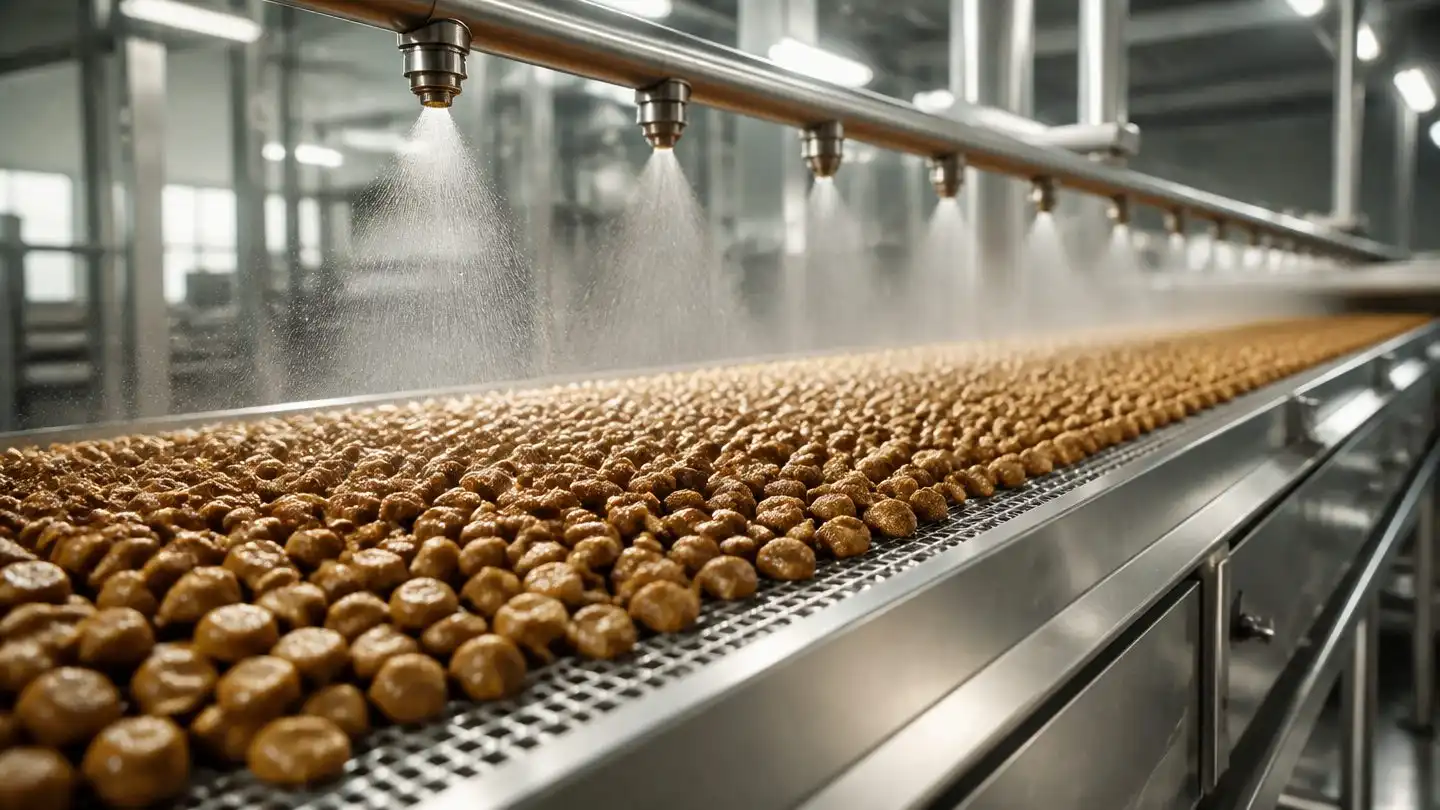
Why the Same Molecule Meets Two Different Failure Modes
In Food, Oxidation Is a Time-and-Oxygen Problem
Food systems fail slowly and visibly. A lipid phase meets headspace oxygen, light through the pack, and whatever thermal history the process imposed. In bulk oils and fats, autoxidation dominates and peroxide value is the standard progress marker; in emulsions the reaction concentrates at the oil–water interface, which is why an extract carrying both a lipid-soluble and a water-soluble fraction has an advantage there. In baked and fried goods the binding constraint is temperature. Carnosic acid and carnosol carry most of the activity; rosmarinic acid is the water-soluble partner.
In Feed, Oxidation Is a Heat-and-Metal Problem
Feed adds three stressors. Heat: steam conditioning, extrusion cooking and rendering push the fat coating through temperature and moisture loads that a retail food chain never sees. Geometry: a fat-coated kibble or pellet presents a thin, porous oil film spread over a large surface, so the oxygen-accessible area per gram of fat is far higher than in a bulk liquid. Catalysis: copper, iron and zinc salts from the mineral premix are oxidation promoters sitting in the same bag as the fat they will attack.
Oxidation in feed therefore shows up as more than rancidity. The same reaction destroys fat-soluble vitamins and pigments, and produces a palatability drift that appears as reduced intake rather than as a value on a certificate of analysis. EFSA's FEEDAP Panel drew the technical bridge between the two scenarios explicitly: the food and feed matrices in which rosemary extracts are used are of comparable nature, therefore the antioxidant effect observed in food is expected in feed as well.
| Dimension | Food systems | Feed systems |
|---|---|---|
| Fat load in the matrix | Low to high; oil is often the carrier itself | High; fat is added as a coating or blended into an energy-dense diet |
| Where oxidation starts | Headspace-exposed surfaces and oil–water interfaces | Porous fat-coated surfaces, plus oil dispersed through a mineral-rich matrix |
| Main promoters | Light, headspace oxygen, process thermal history | Conditioning and extrusion heat, moisture, trace transition metals from the premix |
| Progress markers used | Peroxide value, TBARS, hexanal, sensory rancidity | Peroxide and anisidine value of the coated fat, TBARS, vitamin and pigment retention, intake behaviour |
| Storage profile | Weeks to months under retail and consumer control | Months under ambient warehouse, farm and partly opened bag conditions |
| Regulatory framework | Food additive rules, with maxima set per food category | Feed additive rules, with authorisation granted per additive, species and category |
Format Selection: Lipid-Soluble Oil or Water-Dispersible Powder
Format is where feed projects most often go wrong, because it is decided by the production line rather than by the label. A lipid-soluble oil integrates into a fat stream; a water-dispersible powder distributes through a dry blend. The wrong choice does not simply reduce performance — it adds a process stage, and a new source of variability, in order to correct it.
Where Each Format Belongs
Oil goes wherever fat is already being handled: dosed into a fat stream before coating, injected into liquid fat systems, or blended into the marine oil phase of an aquafeed. It disperses at the molecular level and needs no carrier. Powder goes wherever the feed is dry: premixes, mineral blends, mash and meal-based diets, and any line that cannot accept added moisture. In powder grades, flow behaviour matters more than appearance — particle size distribution, dusting and the absence of liquid bridging decide whether the active is distributed evenly through a several-tonne batch.
The two lines are standardised on different actives, and that difference is deliberate. Feed-grade material is specified on carnosic acid because the target is the fat phase; our rosemary extract powder for food and supplement use is specified on rosmarinic acid. Buyers running both portfolios should hold two specifications rather than assume one grade covers both.
| Application | Preferred format | Why the format matters | Point of addition |
|---|---|---|---|
| Extruded pet food and kibble | Lipid-soluble oil | Disperses directly into the fat used for coating; avoids a separate dissolution step | Fat addition and coating stage, after drying |
| Aquafeed based on marine oil | Lipid-soluble oil | Integrates into the most oxidation-prone fraction of the diet | Oil blending or vacuum coating |
| Fat-coated livestock pellets | Oil, or powder where no liquid dosing exists | Oil suits liquid fat dosing; powder suits dry blending before conditioning | Fat dosing line, or dry blending ahead of conditioning |
| Dry premixes and mineral blends | Water-dispersible powder | Flows and distributes evenly; no liquid bridging in a dry blend | Dry blending, before bagging |
| Bulk edible oils and fats | Lipid-soluble oil | The lipid-soluble fraction disperses without an extra processing stage | Oil stream, before filling |
| Dry mixes, bakery and snack systems | Water-dispersible powder | Blends into premixes and comes through the baking or frying step | Dry ingredient premix, or fat-addition stage |
The Three Feed Categories at a Glance
Extruded Pet Food and Kibble
Pet food is the most demanding of the three: high fat inclusion, high surface area, long ambient shelf life. Fat is sprayed onto dried kibble, placing the antioxidant in the fat stream at a comparatively gentle point of the process — an advantage, because the extruder itself is far harsher on any active. The practical risks are uneven coating and a fat level high enough that the surface film becomes limiting.
Aquafeed
Aquafeed carries the highest intrinsic risk, because marine oils are rich in long-chain polyunsaturated fatty acids. The extract belongs in the oil phase rather than the dry mix, so it is present in the fraction most likely to fail, and the design question becomes whether that protection survives extrusion and vacuum coating.
Poultry and Swine Compound Feed
Compound feed is where the mineral effect is strongest: copper, iron and zinc in the trace premix promote oxidation of both the fat and the added vitamins in the same matrix. The antioxidant should therefore protect the fat before it meets the mineral load, and the specification should be written around vitamin retention as well as fat stability, because in a compound feed vitamin loss is often the first measurable sign that protection is inadequate.
Surviving Pelleting, Extrusion and Rendering
Thermal exposure is the largest single difference between the two use cases, so it is the first thing to design a programme around. In steam pelleting the antioxidant travels in the added fat through conditioning and then through the die. In extrusion the fat coating is applied after the extruder, a far gentler position for the active. In rendering and fishmeal drying the exposure is longer, hotter and wetter than either.
The point of addition therefore matters as much as the grade. Dosing into the fat before coating puts the antioxidant where the oxidation will occur, at a lower thermal load than inside the extruder barrel, and away from the mineral blend. Dosing into the dry premix is simpler, but exposes the active to the full conditioning temperature along with the rest of the mash. Where a line uses both routes, the supplier should be able to state the process conditions under which their stability data was generated; if they cannot, that data cannot predict performance on your line.
Heat tolerance is also why the carnosic-acid fraction is preferred to tocopherols in these applications: tocopherols perform in the fat phase but degrade under repeated thermal load. That makes the two complementary rather than interchangeable.
Regulatory Reference Points: Food Additive Versus Feed Additive
Regulatory status is where food and feed diverge most sharply, and where supplier marketing is most often loose with the facts. In the European Union, rosemary extract is authorised as a food additive, E 392, under Regulation (EC) No 1333/2008, with maximum permitted levels set per food category in Annex II rather than as a single figure. On safety, EFSA's earlier evaluation could not establish an acceptable daily intake because the toxicological dataset was insufficient; a refined exposure assessment followed in 2018. JECFA's position is a temporary acceptable daily intake of 0–0.3 mg/kg body weight, expressed as carnosic acid and carnosol.
Feed sits in a separate legal framework, and the difference is commercial as well as legal. Rosemary extract is not authorised as a technological antioxidant feed additive in the European Union; rosemary oil, oleoresin, extract and tincture appear in the feed flavouring listing, which is a different functional group. Authorisation is granted additive by additive and species by species, so a supplier claiming a blanket EU feed authorisation for rosemary extract is describing something that does not exist. Verify your own combination of additive, species and category in the EU Register of Feed Additives before the label is written.
| Framework | Instrument | Status |
|---|---|---|
| EU, food additive | Regulation (EC) No 1333/2008 | Extracts of rosemary authorised as food additive E 392; maximum levels set per food category in Annex II |
| EU, food safety assessment | EFSA ANS Panel, refined exposure assessment (2018) | An earlier evaluation could not establish an acceptable daily intake for lack of toxicological data; the additive remains under re-evaluation |
| International, food | JECFA | Temporary acceptable daily intake of 0–0.3 mg/kg body weight, expressed as carnosic acid and carnosol |
| EU, feed additive | Regulation (EC) No 1831/2003 and the EU Register of Feed Additives | Rosemary extract is not authorised as a technological (antioxidant) feed additive; rosemary oil, oleoresin, extract and tincture are listed for flavouring |
| EU, feed safety assessment | EFSA FEEDAP Panel (2022) | For the two solvent extracts assessed for cats and dogs, maximum safe concentrations in feed were 300 mg/kg (dogs) and 50 mg/kg (cats); a finding for those additives, not a use instruction |
| EU, feed comparator | Commission Implementing Regulation (EU) 2022/1375 | Authorisation of ethoxyquin as a feed additive denied, removing it from the EU market as an antioxidant option |
Working Alongside Tocopherols and Chelators
Antioxidants are rarely used alone, and the combinations that work are mechanistic rather than commercial. Mixed tocopherols and rosemary extract are complementary: the diterpenes protect and regenerate the tocopherol pool while the tocopherols extend coverage in the lipid phase. Ascorbic acid and its esters contribute in the aqueous phase.
Chelators matter more in feed than in most food systems. Citric acid and phosphates bind the copper and iron that the premix introduces, addressing the catalyst rather than the reaction — which is why the order of addition is a real formulation variable: dosing the antioxidant into the fat before that fat meets the mineral blend keeps active and catalyst apart. These interactions do not transfer reliably between formulations, so a bench trial on your own matrix remains the only reliable basis.
Quality Control and Incoming Acceptance
A rosemary specification is only as useful as the tests behind it. The active should be declared as a number with a method attached: carnosic acid content by HPLC is the standard basis for feed grades, and the carnosic acid to carnosol ratio reflects the fractionation route and therefore the consistency of supply. Everything else on the sheet — peroxide and acid value, heavy metals, solvent residue, microbiology — should be reported per batch rather than as a typical figure, with sieve and flow data added for the powder and clarity data for the oil. A certificate of analysis on every lot, with retention samples held, is the minimum documentation package.
On the Line
Two checks catch most problems before they become complaints. Test the fat rather than the finished feed: peroxide and anisidine values on the coated fat separate an antioxidant question from a processing question, which a whole-feed test cannot do. Then run an accelerated storage check at bench scale and sample the same material at the start and at the end of a production run, so that the process effect is visible separately from the storage effect. Where a supplier offers heat-challenge data, ask for the method as well as the result. The supplier evaluation criteria used for extract grades — declared actives and methods, batch-level contaminant data, both formats from one source — apply unchanged to feed.
Conclusion
Rosemary extract antioxidant is the same chemistry in both scenarios, but the two scenarios ask different questions of it. Food rewards dual-phase behaviour, label position and tolerance of the retail storage cycle. Feed rewards heat tolerance, compatibility with fat coating and dry premixes, and resilience in a matrix that contains its own oxidation catalysts. The decisions that carry the risk are the ones a supplier should be able to document: the format matched to the line, the point of addition matched to the thermal load, and a specification written against the fat that actually needs protecting.
To discuss a food or feed preservation programme, request the technical data sheet and sample for Rosemary Extract Antioxidant — carnosic acid grades from 5% to 20% in lipid-soluble oil and water-dispersible powder, every batch released against a certificate of analysis — or write to wgt@allwellcn.com with your feed type, fat source and process conditions.
This article is technical and commercial information for food and feed industry professionals. It is not a safety assessment or a dosing instruction. Additive authorisation, permitted use levels and labelling requirements differ by jurisdiction, food category and animal species, and must be confirmed against the applicable regulation and your own product data before commercial use.
References
- Aruoma, O. I., Halliwell, B., Aeschbach, R., & Löligers, J. (1992). Antioxidant and pro-oxidant properties of active rosemary constituents: carnosol and carnosic acid. Xenobiotica, 22(2), 257–268. doi:10.3109/00498259209046624
- EFSA Panel on Food Additives and Nutrient Sources Added to Food (ANS) (2018). Refined exposure assessment of extracts of rosemary (E 392) from its use as food additive. EFSA Journal, 16(7), 5373. doi:10.2903/j.efsa.2018.5373
- EFSA Panel on Additives, Products or Substances used in Animal Feed (FEEDAP) (2022). Safety and efficacy of two solvent extracts of rosemary (Rosmarinus officinalis L.) when used as feed additive for cats and dogs (Kemin Nutrisurance Europe SRL). EFSA Journal, 20(1), 6978. doi:10.2903/j.efsa.2022.6978
- JECFA / World Health Organization. Rosemary extract — temporary acceptable daily intake of 0–0.3 mg/kg body weight, expressed as carnosic acid and carnosol. WHO JECFA food additives database. apps.who.int JECFA database, Chemical 6311
- Regulation (EC) No 1333/2008 of the European Parliament and of the Council of 16 December 2008 on food additives (extracts of rosemary, E 392). EUR-Lex CELEX:32008R1333
- Regulation (EC) No 1831/2003 of the European Parliament and of the Council of 22 September 2003 on additives for use in animal nutrition. EUR-Lex CELEX:32003R1831
- Commission Implementing Regulation (EU) 2022/1375 of 5 August 2022 concerning the denial of authorisation of ethoxyquin as a feed additive belonging to the group of technological additives. EUR-Lex CELEX:32022R1375