
How Is Oregano Powder Feed Grade Used in Poultry Feed Production?
2026-09-18 15:33:42
In a working poultry feed plant, Oregano Powder Feed Grade is handled like any other micro-ingredient: weighed in small increments, diluted through a premixture, added to the mixer, and then carried through conditioning, pelleting, cooling and bagging with the rest of the ration. That production reality, not the botanical description, decides whether a formula runs cleanly at tonne scale, and explains why buyers ask about flowability, blend behaviour, heat exposure and sampling before anything else. If you are still deciding whether the ingredient belongs in a formula at all, start with the site's overview of how oregano powder fits into natural feed formulation strategies; this article assumes the decision is made and follows the material from weigh-out to finished bag.
Feed-grade oregano is not culinary oregano. Culinary powder is bought on aroma and colour; feed-grade material is bought against a specification: standardised carvacrol and thymol content, a defined particle size band, moisture limits, heavy metal limits and microbiological parameters. Carvacrol and thymol are the volatile phenols laboratories normally quantify, and the compounds most sensitive to heat, oxygen and time — which is why they sit at the centre of the production questions below.
Why Feed-Grade Status Is a Production Question
A feed mill cannot run an ingredient it cannot reproduce. A commercial line has to deliver the same ration on Monday and Friday, from a different delivery and a different shift, at a different throughput. "Feed grade" is therefore a narrow, practical promise: that the delivered material is consistent enough to be weighed, diluted, blended and processed without adding variation of its own.
Two documents carry most of that promise. The specification sheet fixes the assay range, mesh profile, bulk density and moisture band; the batch certificate of analysis shows that a particular lot met those values. A third control applies where a strongly aromatic powder shares lines and bins with other additives — guidance on additive carry-over during feed production (O'Mahony et al., 2012) describes sequencing, flush batches and dedicated lines, and the same logic governs this ingredient.
Analytical markers and what a batch certificate should carry
Carvacrol and thymol are normally quantified by gas chromatography; a published method determines cinnamaldehyde, carvacrol and thymol in feedstuff additives in a single run after pressurised liquid extraction (Jiménez-Salcedo and Tena, 2017). For the plant, the handling parameters matter as much as the assay:
- Active content — carvacrol and/or thymol, with the analytical method stated.
- Particle size — the mesh profile, matched to the mash it enters.
- Moisture — a controlled band, since absorbed water encourages caking.
- Contaminants — heavy metals and microbiological counts against destination-market limits.
- Batch identity — lot number, production date and a certificate matching the delivery.
Where Oregano Powder Feed Grade Enters the Poultry Feed Line
A poultry mill has three realistic entry points: the premixture line, the complete-feed mixer, and a post-pelleting application after the cooler. The choice is a process decision, driven by the concentration the finished diet requires, the resolution of the weighing and mixing equipment, and the heat the ingredient will meet. Most producers using it now work within programmes that have removed in-feed antibiotic growth promoters, and handle it as one component of a wider botanical strategy. The published article on what makes oregano powder feed grade suitable for animal nutrition surveys how the material is positioned across species; this section stays on the poultry line.
Weigh-out and addition sequence
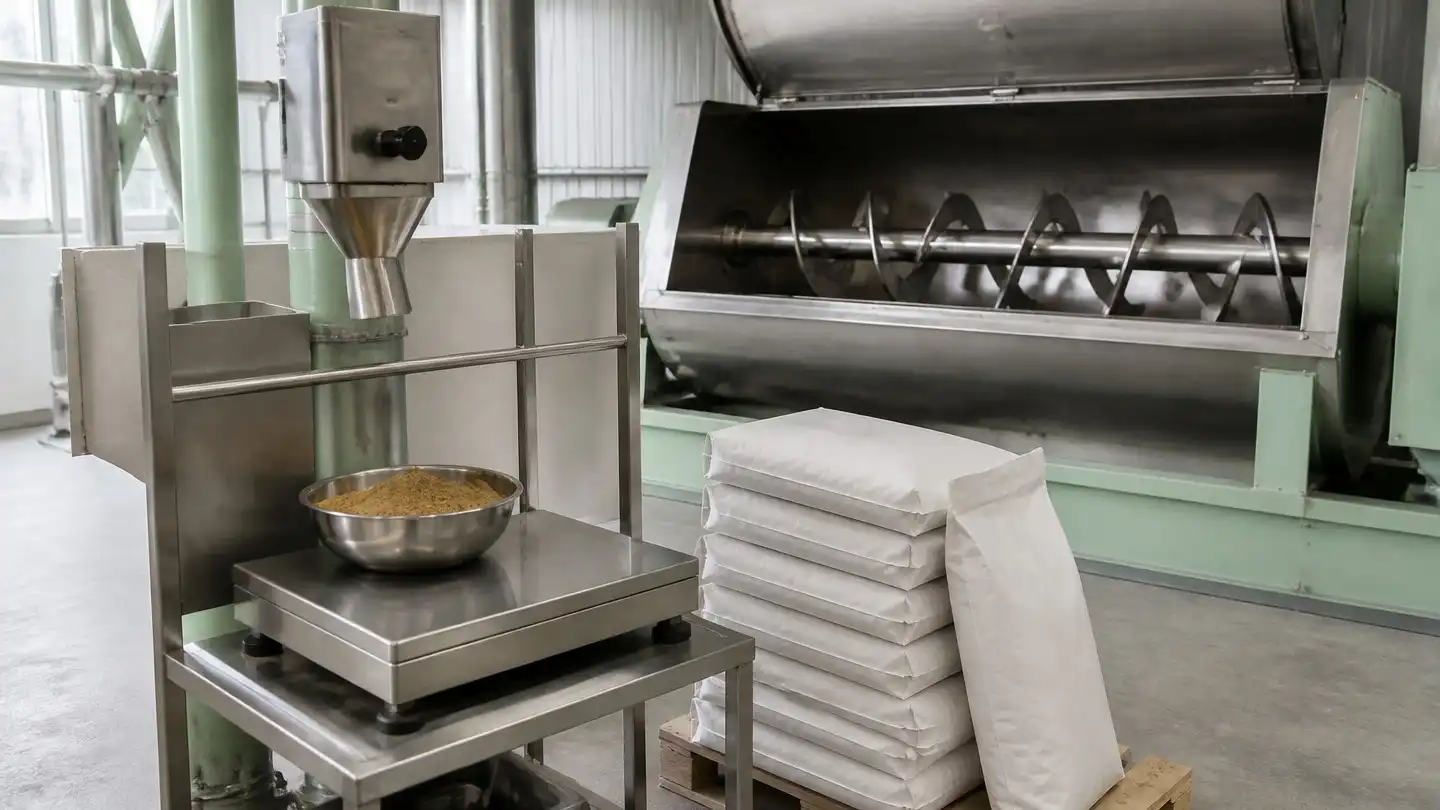
Micro-ingredients are weighed on a scale whose resolution keeps weighing error small relative to the target mass, which usually means a dedicated micro-scale rather than the main batching scale. Standard practice charges the major ingredients first, then the premix or diluted micro-ingredient, so the small quantity lands in a bed of material instead of on bare mixer walls. Addition point, scale and operator confirmation are worth recording, because a sequence deviation is the most common way a micro-ingredient reaches finished feed unevenly.
Premix, complete feed, or after the cooler
Placing the material in a premixture buys the best weighing accuracy and the longest mixing time, at the cost of an extra handling step. Adding it directly to the complete-feed mixer is simpler but demands a mixer that can spread a small mass evenly. Applying it after pelleting avoids heat exposure altogether, but needs dosing equipment downstream of the cooler and a coating step that does not strip the powder off the pellet.
| Addition point | Typical equipment | What it fits | What to watch on the line |
|---|---|---|---|
| Premixture line | Micro-weighing station, ribbon or paddle mixer | Best weighing accuracy and the longest mixing time; simplest way to standardise a diluted grade | Extra handling step; premix moisture pickup in storage |
| Complete-feed mixer (mash) | Ribbon, paddle or twin-shaft mixer | Mash and crumbed diets; shortest route from weigh-out to mixer | Mixing time must be long enough for a small mass; segregation in the surge bin |
| Post-pelleting application | Powder or liquid doser, coating drum after the cooler | Diets where conditioning heat is high and the powder must not be exposed to it | Dosing accuracy at low mass flow; dust control; pellet surface pickup |
Carriers, Diluents and the Dilution Ladder
A carrier becomes part of the ingredient's bulk and is chosen for compatibility — often a ground grain, mineral or by-product already in the ration. A diluent is closer to an inert filler used to bring a concentrated material down to a workable level. Both exist for the same reason: at very low inclusion no mixer can spread an undiluted powder evenly, so the material is stepped down through one or two dilution stages first.
The discipline in a dilution ladder is particle size matching. A powder ground finer than its carrier tends to sift through the blend and settle; one markedly coarser or lighter tends to float. Bulk density should be matched within a narrow band, and electrostatic behaviour checked on fine grades, because a powder that clings to the mixer wall never reaches the feed. The same handling rules apply to every botanical powder a mill buys: a spray-dried material such as quillaja extract arrives with a defined assay and mesh profile and goes through an identical dilution procedure.
Blending with other botanical micro-ingredients
Composite botanical premixtures are common, and the questions they raise are physical: whether two powders share a bulk density and mesh range, whether one is more hygroscopic, and whether the combined aroma changes feed intake in a way the formulation did not anticipate. Standardised powders such as yucca extract feed grade are supplied with their own assay and mesh specification for exactly this reason. Where several are blended, one documented compatibility trial on the mixer — repeated only when a specification changes — is cheaper than discovering the problem in a finished-feed sample.
Mixing Uniformity and Segregation Risk
Mixing uniformity is measured by sampling one batch at several points and comparing marker concentration against the batch average, usually expressed as a coefficient of variation (CV). The CV a mill accepts is an internal decision. What matters is that the marker is recoverable analytically: where carvacrol and thymol can be quantified by GC, uniformity can be measured rather than assumed.
- Check the mixer's rated fill level; over- and under-filling both reduce particle interactions.
- Confirm mixing time with a tracer study, not with a timer setting inherited from another product.
- Inspect the mixer, drop chute and surge bin for dead zones and build-up.
- Reduce free-fall distance into bins and silos, where segregation happens.
- Re-check uniformity after any change of supplier, mesh specification or carrier.
| Check | What to record | Why it matters |
|---|---|---|
| Mixer fill level | Batch mass against rated capacity | Filling outside the working range lengthens the time needed to reach the target CV |
| Mixing time | Seconds at the mixer, confirmed by tracer or marker results | A setting carried over from another product is not evidence of uniform distribution |
| Batch uniformity | Number of samples, sampling points, marker concentration | Turns an assumption into a number the quality team can trend over months |
| Post-mix handling | Drop heights, bin level, conveying type | Uniformity achieved in the mixer can be lost between the mixer and the pellet press |
Heat Processing: Conditioning, Pelleting and Extrusion
Pelleting subjects every ingredient to moist heat and mechanical pressure, and the volatile phenols that define oregano material are the fraction most likely to be affected. Most published heat-stability work in feed processing comes from other volatile or labile micro-ingredients: a study in Animals evaluated how extrusion temperatures, pelleting parameters and ingredient form influenced vitamin stability in feed (Yang et al., 2020), and the point transfers — the fate of a heat-sensitive additive depends on the form supplied and the processing conditions, not on its name.
The useful question at the mill is therefore not whether oregano powder is heat stable, but what the process does to the grade and how the plant would know. A small trial answers it: split a batch, apply the two or three conditioning regimes the plant actually uses, cool and sample each, and compare marker content in pellets against the mash. Encapsulated grades are a form change rather than a claim; the literature on inclusion complexes with thymol and carvacrol (Al-Nasiri et al., 2018) describes work on encapsulating these compounds, so delivery form is a variable the mill can specify and verify.
Sampling, In-Process Checks and Retention Samples
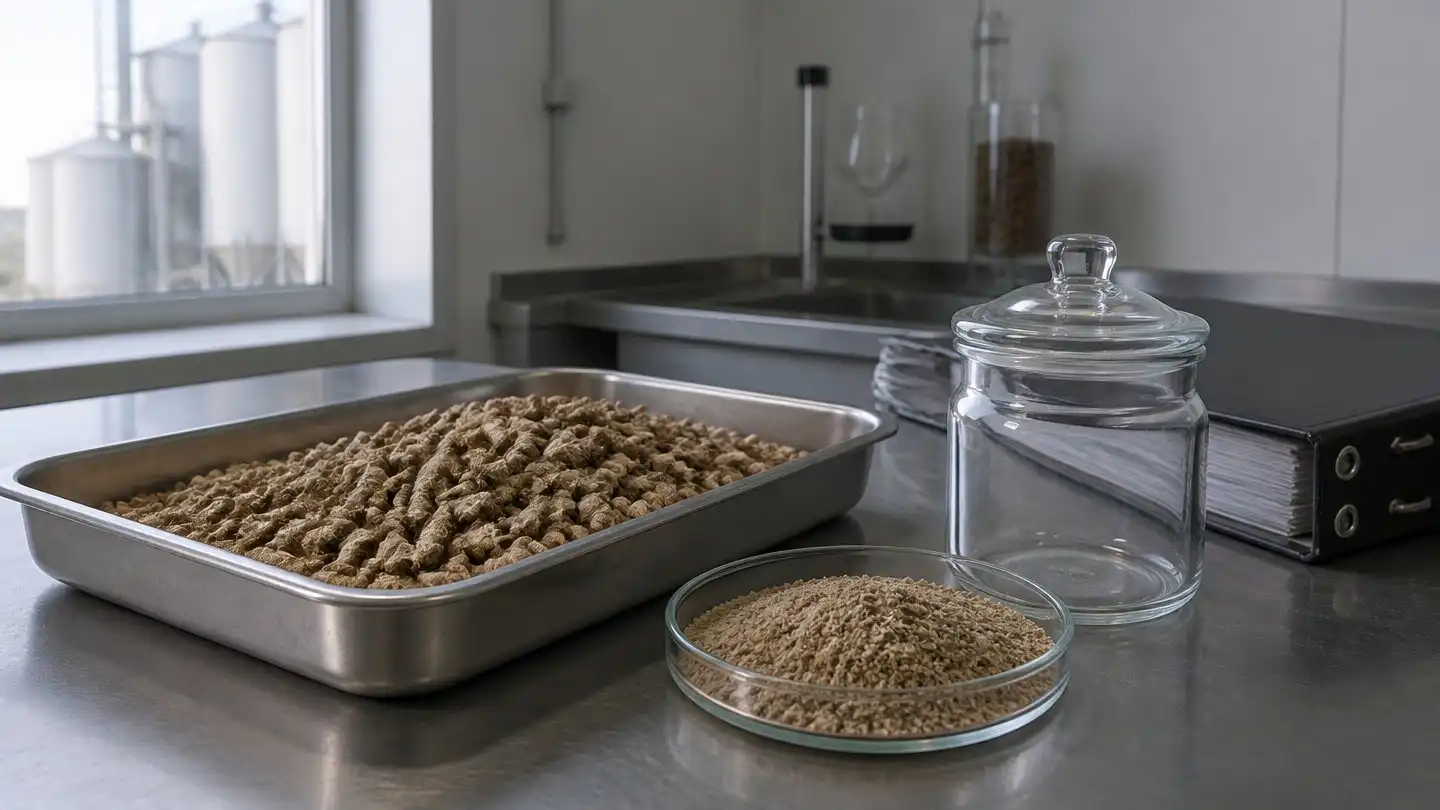
A result is only as good as the sample behind it: at low inclusion, take enough incremental samples, from enough points, to represent the batch rather than a single lucky scoop.
- Sample raw material on receipt and retain a sealed sample per lot.
- Sample the premixture or diluted blend after mixing, at the same points each time, so results can be trended.
- Sample finished feed after cooling and after storage, to separate process losses from storage losses.
- Record sampler, date, lot, sampling points and mass taken.
- Keep retention samples for the period the quality system requires, sealed and moisture-proof.
Finished-Feed Stability, Packaging and Storage
Once feed is bagged, three factors continue to act on the volatile fraction: oxygen, moisture and light, with temperature accelerating all three. Practical controls are ordinary ones: barrier packaging where justified, tight sealing, storage out of direct sunlight, and first-in, first-out rotation. Incoming material deserves the same discipline: sealed, moisture-resistant packaging in a cool, dry store, with partial containers closed immediately after use. Feed that will sit in a farm bin for weeks before consumption deserves one extra check, because the value sampled at the mill gate is not the value the bird receives: the marker analysis used for mixing uniformity can simply be repeated on a stored sample.
Specification and Documentation Checklist for Buyers
A manufacturer qualifying a source should assemble the following before the first commercial delivery. The Wellgreen Oregano Powder (Feed Grade) product page lists Origanum vulgare as the botanical source, carvacrol and thymol as the active ingredients, standardised specifications at 5%, 10% and 20% plus a pure leaf powder, poultry, swine, aquaculture and ruminant applications, FAMI-QS, ISO 22000, HALAL and KOSHER certification, micro-encapsulated options, and an MOQ of 1 kg with samples for testing.
- Botanical identity and plant part, confirmed on the certificate.
- Assay specification for carvacrol and thymol, and the method behind it.
- Particle size, bulk density and moisture band.
- Heavy metal and microbiological limits against destination-market rules.
- Copies of claimed certifications, checked with the issuing body.
- Batch certificate for the lot dispatched, plus a retained sample agreement.
FAQ
Can oregano powder be added to the mixer with other micro-ingredients?
It can, provided each material has been checked against the others for bulk density, mesh range and hygroscopicity, and the mixer can spread that many small masses evenly. With several involved, build a diluted pre-blend first, then add it to the main mixer.
How do mills choose between a leaf powder, a standardised extract and an encapsulated grade?
The decision follows the process more than the product: mash and crumble diets leave more of the powder form in play, pelleted diets make heat exposure decisive, and post-pelleting application removes it again. Verify the grade in your own equipment.
What is the most common production mistake with this ingredient?
Assuming that the mixing time which works for another additive will work for this one. A different particle size, bulk density or aroma load changes the number of particle interactions required, so confirm mixing time and uniformity with a tracer study on the actual line.
Partner with Wellgreen for Oregano Powder Feed Grade Supply
Wellgreen manufactures and supplies Oregano Powder Feed Grade alongside a range of companion botanical feed ingredients. Technical support covers grade selection for mash, pelleted and extruded diets, micro-encapsulated options and OEM formulation, with batch documentation issued per delivery. To request a specification sheet, a batch certificate or a sample for a line trial, contact the technical team at wgt@allwellcn.com or start from the Oregano Powder (Feed Grade) product page.
This article provides technical and commercial information for feed industry professionals. It is not medical or veterinary advice. Inclusion levels, regulatory status and label claims for any ingredient must be confirmed against the requirements of the destination market and the user's own product data before commercial use.
References
- Windisch, W., Schedle, K., Plitzner, C., & Kroismayr, A. (2008). Use of phytogenic products as feed additives for swine and poultry. Journal of Animal Science, 86(suppl_14), E140–E148. https://doi.org/10.2527/jas.2007-0459
- Burt, S. (2004). Essential oils: their antibacterial properties and potential applications in foods — a review. International Journal of Food Microbiology, 94(3), 223–253. https://doi.org/10.1016/j.ijfoodmicro.2004.03.022
- Botsoglou, N. A., Florou-Paneri, P., Christaki, E., Fletouris, D. J., & Spais, A. B. (2002). Effect of dietary oregano essential oil on performance of chickens and on iron-induced lipid oxidation of breast, thigh and abdominal fat tissues. British Poultry Science, 43(2), 223–230. https://doi.org/10.1080/00071660120121436
- Hashemipour, H., Kermanshahi, H., Golian, A., & Veldkamp, T. (2013). Effect of thymol and carvacrol feed supplementation on performance, antioxidant enzyme activities, fatty acid composition, digestive enzyme activities, and immune response in broiler chickens. Poultry Science, 92(8), 2059–2069. https://doi.org/10.3382/ps.2012-02685
- Gopi, M. (2014). Essential oils as a feed additive in poultry nutrition. Advances in Animal and Veterinary Sciences, 2(1). https://doi.org/10.14737/journal.aavs/2014.2.1.1.7
- Jiménez-Salcedo, M., & Tena, M. T. (2017). Determination of cinnamaldehyde, carvacrol and thymol in feedstuff additives by pressurized liquid extraction followed by gas chromatography–mass spectrometry. Journal of Chromatography A, 1487, 14–21. https://doi.org/10.1016/j.chroma.2017.01.042
- Al-Nasiri, G., Cran, M. J., Smallridge, A. J., & Bigger, S. W. (2018). Optimisation of β-cyclodextrin inclusion complexes with natural antimicrobial agents: thymol, carvacrol and linalool. Journal of Microencapsulation, 35(1), 26–35. https://doi.org/10.1080/02652048.2017.1413147
- O'Mahony, J., Moloney, M., Whelan, M., & Danaher, M. (2012). Feed additives and veterinary drugs as contaminants in animal feed — the problem of cross-contamination during feed production. In Animal Feed Contamination (pp. 385–410). Woodhead Publishing. https://doi.org/10.1533/9780857093615.4.385
- Yang, P., Wang, H., Zhu, M., & Ma, Y. (2020). Evaluation of extrusion temperatures, pelleting parameters, and vitamin forms on vitamin stability in feed. Animals, 10(5), 894. https://doi.org/10.3390/ani10050894
- EFSA Panel on Additives and Products or Substances used in Animal Feed (FEEDAP). (2012). Scientific Opinion on the safety and efficacy of propenylhydroxybenzenes (chemical group 17) when used as flavourings for all animal species. EFSA Journal, 10(1), 2532. https://doi.org/10.2903/j.efsa.2012.2532