
Shilajit Extract Applications in Functional Ingredient Formulations
2026-09-21 14:20:05
Formulation teams rarely argue about what Shilajit Extract is. The harder question is how a fulvic acid standardized powder behaves once it reaches a capsule filler, a ribbon blender, a stick-pack line, or a liquid batching tank. It is the physical behavior of the material — not the sourcing story — that decides which dosage form a brand can launch on a realistic timeline.
This article works at that practical layer. It looks at how one standardized fulvic acid specification — 50% as standard, customizable from 10% to 60% — is implemented across four dosage forms: capsules, powder blends, stick packs, and liquid systems. For each format it covers the processing constraints that drive trial runs, the co-ingredient interactions worth screening, and the label points reviewers raise first.
Fulvic Acid Standardization as a Dosage-Form Decision
Standardization is usually discussed as a quality topic. In practice it is a format-selection topic, because assay target and physical form travel together. A higher-assay powder means less material per unit dose; a lower-assay powder means more carrier mass per unit, which changes fill weight, blend ratio, and the sensory profile of the finished product.
What the specification contains
Wellgreen's Shilajit Extract is specified at 50% fulvic acid, with fulvic acid content customizable between 10% and 60%, and is offered as a fine blackish-brown powder, a thick dark resin (paste), and finished OEM capsules. Certifications listed for the product are ISO 22000, HALAL, KOSHER, and GMP Compliant, and the fulvic acid figure is verified by HPLC or UV assay according to the specification agreed at sample stage.
Two implications follow for a production planner. The assay value is a formulation input, not a label decoration, so a 10% material and a 60% material cannot enter the same master formula at the same weight. And whichever target is chosen must be re-verified after blending, because the finished blend — not the incoming raw material — is what the label declaration rests on. Buyers who want the sourcing-side checklist, including the assay, ICP-MS and PAH documentation that should accompany each batch, will find it in our note on what factors matter when sourcing Shilajit Extract bulk supply.
Why moisture is the first number to fix
The other input that decides everything is moisture. Material held below 5% loss on drying flows, resists bridging in hoppers, and does not cake in the blender; material that has picked up ambient humidity does none of these reliably. Moisture control is therefore the precondition for every format discussed below, and it belongs in the specification and in the storage agreement rather than in the warehouse.
Capsules: Fill Weight, Bulk Density and Flow
Capsules are the least forgiving solid format, because the shell size fixes the dose window and everything else has to fit inside it.
Matching fill weight to potency
Wellgreen's OEM capsule range is listed at 250 mg to 500 mg, which sets the working envelope for potency planning. At the upper end of the fulvic acid range, a smaller fill carries the same fulvic acid load and leaves room for other actives or a flow aid; at the lower end, the same target demands a larger fill, and the formulator runs out of capsule volume or spreads the dose across two units. The practical rule is to fix the fill weight first, then select the fulvic acid target that fits it.
Bulk density and particle size distribution then decide whether that fill weight holds at line speed. Two lots with identical assay can fill differently if one is denser or broader in particle size, so density belongs in the specification alongside assay, and each new lot should be re-checked on a trial run rather than assumed to behave like the qualification batch.

Preventing caking and bridging during encapsulation
Hygroscopic powder picks up moisture from the room, and a mineral-organic matrix carrying residual moisture sticks to the dosing disc, bridges in the hopper, and produces weight variation across the run. The countermeasures are mostly procedural: hold the encapsulation room at a controlled low relative humidity, minimize the time between blending and filling, keep containers sealed with desiccant between operations, and use a free-flowing excipient only where the label and the destination market allow it. Any lubricant or glidant should be screened against the organic acid matrix before scale-up.
Powder Blends and Stick Packs: Dry-Blending in Practice
Powder blends and single-serve stick packs share a logic: a small amount of active is distributed through a much larger carrier, and the product is judged by how uniform that distribution stays after transport.
Segregation, flow and blend uniformity
Segregation is the main risk. When active and carrier differ in particle size or density, vibration during filling and shipping stratifies the blend, and the first and last units of a run may not carry the same fulvic acid load. The controls are a matched particle size band between active and carrier, a defined blending sequence with the active added into a pre-blended carrier rather than on top of the bulk, and blend uniformity sampling at more than one point in the blender. Stick packs add a further requirement: the powder has to stay free-flowing through a narrow dosing auger for the length of the run.
Adjacent categories work the same way. Our note on building value into multi-ingredient nutraceutical formulations describes how a powdered active is positioned so that the carrier, not the active, carries the flow characteristics. The format options behind this decision — standardized powder, resin, or OEM capsules — are set out in our overview of natural sourcing options for manufacturers.
Flavor, color and mouthfeel in consumer formats
Capsules hide the material; powders and stick packs do not. A concentrated mineral-organic powder is dark in color and carries a strong earthy, smoky taste, and both intensify as the fulvic acid target rises, because less carrier remains to dilute them. Three approaches are workable. Reduce the load per unit by splitting the serving across two smaller stick packs. Or accept the color and choose a flavor system that reads as intentional — dark berry, cocoa, coffee or roasted notes — rather than fighting it with a light citrus profile. Or move the active into a capsule where flavor is a concern, the route Wellgreen's own product documentation recommends. Where a maskant or carrier is used, check what it does to the moisture balance of the blend and what it adds to the declaration.
Liquid Systems: Dissolution, Sediment and Stability
Liquids are where the mineral-organic character of the material shows up most clearly, because water gives the organic acids and the associated minerals room to move.
Clear systems versus suspended systems
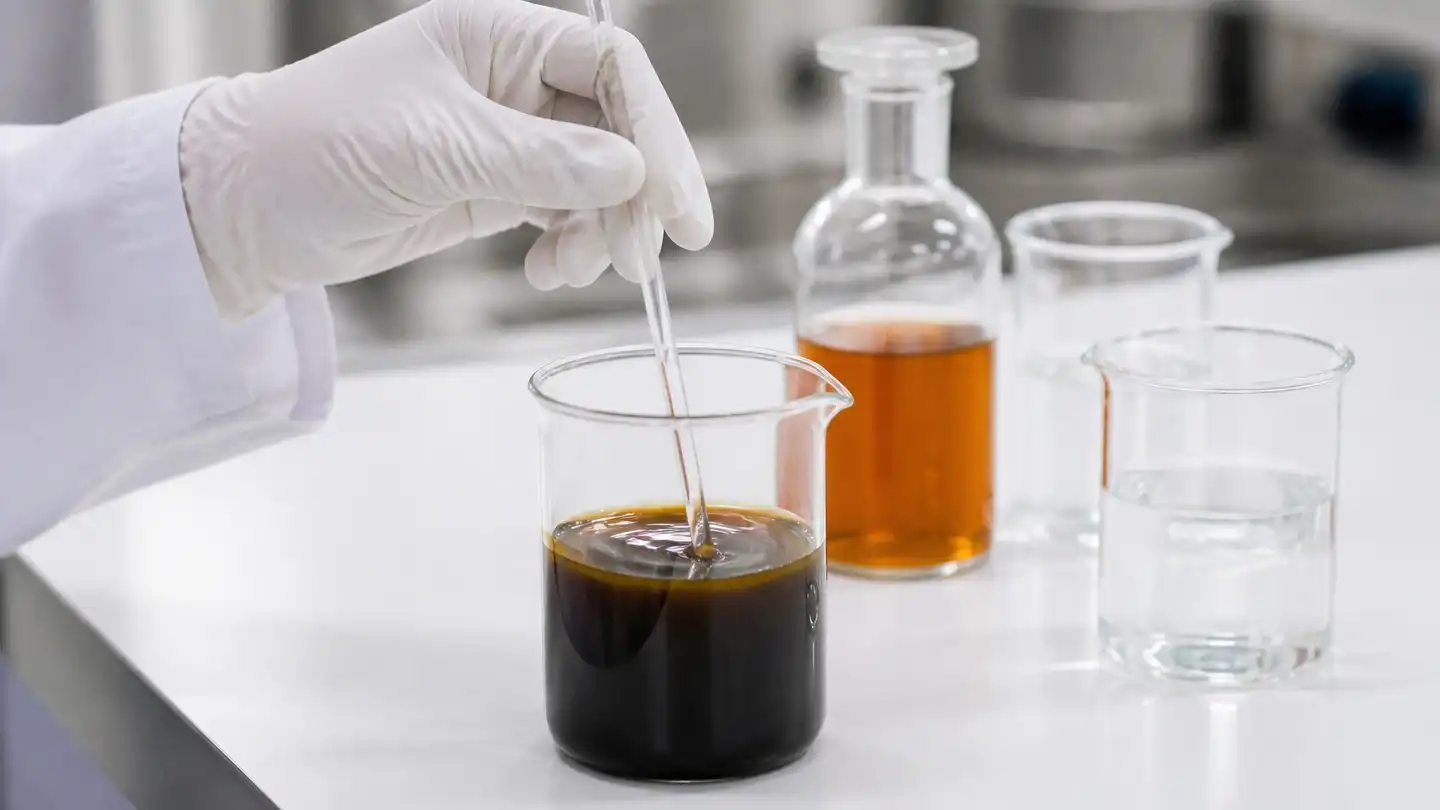
If the brief calls for a clear shot or beverage, the first question is whether the fulvic acid fraction stays in solution at the target concentration and pH. Even soluble material can throw a haze when the system is chilled or when pH moves, and mineral-associated fractions can settle over shelf life. The alternative is a deliberately turbid, stabilized suspension, or a concentrate that the consumer shakes before use under an on-pack instruction. Both routes are legitimate; the failure mode is designing a clear product and finding sediment months later, so clarity and sediment belong among the stability endpoints from the first trial rather than in a final check.
pH, chelation and co-ingredient compatibility
Fulvic acid behaves as a chelating organic acid, and that chemistry is the main compatibility variable in a multi-ingredient liquid. Divalent mineral salts, certain vitamin premixes, and alkaline ingredients can interact with the organic acid fraction, which shows up as cloudiness, a color shift, a taste change, or assay drift in the finished product. Amino acids and botanical extracts are generally easier partners but still need screening, and fat-soluble actives sit outside this discussion unless the system is emulsified.
The workable sequence is to fix the aqueous phase and pH, add the fulvic acid fraction, then add co-ingredients one at a time with an observation point after each addition, and repeat the exercise after accelerated storage. A change in appearance, pH or assay found at that stage is far cheaper to solve than a reformulation after a production run.
| Dosage form | Primary constraint | Moisture / hygroscopicity | Flow or fill consideration | Formulation note |
|---|---|---|---|---|
| Capsule (powder fill) | Fixed fill volume | High sensitivity; sticking and bridging risk | Bulk density and particle size must support the target fill weight (listed OEM range 250–500 mg) | Select the fulvic acid target to fit the fill weight, not the reverse |
| Powder blend | Blend uniformity | Open handling; moisture pickup during blending | A matched particle size band limits segregation | Re-verify assay on the finished blend, not only on incoming material |
| Stick pack | Uniform dose per unit | Sealed unit, but a moisture-sensitive powder | Must stay free-flowing through a narrow auger for the full run | Dark color and earthy taste are most visible in a single-serve pack |
| Liquid system | Clarity or controlled turbidity | Water activity drives preservative and stability choices | Settling and haze tested across shelf life | Screen each co-ingredient addition individually; chelation interactions are format-specific |
| Co-ingredient class | Interaction to screen | Indicative risk in dry blend | Indicative risk in liquid | Practical mitigation |
|---|---|---|---|---|
| Divalent mineral salts (e.g. magnesium, zinc) | Chelation by the organic acid fraction | Low to moderate | Moderate to high | Trial additions one at a time; monitor appearance, pH and assay |
| Water-soluble vitamins | Assay drift and color change in solution | Low | Moderate | Add late in the batch; verify assay after accelerated storage |
| Amino acids | Blend segregation and taste contribution | Low | Low | Match particle size; check flavor balance in the finished unit |
| Botanical extracts | Overlapping color and flavor load | Low | Low to moderate | Set a color reference sample; keep the flavor system consistent with the matrix |
| Fat-soluble actives | No aqueous solubility | Low | High unless emulsified | Use an emulsified system or keep the active in a separate solid format |
| Flavor, color and sweetener systems | Masking capacity against a dark, earthy matrix | Low | Low to moderate | Choose flavor families that complement the base notes rather than oppose them |
Label and Regulatory Points by Dosage Form
Compliance follows the format. The notes below are prompts for review with a regulatory specialist and against the rules of the destination market; they are not statements about a finished product or about any claim.
Capsules and solid units
In the United States, dietary supplement manufacturing, packaging, labeling and holding fall under the cGMP requirements of 21 CFR Part 111, which covers specifications, batch records, laboratory methods and labeling operations. The Supplement Facts panel describes the finished product, so the fulvic acid figure on the label must trace to the finished-batch assay rather than to an incoming raw material certificate. Structure and function statements are held to a different standard from drug claims, as set out in the FDA dietary supplement labeling guidance. In the European Union, supplement labeling sits within the general food information rules of Regulation (EU) No 1169/2011 alongside Directive 2002/46/EC, with permitted nutrient forms and notification duties set nationally.
Powders and stick packs
Single-serve powders carry a net quantity statement and a per-serving declaration, and the serving definition is what drives the color and flavor load discussed earlier. Where a product is positioned as a food or beverage rather than a supplement, a different labeling regime applies, and that decision is best made before artwork is commissioned. For the US market, the Proposition 65 list maintained by California's Office of Environmental Health Hazard Assessment is the reference point for listed chemicals and their safe harbor levels.
Liquid formats
Liquids add preservative, pH and shelf-life obligations to the labeling package, and any statement about the ingredient has to stay inside the permitted claim framework of the market. Maximum levels for polycyclic aromatic hydrocarbons in foodstuffs were introduced in the European Union under Commission Regulation (EU) No 835/2011, since replaced by the current contaminants regulation; confirm the version in force at the time of launch.
A short handover checklist
- Confirm the fulvic acid target against the fill weight, serving size or dose volume — not against a competitor's label.
- Fix moisture, bulk density and particle size in the specification, not only the assay.
- Screen each co-ingredient class in the actual dosage form, then repeat after accelerated storage.
- Verify assay and appearance on the finished blend, and retain a color reference sample.
Specify Your Dosage Form With Wellgreen
Wellgreen supplies Shilajit Extract as standardized powder, resin (paste) and finished OEM capsules, with fulvic acid standardized at 50% and customizable from 10% to 60%, supported by batch documentation covering assay, heavy metals and microbiology. Send us the target format and fill weight and we will return the specification options and sample arrangements that fit your line. Write to wgt@allwellcn.com or contact our technical team through the product page.
Disclaimer: This article provides technical and commercial information for industry professionals and is not medical advice. Ingredient usage levels, regulatory status and label claims depend on the destination market and on the manufacturer's own product data; confirm all usage levels, declarations and claims with your regulatory specialist before commercialisation.
References
1. Wellgreen — Shilajit Extract product page (specification, available forms, certification list). https://www.wellgreenherb.com/nutraceuticals/shilajit-extract
2. Wellgreen — What Factors Matter When Sourcing Shilajit Extract Bulk Supply? (assay verification, moisture below 5% loss on drying, ICP-MS, PAH and HPTLC documentation). https://www.wellgreenherb.com/knowledge/what-factors-matter-when-sourcing-shilajit-extract-bulk-supply
3. Wellgreen — Shilajit Extract Provides Natural Sourcing Options for Manufacturers (powder, resin and OEM capsule formats; compatibility screening before final blend ratios). https://www.wellgreenherb.com/knowledge/shilajit-extract-provides-natural-sourcing-options-for-manufacturers
4. U.S. Electronic Code of Federal Regulations — 21 CFR Part 111, Current Good Manufacturing Practice in Manufacturing, Packaging, Labeling, or Holding Operations for Dietary Supplements. https://www.ecfr.gov/current/title-21/part-111
5. U.S. Food and Drug Administration — Dietary Supplement Labeling Guide (April 2005; contains nonbinding recommendations). https://www.fda.gov/food/dietary-supplements-guidance-documents-regulatory-information/dietary-supplement-labeling-guide
6. California Office of Environmental Health Hazard Assessment — The Proposition 65 List. https://oehha.ca.gov/proposition-65/proposition-65-list
7. EUR-Lex — Commission Regulation (EU) No 835/2011 amending Regulation (EC) No 1881/2006 as regards maximum levels for polycyclic aromatic hydrocarbons in foodstuffs (subsequently replaced by the current contaminants regulation). https://eur-lex.europa.eu/legal-content/EN/TXT/?uri=CELEX%3A32011R0835
8. EUR-Lex — Regulation (EU) No 1169/2011 on the provision of food information to consumers. https://eur-lex.europa.eu/legal-content/EN/TXT/?uri=CELEX%3A32011R1169
9. EUR-Lex — Directive 2002/46/EC on the approximation of the laws of the Member States relating to food supplements. https://eur-lex.europa.eu/legal-content/EN/TXT/?uri=CELEX%3A32002L0046