
Ube Purple Yam Powder Helps Food Manufacturers Create Naturally Purple Product Lines
2026-09-24 14:18:01
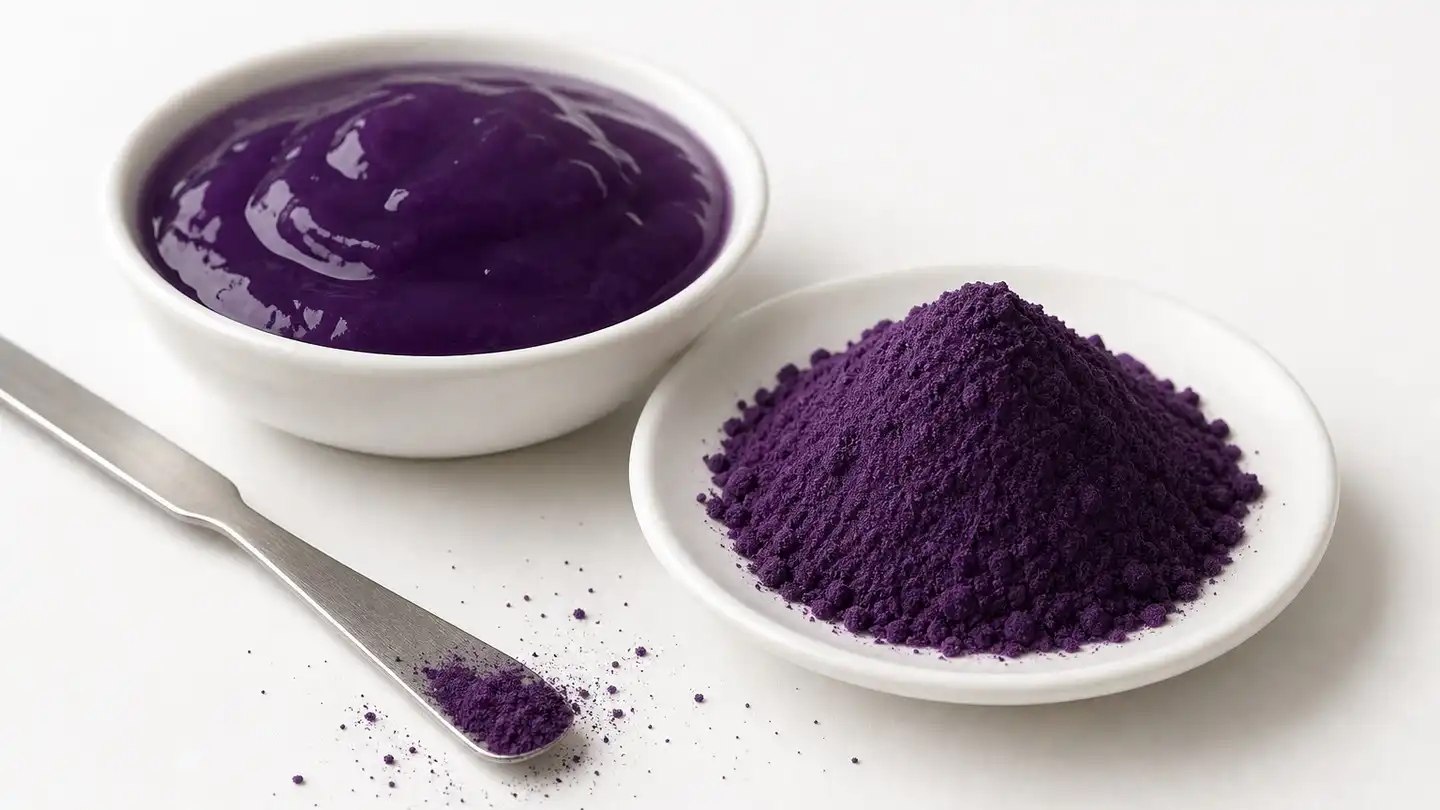
Colouring a single SKU is a formulation task. Colouring a whole purple range is a portfolio decision, and the two are not solved the same way. Ube Purple Yam Powder, the water-soluble, anthocyanin-bearing powder milled from Dioscorea alata, is usually presented as a natural violet alternative to synthetic dyes; the more useful question for a product-line owner is whether one ingredient can hold a single target shade across products that differ in pH, fat level, water activity and shelf life. This article works through that portfolio problem: defining the shade standard, predicting how pH moves the hue, containing drift and migration between phases, choosing a label declaration that survives scrutiny, and comparing options on the only basis that matters commercially — cost-in-use.
Define One Target Shade Before You Brief a Supplier
A portfolio standard has to be written in numbers, not adjectives. "Deep violet" means one thing to a brand manager and another to a quality manager, and neither survives a scale-up trial. The workable standard is a set of CIE L*a*b* coordinates with a tolerance envelope, plus the hue-angle range you will accept and the direction of drift you can live with.
Three rules keep that standard honest:
- Build it in a finished matrix, not in water. The base you actually sell is the only place where the reference shade is meaningful.
- Build it in the hardest base in the range. If the palest, least stable member of the line can reach the standard, every other SKU can be matched to it.
- Keep a physical retained sample and a spectral record, so a later batch dispute is a measurement conversation rather than an opinion.
Ask suppliers for colour data produced on the same basis you measure on — spectrophotometric colour value and, where possible, L*a*b* readings of a dispersion prepared your way — plus the specification fields they control: moisture, particle size, batch documentation. Wellgreen's Ube Purple Yam Powder page publishes its specification fields (Product Name, Botanical Name, Appearance, Processing, Solubility, Flavour Profile, Certification) and states its certification fields as ISO22000, HALAL, KOSHER and Non-GMO; read those directly rather than second-hand.
If the range is still being scoped, settle early whether ube is the right purple source at all: the trade-offs against purple sweet potato and synthetic dyes are set out in our comparison of purple sweet potato powder versus artificial dyes.
Finally, decide which drift you can tolerate. In a dairy base a hue sliding toward blue-grey reads as stale; in a fruit beverage a slide toward red-magenta reads as fruity and is often welcome. Encode that judgement per SKU rather than applying one number across the range.
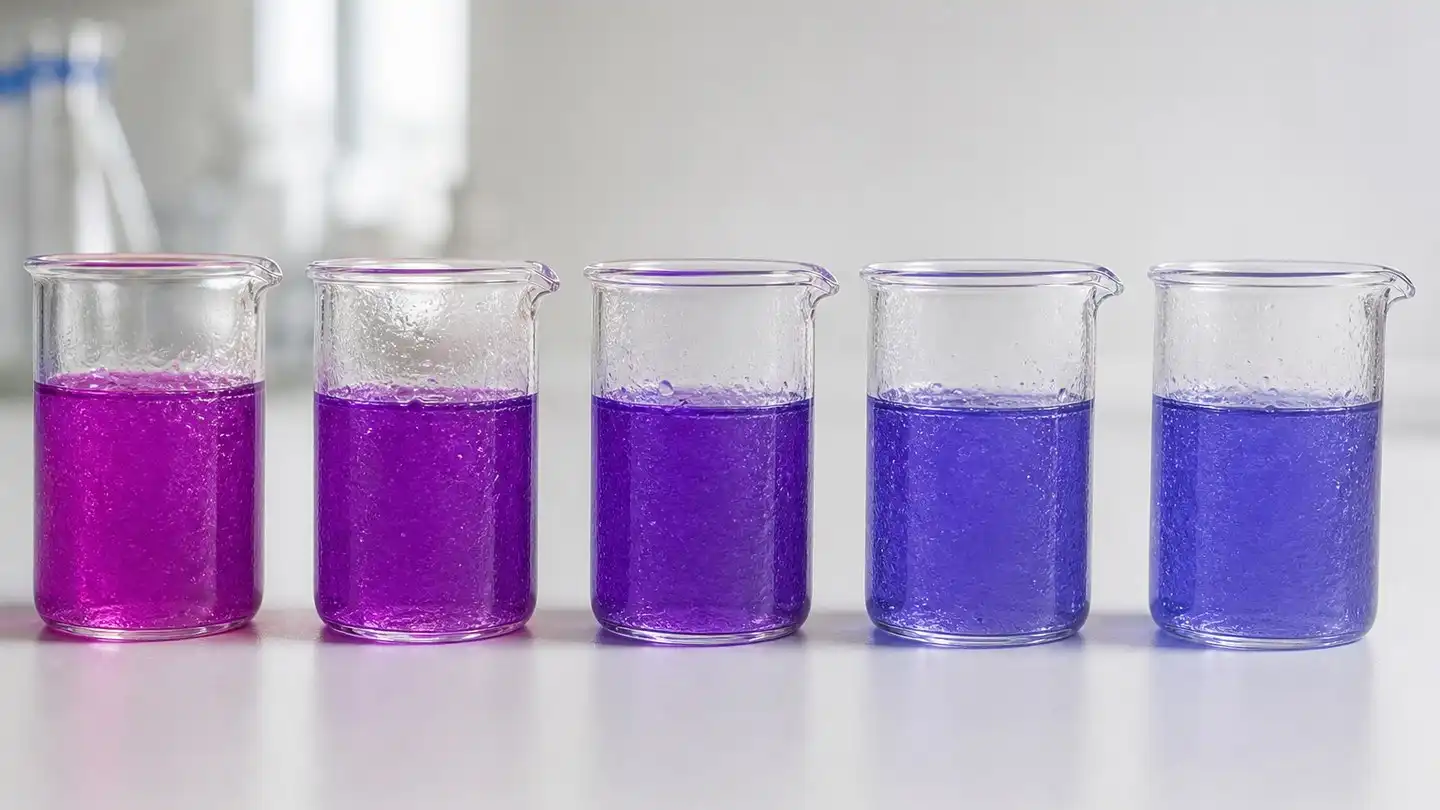
Because anthocyanin hue is a function of the base itself, no single target shade behaves identically everywhere. The table below sets out what to expect from one powder across typical base chemistry.
| Base in the range | Typical pH region | What the anthocyanin does | Consequence for the portfolio |
|---|---|---|---|
| Acidic beverage, fruit system, fermented base | Below roughly 4 | Flavylium cation dominates; hue moves toward red-magenta and colour is at its most stable | Highest colour yield of the range — use it as the reference shade |
| Slightly acidic dairy drink, yoghurt-type base | Roughly 4 to 4.6 | Between forms; very little hue from either the flavylium cation or the quinonoidal anion | Reads palest and weakest; the hardest SKU to match to a deep standard |
| Near-neutral dairy, plant base, custard, gel | Roughly 6.2 to 7.0 | Quinonoidal species dominate; hue moves to true violet and violet-blue | Closest to the familiar ube look; watch fade over shelf life |
| Bakery dough, batter, filling | Variable, often 6 to 8 or higher | Hue can drift grey-blue where alkaline agents or flour chemistry push pH upward | Standardise dough pH, not just powder loading, or the shade moves batch to batch |
How pH Moves the Hue — and Why a Range Never Matches Exactly
Anthocyanins are not a single pigment with a single colour. They exist as an equilibrium mixture of molecular species, and pH decides which species is present. In strongly acidic conditions the flavylium cation gives a red-purple; through the middle of the pH scale the colour fades because neither the flavylium cation nor the quinonoidal anion is present in quantity; at neutral pH the resonance-stabilised quinonoidal anions restore a purple hue; and as conditions become alkaline the colour continues toward blue. Khoo and colleagues set out that chemistry, including the observation that acylation increases the proportion of flavylium cation and helps maintain colour as pH rises.
That matters because the pigment profile is not generic. The anthocyanins of Dioscorea alata are cyanidin-based and include non-acylated, mono-acylated and di-acylated glycosides acylated with sinapic or ferulic acid, with alatanin C reported as a major component in the accessions studied by Srivichai and Hongsprabhas. A powder carrying a higher share of acylated species holds its hue further up the pH scale than one that does not — precisely the difference a range spanning low-pH beverages and near-neutral dairy will expose. The same mechanism governs other anthocyanin sources: it is why a blueberry-derived colourant can read blue, purple or pink depending on the matrix, as described in our note on blueberry extract powder as a natural food colouring.
Four Habits That Keep a Range Coherent
- Nominate one reference SKU — normally the acidic beverage, where colour yield is highest — and match every other SKU to the retained sample.
- Adjust hue per SKU, not the standard. A near-neutral dairy reading more violet and a low-pH drink reading more magenta is a designed family resemblance, not a defect.
- Control pH deliberately within what recipe, process and applicable rules allow, and log it as a critical process parameter alongside loading.
- Ask for the pigment profile, not just a colour value, when the range spans a wide pH window — it helps you predict the middle of the range before the trial.
Shade Drift and Colour Migration Between Phases
Anthocyanins are water-soluble, so they follow water. In a single-phase beverage or gel that is an advantage; in a multi-phase product it becomes the central technical risk.
Consider what a purple range usually contains: an iced bun with purple icing over pale dough; a dairy base with a swirled ribbon; ice cream with coloured inclusions; a filled confection with a purple centre in a white shell. In each case the pigment sits in one phase and is largely absent from the next, and moisture movement carries colour across the boundary. The outcomes are familiar: a swirl that softens into the base over weeks, a boundary that blurs, inclusions that tint the matrix around them, and a contrast that no longer looks deliberate.
The migration logic is shared with other water-soluble botanical colourants — the same reasoning that applies to an anthocyanin-derived purple also governs beetroot extract used as a natural red food colouring — even though the two pigment families respond differently to pH and heat.
Treat Migration as a Shelf-Life Property
- Set the shade standard on the assembled product at end of shelf life, not on the freshly made component — day-zero bench samples flatter multi-phase systems.
- Model water activity and moisture gradients across the phase boundary, and use a barrier, fat-phase adjustment or reformulation where the gradient is steep.
- Measure at defined intervals with a spectrophotometer and report ΔE against the retained standard, so drift is a trend line rather than a surprise at month nine.
- Respect the pigment's sensitivities in storage and transport — light, oxygen and heat accelerate fading, so pack format and distribution belong in the colour specification.
The Label-Declaration Choice: Two Routes, One Decision
When a developer colours a purple range with a botanical ingredient, the same material can sit on the label in different ways depending on what it is, how it was made and how it is used. That choice affects the ingredient list, the evidence file and, in some markets, the permissibility of the product itself — worth documenting before the first production run.
United States. Colour additives used in food require authorisation, and 21 CFR Part 73 lists colour additives exempt from certification — the plant, animal and mineral-derived colourants — together with their specifications and conditions of use. The FDA also publishes the regulatory status of individual colour additives, the reference point for checking where a given material sits. Whether a purple yam ingredient is positioned as a colour additive or as an ingredient that happens to contribute colour depends on the material's identity, its production route and the claims made for it; that position should be recorded and supported.
European Union. Regulation (EC) No 1333/2008 governs food additives, and its recital 5 draws the line clearly: substances considered foods and used for a technological function, such as saffron used for colouring, fall outside the additive regime, while preparations obtained from foods by selective extraction of constituents — pigments, for example — relative to the nutritive or aromatic constituents are considered additives. Anthocyanins are authorised as the colour E 163; EFSA's re-evaluation found the available toxicological database inadequate to establish a numerical acceptable daily intake, while for anthocyanins extracted from edible fruits and vegetables by aqueous processes it considered that changes in composition would not be expected and that exposures from current uses were unlikely to be of safety concern. Consumer-facing declaration of colours sits under Regulation (EU) No 1169/2011.
The comparison below is context for a compliance conversation, not a substitute for it. One grey area deserves naming: ingredients that are foods in their own right may be used partly for colour while also carrying flavour, which is where a botanical powder used for both functions tends to sit. There the declaration route rests on the character of the material and the intention behind its use, and the reasoning should be written down while the formula is still fluid.
| Dimension | Colour-additive route | Colouring-foodstuff route |
|---|---|---|
| What the material is | A preparation standardised for pigment, characterised as an additive | A food ingredient used at least partly for its colour effect |
| Ingredient-list consequence | Declared as a colour additive under its authorised name or class | Declared as the food ingredient itself |
| Where the boundary sits in the EU | Selective extraction of pigments relative to nutritive or aromatic constituents points toward the additive regime | A substance regarded as a food used for a technological function sits outside the additive regime |
| Evidence to hold on file | Specification compliance, authorisation basis, batch conformity data | Identity, composition, unmodified character, intended use and market-specific guidance |
| Typical fit in a purple range | Ranges that need a characterised, standardised colour specification | Ranges led by a botanical story and a familiar ingredient name, as with an organic goji berry powder used for colour and flavour at once |
Cost-in-Use: the Only Basis for Comparing Colour Options
Raw-material price per kilogram answers the wrong question, because a colourant is bought for the colour it delivers, and colouring power per unit of material varies widely between sources, grades and processing routes. A cheaper ingredient that needs more material, more rework or a higher overage to hit the same shade is not cheaper. The comparison belongs per finished unit and per tonne of finished product.
Nothing in this section is a price, a rate or a quote; it is the structure of the calculation, built once and reused for every option under consideration.
| Line in the calculation | Unit | How to populate it |
|---|---|---|
| Colouring power of the ingredient | Colour value per unit of material | Spectrophotometric measurement at the working pH of each base in the range |
| Material required to hit the target shade | Per batch of each SKU | From the trial that matched the retained standard, with the pH of that batch recorded |
| Process and overage loss | Percentage of the batch | Measured loss across heat, oxygen and light exposure in your own process |
| Delivered colour at end of shelf life | ΔE against the retained standard | Accelerated and real-time storage trials on the assembled product |
| Rework and batch failure exposure | Per campaign | Historic hold, rework and downgrade rates for colour-driven deviations |
| Freight, storage and handling of the ingredient | Per unit of colour delivered | Ingredient mass needed per finished tonne, converted to logistics volume |
| Development and compliance effort | Per SKU in the range | Trial iterations, shelf-life studies, specification and documentation work |
Run the same worksheet for each candidate, then divide by finished units and by finished tonnes. Options that look expensive per kilogram routinely reverse position once overage, rework and logistics are expressed per finished unit; options that look cheap per kilogram can lose that advantage the moment delivered colour at end of shelf life is counted.
A Short Decision Checklist for a Purple Range
Before committing an ingredient to a multi-SKU purple programme, confirm the following — each item costs a little laboratory time now and saves a reformulation later.
- Shade standard defined in a finished matrix — L*a*b* coordinates, hue-angle range, stated ΔE tolerance.
- Reference SKU nominated and a retained sample held at both ends of the range.
- pH recorded for every base, with the hue consequence documented per SKU rather than assumed.
- Pigment profile requested, including the acylation pattern where the range spans low-pH and near-neutral bases.
- Migration risk assessed for every multi-phase product, with end-of-shelf-life colour as the criterion.
- Declaration route chosen and documented per market, with supporting evidence in the technical file.
- Cost-in-use worksheet completed per finished unit and per finished tonne.
- Supplier data verified against the specification fields and certification status on the supplier's own product page.
If the range leans on a botanical story rather than colour alone, the same discipline applies to colour-plus-flavour ingredients, where one material carries both a hue and a taste profile — a different balance that changes which line of the worksheet carries the weight.
If you are testing one target shade across a full purple range — a beverage, a dairy or plant base, a bakery item and a gel — the natural starting point is a powder with a documented specification and a stable processing route. Wellgreen supplies Ube Purple Yam Powder to food and beverage manufacturers and shares its specification and certification fields openly on the product page; send your application, target shade and market requirements to wgt@allwellcn.com and our team will respond with the technical data you need to run the comparison.
Disclaimer: This article provides technical and commercial information for food industry professionals and is not medical advice; use levels, regulatory status and label claims for any product must be confirmed against the rules of your target market and your own finished-product data.
References
- U.S. Food and Drug Administration. Regulatory Status of Color Additives. https://www.fda.gov/industry/color-additive-inventories/color-additive-status-list
- Electronic Code of Federal Regulations. 21 CFR Part 73 — Listing of Color Additives Exempt from Certification. https://www.ecfr.gov/current/title-21/chapter-I/subchapter-A/part-73
- European Parliament and Council. Regulation (EC) No 1333/2008 of 16 December 2008 on food additives. Official Journal L 354, 31.12.2008, pp. 16–33. https://eur-lex.europa.eu/legal-content/EN/TXT/?uri=CELEX%3A32008R1333
- European Parliament and Council. Regulation (EU) No 1169/2011 of 25 October 2011 on the provision of food information to consumers. Official Journal L 304, 22.11.2011, pp. 18–63. https://eur-lex.europa.eu/legal-content/EN/TXT/?uri=CELEX%3A32011R1169
- EFSA Panel on Food Additives and Nutrient Sources added to Food (ANS). (2013). Scientific Opinion on the re-evaluation of anthocyanins (E 163) as a food additive. EFSA Journal, 11(4), 3145. https://doi.org/10.2903/j.efsa.2013.3145
- Khoo, H. E., Azlan, A., Tang, S. T., & Lim, S. M. (2017). Anthocyanidins and anthocyanins: colored pigments as food, pharmaceutical ingredients, and the potential health benefits. Food & Nutrition Research, 61(1), 1361779. https://doi.org/10.1080/16546628.2017.1361779
- Srivichai, S., & Hongsprabhas, P. (2020). Profiling anthocyanins in Thai purple yams (Dioscorea alata L.). International Journal of Food Science, 2020, 1594291. https://doi.org/10.1155/2020/1594291
- Tamaroh, S., Sari, Y. P., Wariyah, C., Huda, N., & Candraruna, D. B. (2024). Formulation and characterization of nanoemulsion containing anthocyanin extract from purple yam (Dioscorea alata L.). Food Science and Biotechnology, 34(4), 905–911. https://doi.org/10.1007/s10068-024-01713-x