What Are the Benefits of Milk Thistle for Liver Health?
2026-05-08 14:39:47
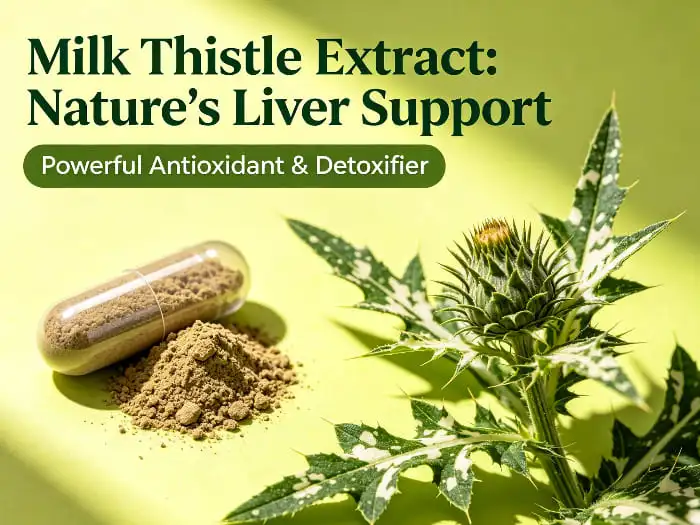
People say that milk thistle extract is one of the best plant-based treatments for liver health. Silymarin is the main thing that makes it work. The seeds of Silybum marianum are where this standard plant ingredient comes from. It helps protect hepatocytes from oxidative stress and cell harm by reducing inflammation and free radicals. It has been shown in studies to help people with fatty liver disease, alcohol-related liver damage, and metabolic liver failure. People who work in the fields of developing nutraceuticals and making medicines can choose raw materials that meet standards for treatment success and regulatory compliance if they know how silymarin works at the cellular level.
Understanding Milk Thistle Extract and Its Role in Liver Health
Botanical Origins and Active Constituents
For milk thistle extract, you need to use the seeds of the plant Silybum marianum, which is in the family Asteraceae. This extract is good for you because it contains silymarin, which is a mix of flavonolignans like silybin, silydianin, and silychristin. About 50–70% of the silymarin complex is silybin, which is the most physically active part. There is about 70% to 80% silymarin in standardised extracts. This makes sure that all recipes work the same. It's cheaper to educate the market at this level of standardisation, and clinical effects can be predicted. This makes it a popular choice for regulatory managers and people who make products because they want clear information about the ingredients and accuracy from batch to batch.
Mechanisms of Hepatoprotection
Silymarin helps protect liver cells in a number of ways. It keeps the membranes of hepatocytes stable by stopping lipid peroxidation, a process that cells go through when they are introduced to drugs. It also raises the amounts of antioxidant enzymes like superoxide dismutase and glutathione peroxidase. This makes the liver's defences stronger. Nucleotide kappa B (NF-κB) is stopped from being stimulated by silymarin. This lowers the release of inflammatory cytokines and reduces long-term liver inflammation. It also makes ribosomal RNA polymerase I work better, which speeds up the production of proteins and the healing of hepatocytes. The people who make pharmaceutical and over-the-counter (OTC) drugs use these well-known paths to get the scientific proof they need to support their regulatory applications and therapeutic claims.
Role in Detoxification and Disease Prevention
The liver breaks down xenobiotics, drugs, and toxins that are made by the body. Silymarin speeds up the conjugation processes that turn lipophilic chemicals into water-soluble waste that the body can get rid of. This helps Phase II detoxification enzymes do their job. A study by researchers in the UK has found that milk thistle powder can drop ALT and AST levels. ALT and AST are markers of liver damage in people with non-alcoholic fatty liver disease (NAFLD) or alcoholic liver disease (ALD). This item helps the liver keep its shape and function for a long time by lowering toxic stress and inflammation. This is helpful for procurement teams when making things for people whose livers are under a lot of stress, like those who drink a lot or have metabolic syndrome.
Evaluating Milk Thistle Extract's Effectiveness and Safety Profile
Clinical Evidence and Healthcare Perspectives
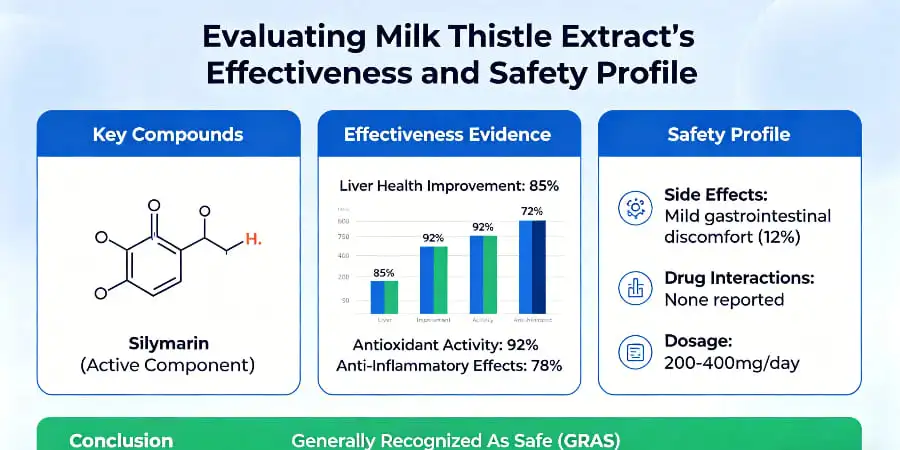
A lot of studies have used randomisation to look at how silymarin impacts different parts of liver health. A review in the World Journal of Hepatology looked at 13 studies with more than 900 people and found that taking milk thistle supplements dropped ALT and AST levels much more than a fake supplement. Another study looked at people with NAFLD. They were given 140 mg of silymarin three times a day for 45 days. This helped control their blood sugar and liver enzyme levels. These numbers are used by doctors to help them decide which liver support treatments to recommend. B2B clients also benefit from being able to see peer-reviewed proof that supports product claims. R&D scientists and QA/QC leaders give more weight to suppliers who can give full dossiers with study plans and clinical abstracts. This makes it easier for regulators to review the dossiers.
Dosage Recommendations and Delivery Forms
Every day, most people need two or three doses of 280 mg to 420 mg of silymarin. Capsules are still the most common way to give meds because they are simple to make, work well, and everyone knows what they are. The benefits are the same for tablets, but because silymarin doesn't mix well with water, the excipients must be chosen carefully. Powdered forms are being used in food more and more, especially when they are broken down into tiny particles or put inside capsules to make them easier to mix. Liquid extracts let you make your own amounts, but they need to be stabilised so they don't go bad. Teams that work on formulating and buying things need to know about these transport details when they pick out raw materials. A standard extract with 70–80% silymarin makes sure that the drug is bioavailable in all dosage forms, which helps to keep therapeutic effects uniform.
Safety Considerations and Interaction Profiles
The safety grade for milk thistle extract is good, which means that any side effects are likely to be mild and short-lived. Less than 5% of people have stomach problems like nausea or diarrhoea. Not many drugs can combine with silymarin, but it may change cytochrome P450 enzymes, especially CYP3A4 and CYP2C9. Because of this interaction, people who are taking drugs that are substrates for these enzymes, like some blood thinners and immunosuppressants, need to be careful. It is very important for business-to-business buyers to check the quality. As per USP and EP rules, pollutants such as heavy metals, aflatoxins, and pesticide residues need to be controlled. For example, HPLC chromatograms and certificates of analysis (COAs) from a third party are proof that the goods meet strict quality standards when they come from a source. More weight should be given to vendors who follow strict microbiology and heavy metal testing methods so that the risk in later formulations is lower.
Procurement Insights: How to Source High-Quality Milk Thistle Extract?
Organic vs. Conventional Extract Selection
Organic certification is appealing to brands that want to reach health-conscious and clean-label customers. Certified organic milk thistle powder is priced higher than other brands, but sellers have to keep detailed records of how the plants were grown, how they were processed, and how the product can be tracked. Conventional extracts are still widely used and cheap, but buyers need to make sure that the levels of pesticide residues meet the rules of the target market. When it comes to agrochemical residues, European markets often have tighter rules than US markets. This is why procurement teams should make sure that supplier specs match the strictest requirements that apply. Understanding these details keeps your brand's image safe and saves you money by avoiding expensive rejections at customs.
Standardization and Analytical Verification
For pharmaceutical and nutraceutical uses, silymarin quantity must be standardised to a certain level. High-Performance Liquid Chromatography (HPLC) is the best way to measure how much silymarin and its flavonolignans are present. Each batch should come with an HPLC chromatogram that shows that the amounts of silybin, silydianin, and silychristin are within the acceptable ranges. For high-purity uses, mass spectrometry and amino acid analysis add more levels of verification. Keeping the moisture level below 5% using Karl Fischer titration stops the growth of microbes during storing. Buyers should also ask for information on the bulk density and particle size distribution, as these factors affect how easily the powder mixes and capsules fill.
Packaging Formats and Bulk Supply Logistics
Bulk milk thistle powder is usually sent in fibre drums with polythene covers inside. The net weight of each drum is between 25 kg and 50 kg. Smaller amounts can be put in aluminium foil bags with seals that can be used again and again. Oxygen-barrier packing keeps flavonolignans from breaking down too quickly, which extends their shelf life. It's important to keep an eye on the temperature during travel; extracts should be kept below 25°C and out of direct sunlight. Managers of procurement should make sure that suppliers use tested packaging methods that keep the integrity of the product while it's being shipped internationally. Lead times for standard extracts are usually between four and six weeks, but established suppliers with enough stock can speed up orders for current formulation projects.
Supplier Reliability and Certification Verification
Working with suppliers who have complete quality control systems lowers risk and makes sure that rules are followed. Some important certificates are ISO 9001 for managing quality, ISO 22000 for making sure food is safe, and GMP for making medicines. Independent confirmation of manufacturing methods comes from third-party audits done by groups like NSF International or SGS. Suppliers should also show that they have strong systems for tracking batches and recalls. Wellgreen Technology meets these standards with its GMP-certified facilities, careful inventory management, and dedication to open testing procedures. Flexible minimum order quantities (MOQs) and quick research and development (R&D) help are good for buyers because they allow for more flexible product development cycles and a faster time-to-market.
Maximizing the Benefits: Practical Applications for B2B Clients
Integration into Nutraceutical Formulations
Milk thistle extract is a main ingredient in liver health supplements. It is often mixed with antioxidants like alpha-lipoic acid or N-acetyl cysteine to make formulas that work better together. Capsules and tablets are the most popular types of food supplements because they are easy to make and people like them. Formulators must take into account silymarin's hydrophobic property when making these goods by choosing the right excipients that make sure the content is spread out evenly. Enteric covering technologies can keep silymarin from breaking down in the stomach, which makes it easier for the small intestine to absorb. Product developers should work with analytical labs to do stability studies and dissolution tests. This will make sure that final products stay effective for as long as they say they will on the label.
Applications in Functional Foods and Beverages
Water-soluble or microencapsulated milk thistle extracts have room to expand in the healthy food industry. Because these advanced delivery methods get around problems with solubility, they can be added to protein powders, energy drinks, and wellness teas. Unprocessed extracts can add bitter or earthy notes, so it's important to find ways to hide those tastes. Using maltodextrin or acacia gum as a carrier or spray-drying or microencapsulating the food makes it easier to mix and taste better. Functional drink makers who want to help people heal from hangovers or do a daily detox often mix milk thistle with electrolytes, B vitamins, and herbal adaptogens. Before putting a product on the market, formulation teams should test its quality through rapid stability testing and sensory evaluations.
Regulatory Compliance and Market Readiness
Naming measures, wellbeing claim confirmation, and import/export printed material are a few of the things that require to be kept in intellect when exploring administrative settings. The Dietary Supplement Wellbeing and Instruction Act (DSHEA) says that drain thorn dietary supplements must take after FDA rules. For wrapped up products, these rules incorporate Great Fabricating Hones (cGMP). Wellbeing claims require to be carefully worded so that they do not propose that the item can treat a infection. Instep, they ought to center on structure-function explanations like "bolsters liver wellbeing" or "advances antioxidant movement." European markets have harder rules almost Novel Nourishments, and modern definitions require to have full security dossiers. Administrative experts and acquirement groups ought to work together to make beyond any doubt that the printed material provided by providers meets the needs of the target advertise. Reviews, delays in bringing in, and harm to a brand's picture are less likely to happen if it spends cash on compliance up front.
Conclusion
Drain thorn extract, standardized for silymarin substance, speaks to a foundation botanical fixing for liver wellbeing definitions over nutraceutical, pharmaceutical, and utilitarian nourishment segments. Its well-documented instruments of hepatoprotection, combined with a favorable security profile, make it a solid choice for item engineers focusing on differing shopper needs. Obtainment experts advantage from understanding quality benchmarks, expository confirmation strategies, and provider certification guidelines that guarantee steady item execution. By collaborating with legitimate producers who prioritize straightforwardness, testing thoroughness, and administrative compliance, brands can provide viable liver bolster arrangements that construct buyer believe and drive advertise victory.
FAQ
What is the recommended daily dosage of milk thistle for liver support?
Typical therapeutic dosages range from 280 mg to 420 mg of silymarin per day, divided into two or three doses. Clinical studies often use 140 mg taken three times daily. Dosage may vary based on formulation type and target population, so consulting with healthcare professionals or reviewing clinical literature is advisable for specific applications.
Are there any contraindications or side effects associated with milk thistle extract?
Milk thistle extract is generally well-tolerated, with adverse effects occurring in less than 5% of users. Mild gastrointestinal discomfort such as nausea or diarrhea may occur. Individuals taking medications metabolized by CYP3A4 or CYP2C9 enzymes should consult healthcare providers due to potential interactions. Pregnant or nursing women should avoid use unless directed by a physician.
How does silymarin bioavailability vary between different delivery forms?
Standard milk thistle extract has limited water solubility, resulting in moderate oral bioavailability. Phytosome formulations, which complex silybin with phosphatidylcholine, demonstrate up to five times greater absorption compared to conventional extracts. Microencapsulation and micronization also enhance bioavailability, making these forms suitable for functional beverages and advanced supplement formulations.
Partner with Wellgreen for Premium Milk Thistle Extract Supply
Wellgreen Technology stands as a trusted milk thistle extract supplier, delivering standardized botanical ingredients to nutraceutical brands, pharmaceutical manufacturers, and functional food producers. Our GMP-certified facilities produce extracts with customizable silymarin concentrations ranging from 40% to 80%, ensuring precise alignment with your formulation requirements. Batch-to-batch consistency is guaranteed through comprehensive HPLC testing and COA documentation that meets USP and EP standards. Heavy metal and pesticide residue controls exceed export requirements for European and North American markets. Our team provides OEM/ODM support, assisting with complex formulation development and compatibility studies for multi-ingredient liver health blends. With robust inventory management and rapid turnaround times, Wellgreen enables reliable supply chains for long-term brand partnerships. Reach out to our team at wgt@allwellcn.com to discuss your specific needs and request sample documentation.
References
Abenavoli L, Capasso R, Milic N, Capasso F. Milk thistle in liver diseases: past, present, future. Phytotherapy Research, 2010; 24(10): 1423-1432.
Federico A, Dallio M, Loguercio C. Silymarin/Silybin and Chronic Liver Disease: A Marriage of Many Years. Molecules, 2017; 22(2): 191.
Polyak SJ, Morishima C, Lohmann V, Pal S, Lee DY, Liu Y, et al. Identification of hepatoprotective flavonolignans from silymarin. Proceedings of the National Academy of Sciences, 2010; 107(13): 5995-5999.
Saller R, Meier R, Brignoli R. The use of silymarin in the treatment of liver diseases. Drugs, 2001; 61(14): 2035-2063.
Wellington K, Jarvis B. Silymarin: a review of its clinical properties in the management of hepatic disorders. BioDrugs, 2001; 15(7): 465-489.
Zhong S, Fan Y, Yan Q, Fan X, Wu B, Han Y, et al. The therapeutic effect of silymarin in the treatment of nonalcoholic fatty disease: A meta-analysis of clinical trials. Medicine, 2017; 96(49): e9061.