What Makes Bulk Green Tea Extract Suitable for Beverage and Food Applications?
2026-08-21 14:00:01
Bulk Green Tea Extract stands out in beverage and food applications due to its concentrated bioactive compounds, exceptional water solubility, and thermal stability during processing. Derived from Camellia sinensis leaves through gentle water or ethanol extraction, this ingredient delivers standardized polyphenol concentrations (50%-98%) and high EGCG levels that function as natural antioxidants and preservatives. Its fine particle structure ensures uniform dispersion in liquid formulations without precipitation, while its clean-label profile meets growing regulatory demands for synthetic-free ingredients across North American and European markets.
Introduction
The global functional beverage and food sectors are experiencing a fundamental shift toward plant-based wellness ingredients. Bulk Green Tea Extract has become an important raw material for companies that want to meet the health needs of their customers while also making their production more efficient. This concentrated plant ingredient contains all of green tea's healthy chemicals, such as catechins, EGCG, and L-theanine. It does this by using controlled extraction methods that keep the bioactivity while getting rid of the unpleasant astringency.
Recent changes in regulations, especially the faster limits on synthetic chemicals that will happen in the US and EU in 2026, have made green tea extract an option that is ready for compliance for product makers. It can do many things, from naturally preserving food to supporting metabolism. This helps meet the needs of both extending shelf life and making health claims. We've seen buying teams give more weight to suppliers who can show consistency from batch to batch and provide a lot of paperwork to back up clean-label promises.
There are chances for makers who know the technical specs needed for different application matrices because there is a growing demand for clear ingredient sourcing. Choosing the right standardized extract grades is important for both the success of processing and the performance of the final product, whether you're making ready-to-drink drinks with an acidic pH or capsule vitamins that need to have certain flowability properties.
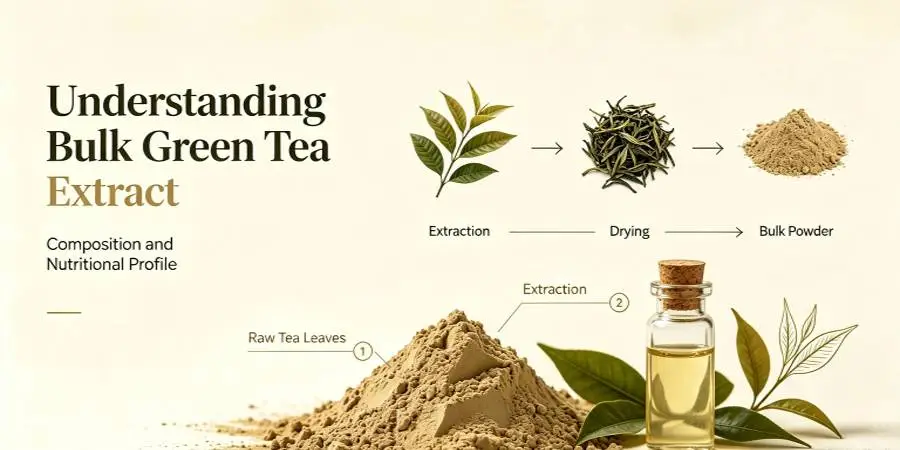
Understanding Bulk Green Tea Extract: Composition and Nutritional Profile
Extraction Technology and Bioactive Concentration
Bulk Green Tea Extract comes from the Camellia sinensis leaves that have not been oxidized. The leaves are extracted using mild water or food-grade ethanol. This method makes the antioxidants in tea, especially catechins like epigallocatechin gallate (EGCG), much stronger than they are in iced tea. Filtration, concentration, and spray-drying are all steps in the extraction process that make a fine powder with a controlled moisture content below 5%. This keeps the powder stable while it is being stored and shipped.
Modern facilities for extraction use multiple stages of processing to get rid of tannins and bitter chemicals while keeping the catechin profile. With this process, extracts are made that have polyphenol concentrations between 50% and 98%, total catechin concentrations between 30% and 90%, and pure EGCG fractions between 15% and 98%. The standardization process lets formulators figure out the exact amounts needed to reach the desired antioxidant levels without changing the taste.
Physical and Chemical Characteristics
The color of good Bulk Green Tea Extract powder ranges from light yellow to dark brown, based on how dense the catechins are. The material usually goes through 80-100 mesh screens, which creates a regular spread of particle sizes that is needed for smooth mixing and dissolving. When measuring bulk density between 0.3 and 0.5 g/ml, it changes how well automated production lines can figure out the capsule fill weight and do volumetric dosing.
The chemical fingerprint has polyphenolic compounds, as well as small amounts of vitamins, minerals, and amino acids that work together to make the extract effective. Even though it's present in smaller amounts, L-theanine content helps the brain and works with catechins to speed up metabolism. Professional-grade extracts are tested using HPLC to confirm catechin profiles, UV spectrophotometry to measure total polyphenols, and ORAC tests to check their antioxidant potential. These methods of analysis give the technical information needed for regulatory applications and to back up claims on product labels.
Decaffeinated Variants and Custom Specifications
Bulk Green Tea Extract usually has between 2% and 10% caffeine, which could be an issue for some formulations meant to be used in the evening or by people who are sensitive to caffeine, and for Green Tea Extract Powder, using supercritical CO2 or water-based ways, new decaffeination technologies lower the caffeine level to less than 0.1% while keeping the catechins intact, and this customization feature caters to specific market segments, such as those looking for nighttime recovery supplements, calming drinks, and products made for people who are trying to cut down on caffeine intake. Using supercritical CO2 or water-based methods, new decaffeination technologies lower the caffeine level to less than 0.1% while keeping the catechins intact. This customization feature caters to specific market segments, such as those looking for nighttime recovery supplements, calming drinks, and products made for people who are trying to cut down on caffeine intake.
Key Benefits of Bulk Green Tea Extract in Food and Beverage Applications
Potent Antioxidant and Free Radical Scavenging
Bulk Green Tea Extract is a powerful antioxidant because it contains a lot of EGCG, a chemical that can neutralize free radicals many times better than vitamin C or vitamin E. For companies that make food and drinks, this property means a lot of useful things. The extract stops lipid peroxidation, which makes products with oxidation-sensitive ingredients like natural colors or omega-3 fatty acids last longer. Products with standardized extract amounts keep their nutritional value and stability in taste throughout their distribution cycle.
In addition to preservation, the antioxidant profile helps the product make wellness claims about the health of cells and getting older. The way it works is by blocking processes that cause oxidative stress and helping the body's own antioxidant enzyme systems. This two-in-one effect has been shown in many clinical studies, giving marketers and controlled markets the solid basis they need to back up health claims.
Metabolic Support and Weight Management Functionality
Green tea catechins change the way your body uses energy by speeding up thermogenesis and fat burning. EGCG in particular has been shown to speed up metabolism and make better use of substrates while exercising. Because of these effects, Bulk Green Tea Extract is a key part of sports nutrition drinks, functional protein mixes, and dietary products that help people reach their body composition goals.
The biochemical effects happen when catechin interacts with catechol-O-methyltransferase enzymes. This makes norepinephrine work longer in the body. When green tea extract is mixed with other thermogenic substances, they work better together, which is explained by this biochemical route. Formulation teams use this synergy to their advantage by mixing compounds that work through different metabolic pathways, but with botanical extracts, amino acids, and minerals that work well together.
Superior Solubility and Processing Compatibility
As extraction and cleaning technologies have improved, Bulk Green Tea Extract powders have become very water-soluble and don't settle to the bottom of finished goods as much. Cold-water soluble grades dissolve quickly, even in low-temperature processing environments. This means that heat-sensitive co-ingredients don't have to be heated, which can damage them. The high clarity achieved in solution form stops the "tea cream" precipitation that often happens with crude tea extracts, so they look good in clear drinking uses.
Manufacturing compatibility includes maintaining a stable pH level across acidic formulations that are common in functional drinks. Many plant-based ingredients break down or change color in drinks with pH levels between 3 and 4, but this extract keeps the catechins intact. This stability window matches the recipe specs for sports drinks, enhanced waters, and carbonated functional drinks. Processing tests show that properly standardized extracts can survive high temperatures for pasteurization without losing a lot of bioactive material. This supports the need for industrial sterilization.
Natural Preservation and Shelf-Life Extension
Green tea polyphenols' antibacterial qualities make them a clean-label way to keep food fresh without using artificial additives. Catechins work against common organisms that cause food to go bad and pathogenic bacteria, which helps keep products safe from microbes whether they are at room temperature or in the fridge. This preservative effect works well with other barrier technologies, such as modified atmosphere packing and acidity, so formulators can make products with little processing that still have a good shelf life.
Microbes' cell walls are broken, and bacterial enzyme systems are stopped as part of the preservation process. Bulk Green Tea Extract supports product stories about natural protection and ingredient transparency, while traditional preservatives may make people nervous. This fits with what people expect from clean labels, which has led to widespread use across organic product lines and brands that focus on plant ingredient platforms.
How to Use Bulk Green Tea Extract in Food and Beverage Manufacturing?
Dosage Guidelines and Formulation Parameters
To incorporate something effectively, you must first understand how Bulk Green Tea Extract standardization, goal dosage, and desired functional results are connected. Based on the certified polyphenol percentage of the extract, ready-to-drink drinks usually have 50–200 mg of catechins per serving. A 50% polyphenol extract gives 500 mg of total polyphenols per gram of powder, which makes it easy to figure out exactly how much raw material is needed to meet label claims.
Dietary products that aim to speed up metabolism usually have higher amounts, with each dose containing between 250 and 500 mg of EGCG. To keep capsule or tablet sizes reasonable at these levels, extracts must be standardized to contain 60% EGCG or more. Formulation scientists have to balance the need for potency with the needs of the taste buds. This is because higher catechin concentrations cause stronger astringency that needs to be hidden or matched with flavor systems.
Application Categories and Technical Considerations
The largest amount is used in beverage uses, which include everything from improved waters to pre-workout mixes. Bulk Green Tea Extract is easy for the extract to mix into both clear and cloudy liquids. Clear beverage creation needs to pay attention to how polyphenols and proteins combine, as these interactions can lead to haze. Using extracts that have been handled with enzymes or changing the mineral content can help stop haze from forming during shelf life.
The extract is an antioxidant that keeps dairy and plant proteins from going bad, which is good for protein drinks and meal replacements. The extract keeps the protein matrix stable and adds to functional claims about helping with energy and focus. Technical teams keep an eye out for any possible interactions between catechins and minerals that are linked to proteins. They change chelation techniques to keep both types of nutrients bioavailable.
Regulatory Compliance and Safety Considerations
Bulk Green Tea Extract is used to make capsules, tablets, softgels, and powder blends that are used as supplements. Granulated forms with better flow properties make high-speed sealing possible without problems with bridging or segregation. When making tablets, you need to choose excipients that work with the extract's ability to absorb water while still allowing it to be compressed and preventing problems with the caps during compression.
In the United States, green tea extract is generally recognized as safe (GRAS) for use in food. This means that there are set amounts of green tea extract that are safe to eat every day. The European Food Safety Authority (EFSA) sets similar rules for how products can be made for EU markets. Manufacturers must make sure that the caffeine content labels are correct, especially for products that are aimed at people who are sensitive to stimulants. Pesticide residue limits should be included in quality standards that are in line with Codex Alimentarius guidelines or stricter area rules. Heavy metal tests for mercury, arsenic, lead, and arsenic are important ways to make sure that things are safe. For microbial requirements, aerobic plate counts must be less than 10,000 CFU/g and diseases like Salmonella and E. coli must not be present. Testing for solvent residues shows that the extraction method is legal, and the amount of ethanol left over is kept below the legal limits.
Evaluating and Selecting Bulk Green Tea Extract Suppliers
Quality Certifications and Manufacturing Standards
The first step in evaluating a supplier is to check that they have basic quality certifications that show they can make things and follow the rules. Certifications like ISO 9001 show that quality management systems are in place, while ISO 22000 or FSSC 22000 certifications focus on food safety management. GMP (Good Manufacturing Practice) certification makes sure that the places where drugs are made are clean enough and follow strict rules for process control.
Organic approval from the USDA, the EU, or a similar body is very valuable for brands that want to sell natural products. For something to be organic, it has to be able to be traced back to approved tea farms that don't use synthetic fertilizers and pesticides. An annual audit of the whole supply chain is part of the certification process to make sure that all the rules are being followed. Verification by the Non-GMO Project and kosher or halal approvals meet the needs of other market segments.
Technical Documentation and Analytical Support
Professional providers include full Certificate of Analysis (COA) documents with every production lot. These documents list the product's physical and chemical qualities, as well as its microbial status and the results of any contaminant screenings. The certificate of analysis (COA) should have information about each batch's polyphenol percentage, catechin profile via HPLC, caffeine content, moisture level, heavy metals panel, pesticide screening, and microbial limits testing. This paperwork helps with the quality control of arriving raw materials and makes it possible to track them for auditing reasons.
Third-party testing by reputable labs like SGS, Eurofins, or NSF International lets you be sure that quality claims are true, and for Green Tea Extract Powder, when you send these reports to regulators, they give your submissions more authority and protect you from changes in source quality, and having access to samples that have been kept lets tests be done on older samples if quality issues come up during the product's shelf life. When you send these reports to regulators, they give your submissions more authority and protect you from changes in source quality. Having access to samples that have been kept lets tests be done on older samples if quality issues come up during the product's shelf life.
Supply Chain Capabilities and Partnership Value
Sourcing methods should look at how much overstock a supplier has and how much they can make to make sure that materials are always available, even when demand changes. Suppliers who keep a lot of stock on hand protect against changes in the crop and shipping delays. Finding out how they get their raw materials—whether they buy from stock channels or control the supply from plantations—can help you understand how consistent their quality is and how safe their supply is.
Minimum order quantities (MOQ) vary a lot from one supplier to the next, which can affect your cash flow and the cost of keeping inventory. Established suppliers usually accept smaller initial orders for product development, and their pricing is based on volume, which rewards customers who stick with them. Different production levels and handling systems can work with different types of packaging, such as 25 kg fiber drums and bulk totes. Strategic sellers are different from transactional vendors because they offer technical help. Application scientists who know about formulation problems can give you information on suitability, offer the best extract grades for your needs, and fix processing problems. This collaborative approach shortens the time it takes to make a new product and lowers the costs of changing the recipe when ingredients are replaced.
Addressing Batch Consistency Concerns
Through our complete support infrastructure, Wellgreen Technology lives up to these partnership principles. Our GMP-certified factory keeps a large stock of standardized Bulk Green Tea Extract grades, which lets us quickly fill orders for both small amounts for testing and large amounts for business use. We get our leaves from controlled farms at high elevations. To make sure they meet FDA, EU, and foreign phytosanitary standards for agricultural residues, we do a lot of testing.
Our extraction process only uses food-grade ethanol and pharmaceutical-grade water, so there are no risks of industrial solvent contamination. This promise makes sure that the amounts of residual solvents, plasticizers, and polycyclic aromatic hydrocarbons (PAHs) always meet the standards for medicinal use. Decaffeination services offer customized caffeine levels of 0.1% or less, which helps formulations that need to be positioned as stimulant-free. Finding natural ingredients can be hard because they vary, but professional sellers can help by using standardization standards. Changes in color value and taste profiles could be caused by changes in harvest times, growing conditions, and leaf maturity. To make sure that all of these factors are equal, we use blending technologies and controlled drying parameters to make sure that every production lot meets strict requirements for absorbance values and sensory characteristics. This consistency makes sure that the final product stays the same in terms of how it looks and tastes across production runs. Not only do we have manufacturer COAs, but we also have third-party proof through SGS, Eurofins, or NSF tests for pesticide residues, GMO status, irradiation history, and allergen absence. This complete documentation package makes it easier to file regulatory compliance documents and meets the needs of quality assurance teams for due diligence.
Bulk Green Tea Extract in the Market: Trends and Future Prospects
Clean Label Movement and Regulatory Drivers
The need for ingredients that people can recognize and identify is changing the goals for product development in all food and drink categories. Bulk Green Tea Extract satisfies this preference while delivering functional benefits that justify premium positioning. Regulatory changes that support this movement include plans to limit manmade colorants and additives in major markets by 2026. Companies that change their recipes to include plant options get an edge over their competitors because they can get into the market earlier and make sure customers like the new recipes.
The clean label trend is more than just getting rid of fake chemicals. It also includes being open about where the ingredients come from, how they are processed, and how sustainable the product is. Brands are talking more and more about the stories behind their plant ingredients, emphasizing things like fair trade, controlled farming, and caring for the environment. Suppliers who give detailed information about where their goods come from and back up these story elements add strategic value that goes beyond commodity pricing.
Technological Advancements in Extraction Efficiency
New developments in extraction technology keep making it more efficient at producing crops and keeping medicinal substances safe. Molecular weight separations can be done precisely with membrane filtration techniques, which creates extracts with higher catechin ratios and lower tannin content. These improvements mean better flavor profiles with less bitterness, which means they can be used in more taste-sensitive areas, like kids' goods and flavored drinks.
As they are being worked on, enzyme-assisted extraction methods promise to be gentler on compounds that are sensitive to heat while also cutting down on extraction time and solvent use. These technologies that focus on sustainability are in line with companies' environmental goals and could lower production costs. Early adopters of advanced extraction platforms may be able to get better quality as these methods are used on a large scale.
Emerging Application Opportunities
As new products come out, green tea extract keeps finding new uses outside of its traditional categories. A new area of nutrition is pet nutrition, which includes functional pet foods and vitamins that contain botanical antioxidants to help keep pets healthy. The extract is safe and tastes good in meat-based mixtures, which makes it easier to come up with new products for this growing market.
More and more functional snack foods, like protein bars, baked goods, and sweets, contain green tea extract to keep them fresh and promote health. Encapsulation technologies keep catechins from oxidizing while they are being baked or extruded, so the bioactivity stays the same during production. This technical skill opens up application areas that were hard to reach before. As beauty and wellness become more connected, a trend often called "ingestible beauty" opens up new product opportunities that help skin health by affecting nutrients. Green tea catechins have been shown to protect collagen and lessen UV damage, which supports formulas that aim to improve look from the inside out. This positioning needs strong clinical support, but it offers unique value propositions that justify higher prices.
Conclusion
It has become clear that Bulk Green Tea Extract is an important item for companies that want to meet the needs of consumers who care about health, clean labels, and functional performance. It has a concentrated bioactive profile that gives it measurable antioxidant activity, metabolic support, and natural preservation while still being compatible with a wide range of processing methods. The ingredient is a key raw material for future product development because it is accepted by regulators, has scientific support, and fits with plant-based health trends. For implementation to go smoothly, you need to work with suppliers who can guarantee consistent quality, provide detailed documentation, and offer technical support for formulation optimization. The market is expected to keep growing because of regulatory tailwinds and changes in consumer tastes toward well-known botanical ingredients.
FAQ
What is the typical shelf life of Bulk Green Tea Extract?
High-quality Bulk Green Tea Extract powder stays stable for 24 to 36 months if kept in the right way, in sealed cases away from light, heat, and water. When kept at temperatures below 25°C (77°F) in dry places, the catechin profile stays within the parameters. When stored correctly, oxidation doesn't happen, which breaks down the polyphenols and darkens the color. When making products that need to last longer, manufacturers should look at specific supplier stability data and do accelerated aging studies.
Does green tea extract work in both hot and cold beverage formulations?
Modern green tea extracts are very stable at high temperatures. They can be pasteurized and processed in hot fill without losing many catechins. Cold-water soluble grades dissolve easily in warm or cold liquids, so they don't need to be heated. The extract keeps its bioactivity even when mixed with different types of beverages and heated in different ways. Formulation testing should make sure that it works with certain recipe parameters and processing tools.
What documentation do I need for importing green tea extract into the United States?
Importing into the U.S. needs a Certificate of Analysis that shows it meets FDA rules for food additives, EPA rules for pesticide residue limits, and heavy metal requirements. The process of importing starts when a Prior Notice is filed through the FDA Prior Notice System. Some other types of proof could be organic certificates if the product is claimed to be organic, non-GMO verification, and allergen statements. Working with suppliers who have experience exporting from the U.S. makes sure that the right paperwork is sent and cuts down on clearance delays.
Partner with Wellgreen for Premium Green Tea Extract Supply
You can count on Wellgreen Technology to be your dedicated Bulk Green Tea Extract supplier. We combine high-quality manufacturing with custom buying options. We have a huge selection of standardized extract grades, ranging from 50% polyphenols to 98% EGCG isolates. This gives you a lot of options when making drinks, supplements, and useful foods. Our production sites are GMP-certified and have strict systems for controlling contaminants to make sure that every batch meets international safety standards. Our expert team helps you speed up the time it takes to make a product by giving you formulation compatibility data, stable testing support, and custom standard development. Our processing skills allow us to provide exactly tailored solutions, whether you need decaffeinated versions for nighttime formulations or grades that dissolve in cold water for ready-to-drink drinks. Email our team at wgt@allwellcn.com to talk about your particular needs, get samples, and get access to low-price structures made for B2B partnerships. You can look at our whole line of plant extracts at wellgreenherb.com.
References
1. Graham, H.N. (1992). Green tea composition, consumption, and polyphenol chemistry. Preventive Medicine, 21(3), 334-350.
2. Cabrera, C., Artacho, R., & Giménez, R. (2006). Beneficial effects of green tea—A review. Journal of the American College of Nutrition, 25(2), 79-99.
3. Sharangi, A.B. (2009). Medicinal and therapeutic potentialities of tea (Camellia sinensis L.)—A review. Food Research International, 42(5-6), 529-535.
4. Pastoriza, S., Mesías, M., Cabrera, C., & Rufián-Henares, J.A. (2017). Healthy properties of green and white teas: an update. Food & Function, 8(8), 2650-2662.
5. Wang, H., Provan, G.J., & Helliwell, K. (2000). Tea flavonoids: their functions, utilisation and analysis. Trends in Food Science & Technology, 11(4-5), 152-160.
6. Reygaert, W.C. (2014). The antimicrobial possibilities of green tea. Frontiers in Microbiology, 5, 434.