How Do Manufacturers Select Reliable Bulk Boswellia Serrata Extract Suppliers?
2026-08-18 14:00:00
Manufacturers select reliable Bulk Boswellia Serrata Extract suppliers by evaluating standardized boswellic acid content (typically 65%-85% total acids or 10%-30% AKBA via HPLC), verifying GMP and ISO certifications, examining Certificates of Analysis for heavy metal limits and microbial safety, conducting supplier audits to confirm authentic botanical sourcing, and assessing supply chain transparency including lead times and traceability systems. These criteria ensure consistent quality, regulatory compliance, and production stability across nutraceutical, pharmaceutical, and cosmetic applications.
Introduction
Boswellia Serrata Extract is a key ingredient in many nutraceutical formulations, pharmaceutical APIs, and cosmetic products because of the high demand for natural anti-inflammatory ingredients around the world. This plant product comes from the natural gum resin of the Boswellia Serrata tree (family Burseraceae). It is high in boswellic acids, especially the highly bioactive AKBA (3-O-acetyl-11-keto-β-boswellic acid), which is known as the best for joint health and inflammation control. Its unique way of blocking the 5-lipoxygenase (5-LOX) pathway makes it a natural option to NSAIDs that doesn't have any bad effects on the digestive system.
Purchasing managers are under more and more pressure to get reliable, legal raw materials that meet strict regulatory standards and back up promises that a product works. With the risk of adulteration, the variable nature of the supply chain, and changing quality standards, choosing the right provider takes more than just comparing prices. This book gives purchasing managers, regulatory teams, and formulation scientists frameworks they can use to find reliable partners and lower the risks of buying botanical extracts in the competitive market.
Understanding the Core Challenges in Procuring Bulk Boswellia Serrata Extract
Variability in Active Compound Concentration
Boswellic acid levels change a lot depending on where the resin comes from, when it is harvested, and how it is extracted. Different batches make it harder for the recipe to stay stable and for the label promises to be true. Manufacturers of joint health products or anti-aging serums need accurate AKBA amounts that can only be found through HPLC testing and not less reliable titration methods. Without uniform specs, downstream production faces the costs of reformulating and the risk of not following the rules set by regulators.
Authentication and Adulteration Concerns
A lot of fake plant extracts on the market are made with manufactured acids, low-quality resins, or species that aren't Boswellia Serrata. Suppliers who don't have HPTLC fingerprinting tools can't guarantee that the species is real. Fake materials make products less effective, hurt the reputation of brands, and lead to expensive product recalls. Teams in charge of buying things should give more weight to sellers who can show clear source and batch-level botanical proof.
Supply Chain Disruptions and Lead Time Uncertainty
The availability of resin that was collected in the wild depends on the weather and political stability in the source areas. When sellers can't keep steady stock levels, manufacturers who use just-in-time inventory methods have to stop production. Supply problems are made worse by late shipping, problems with customs, and bad packing. It's just as important to evaluate logistical skills and inventory management as it is to evaluate the quality of the extract.
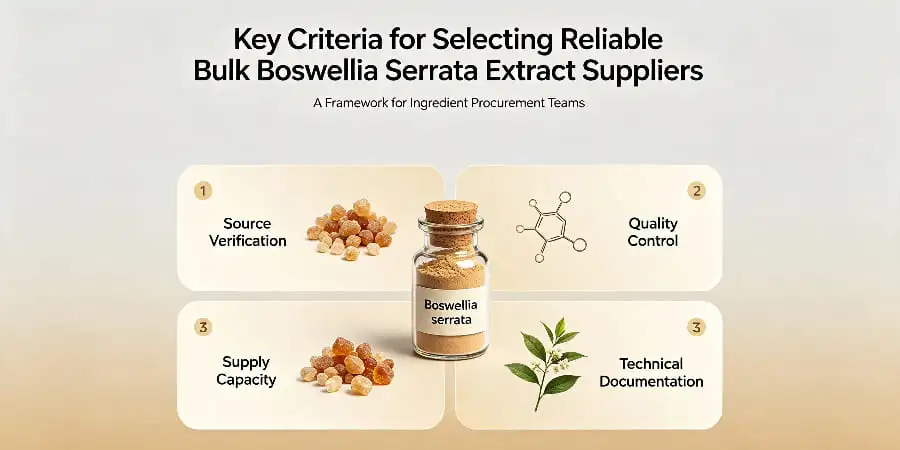
Key Criteria for Selecting Reliable Bulk Boswellia Serrata Extract Suppliers
Quality Assurance and Standardization Protocols
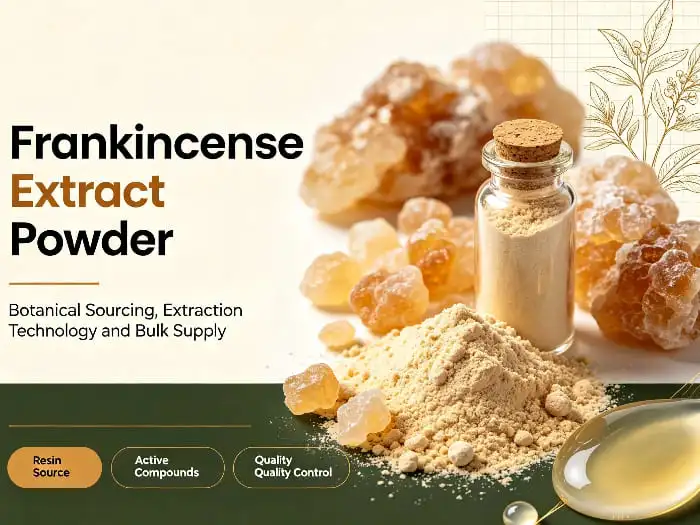
Premium providers offer different levels of standards to meet the needs of different applications, and for Frankincense Extract Powder, total boswellic acids between 65% and 85% work well in capsules and tablets for dietary supplements, while concentrated AKBA fractions between 10% and 30% work well in anti-inflammatory formulations, and HPLC testing makes sure that the strength is the same across batches, while titration methods can't tell the difference between different acid components. Total boswellic acids between 65% and 85% work well in capsules and tablets for dietary supplements, while concentrated AKBA fractions between 10% and 30% work well in anti-inflammatory formulations. HPLC testing makes sure that the strength is the same across batches, while titration methods can't tell the difference between different acid components.
Manufacturers must ask for full scientific specs that include the following:
- Boswellic acid profile: measured amounts of α-boswellic acid, β-boswellic acid, KBA, and AKBA
- Physical characteristics: particle size range (usually 80–100 mesh), bulk density (0.35-0.50 g/ml), and flowability measurements are important for machines that fill capsules
- Organoleptic properties: color consistency (pale yellow to off-white), smell strength (mild woody aroma achieved through deodorization), and taste profile
These factors have a direct effect on how well the mixture works. Fine particle size improves the rate at which functional drinks dissolve, and the right bulk density keeps the mixture from clumping during automated packaging processes.
Certification and Regulatory Compliance
Industry-recognized certifications prove that manufacturing standards are met and that rules are followed. Good Manufacturing Practice (GMP) certification proves that production areas are controlled, while ISO 22000 certification proves that food safety management systems are in place. Organic certifications (USDA and EU Organic) are appealing to clean-label brands that want to attract health-conscious customers.
Manufacturers should check that the facility has the right qualifications and that it follows the rules for that area. Products coming into the US must follow USP (United States Pharmacopeia) rules for food supplements. These rules include strict limits on heavy metals (lead < 3.0 ppm, arsenic < 2.0 ppm, cadmium < 1.0 ppm, mercury < 0.1 ppm) that are found through ICP-MS research. For pesticide leftovers to be sold in Europe, they must meet the requirements of EC Regulation 396/2005. For cosmetics, they must meet the requirements of REACH.
When suppliers provide complete paperwork like Certificates of Analysis, allergen statements, BSE/TSE-free declarations, and non-GMO confirmations, it makes regulatory submissions easier and speeds up the time it takes for new products to hit the market.
Supply Chain Transparency and Traceability
Transparent buying methods lower the risk of adulteration and make sure that goods are bought in an honest way. Reliable sellers keep written records of their relationships with resin collectors, identify plants at harvest sites, and use batch tracking systems to connect the source of finished extract to the source of raw materials.
Traceability goes all the way through the production process, including the type of extraction fluid (food-grade ethanol vs. illegal dichloromethane), temperature profiles that protect thermosensitive chemicals, and de-gumming methods that get rid of impurities in sticky glue. Companies that make things should ask for process flow maps and solvent residue reports that show amounts are below USP Class 3 limits (ethanol < 5000 ppm).
Logistical skills are just as important. Suppliers who manage temperature-controlled storage (15–25°C), moisture-proof packaging (double-layer polyethylene bags inside fiber drums), and long-term relationships with customs brokers keep goods in good condition during transport and cut down on clearance times.
Comparing Bulk Boswellia Serrata Extract Offerings: What Manufacturers Should Look For?
Extract Form and Application Suitability
Bulk purchases of powdered extracts are most common because they can be made in a variety of ways, and for Bulk Boswellia Serrata Extract, standardized powder is used by nutraceutical brands to make capsules, tablets, and softgels, and water-soluble grades are used by functional food brands to make protein shakes and energy bars, and cosmetic formulators like powders that can be mixed with oils so that anti-aging creams can be absorbed through the skin. Standardized powder is used by nutraceutical brands to make capsules, tablets, and softgels. Water-soluble grades are used by functional food brands to make protein shakes and energy bars. Cosmetic formulators like powders that can be mixed with oils so that anti-aging creams can be absorbed through the skin.
Contract manufacturers who do smaller runs or brands that want turnkey solutions can use encapsulated forms. But buying powder in bulk can save you money and give you more options for customization, like changing the particle size for use in drinks or mixing it with other ingredients to make it flow better.
Boswellic Acid Concentration and Efficacy
Higher levels of boswellic acid are linked to stronger anti-inflammatory effects, but they need to be carefully formulated. Extracts that are standardized to 85% total acids work best in joint support supplements that aim to relieve osteoarthritis pain, while middle concentrations (65%) are good for mass-market products because they balance action with cost-effectiveness.
Because they block 5-LOX better, AKBA-enriched extracts (20% to 30% AKBA) are highly valued. Compared to normal boswellic acid blends, clinical studies show that these blends are more bioavailable and relieve symptoms faster. When making over-the-counter painkillers, pharmaceutical developers put AKBA standards first and are willing to pay more for raw materials in exchange for making different therapeutic claims.
When manufacturers ask for stable data, they should make sure that the acid stays in the product even after six months of rapid aging at 40°C and 75% RH. If degradation is more than 5%, it means that the product wasn't processed or packaged properly, which can mean that it won't last long on the shelf.
Addressing Common Formulation Challenges
Because Boswellia Serrata Extract is resinous, it can be hard to process because the powder can clump together during storage, capsule fillers can get stuck in equipment, and the blend isn't always homogeneous. Advanced sellers use their own solutions:
De-gumming Technology: Physical precipitation methods get rid of sticky resin parts without using chemical agents. This process makes powder move better (angle of repose <35°), stops it from clumping, and makes it more compatible with water-loving additives like starch and cellulose.
Granulation and Coating: Fluid-bed granulation turns fine powder into granules that can flow freely and are easier to compress for direct compression tablets. Anti-sticky coatings (silicon dioxide, magnesium stearate) make it even less likely for punches to stick to tablets during production.
Odor Masking: The strong, pine-like smell of raw resin makes people not want to buy chewable pills and candies that contain it. Low-temperature deodorization methods remove volatile terpenes while keeping reactive acids. This makes products that don't smell anything and can be used with flavoring systems.
Practical Steps Manufacturers Use to Vet and Select Bulk Suppliers
Documentation Review and Analytical Verification
Requests for documents are the first step in the seller screening process. The full Certificate of Analysis (CoA) should have the following:
- Test data for each boswellic acid (not just the total amount)
- Validated ICP-MS methods are used for heavy metal screening
- Analysis of pesticide residues using GC-MS/MS and LC-MS/MS for more than 500 compounds
- Tests for microbes: Total Plate Count (<1000 cfu/g), Yeast and Mold (<100 cfu/g), and the lack of Salmonella and E. coli
- Confirmation of solvent residues (ethanol, acetone, and hexane)
Manufacturers should compare data from the COA with testing done by a third party, and for Frankincense Extract Powder, independent testing by accredited labs (ISO/IEC 17025) makes sure the provider is telling the truth and finds problems between what they say they will do and what they actually do, and many procurement teams use "dual-source" methods, which means they keep backup sources on hand so they don't have to rely on just one. Independent testing by accredited labs (ISO/IEC 17025) makes sure the provider is telling the truth and finds problems between what they say they will do and what they actually do. Many procurement teams use "dual-source" methods, which means they keep backup sources on hand so they don't have to rely on just one.
Sample Testing and Pilot Production Trials
By asking for pre-production samples, you can test the product in real life before committing to buying a lot of it. Physical features are checked by quality control teams using laser diffraction to find out the particle size distribution, Karl Fischer titration to find out the moisture content, and bulk/tapped density readings. Sensory screens compare the color, smell, and taste of something to standard values.
Pilot-scale manufacturing tests show that the formulations work well together. Nutraceutical companies test how well capsules are filled, looking for problems like bridging, segregation, or electrostatics. Cosmetic formulators test sample serums kept under stressful conditions to see how stable the emulsion is, how the pH changes, and how the colors move. When pilot runs go well, they back up what the supplier says and lower the risk of full-scale production.
On-Site Audits and Manufacturing Assessments
Going to a plant in person gives you a clear picture of its operational skills. What should be on audit checklists?
- Conditions for storing raw materials: separate areas, pest control, and first-in, first-out (FIFO) systems
- Equipment for extraction: includes solvent recovery devices, temperature tracking, and cleaning validation methods
- Quality control labs: records of instrument calibration, proof of method validation, and analyst training certificates
- Practices for keeping records: records of each batch, probes into deviations, and change control processes
When you watch production workflows in action, you can spot red flags like bad hygiene practices, old equipment, or not enough testing. Transparent suppliers are open to audits and take steps to fix any problems that are found. On the other hand, reluctant suppliers often hide quality problems.
Leveraging Industry Insights and Technology in Supplier Selection
Digital Platforms and Supplier Databases
Online B2B platforms collect information about suppliers, such as their profiles, qualifications, and reviews from buyers. Plant-based ingredient platforms let you do advanced filtering by boswellic acid concentration, organic status, or manufacturing location. Verified supplier badges show that background checks have been done, which lowers the risk of fraud.
But digital tools don't replace due diligence; they add to it. Manufacturers should back up promises made online with direct contact, testing of samples, and checking with references. Industry trade shows like SupplySide West and Vitafoods Europe allow people to meet in person, which helps build relationships and show off new technologies.
Staying Current with Research and Market Trends
New research affects the criteria used to choose a supplier. New studies show that some mixtures work better together than alone. For example, mixing boswellia extract with curcumin makes the anti-inflammatory benefits stronger by using different COX/LOX inhibition pathways. Suppliers who offer co-processed blends or formulation support services shorten the time it takes to make a new product.
As the market moves toward clean labels and sustainability, there is a greater need for sellers who do ethical wildcrafting, help resin tapper communities, and start planting programs. When brands talk about transparency, they need to show proof that their suppliers are responsible. They do this by making social responsibility an important part of the supplier selection process, along with technical requirements.
Customization Capabilities and Technical Support
OEM makers and private-label brands gain when suppliers let them make changes. Our services include changing acid profiles to fit specific needs, creating formats that dissolve in water or form nano-emulsions, and creating ingredient matrices that work well together. Responsive technical teams offer stability studies, regulatory dossiers, and formulation fixing, which are all very useful for businesses that don't have their own R&D infrastructure.
When suppliers participate in innovation agreements, they show that they care about more than just making sales. Collaborative development agreements match the skills of suppliers with the plans of manufacturers. This helps with long-term strategic alignment and setting yourself apart from competitors.
Conclusion
To find trusted providers of Boswellia Serrata Extract, you need to do a lot of research on their technical skills, ability to ensure quality, compliance with regulations, and openness about the supply chain, and for Bulk Boswellia Serrata Extract, standardized boswellic acid content, thorough testing protocols, and real botanical sourcing are some of the things that manufacturers do to reduce the chances of fraud and production problems, and cost-effectiveness and quality assurance must be balanced in order for procurement to work well. Standardized boswellic acid content, thorough testing protocols, and real botanical sourcing are some of the things that manufacturers do to reduce the chances of fraud and production problems. Cost-effectiveness and quality assurance must be balanced in order for procurement to work well. It is important to know that premium suppliers provide long-term value through consistent specifications, formulation support, and regulatory expertise. As natural anti-inflammatory ingredients become more popular, smart relationships with suppliers become more valuable. They help protect the quality of products, the safety of consumers, and the image of brands in global markets that are becoming more demanding.
FAQ
What certifications should reliable Boswellia extract suppliers provide?
Reliable providers keep GMP certifications that show they have controlled production settings, ISO 22000 certifications for food safety management, and, if necessary, USDA and EU organic certifications. Certificates of Analysis for each batch, allergen-free claims, non-GMO confirmations, and compliance statements for region-specific rules like USP standards or EC pesticide limits are some of the other paperwork that is needed. These badges prove that quality systems work and make it easier to submit information to regulators.
How can manufacturers verify extract quality before bulk purchases?
To check the quality, you have to do a few things: ask for Certificates of Analysis that show HPLC-tested profiles of boswellic acid; have independent third-party lab tests done at ISO/IEC 17025 accredited facilities; check physical samples for particle size and flowability; and do pilot production trials to see how well the formulation works with the samples. On-site factory audits that look at how raw materials are handled, how they are extracted, and the quality control labs give full supplier validation.
What are typical lead times for Boswellia extract orders?
Depending on the number of orders, the level of customization needed, and the distance of the shipment, lead times are usually between two and six weeks. Stocking standard grades (65% to 85% boswellic acids) speeds up delivery, while custom AKBA concentrations or specialized handling may cause delays. Reliable suppliers keep a safety stock to account for changes in supply and make production schedules clear when an order is confirmed. International shipping takes longer because of customs clearance, so operations planning needs to be done ahead of time.
Partner with Wellgreen for Premium Bulk Boswellia Serrata Extract
Wellgreen Technology is a reliable company that makes Bulk Boswellia Serrata Extract. Their quality is GMP-certified and is backed by strict HPTLC identification and HPLC-verified boswellic acid standards. Our unique de-gumming process gets rid of formulation problems, making sure that the powder flows better and performs consistently batch to batch. Our extracts meet strict USP and EU regulatory standards because they have been tested for heavy metals, pesticide residues, and microbial safety. We keep a lot of stock on hand so that we can keep our delivery dates, and we can make any changes you need, from standard 65% acids to concentrated AKBA grades. Our responsive technical support will also help speed up your R&D cycles. Email our team at wgt@allwellcn.com to get samples, talk about specifics, or find out how our knowledge of plant extracts can help you reach your product development goals. Wellgreenherb.com has all the information you need about a product.
References
1. Ammon, H.P.T. (2016). "Boswellic Acids and Their Role in Chronic Inflammatory Diseases." Advances in Experimental Medicine and Biology, 928, 291-327.
2. Bannuru, R.R., Osani, M.C., Al-Eid, F., & Wang, C. (2018). "Efficacy of Curcumin and Boswellia for Knee Osteoarthritis: Systematic Review and Meta-Analysis." Seminars in Arthritis and Rheumatism, 48(3), 416-429.
3. Siddiqui, M.Z. (2011). "Boswellia Serrata, a Potential Anti-inflammatory Agent: An Overview." Indian Journal of Pharmaceutical Sciences, 73(3), 255-261.
4. Abdel-Tawab, M., Werz, O., & Schubert-Zsilavecz, M. (2011). "Boswellia Serrata: An Overall Assessment of In Vitro, Preclinical, Pharmacokinetic and Clinical Data." Clinical Pharmacokinetics, 50(6), 349-369.
5. Sharma, S., Thawani, V., Hingorani, L., Shrivastava, M., Bhate, V.R., & Khiyani, R. (2004). "Pharmacokinetic Study of 11-Keto β-Boswellic Acid." Phytomedicine, 11(2-3), 255-260.
6. European Medicines Agency. (2015). "Assessment Report on Boswellia Serrata Roxb., Gummiresin." Committee on Herbal Medicinal Products (HMPC), EMA/HMPC/206338/2013.