Can Tongkat Ali Extract Powder Fit Functional Beverage and Powdered Drink Formulations?
2026-10-10 15:12:10
Whether Tongkat Ali Extract Powder can carry a functional beverage or a powdered drink mix is not a question of reputation but of four engineering facts: how the extract behaves in water, how it tastes at the load a drink can actually carry, how it survives processing and shelf life, and whether it blends uniformly into a dry mix. The short answer is yes, with conditions. This article works through those conditions from the formulator's side of the bench — dispersion and appearance, sensory screening, process tolerance, and pilot-scale trials — using Tongkat Ali Extract Powder from Eurycoma longifolia root as the reference material.
What a Beverage Vehicle Asks of a Botanical Powder
A drink is unforgiving to a botanical extract. The vehicle is mostly water, so whatever does not dissolve becomes a visible defect: haze in a clear liquid, a ring at the meniscus, grit at the bottom of the bottle. The dry mass per unit volume is low, so the extract must express itself in a small mass of solids carried by a large volume of liquid — and that matrix is then pushed through heat, shear, acid and time.
A capsule hides these problems; a beverage exposes them. The practical question is therefore rarely whether the ingredient suits a drink at all, but which format, grade and process can tolerate it. The table below maps the main formats by the demand each places on the extract.
| Beverage format | Vehicle demand | Dispersion demand | Taste tolerance | Dominant stability risk |
|---|---|---|---|---|
| Clear ready-to-drink (still) | High — water is the whole matrix; clarity is visible | Very high — any haze reads as a fault | Low to moderate | Haze, colour drift, fine sediment |
| Carbonated ready-to-drink | High — low pH plus dissolved CO2 | High | Low — acidity sharpens bitterness | Acid-driven change, colour shift, loss of carbonation |
| Concentrated shot | Moderate volume, high solids per serve | High | Very low — everything is delivered at once | Phase separation, sediment, flavour intensity |
| Instant drink-mix sachet (dry) | None until reconstitution | Moderate — cold-water reconstitution is the test | High — full taste arrives on reconstitution | Segregation, fill-accuracy loss, caking |
| Instant coffee or tea mix | Warm to hot water, strong native flavour | Moderate — heat helps wetting | High — bitterness can be made to work | Moisture pickup, caking, colour darkening |
| Bulk powdered soft-drink base | None until reconstitution | Moderate | High | Segregation during transfer, content uniformity |
Solubility and Dispersibility Come First
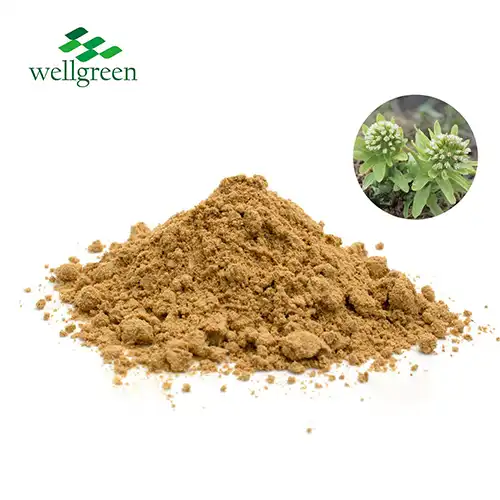
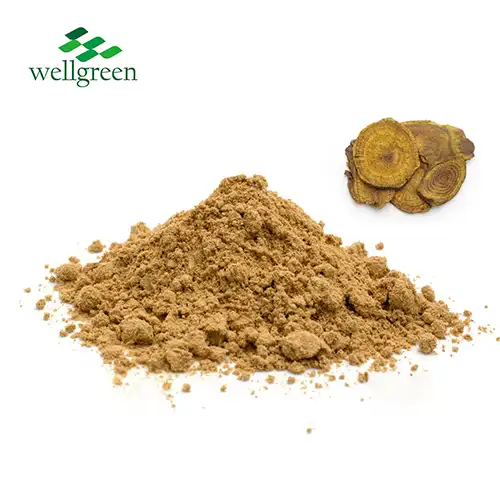
Spray-dried root extracts contain both readily soluble and less soluble fractions, and suppliers often add a carrier such as maltodextrin during drying. The result mixes easily in warm liquids — the familiar instant coffee and tea mixes — but can behave differently in cold water. Wellgreen's product page describes its Eurycoma longifolia root extract as a yellow-brown fine powder with 95% or more passing 80 mesh and moisture below 4%: a typical starting point for a beverage grade, not a finishing point.
Cold water: wetting, lumping and haze
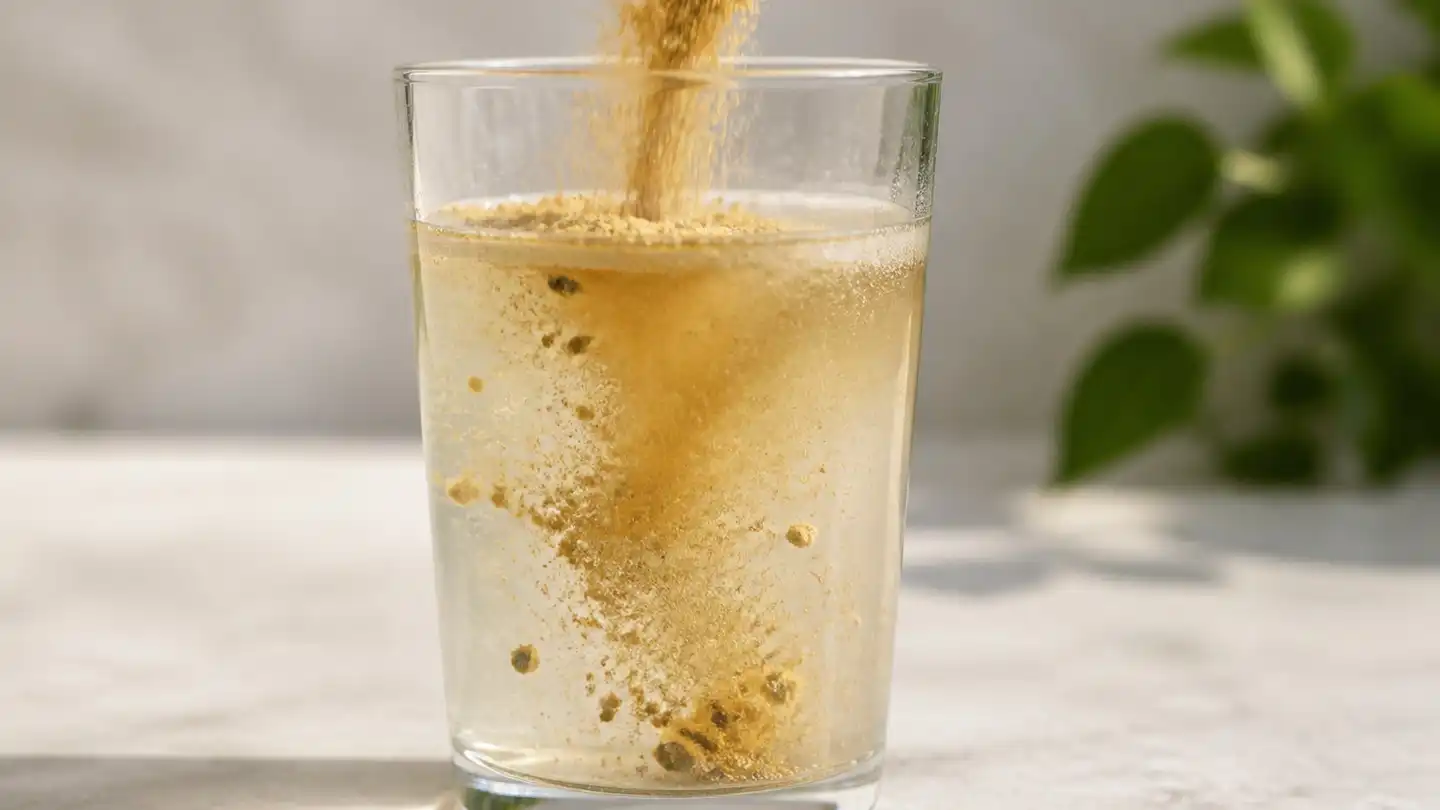
The failure mode in cold water is usually not solubility itself but wetting and dispersion kinetics. A fine, hygroscopic powder dropped onto the surface of cold water tends to float as dry islands. When particles do wet quickly, the outer layer can absorb water, swell and fuse into a gel skin that seals the interior dry — the classic clump that survives stirring and later settles as sediment. Reviews of instant-powder rehydration describe exactly this barrier effect, and it is why powder producers control wettability and dispersibility as properties separate from solubility [4].
Haze is the second cold-water issue. Even where the extract dissolves fully, colloidal and fine insoluble particles scatter light. In a clear, lightly coloured drink a little turbidity reads as "dirty"; in an opaque juice, a milky drink or a dark coffee it is invisible. Clarity is a decision about the base as much as about the ingredient.
Carriers, grades and what to measure
Three levers usually resolve dispersion:
- Grade and drying route. A spray-dried, carrier-assisted grade wets and disperses more predictably than an unagglomerated fine powder.
- Agglomeration. Granulating the powder into porous agglomerates increases particle size and lets water penetrate the structure instead of sealing its surface.
- Carrier dilution. Pre-blending the extract onto a soluble carrier lowers the local concentration at the wetting front.
Measure rather than assume. The bench panel is small but specific: wettability time and dispersibility in cold water; reconstitution time under a defined stir; particle size against the supplied mesh specification; turbidity in NTU against the unfortified base; and sediment volume after standing. Run these at the lowest serving temperature the product will realistically meet, because dispersion worsens as water gets colder. Formulators building a scented, acidic, clear base will recognise the same discipline used in formulating functional beverages with hibiscus extract powder, where colour and clarity carry as much weight as flavour.
Taste Is the Real Ceiling
In most formats taste sets the ceiling. A beverage delivers the extract dissolved and in full contact with the tongue, so bitterness and astringency that would be hidden inside a coated tablet become the defining sensory impression of the drink.
Bitterness, astringency and linger
The bitter character is expected rather than accidental: quassinoids are a dominant class of root constituents, and eurycomanone is the most widely used marker for standardising the root extract [1][2]. Astringency is a different perception — a drying, puckering, mouth-coating effect from polyphenol interaction with salivary proteins rather than a taste receptor — and it should be scored separately, because the two respond to different fixes [3].
Linger matters just as much: the aftertaste that persists after swallowing. Rejection of a fortified drink is usually driven by lingering bitterness rather than first-sip intensity, so a useful panel measures time to resolution in seconds instead of scoring "aftertaste" as one number.
The masking toolkit a formulator actually has
- Sweetener system. Sweetness suppresses perceived bitterness, but high-intensity sweeteners can bring their own bitter or metallic edge, so blends often outperform a single sweetener.
- Acid selection. Acidulants sharpen the profile and can amplify bitterness at low pH; changing the acid type, or trimming titratable acidity, shifts the impression more than the pH value alone suggests.
- Flavour architecture. Dark roast coffee, cocoa, vanilla, roasted cereal and brown-sugar notes sit comfortably with the extract, while bright citrus and berry can carry it in a lighter base if sweetness is balanced.
- Sub-threshold rounding. Very small amounts of salt or umami compounds can round off bitterness without being individually perceptible.
- Encapsulation and complexation. Coating or complexing the extract delays its release and lowers peak bitterness, at the cost of a slower release in the finished drink.
- Carrier dilution. Distributing the extract through a larger soluble mass lowers the concentration the palate meets at any instant.
None of these is free — every masking route adds cost, label complexity and its own flavour risk. The efficient path is a designed sensory ladder rather than an improvised bench tasting, paired with the process work, because heat and acid both move the sensory target.
| Trial | Design | Panel or instrument | What is recorded | Decision it unlocks |
|---|---|---|---|---|
| Bitterness ceiling ladder | Ascending-step series in a fixed base, blind, randomised, replicated | Trained descriptive panel (8–12 assessors) | Bitterness, astringency, linger (seconds), metallic note, overall liking | The highest extract load the chosen base will carry |
| Masking factor screen | Base versus base plus one masking system, paired presentation | Descriptive panel plus consumer check | Change in bitterness, linger and mouthfeel | Which masking route earns its cost |
| Cold reconstitution | Chilled water at the lowest expected serve temperature, timed stir | Instrument plus panel | Wettability, clump count, reconstitution time, turbidity | Grade, carrier and agglomeration choice |
| Heat-load tolerance | Before and after the intended pasteurisation or hot-fill regime, at least two temperature/time combinations | HPLC and colorimeter | Marker retention, colour difference, haze | Whether the thermal process is viable at all |
| Accelerated shelf life | Elevated-temperature storage, sampled at intervals | HPLC, turbidity, colorimeter, sediment | Marker retention, haze, colour drift, sediment and re-dispersibility | Shelf-life assumptions for the format |
| Dry-blend uniformity | Unit sachets sampled across the whole fill run | Assay of individual units | Content variation between units | Blend order, particle-size spec and handling limits |
Process and Shelf Life: Heat, Shear, pH and Clarity
Heat. Pasteurisation and hot-fill are the most aggressive steps a beverage applies, and their effect on plant constituents is not uniform: comparative work on pasteurised fruit-based drinks shows phenolic profiles both rising and falling depending on the compound and the process, so the thermal effect must be measured rather than assumed [8]. If hot-fill is required for microbiological reasons, test marker retention across the actual temperature and hold time, not a generic reference condition.
Shear. Homogenisation changes particle size and can move clarity or sediment either way. A high-pressure pass that breaks agglomerates may improve uniformity while a milder pass leaves visible particles; fix homogenisation pressure as a process parameter and treat any change as a formulation change.
pH and acidulants. Acidified drinks sit at low pH for their whole life, and acidulants differ in how they interact with bitter and astringent notes as well as in how they may affect labile constituents. Run a pH-margin study rather than a single set point.
Colour and clarity drift. A yellow-brown powder can shift a pale base noticeably over time. Track colour difference numerically and haze separately, because a drink can hold its colour while developing visible turbidity.
Sedimentation and phase separation. Fine insoluble matter settles into a visible layer, and in emulsified or pulp-bearing drinks the extract can also influence phase behaviour. Record the sediment volume and how easily it re-disperses: a sediment that vanishes with a gentle inversion is a different defect from one that leaves a hard ring. This is the same stability discipline applied to bamboo leaf extract in functional foods and beverages, where colour and long-term stability drive format choice.
Powdered Drink Mixes: Engineering the Dry Blend
In a dry mix the problem moves from water to solids. Three issues dominate.
Particle-size matching. A minor component that differs sharply in size from the bulk will segregate: during transfer, filling and vibration, finer particles percolate downward through the voids of coarser ones, so the sachet filled last is not the sachet filled first. Reviews of powder segregation place the threshold for sifting segregation at a size ratio of about 1.3 to 1 between components, and note that particle-size difference is the key condition for demixing regardless of mechanism [6]. Excipient particle size likewise drives blend homogeneity at low loadings [7]. Matching the extract's size distribution to the carrier, or granulating both to a common size, is therefore the most effective anti-segregation measure.
Sachet fill accuracy. A minor ingredient is also a minor fraction of the fill mass, so a small relative error becomes a large relative error per unit. Control blending sequence, hold the particle-size specification tight, avoid unnecessary transfer and vibration, and verify by assaying individual units rather than a composite sample.
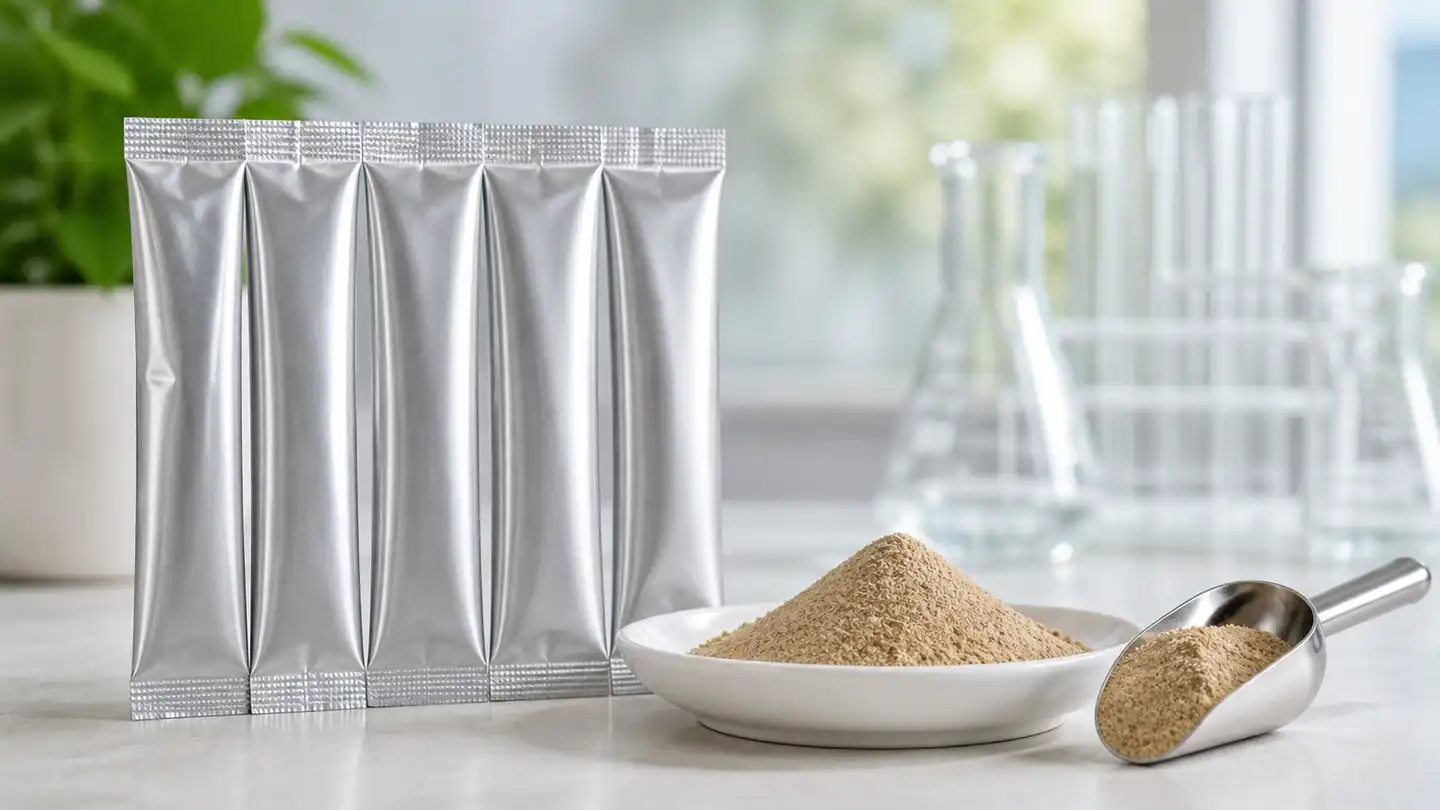
Cold-water reconstitution and caking. The consumer's first experience is powder hitting cold water, so the wetting and lumping behaviour described above is the whole product experience in miniature [4]. In storage, an amorphous powder can cake as moisture is taken up and the material passes its glass-transition conditions; water activity and temperature together govern how quickly that happens [5]. A moisture-barrier sachet, a desiccant where appropriate, and a realistic humidity shelf-life test protect the format.
Formulators balancing these requirements against a flavour system will find the trade-offs familiar from bulk green tea extract for beverage formulation, where dry-blend uniformity and reconstitution set the practical limits on how much active can be carried.
From Bench to Pilot: A Development Checklist
Working through these steps in order avoids the most expensive pilot-scale surprises.
- Fix the format first — clear, opaque, carbonated, shot or dry mix — and accept its dispersion and clarity limits before optimising taste.
- Characterise the incoming extract: particle-size distribution, moisture, colour, marker content and method.
- Run a cold-water dispersion panel at the lowest realistic serve temperature.
- Establish a bitterness and linger baseline before adding any masking system.
- Screen masking systems one variable at a time, and re-check the taste target after each acid and process change.
- Confirm marker retention across the intended thermal process, with at least two temperature and time combinations.
- Study pH margin and acidulant choice, not a single pH set point.
- Measure colour difference, haze and sediment at t=0 and through accelerated storage, including re-dispersibility.
- Match the extract's particle size to the carrier, then verify blend uniformity by assaying individual units.
- Confirm fill accuracy across a full run, sampling from the start, middle and end of the fill.
- Run a humidity and temperature storage trial on the packed sachet, not on bulk powder.
- Scale to pilot only after the dispersion, sensory and stability targets hold together in the same batch.
Working With Wellgreen
Wellgreen supplies Tongkat Ali Extract Powder derived from Eurycoma longifolia root, listed on our product page as a yellow-brown fine powder with 95% or more passing 80 mesh, moisture below 4% and a two-year shelf life, offered in 10:1, 20:1 and 200:1 specifications tested by UV and TLC; the page also lists ISO 9001:2015, ISO 22000, HACCP, Halal and Kosher certification for the product. For beverage and powdered-drink projects we can provide samples, batch documentation and technical support while you run dispersion, sensory and stability trials in your own matrix. Write to wgt@allwellcn.com with your target format and process, and we will match a grade to your trial.
This article provides technical and commercial information for industry professionals and is not medical advice; permitted use levels, regulatory status and label claims for any finished product must be confirmed against the rules of the target market and the manufacturer's own product data.
References
- Farag MA, Ajayi AO, Taleb M, Wang K, Ayoub IM. A Multifaceted Review of Eurycoma longifolia Nutraceutical Bioactives: Production, Extraction, and Analysis in Drugs and Biofluids. ACS Omega. 2022;8(2):1838–1850. doi:10.1021/acsomega.2c06340. https://pmc.ncbi.nlm.nih.gov/articles/PMC9850716/
- Review on a Traditional Herbal Medicine, Eurycoma longifolia Jack (Tongkat Ali): Its Traditional Uses, Chemistry, Evidence-Based Pharmacology and Toxicology. Molecules. 2016;21(3):331. doi:10.3390/molecules21030331. https://pmc.ncbi.nlm.nih.gov/articles/PMC6274257/
- Osakabe N, Shimizu T, Fujii Y, Fushimi T, Calabrese V. Sensory Nutrition and Bitterness and Astringency of Polyphenols. Biomolecules. 2024;14(2):234. doi:10.3390/biom14020234. https://pmc.ncbi.nlm.nih.gov/articles/PMC10887135/
- A Comprehensive Review of the Rehydration of Instant Powders: Mechanisms, Influencing Factors, and Improvement Strategies. Foods. 2025;14(16):2883. doi:10.3390/foods14162883. https://pmc.ncbi.nlm.nih.gov/articles/PMC12385211/
- Effects of Water Activity and Temperature on the Caking Properties of Amorphous Carbohydrate Powders. Journal of Applied Glycoscience. 2025;72(1):7201103. doi:10.5458/jag.7201103. https://pmc.ncbi.nlm.nih.gov/articles/PMC11975220/
- Jakubowska E, Ciepluch N. Blend Segregation in Tablets Manufacturing and Its Effect on Drug Content Uniformity — A Review. Pharmaceutics. 2021;13(11):1909. doi:10.3390/pharmaceutics13111909. https://pmc.ncbi.nlm.nih.gov/articles/PMC8620778/
- An Investigation into the Effects of Excipient Particle Size, Blending Techniques and Processing Parameters on the Homogeneity and Content Uniformity of a Blend Containing Low-Dose Model Drug. PLOS ONE. 2017;12(6):e0178772. doi:10.1371/journal.pone.0178772. https://pmc.ncbi.nlm.nih.gov/articles/PMC5469472/
- High Hydrostatic Pressure vs. Thermal Pasteurization: The Effect on the Bioactive Compound Profile of a Citrus Maqui Beverage. Foods. 2021;10(10):2416. doi:10.3390/foods10102416. https://pmc.ncbi.nlm.nih.gov/articles/PMC8535227/
- Powdered Foods: Structure, Processing, and Challenges: A Review. Applied Sciences. 2023;13(22):12496. https://www.mdpi.com/2076-3417/13/22/12496