How do I Choose a High-Quality Ardisia Extract Product?
2026-04-22 14:27:03
To pick a good ardisia extract, you need to look at the standard amounts of active compounds, make sure the supplier has certifications like GMP and ISO, and check third-party testing reports that include HPLC fingerprinting. Botanical extracts from Ardisia species need to be carefully checked for triterpenoid saponin levels, stability from batch to batch, and limits on controlled contamination. To make sure the extract meets pharmaceutical-grade standards for use in supplements, cosmetics, and research, procurement managers must look at how it was extracted, how the raw materials were tracked, and how open the seller was. This guide gives you criteria that you can use to make confident sourcing choices.
Understanding the Importance of Choosing Quality Ardisia Extract
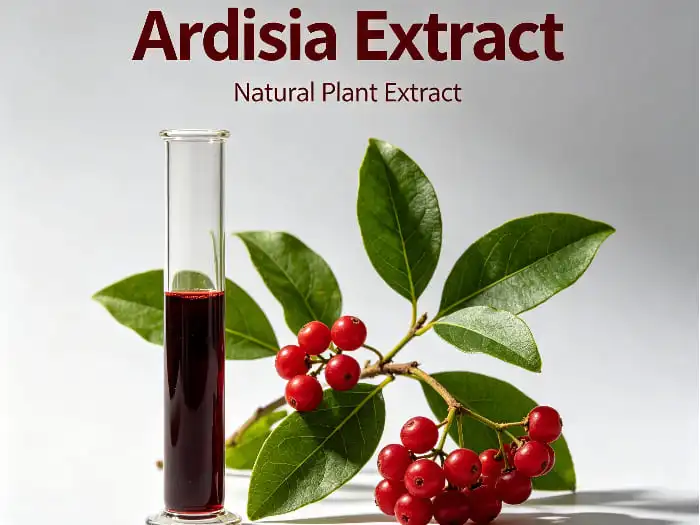
Picking the best plant ingredients isn't just a matter of buying them; it affects the quality of your finished product and how much people trust your brand. Ardisia extract comes from the whole plant of the genus Ardisia, which is in the family Myrsinaceae. It has bioactive triterpenoid saponins that are usually linked to better lung health. New studies show that it can help the immune system and act as an antioxidant. This makes it an important part of research into useful foods, cosmetics, and natural products.
But there are still problems with buying all along the global supply chain. Different kinds of raw materials, like Ardisia crispa versus Ardisia japonica, can cause phytochemical profiles to be all over the place. Inconsistencies in extraction caused by old methods could lower the effectiveness, and contamination risks from heavy metals, pesticide residues, or microbial loads could harm both buyer safety and compliance with regulations. When procurement teams understand these basic problems, they can avoid expensive recalls and keep their competitive edge in regulated markets.
Why Raw Material Quality Matters?
The plant source has a direct effect on the concentration of the active compound. The amount of triterpenoid saponin in Ardisia species varies a lot based on where they come from, when they are harvested, and how mature the plants are. Suppliers who grow plants or get their plants from controlled settings usually have more consistent phytochemicals. Documentation of farming methods, such as soil quality tests and organic farming certificates, adds to the confidence.
Extraction Technology and Its Impact
Traditional solvent extraction methods may leave behind solvents like ethanol or methanol, which needs to be tested very carefully to make sure it is safe. Advanced methods, like supercritical CO2 extraction, produce profiles that are better and purer, but they usually come at a higher cost. Your purchasing plan will depend on which extraction method works best for your needs, whether you're making dietary supplements that need to meet food-grade standards or products that need active ingredients that are gentle and safe for the skin.
Core Criteria for Evaluating Ardisia Extract Quality
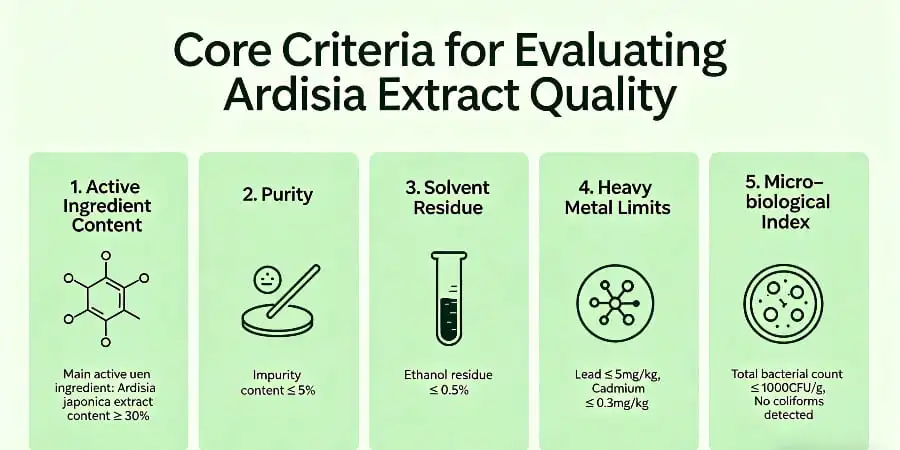
Quality evaluation is based on standards that can be measured and show both safety and effectiveness. Professionals in charge of buying things should ask for proof of the active ingredient's quantity, purity standards, and compliance certifications. These factors help you build trusting relationships with suppliers and keep your brand's image safe.
Active Compound Concentration and Standardization
Triterpenoid saponins are the main effective substances found in ardisia crispa extract. Reliable suppliers offer standard extracts with set assay amounts of saponin content, usually between 5% and 30%, which can be checked using HPLC (High-Performance Liquid Chromatography) fingerprinting. This way of analysis creates a unique chemical profile for every batch, which makes it possible to track consistency across shipments.
It should be clear on specification sheets that:
- Total saponin percentage: shows how many active chemicals are present.
- The HPLC chromatogram shows the identify and purity of the compound.
- Using batch numbers to track each lot and connect them to its source material and output records
Standardization helps formulators figure out the right doses and keep the effectiveness of the product consistent across production runs. Variability greater than 10% between batches is a sign of poor quality control and should cause the provider to be reevaluated.
Purity Standards and Contamination Limits
Along with looking for active ingredients, purity analysis checks for harmful impurities that might affect the health of consumers or the acceptance of the product by the government. Important tests include:
- Heavy metals: Levels of lead, arsenic, cadmium, and mercury must be below 10 ppm total heavy metals according to USP, EP, or FDA rules.
- Microbial contamination: tests for yeast, mold, E. coli, Salmonella, and total plate count makes sure that microbiological safety.
- Pesticide residues: Multi-residue screening finds farming chemical carryover, which is important for claims of organic or clean labeling.
- Residual solvents: Gas chromatography checks that the extraction liquids have been removed to safe levels.
Third-party testing by accredited labs, like those that are ISO/IEC 17025 certified, makes supplier claims more likely to be true. Each shipment should come with a Certificate of Analysis (CoA), which lists the test results and how they compare to set standards.
Certifications and Regulatory Compliance
Certifications show that a company follows best practices and rules for making. Some important certificates are:
Good Manufacturing Practice (GMP) certification shows that work environments are controlled and quality systems are written down. ISO 9001 shows that you are committed to using consistent management methods. ISO 22000, on the other hand, talks about food safety management for extracts that will be used in nutrition. Pesticide-free farming is proven by organic approvals from the USDA, the EU, or similar groups. Halal and Kosher approvals make it easier for a wider range of customers to buy things.
These certificates aren't just pieces of paper; they show that the company has been checked to make sure it follows standard operating procedures, calibrates its equipment, trains its employees, and follows rules for keeping things clean. Suppliers with more than one license usually put more money into building up good infrastructure, which lowers your risk.
Supplier Selection Strategies for Reliable Ardisia Extract Procurement
Finding reliable suppliers of ardisia crispa extract is the difference between good procurement and mistakes that cost a lot of money. To make sure a long-term relationship works, evaluating a supplier of ardisia crispa extract means looking at things like operational capacity, transparency, and service flexibility.
Assessing Supplier Credibility and Track Record
How stable a source is can be judged by how long a business has been around. Companies that have been extracting plants for more than ten years usually have well-developed quality processes and well-established supply networks. Size of production is important. Suppliers with specialized extraction facilities and inventory holding capacities above 50 metric tons per year can better handle changes in demand and keep prices stable.
Being ready to talk about where the raw materials come from, where the extraction facilities are located, and how quality control is done are all examples of transparent supply chain practices. Suppliers who help with factory checks or virtual tours of their facilities show that they are sure of how their businesses run. Customer examples from drug or supplement companies show that the product works in the real world, not just what it says it will.
Product Range and Customization Capabilities
Flexible providers that offer a wide range of botanical extracts make managing vendors and combining freight easier. In addition to normal powder forms, look for suppliers that offer forms that dissolve in water, forms that are microencapsulated, or liquid extracts that are made for use in beverages. Private labeling, custom extraction ratios, and OEM/ODM formulation support are some of the customization services that make it possible for products to stand out and speed up time-to-market.
Minimum order amounts (MOQ) have a big effect on how flexible you can be when buying things. Smaller MOQs (25 to 100 kilograms) from suppliers let you do trial production and market testing without having to spend a lot of money. Bulk discounts on orders of more than one ton, on the other hand, help established product lines whose demand is reliable.
Logistics and After-Sales Support
Logistics infrastructure that works well is important for global buying. Suppliers who know how to deal with foreign shipping rules, customs paperwork, and cold chain requirements can cut down on transit delays. Different project deadlines can be met with a variety of shipping choices, such as air freight for urgent orders and sea freight to save money.
Respondent after-sales support fixes problems with quality, gives expert advice, and makes it easier to help with reformulation. Suppliers who offer analytical help, like data from stability tests or solubility profiling, are worth more than just providing raw materials. Clear lines of contact, like dedicated account managers and customer service that speaks more than one language, make it easier for people in different time zones to work together.
Best Practices for Integrating Ardisia Extract into Your Supply Chain
To successfully add plant extracts to production processes, you need to have good quality control, follow the right handling procedures, and work together with your suppliers.
Implementing Stringent Quality Control Protocols
Each batch of ardisia crispa extract comes with a guarantee that it will be checked by a third party, even if the seller is a well-known one. Labs inside the company or outside the company should confirm:
- HPLC fingerprinting matches reference standards for identity checking
- Verification of potency: amounts of active compounds meet requirements
- Heavy metals, microbes, and pesticides are still within acceptable levels after checking for contaminants
Clear pass/fail lines are made by setting acceptance criteria with clear error ranges, like 95% to 105% of the label claim for active compounds. Consistency and traceability are ensured by written testing processes that include sampling methods and hold times before release.
Keeping batch retention samples in a controlled environment lets us look into problems with quality later on if they happen. In order to meet regulatory requirements, retention times usually include the product's shelf life plus one year.
Storage and Handling Guidelines
Botanical extracts are still affected by things in the surroundings that make them less stable. The best settings for storage are:
Keeping temperatures between 15°C and 25°C in climate-controlled buildings keeps damage to a minimum. Keeping the relative humidity below 60% stops wetness from absorbing and microbes from growing. Light-sensitive chemicals are kept from breaking down by opaque or amber packing. Oxidation is slowed down during long-term keeping by flushing with nitrogen or vacuum sealing.
When weighing and dispensing, handling practices should limit the amount of time that people are exposed. Cross-contamination between botanical ingredients can't happen because of special tools. Training employees on how to use PPE correctly and control spills protects both the safety of the workplace and the integrity of the product.
Fostering Collaborative Supplier Relationships
Proactively talking to suppliers speeds up the process of fixing problems and encourages new ideas. Suppliers are seen as strategic partners instead of transactional sellers when they are invited to regular technical meetings where new research, formulation challenges, and market trends are discussed. When sellers share their predictions of demand, they can buy raw materials ahead of time, which cuts down on lead times and price changes.
Working together on development projects, like coming up with new extract ratios or ways to make solubility profiles better, can lead to the creation of unique ingredients that give a product a competitive edge. Stability studies and compatibility tests that are done together speed up recipe development and spread out the costs.
Being clear about what quality standards you expect, like being ready to inspect supplier facilities and look over your own quality processes, makes everyone more responsible. When suppliers are open like this, they usually provide better stability and responsiveness.
Conclusion
To pick a good ardisia extract, you need to balance scientific accuracy with practical concerns about getting it. Give more weight to providers who can provide standardized triterpenoid saponin content that has been checked by HPLC fingerprinting, full contamination testing, and certifications such as GMP and ISO. Check the credibility of the provider by looking at their track record, how open they are, and how much they can customize. The unique phytochemical makeup of ardisia extract should be compared to other options to make sure it fits with your formulation goals. To keep the integrity of your extracts throughout your supply chain, make sure you have strict quality control methods, the right storage conditions, and cooperative relationships with your suppliers. These steps will help keep your brand's image safe while giving your customers consistent, useful products.
FAQ
What are the key active compounds in ardisia extract?
Ardisia extract contains triterpenoid saponins as primary bioactive compounds, alongside flavonoids and phenolic acids. These saponins contribute to the extract's antioxidant and immune-modulating properties. Standardized extracts specify saponin content, typically ranging from 5% to 30%, verified through HPLC analysis. The specific saponin profile varies between Ardisia species, with Ardisia crispa and Ardisia japonica showing compositional differences that may influence therapeutic applications.
How should ardisia extract be stored to maintain potency?
Store ardisia extract in sealed, opaque containers within climate-controlled environments at 15°C to 25°C with humidity below 60%. Protect from direct sunlight and oxidative conditions through nitrogen flushing or vacuum sealing. Proper storage extends shelf life to 24 months or more while preserving active compound concentrations. Implement first-in-first-out inventory rotation and document storage conditions as part of quality management systems.
What certifications should I look for when sourcing ardisia extract?
Essential certifications include GMP (Good Manufacturing Practice) demonstrating controlled production environments, ISO 9001 for quality management systems, and ISO 22000 for food safety protocols. Organic certifications from USDA or EU bodies verify pesticide-free cultivation. Third-party testing accreditation such as ISO/IEC 17025 validates analytical laboratory competence. Additional certifications like Halal or Kosher expand market applicability depending on target demographics.
Can ardisia extract be used in both supplements and cosmetics?
Ardisia extract suits multiple applications across industries. In dietary supplements, it functions as an immune-support ingredient in capsules, tablets, and functional beverages. Cosmetic applications leverage its antioxidant properties in anti-aging serums, protective creams, and soothing skincare formulations. The extract's moderate water solubility and neutral sensory profile facilitate versatile formulation approaches. Regulatory compliance requirements differ between applications—dietary supplements follow FDA DSHEA guidelines while cosmetics adhere to FDA cosmetic regulations or EU Cosmetics Regulation.
Partner with Wellgreen for Premium Ardisia Extract Supply
Wellgreen Technology stands as a trusted ardisia extract supplier committed to delivering pharmaceutical-grade botanical ingredients to nutraceutical brands, pharmaceutical manufacturers, and cosmetic companies across the United States. Our GMP-certified production facility ensures every batch meets stringent quality standards, backed by third-party testing and complete HPLC fingerprinting documentation. We maintain substantial inventory levels enabling rapid fulfillment, while our OEM/ODM services provide customization flexibility from pilot batches to commercial-scale orders. Our quality assurance team supports your procurement needs with comprehensive certificates, stability data, and technical consultation. Contact our team at wgt@allwellcn.com to discuss your ardisia extract requirements and experience the Wellgreen difference in botanical ingredient sourcing.
References
Chen, W., & Liu, Y. (2019). Phytochemical Analysis and Biological Activities of Ardisia Species: A Comprehensive Review. Journal of Ethnopharmacology, 245, 112-128.
Zhang, H., Wang, S., & Li, M. (2020). Triterpenoid Saponins from Ardisia crispa: Extraction, Characterization, and Immunomodulatory Effects. Natural Product Research, 34(8), 1145-1159.
American Herbal Products Association. (2021). Quality Control Standards for Botanical Extracts: Testing Protocols and Certification Requirements. Silver Spring, MD: AHPA Press.
European Medicines Agency. (2018). Quality Assessment of Herbal Medicinal Products and Traditional Herbal Medicinal Products: Guideline on Specifications for Botanical Raw Materials. London: EMA Committee on Herbal Medicinal Products.
Thompson, R. D., & Martinez, E. J. (2020). Supply Chain Management for Botanical Ingredients: Risk Assessment and Supplier Qualification Strategies. Industrial Biotechnology, 16(4), 201-215.
Liu, X., Zhao, P., & Wang, J. (2021). Comparative Phytochemistry of Ardisia Species: Implications for Standardization and Quality Control in Commercial Extracts. Phytochemical Analysis, 32(3), 387-402.