
How Egg Yolk Lecithin Supports Creamy Sauce Formulations
2026-11-18 14:00:00
A creamy sauce is an emulsion that has to survive a factory and then a kitchen. It is heated, pumped, filled, sometimes retorted, then stored and reheated by someone who expects it to look the same as it did in the photograph. Most sauce failures are emulsion failures, and most emulsion failures trace back to the emulsifier being chosen by habit rather than by function. This note looks at what egg yolk lecithin contributes to a sauce system, what it cannot do, and which specification items predict whether it will work.
What a Sauce Emulsion Actually Asks of an Emulsifier
In a savoury sauce the dispersed phase is usually oil or a fat blend, the continuous phase carries starch, salt, sugar and acid, and the whole system is processing at a pH and a temperature that would destabilise a simple laboratory emulsion. The emulsifier has to sit at the oil-water boundary, lower the interfacial tension enough for droplets to break up during homogenisation, and then hold that boundary in place while the starch gels around it.
Those are three separate jobs. A material that performs the first well and the third badly will look correct in a beaker and split in a retort. That is why the selection conversation should start with the process, not with the ingredient.
Why Egg Yolk Lecithin Rather Than Soy Lecithin
Both are phospholipid mixtures and both are surface active. The differences that matter in a sauce are the class distribution of the phospholipids, the fatty acid profile, and the flavour contribution.
Phospholipid class distribution
A certificate that reports total phospholipids tells a buyer very little about behaviour. The classes — phosphatidylcholine, phosphatidylethanolamine, phosphatidylinositol and the rest — differ in how they pack at an interface and in how they respond to calcium, salt and pH. Ask for the class distribution, and compare two suppliers on that basis rather than on total content.
Flavour neutrality
Savoury sauces are less forgiving of a background note than a sweet bakery system, because there is nothing to mask it. A soy-derived emulsifier can contribute a cereal or beany note that reads as off in a clean white sauce or a cheese-style sauce. Egg-derived lecithin generally contributes less, which is why it appears in culinary applications where the flavour profile is deliberately simple.
Allergen declaration
Egg is a declared allergen in most major markets and soy is a separate declaration. A sauce that already carries an egg line absorbs the change without a label rewrite; a product built on an egg-free platform cannot use this route at all. This is the first decision to settle, because it eliminates options before any trial starts.
Reading the Specification as a Set of Predictions
An emulsifier specification is a chemical description, and every line in it forecasts something about the sauce. The table below maps the useful items to the behaviour they govern.
| Specification item | What it predicts in a sauce system | How to verify |
|---|---|---|
| Acetone-insoluble matter | Phospholipid content as distinct from neutral oil carried through refining | Method stated on the certificate, run per lot |
| Acid value | Hydrolytic ageing; a rising value points to storage rather than to grade | Titrimetric method, per lot |
| Peroxide value | Oxidative state of the lipid phase and the risk of a painty off-note | Iodometric method, per lot |
| Moisture | Weighing accuracy and microbiological stability | Loss on drying, per lot |
| Colour | Visible effect in a white or pale sauce | Instrumental reading against a retained standard |
| Consistency | Whether the plant can pump and dose it at all | Viscosity or penetration value, with temperature stated |
Two samples can both be sold as lecithin and differ on four of these six. A supplier that cannot state the method behind a number is not providing a specification; it is providing a summary.
Heat Processing: The Deciding Test
Retort and hot fill
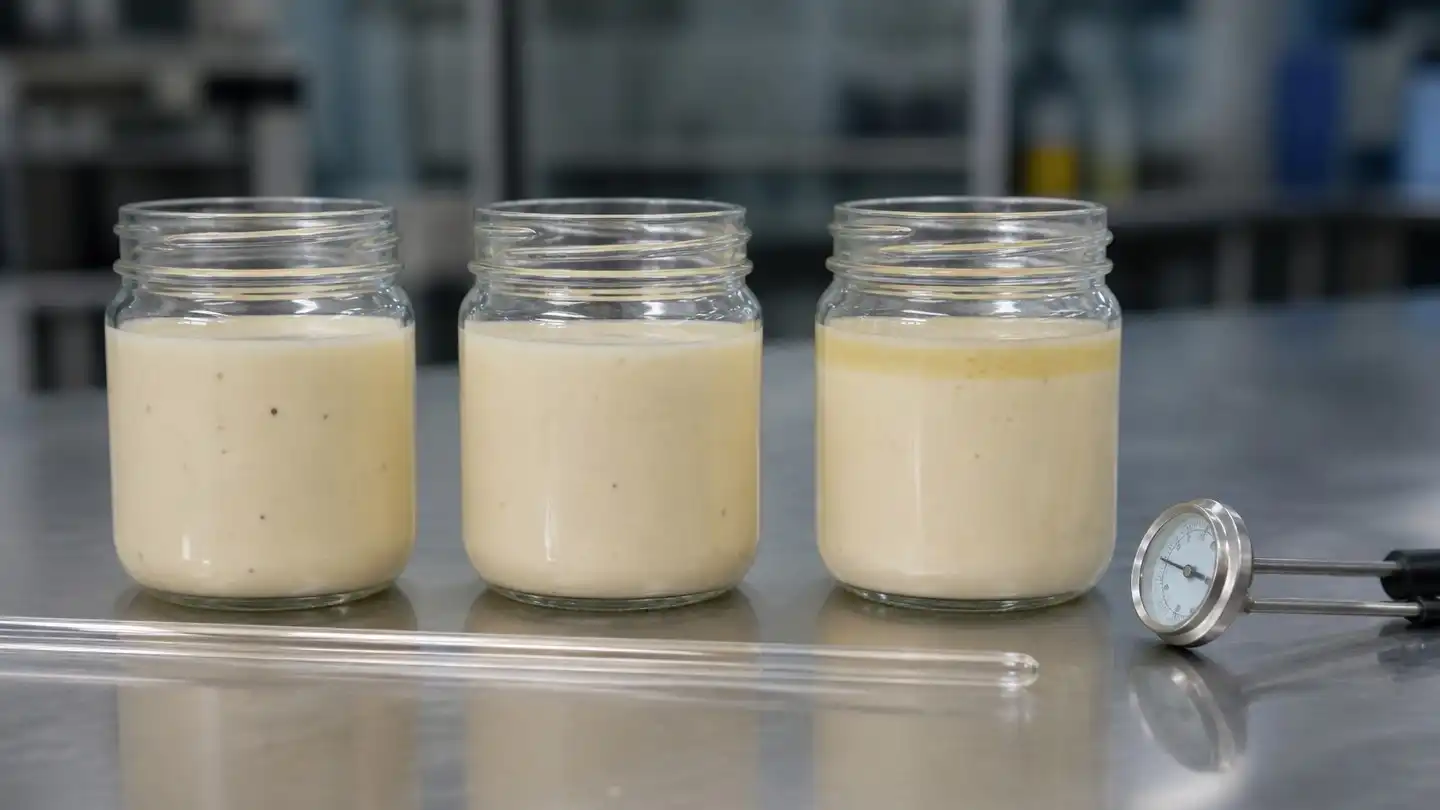
A retorted sauce sees temperatures and pressures that rearrange an interface. Lecithin holds up better than many proteins in that environment, but the dose has to be sufficient to cover the new interfacial area created during homogenisation and then maintained through the hold. Under-dosing shows up as a thin oily ring at the surface after retorting, or as a grainy texture where droplets have coalesced.
Freeze-thaw and chill stability
If the sauce is chilled or frozen, ice crystal growth concentrates the aqueous phase and pushes the emulsion toward instability. A sauce that survives retort can still break on the second freeze-thaw cycle. Test it: three cycles, with a visual and a viscosity reading after each, is a cheap way to find the limit before a customer does.
Interaction With Starch and Hydrocolloids
Most creamy sauces are stabilised by starch as well as by emulsifier, and the two interact. Lecithin can improve the dispersion of fat into a starch paste, which reduces the amount of shear needed to reach a smooth texture. It can also compete with the starch for water at the interface, and in a heavily modified-starch system the effect of adding emulsifier may be smaller than expected.
The practical implication is that the emulsifier dose cannot be optimised in isolation. A trial that changes lecithin while holding starch constant measures one half of a two-variable system. Where the reformulation brief allows it, run a small matrix: two emulsifier levels against two starch levels, and read viscosity and visual stability at each corner.
Salt, Acid and the Ionic Environment
Savoury sauces carry salt, and some carry acid. Both change the electrical environment at the droplet surface, and phospholipids respond to that change differently from synthetic emulsifiers. A system that is stable at neutral pH can show creaming when acidified, particularly if the acid is added late in the process.
The test is straightforward: make the sauce at the final pH and salt level, not at a convenient laboratory level, and hold it for the intended shelf life at the intended temperature. Accelerated storage is useful for screening, but the correlation with real-time behaviour has to be established for your own system before it can be trusted.
Dosing: A Variable, Not a Number
Published usage levels for lecithin in sauces span a wide range because the requirement depends on fat content, homogenisation energy, starch type and the presence of other emulsifiers. A trial should bracket the incumbent rather than replace it: run at roughly three quarters, the current level, and one and a quarter times the current level, and evaluate all three after the thermal process.
Two further points protect the decision. First, compare suppliers at equal phospholipid contribution rather than equal weight, because a diluted material will need a higher dose and the price comparison is otherwise meaningless. Second, keep the dose inside the range permitted for the category in the destination market, which is a regulatory question and should be checked before the trial rather than after.
There is a second reason to keep the emulsifier level explicit rather than inherited. Retail and foodservice specifications increasingly ask for a declared ingredient list per 100 g, and an emulsifier carried over from an old formulation may sit above the level the new brief permits. Rebuilding the dose from the trial data takes an afternoon; discovering the overage during a customer specification review takes a production run.
Common Failure Modes and What They Indicate
| Symptom | Likely cause | Where to look first |
|---|---|---|
| Oily ring after retorting | Insufficient interfacial coverage at the final fat load | Emulsifier dose relative to fat, and homogenisation pressure |
| Grainy mouthfeel | Droplet coalescence during the hold | Starch-emulsifier balance; hold time and temperature profile |
| Creaming on storage | Density difference with inadequate viscosity support | Hydrocolloid system before changing the emulsifier |
| Pale sauce turning grey | Oxidised lipid phase | Peroxide value of the emulsifier and storage conditions |
| Visible specks | Poor dispersion of a semi-solid emulsifier | Melting and addition point in the process |
Reading a failure this way turns a complaint into information. In most cases the answer is a process change rather than a new supplier, and knowing which is which saves a reformulation cycle.
Supplier Questions Worth Asking
Ask which refining route produced the material, whether the phospholipid class distribution is available, how the product is stored before shipment, and what the maximum storage temperature is. Ask for the allergen statement per lot and for the change-notification clause covering carriers and blending.
The engineering side of handling a semi-solid or powder emulsifier — dispersion into a fat phase, addition point, and the effect of carrier choice on flow — follows the same logic described in this note on carrier specifications for powdered lipids, and the same discipline of measuring dispersion rather than assuming it is set out in this discussion of dispersion in powder blends.
Cost, Dose and the Real Comparison
Buyers compare emulsifiers on price per kilogram, which is the wrong unit. The right unit is cost per unit of interfacial coverage delivered in the finished sauce, and that requires three numbers: the phospholipid content, the dose the trial actually needed, and the yield loss caused by any instability.
A higher-phospholipid grade that costs more per kilogram and doses at two thirds of the rate is usually the cheaper material. Building that comparison once, on data from your own process, is more valuable than renegotiating price every quarter. The company-level certification and quality framework that sits behind the documents is listed on the quality and accreditation page.
A Trial Worth Running
Four batches: the incumbent as control, an equal-phospholipid substitution, a reduced-fat version, and a repeat of the substitution to measure process noise. Evaluate each after retort and after three freeze-thaw cycles, recording viscosity, droplet appearance under a microscope and a photograph against a fixed reference.
If the repeat differs from the substitution by more than the substitution differs from the control, the trial has measured the kitchen and not the ingredient. Running it again is cheaper than reformulating a product that was never the problem.
Conclusion
Egg yolk lecithin earns its place in creamy sauces when the specification is read as a forecast of interfacial behaviour, when the trial is run through the real thermal process, and when the dose is bracketed in the finished matrix. Compared on equal phospholipid contribution with a soybean lecithin or with a spray-dried alternative such as those described in this comparison of spray-dried and freeze-dried powders, it is a predictable component rather than a variable.
If you are developing a retorted, chilled or freeze-thaw stable creamy sauce and need to compare emulsifiers on the same analytical basis, we can provide specification sheets, lot certificates with methods, allergen statements and samples for a four-batch trial. Send the process route, the fat load and the target texture to wgt@allwellcn.com and the technical team will answer against your matrix.
References
- U.S. Food and Drug Administration. 21 CFR Part 184 — Direct Food Substances Affirmed as Generally Recognized as Safe. Current edition.
- U.S. Food and Drug Administration. 21 CFR Part 101 — Food Labeling; allergen declaration requirements. Current edition.
- Codex Alimentarius Commission. General Standard for Food Additives (CXS 192-1995, as amended). FAO/WHO.
- International Organization for Standardization. ISO 660 — Animal and vegetable fats and oils: determination of acid value and acidity. 2020.
- International Organization for Standardization. ISO 3960 — Animal and vegetable fats and oils: determination of peroxide value. 2017.
- International Organization for Standardization. ISO 4833-1 — Microbiology of the food chain: colony count at 30 °C. 2013.
This article is intended for business-to-business ingredient sourcing and formulation discussion. It does not provide medical, nutritional, or regulatory advice for any specific product or market.