
Oat Beta Glucan Powder Improves Texture and Stability in Commercial Food Products
2026-10-14 19:18:01
Oat Beta Glucan Powder that produces a smooth, spoonable gel in a laboratory beaker can arrive at the filler thinner, paler and less stable than the bench sample ever promised. The cause is almost never the powder. It is the line. The functional effect of a soluble-fibre hydrocolloid such as oat beta glucan powder is not a fixed property of the raw material — it is the accumulated product of every unit operation the mixture passes through, from powder induction to the final cooling stage. Formulators who treat the ingredient as a constant and the process as a detail tend to meet their surprises at the first production run rather than at the bench.
This article is written for technical teams that have already selected the ingredient and now have to make it work at scale. It sets out which unit operations change what the hydrocolloid actually does, what a scale-up trial has to measure rather than merely confirm, how the dominant stresses differ by product category, and how to structure verification runs so that a bench result becomes a production specification instead of a source of argument.
Why a Bench Texture Rarely Survives the Transfer to Production
The bench recreates the recipe but not the process. In a beaker, temperature is controlled with a bath, mixing is visible, and cooling takes minutes. On a line, the same formulation is pumped through tens of metres of pipe, held in balance tanks while the filler catches up, sheared as it passes a homogeniser or a filling valve, and cooled according to a profile set by tank geometry rather than by the formulator. Each of those steps imposes a physical treatment on a shear-thinning polymer network, and the effects accumulate rather than cancel.
That is why a single viscosity figure is a misleading specification. One number describes one condition, and the condition almost never matches the one the product meets in the plant. The more useful framing is to treat texture as an output of a process path and then identify which points on that path can move it. The structural background — why this fibre behaves the way it does — is covered in our explainer on what oat beta glucan is; the subject here is control rather than mechanism.
An ingredient stream also has to survive more than one plant. When a brand scales from a pilot facility to a contract producer, or runs the same recipe on two lines, the specification has to be robust rather than optimal for a single site.
The Unit Operations That Change What the Hydrocolloid Does
Five variables dominate, and each is usually owned by a different part of the operation. That division of ownership is precisely why inconsistent texture is so hard to trace: a formulation problem and a maintenance problem can produce the same defect on the same day.
Shear Is Cumulative, Not Local
Pumping, high-shear mixing, colloid milling and homogenisation all inject mechanical energy into the solution. For a high-molecular-weight soluble fibre the consequence is well described in the polysaccharide literature: the physical properties of cereal β-glucans in solution and in the gel state — solubility and rheological behaviour — are governed by molecular features such as molecular weight and linkage pattern, together with temperature and concentration. Mechanical and thermal treatments that depolymerise the chain lower the effective molecular weight, and lower effective molecular weight builds less viscosity for the same mass of powder.
The practical consequence is that two plants running the “same” recipe can produce visibly different textures if one homogenises at a higher pressure, recirculates its batches for longer, or uses a different pump type on the transfer route.
Thermal Load Accumulates Across the Whole Line
A single pasteurisation step is easy to specify and easy to verify. The total heat history is neither. Pre-heating in the balance tank, the hold tube, the filler block, any hot-fill soak and any rework loop all contribute, and the hydrocolloid experiences the integral of time and temperature rather than one discrete treatment. Research on concentrated oat β-glucan products found that β-glucan molecular weight decreased during manufacturing and attributed the change to the rigorous jet-cooking conditions used in that process. The transferable lesson: when a scaled-up batch under-delivers viscosity, the explanation is more often a longer effective hold than the bench protocol assumed, rather than a weaker raw material.
Holding Time and Temperature Are Separate Variables
Holding a batch is not neutral. Time at temperature drives hydration and, past a point, degradation; time at rest allows structure either to develop or to relax, depending on the system. A batch held half an hour longer than planned because the filler is down is not the same product as the batch before it. Maximum hold windows, expressed as time inside a temperature band, belong in the batch record — not merely a target temperature.
Point and Order of Addition
Where the powder enters the process changes everything downstream of it. Inducted into cold water in a balance tank it hydrates slowly and unevenly; introduced into a hot, high-shear zone it hydrates quickly and can also be degraded quickly. The order of addition relative to acid, salts, sugars and protein matters too, because those ingredients compete for water and alter the hydration environment. A change of addition point made to solve a dusting or lumping problem can quietly alter the finished texture weeks later.
In-Line Versus Batch Hydration
In-line hydration — powder inducted into a moving stream and stabilised in a short residence loop — gives tight, repeatable hydration with little forgiveness for rate changes. Batch hydration allows time and correction, at the cost of exposing the entire mass to the full shear and thermal history of the tank and the transfer route. Neither approach is inherently better. The choice has to be validated against the filling operation, because hydration quality and filling stress sit at opposite ends of the same chain.
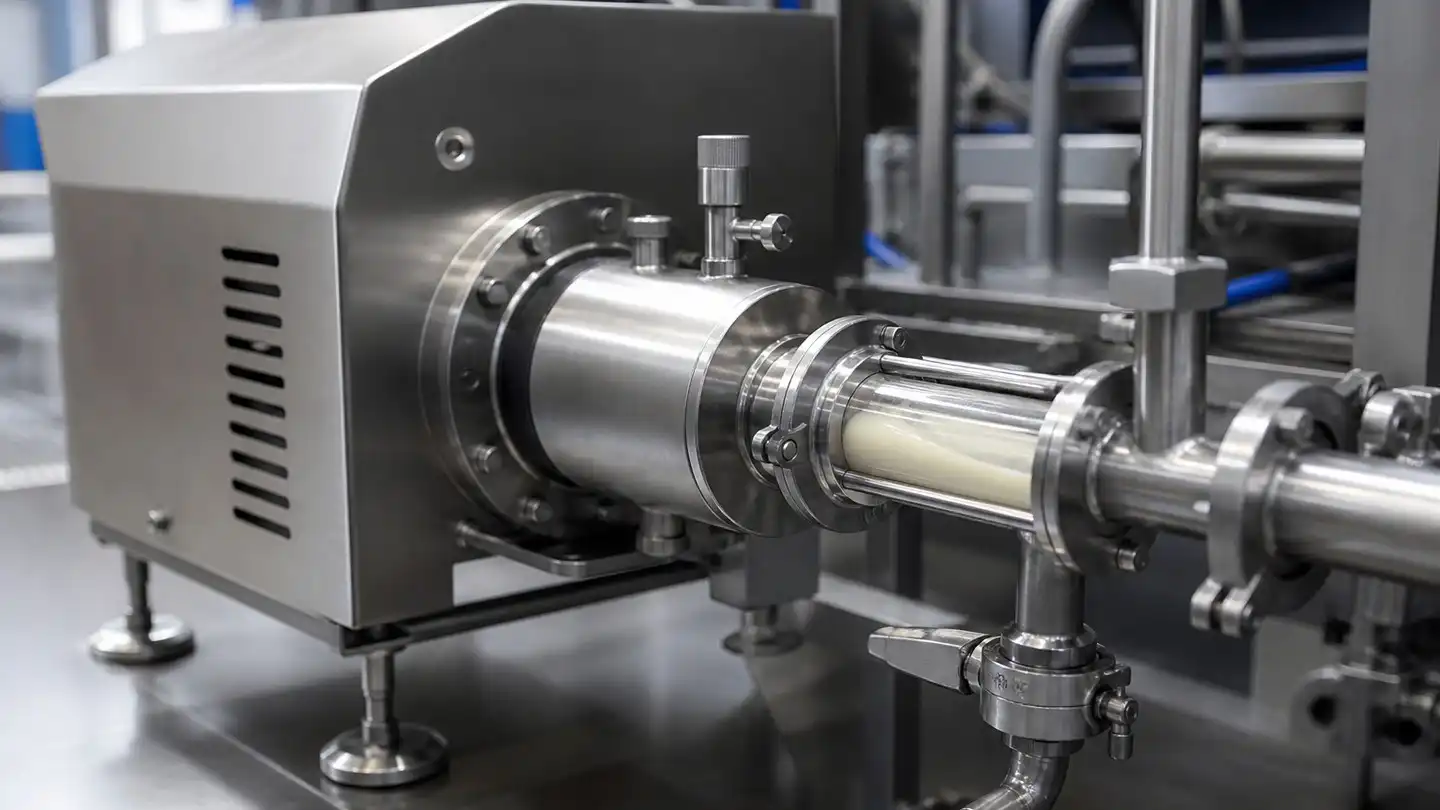
What a Scale-Up Trial Must Actually Measure
A trial that only asks whether the finished product is “acceptable” consumes a production slot and answers nothing that can be written into a specification. Four measurements make a run worth its cost, and each has to be taken at the right point in the process rather than on a convenient bench sample.
Viscosity at Production-Identical Shear Rates
A laboratory spindle reading is taken at a shear rate with no relationship to a pump, a plate heat exchanger or a filling nozzle. Because the network is shear-thinning, that single point cannot predict what happens inside a pipe. Measure with a rheometer across a shear-rate range and report the apparent viscosity at the shear rates the product actually encounters — transfer line, heat exchanger, filler — and record those rates in the specification so that a second site can reproduce the measurement rather than reinterpret it.
Phase Separation and Syneresis After the Real Cooling and Filling Path
Serum separation, whey-off and surface film frequently appear only after the product has been cooled and filled the way the line cools and fills it. Sample at the filler, then again after the defined cooling profile, and log the time between the two. A bench sample cooled in a water bath has not travelled that path and cannot predict the outcome.
Texture After the Real Storage and Distribution Profile
Textural change is time- and temperature-dependent. A reading taken the following morning says very little about the product after the intended shelf life under the temperature profile distribution actually imposes, including whatever abuse window the category tolerates. Age samples under the intended profile and treat an accelerated condition as an early warning, not a substitute.
Colour and Appearance as a Stability Indicator
Colour drift, haze and speckling are inexpensive, early and whole-batch indicators. A reference photograph plus a colorimetric reading at each stage — bench, post-hold, post-fill and end of shelf life — will often flag an over-sheared or over-heated batch before any instrumental texture result does.
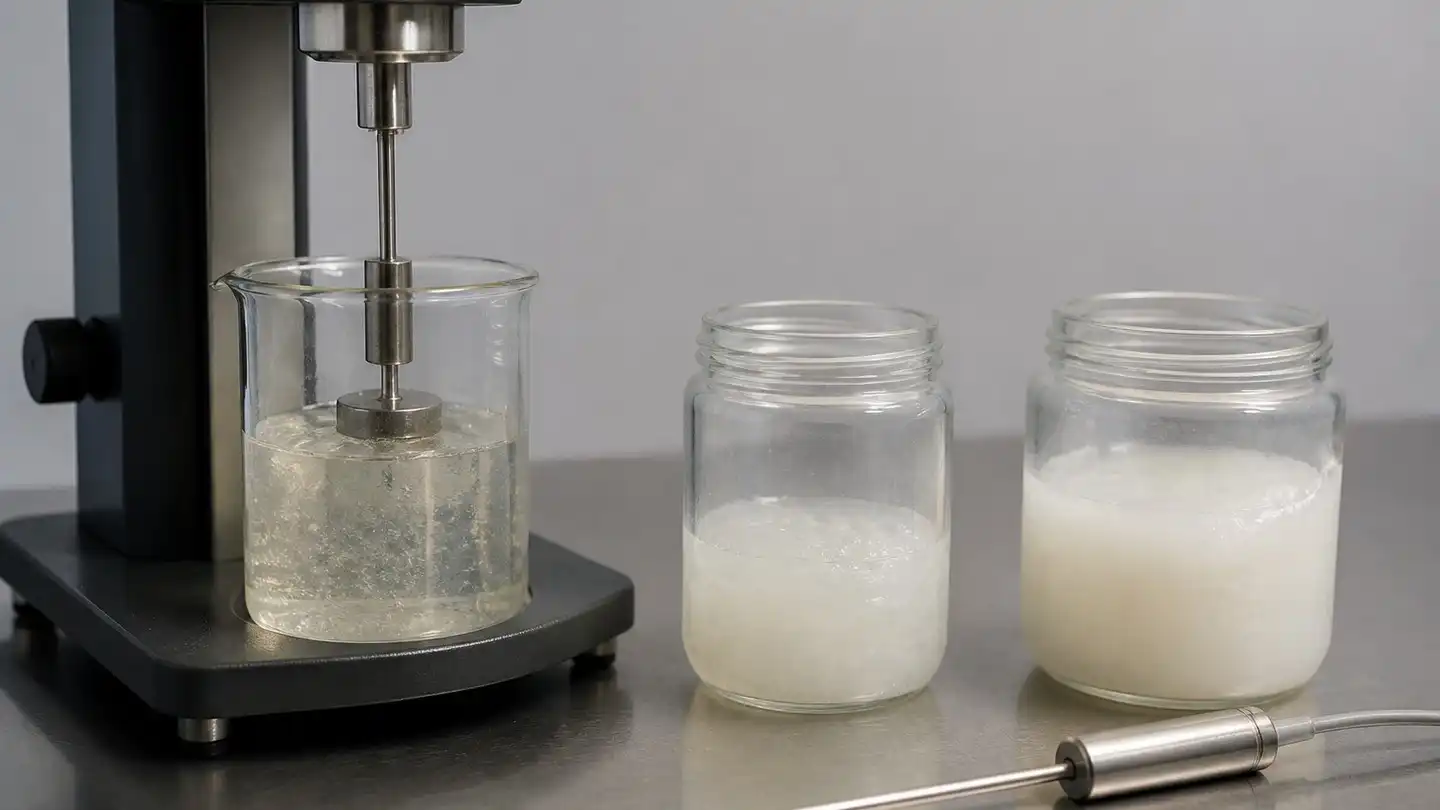
Category-Specific Robustness: What the Line Does Differently
The unit operations above are universal, but their balance is not. The category decides which stress dominates, and therefore which part of the process needs the tightest control — and which ingredient format is worth testing, whether that is a standardised oat fraction or a whole-plant material such as pumpkin powder in systems where colour and particulate load are part of the brief.
| Category | Dominant stresses on the line | Effect on the hydrocolloid | Where to focus control |
|---|---|---|---|
| Chilled beverages and drinking yoghurt | High-shear filling, homogenisation, cold transfer | Viscosity built at the bench is partly lost; suspension power falls | Hydration method and homogenisation pressure |
| Retort and hot-fill sauces, soups and desserts | Sustained thermal load, long hold, post-fill soak | Gel strength and colour shift with accumulated heat | Time–temperature integral and maximum hold window |
| Frozen and thawed products | Freeze–thaw cycling, ice-crystal growth, freeze concentration | Network disruption and water release on thaw | Freeze–thaw cycling of the finished pack |
| Extruded and baked snacks and cereal | Very high shear at high temperature, short residence time | Effective molecular weight reduced; expansion and crumb change | Screw configuration, moisture and die conditions |
| Dry mixes and instant beverages | Pneumatic conveying, segregation, dusting, reconstitution | Delivered dose varies from sack to sack; lumps or slow wet-out | Conveying velocity, blend order, particle-size match |
A chilled beverage line is dominated by high-shear filling and homogenisation, so shear tolerance and a repeatable hydration method matter more than thermal stability. A retort or hot-fill operation inverts that priority entirely. A frozen system adds a freeze–thaw cycle that can disturb a gel network without any shear at all. An extrusion line combines intense shear with high temperature in a very short time, which is why extrusion performance tends to be established empirically rather than predicted from bench rheology. Dry-mix conveying looks benign by comparison, yet segregation and dusting change the delivered dose from one sack to the next — a texture problem in disguise.
Ingredient-stream selection follows the same logic in reverse. Where a process is inherently aggressive, it can be more efficient to choose a grade and a supply format that tolerate the line than to redesign the line around a single ingredient. Our oat extract range is one example of the same raw material supplied in a different form for a different process position.
A Scale-Up Verification Plan You Can Copy
Verification runs are cheaper and far more informative when each one isolates a variable. The plan below moves from bench confirmation to pilot scale, then to first production, and finally to a distribution hold, changing one process condition at a time and recording the same measurements at every stage.
| Stage | What to fix between runs | What to measure | Acceptance decision |
|---|---|---|---|
| Run 0 — bench confirmation | Freeze the reference recipe and agree the test methods | Apparent viscosity against shear rate; appearance; pH | Baseline defined and methods signed off |
| Run 1 — pilot at line shear | Reproduce transfer, homogenisation and filling stresses at pilot scale | Apparent viscosity at the same shear rates; separation at the filler | Baseline matched inside the agreed window |
| Run 2 — first production | Set the hydration point, hold window and cooling profile from Run 1 data | Viscosity, syneresis, colour and filled weight across the whole run | Head, middle and tail samples all inside the window |
| Run 3 — pack and distribution hold | Freeze the process settings; age product in the intended pack | Texture, syneresis and colour at end of shelf life plus one abuse condition | Product inside the window at end of life |
| Run 4 — second site or line | Transfer the recorded shear rates and thermal integral, not the recipe alone | The Run 2 panel, compared against the original site | Site-to-site variation inside the window |
Two decisions make the plan work. The first is agreeing the acceptance window before the run, expressed as a range on the measurements above rather than a pass or fail on taste. The second is deciding in advance what will be changed if the product misses: for example, adjusting hydration time before adjusting shear, because a pump or homogeniser change is a capital question while a hydration change is a scheduling question. Recording the shear rate and the time–temperature integral for every run turns a series of trials into a transferable specification instead of a set of anecdotes.
Working With a Supplier on Process Robustness
Most supply conversations stop at specification, certificates of analysis and price. A process-robustness conversation asks different questions: which grade the supplier recommends for a high-shear filling operation, whether dispersion behaviour is consistent batch to batch, and whether the supplier can hold a tight specification while a second plant is qualified. Batch-to-batch consistency is the part of the chain a formulator cannot control internally, which is why it belongs in the qualification file next to the analytical data rather than in a separate commercial discussion.
Request a Scale-Up Sample From Wellgreen
Wellgreen supplies oat beta glucan powder from a GMP-certified facility, standardised to 80%–90% oat beta-glucan with customisation available, and supported by standing inventory and an experienced export documentation team. The product page lists the certificates the material is supplied against — ISO9001:2015, ISO22000, Halal, Kosher and HACCP — together with the analytical and packaging details. For a scale-up sample, a specification review, or a discussion of how the ingredient behaves under your own process conditions, write to wgt@allwellcn.com.
This article is written for food industry professionals evaluating ingredients and processes. It is not consumer advice, and it makes no claim about the performance of any finished product, which depends on the specific formulation, process and plant.
References
- Wellgreen. Oat Beta Glucan Powder (product page, specification, certificates and packaging). https://www.wellgreenherb.com/standardized-extract/oat-beta-glucan-powder
- Wellgreen. What Is Oat Beta Glucan? https://www.wellgreenherb.com/knowledge/what-is-oat-beta-glucan
- Wellgreen. Oat Extract (product page, specification and applications). https://www.wellgreenherb.com/standardized-extract/oat-extract
- Wellgreen. Pumpkin Powder in Functional Foods and Beverages. https://www.wellgreenherb.com/knowledge/pumpkin-powder-in-functional-foods-and-beverages
- Wellgreen. High Purity Quercetin Dihydrate Powder Enhances Consistency in Food and Beverage Applications. https://www.wellgreenherb.com/knowledge/high-purity-quercetin-dihydrate-powder-enhances-consistency-in-food-and-beverage-applications
- Wellgreen. Bulk Green Tea Extract for Beverage Formulation and Functional Ingredient Supply. https://www.wellgreenherb.com/knowledge/bulk-green-tea-extract-for-beverage-formulation-and-functional-ingredient-supply
- Wellgreen. Formulating Functional Beverages with Hibiscus Extract Powder. https://www.wellgreenherb.com/knowledge/formulating-functional-beverages-with-hibiscus-extract-powder
- Kim, S., Inglett, G. E., & Liu, S. X. (2008). Content and molecular weight distribution of oat beta-glucan in Oatrim, Nutrim, and C-Trim products. Cereal Chemistry, 85(5), 701–705. Publication record: U.S. Department of Agriculture, Agricultural Research Service. https://www.ars.usda.gov/research/publications/publication/?seqNo115=218811
- Lazaridou, A., & Biliaderis, C. G. (2007). Molecular aspects of cereal β-glucan functionality: Physical properties, technological applications and physiological effects. Journal of Cereal Science, 46(2), 101–118. https://doi.org/10.1016/j.jcs.2007.05.003 — record: https://agris.fao.org/search/en/providers/122535/records/65df741c0f3e94b9e5d88918