
Oregano Powder Feed Grade Applications in Poultry and Livestock Nutrition
2026-09-22 14:00:01
Oregano Powder Feed Grade has no single correct position in a diet. The same standardised Origanum vulgare powder can sit in a broiler premix, a piglet creep feed, a dairy mineral supplement or an extruded aquafeed — and each position changes what a buyer must specify and what the surrounding label may say. Wellgreen supplies Oregano Powder Feed Grade against a specification rather than a culinary description: carvacrol and thymol content, a particle size band, a moisture limit and a batch certificate of analysis. What changes across species is not the ingredient's identity but its programme position, its carrier and its claim route.
Why Programme Position Matters More Than Product Identity
A feed additive is defined by its function and its authorisation, not by the plant it came from. The same botanical material can be handled as a sensory additive — a flavouring — in one market, as a generally recognised as safe (GRAS) spice or essential-oil extractive in another, and as a product requiring its own registration dossier in a third.
That reframes the first question: not "how much oregano powder?" but "where does this material enter my programme, and what am I claiming about it?" A powder used to give a diet a consistent aroma sits in a different commercial and legal position from one presented as delivering a performance outcome, and the difference surfaces later — in a label review or at a border.
Three variables follow:
- Where it is added — premix, complete feed, or a separate on-farm addition.
- Which form is bought — pure leaf powder, a standardised extract, or a micro-encapsulated grade.
- What the specification stresses — carrier type, particle size band and bulk density, matched to the mixer, mash or pellet line it meets.
Where the Ingredient Sits in Each Species Programme
Poultry — Broilers and Layers
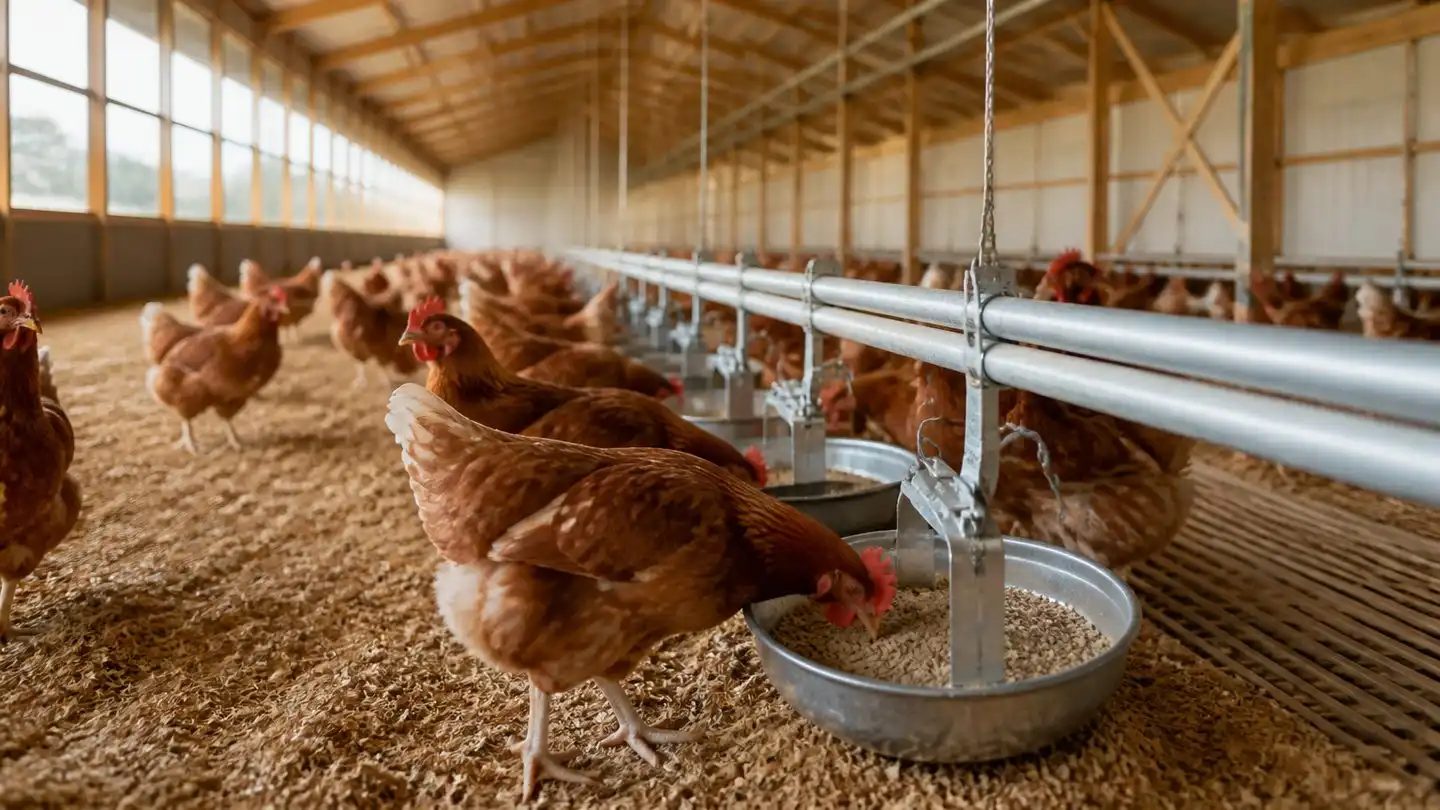
Poultry is the most standardised of the main programmes, and premix placement pays off most clearly here. In an integrated broiler system the material normally enters through the vitamin–mineral premix or a dedicated pre-blend diluted into complete feed, a route that allows accurate weighing of a small mass and the longest available mixing time.
Layer operations often run mash or crumble rations alongside pelleted feed, and the two are not interchangeable from a specification point of view. A mash diet leaves the powder's particle size band in play; a pelleted diet puts that powder through conditioning heat and mechanical pressure, which is why encapsulated grades and post-pellet application exist as separate line items rather than variations of one product. Drinking-water dosing is a third route: a different form and, in the EU, a separately assessed route with its own conditions.
Swine — Piglets, Growers and Sows
Swine programmes mix premix supply with on-farm blending, so a specification must survive two handling environments. Creep and weaning diets are small, high-value batches in which the powder arrives through a diluted pre-blend, where a fine, free-flowing, low-dust grade is easiest to handle. Grower and finisher diets run at much larger volumes, where a coarser, denser grade follows the mineral carrier through the surge bin with less risk of segregation.
Sow and gilt diets sit between the two, formulated with a broad mineral package that also carries the botanical powder — an argument for specifying carrier and bulk density, not assay alone.
Ruminants — Dairy and Beef
Ruminant programmes are the least uniform. Total mixed ration (TMR) systems distribute an additive through a whole-ration mixer in which it is a very small fraction of a large, coarse, moist mass. Repeatability there is largely a particle-size and density question, and a common reason to specify a coarser or granulated, encapsulated form rather than a fine extract powder.
Intensive dairy units more often place the material in a mineral or supplement premix weighed and fed per head — tighter control, and generally preferred when a defined intake matters more than a ration average. Beef feedlot rations follow the premix route into a processed ration, where heat exposure during flaking or pelleting decides the specification.
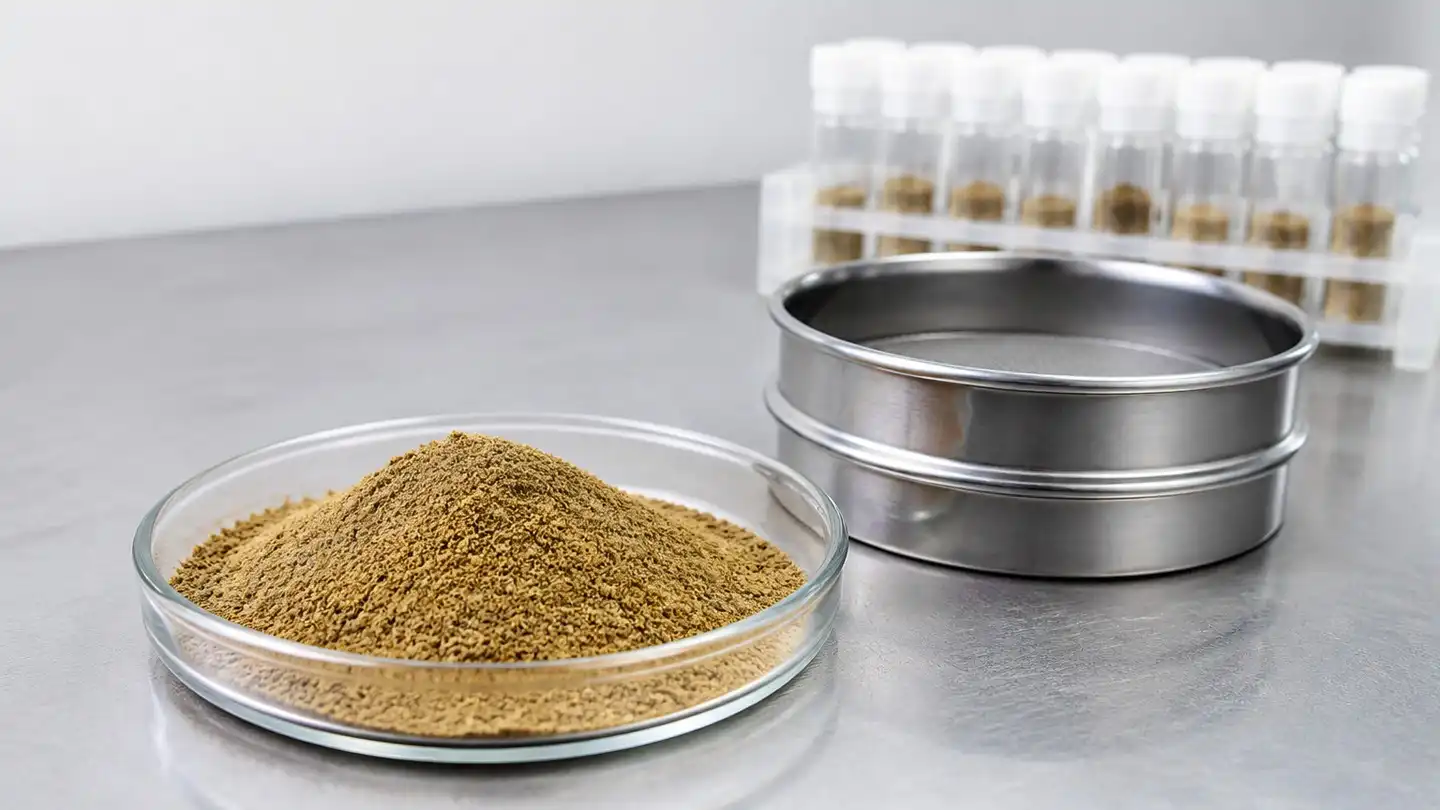
The table below maps the same ingredient into each species programme, including extruded aquafeed and pet food, where heat and water stability rather than mash blending govern the grade. It describes application positions and form choices only: it is not an inclusion-rate table and not a statement of effect.
| Species / production stage | Typical programme position | Delivery route and carrier | What the specification should stress |
|---|---|---|---|
| Broilers | Vitamin–mineral premix or additive pre-blend, diluted into complete feed | Micro-weighing into premix; mineral or ground-grain carrier | Free-flowing fine powder; assay range and moisture band; batch certificate |
| Layers | Premix into mash or crumble; separate grade where the diet is pelleted | Premix, or a post-pellet application point where conditioning heat is high | Heat protection (encapsulated grade) for pelleted diets; mesh profile matched to the mash |
| Swine — piglets | Creep and weaning diets via a diluted pre-blend | Small-scale mixing; mineral or milk-replacer base | Flowability and dust control at small batch mass |
| Swine — growers, sows | Mineral carrier into compound feed or on-farm mix | Bulk blending onto the standard mineral package | Bulk density matched to the carrier to limit segregation |
| Ruminants — dairy | Mineral or supplement premix weighed per head | Premix on a mineral base | Defined intake per head; coarser band where TMR delivery is used |
| Ruminants — beef feedlot | Premix into a processed ration | Premix through the ration mixer | Heat exposure at flaking or pelleting; granulated or encapsulated form |
| Aquaculture | Compound diet applied after extrusion | Post-extrusion dosing or coating | Heat and water stability; compatibility with the coating line |
| Companion animals | Extruded complete diet | Post-extrusion application | Encapsulated grade; aroma load assessed against palatability targets |
Specification Levers That Move With Species and Stage
The powder a broiler mill buys is rarely the powder a dairy premix manufacturer buys, even under the same name. Four levers do most of that differentiation.
Active content and the assay basis
Wellgreen's feed-grade oregano range is standardised at 5%, 10% and 20% carvacrol plus a pure leaf powder, with custom concentrations and micro-encapsulated options. The commercial question behind those numbers is the assay basis: which marker, measured by which method, against which range. A certificate reporting a single average is less useful to a formulator than one reporting carvacrol and thymol separately against a stated range, because only the second can be trended across batches.
Particle size and bulk density
Particle size band changes most often between species. A fine band suits premix weighing and small piglet batches; a coarser, denser band suits bulk blending and TMR distribution. The discipline is matching the additive to its carrier rather than to a house standard; the mechanics are covered in how oregano powder feed grade is used in poultry feed production, where dilution, carrier and segregation are treated as a production problem.
Carrier and delivery form
Carrier choice follows the destination, not the ingredient: premix manufacturers use a mineral base already in the formula, compound feed mills a ground grain or by-product. Where the diet is pelleted or extruded, the form change from free powder to encapsulated or granulated material protects the volatile fraction through the process, and should be specified as a product attribute rather than assumed.
Moisture, contaminants and batch identity
A controlled moisture band prevents caking in the bag and in the mixer. Heavy metal and microbiological limits are set against destination-market rules, which is why the same material may be supplied against two specification sheets. Batch identity — lot number, production date and a matching certificate — is what makes the other three auditable.
European Union: The Flavouring Route and Its Boundaries
The EU framework is Regulation (EC) No 1831/2003 on additives for use in animal nutrition, which governs authorisation and the rules for placing additives on the market, labelling and use. The Commission's position is explicit: a feed additive may not be placed on the market without authorisation following a scientific evaluation showing no harmful effects on human health, animal health or the environment. Authorisations are time-limited and tracked in the EU Register of Feed Additives.
For oregano phenolics the route normally relied on is the flavouring route. The EFSA FEEDAP Panel assessed the phenol derivatives group that includes thymol and carvacrol — chemical group 25 — as flavourings for all species. Its assessed safe level is 5 mg/kg complete feed for all animal species, substantially below the maximum proposed use level for thymol and carvacrol of 125 mg/kg complete feed; the margin of safety is roughly 1 to 5 for pigs and poultry, the most sensitive species. These are regulatory assessment values, not product recommendations. Because the compounds are used as flavourings in food and their function in feed is essentially the same, no further demonstration of efficacy was considered necessary.
That last sentence is the compliance boundary. A flavouring authorisation states that a material is safe and that it flavours; it is not a performance authorisation and carries no claim about animal output. Where routes are separated, conditions are too: in the related group 17 assessment, use as a flavour in feed for fish and other aquatic species was contra-indicated, and simultaneous administration in feed and drinking water for poultry was advised against. The register entry, not a supplier's summary, is the document to check.
The two frameworks also diverge in a way that reaches the specification: the comparable US position rests on a GRAS listing, a different instrument with a different scope. Buyers working both markets need findings that hold in each jurisdiction's own terms; see oregano powder feed grade in natural feed formulation strategies.
United States: GRAS Listings and the Drug Boundary
In the United States the entry point is the Federal Food, Drug, and Cosmetic Act and the GRAS listings in Title 21 of the Code of Federal Regulations. Two listings are directly relevant, and the difference between them is a practical labelling issue.
Section 582.10, covering spices and other natural seasonings and flavourings, carries a spice entry for oregano — and the botanical source named against it is Lippia spp., not Origanum. Section 582.20, covering essential oils, oleoresins and natural extractives, lists Origanum spp. directly. A manufacturer presenting a standardised Origanum vulgare extract should be able to say which listing its own material falls under, and not assume the spice entry covers it by name.
The second boundary is the drug boundary. Part 558 of Title 21 governs new animal drugs for use in animal feeds: it defines medicated feed in types (Type B and Type C) and a veterinary feed directive (VFD) drug as one restricted by an approved, conditionally approved or indexed application for use under the professional supervision of a licensed veterinarian. None of that applies to material handled purely as a feed flavouring or GRAS extractive. It applies the moment a product is presented as treating, preventing or controlling something, or as delivering an animal health outcome — the most important line for a distributor to stay behind, and a documentation question as much as a wording one.
The table below sets the two frameworks side by side at the level a buyer or regulatory affairs officer has to work at. It is a compliance summary, not legal advice, and does not replace the primary texts.
| Question | European Union | United States |
|---|---|---|
| Governing instrument for a feed additive | Regulation (EC) No 1831/2003 — authorisation, placing on the market, labelling and use | Federal Food, Drug, and Cosmetic Act, with GRAS listings in 21 CFR Part 582 |
| How an oregano preparation is normally positioned | Sensory additive — flavouring; EFSA has assessed the phenol derivative group including thymol and carvacrol as flavourings for all species | GRAS spice / natural seasoning entry and a GRAS essential-oil and extractives entry |
| Botanical identity on the listing | Authorisation entries are compound-specific; the register entry governs | 21 CFR 582.10 names Lippia spp. for the oregano spice entry; 21 CFR 582.20 names Origanum spp. for essential oils and extractives |
| Status of a standardised carvacrol product | Covered by the group assessment for the flavouring route, subject to the conditions on the individual entry | 21 CFR 582.60 names other synthetic flavouring substances but not carvacrol or thymol; status must be established for the specific material |
| Performance or health claim | A flavouring authorisation carries no zootechnical claim; efficacy was not separately demonstrated because the function in feed matches food use | A therapeutic or production claim moves the product toward new-animal-drug and medicated-feed territory under 21 CFR Part 558 |
| Labelling discipline | Additive must be authorised and labelled under the Regulation; confirm conditions in the EU Register of Feed Additives | Confirm the ingredient definition and labelling against FDA requirements and the destination state's feed rules |
| Species scope | Assessments quoted cover all species, but conditions attach to entries — including route of administration | 21 CFR 558.3 defines major species as cattle, horses, swine, chickens, turkeys, dogs and cats |
| Published safe-use level (assessed, not a recommendation) | 5 mg/kg complete feed for the group; 125 mg/kg complete feed as the maximum proposed use level for thymol and carvacrol | No equivalent published group assessment; the supplier must hold its own safety and identity data |
What a Defensible Claim Looks Like
Everything above is a framework, not a permission. Two rules follow, and both belong in a supplier's quality system rather than in a marketing paragraph.
First, any efficacy or performance statement must be supported by the claims permitted in the destination market and by the supplier's own product-specific data. A published study must be quoted as a study — with its species, design and conditions — and never converted into a recommended inclusion rate; published inclusion levels describe what a trial did, not a dosing instruction.
Second, identity and specification data should be traceable to the lot in hand. Botanical identity, plant part, assay method, particle size, moisture, contaminant limits and batch certificate let a formulator, an auditor or a border officer check a claim rather than accept it. Suitability is, in that sense, a documentation property as much as a chemical one — the argument set out in what makes oregano powder feed grade suitable for animal nutrition.
This article is limited to application positions and the regulatory framework. It proposes no inclusion rate and makes no health, therapeutic or performance claim for any species.
Partner With Wellgreen for Oregano Powder Feed Grade Supply
Wellgreen supplies Oregano Powder Feed Grade from Origanum vulgare, standardised at 5%, 10% and 20% carvacrol plus a pure leaf powder, with custom concentrations and micro-encapsulated options, and certified to FAMI-QS, ISO 22000, HALAL and KOSHER. Batch certificates of analysis, heavy metal and microbiological data, and samples for testing are available (MOQ 1 kg). To discuss the specification that fits your species programme and market, contact wgt@allwellcn.com or review the product page for Oregano Powder Feed Grade.
This article provides technical and commercial information for feed industry professionals. It is not medical or veterinary advice. Inclusion levels, regulatory status and label claims for any ingredient must be confirmed against the requirements of the destination market and the user's own product data before commercial use.
References
1. European Commission. Regulation (EC) No 1831/2003 of the European Parliament and of the Council of 22 September 2003 on additives for use in animal nutrition. OJ L 268, 18.10.2003, pp. 29–43. https://eur-lex.europa.eu/legal-content/EN/TXT/?uri=CELEX%3A32003R1831
2. European Commission, Directorate-General for Health and Food Safety. Feed additives (authorisation types, EU Register of Feed Additives, legislation on feed additives). https://food.ec.europa.eu/food-safety/animal-feed/feed-additives_en
3. EFSA Panel on Additives and Products or Substances used in Animal Feed (FEEDAP). (2012). Scientific Opinion on the safety and efficacy of phenol derivatives containing ring-alkyl, ring-alkoxy and side-chains with an oxygenated functional group (chemical group 25) when used as flavourings for all species. EFSA Journal, 10(2), 2573. https://doi.org/10.2903/j.efsa.2012.2573
4. EFSA Panel on Additives and Products or Substances used in Animal Feed (FEEDAP). (2012). Scientific Opinion on the safety and efficacy of propenylhydroxybenzenes (chemical group 17) when used as flavourings for all animal species. EFSA Journal, 10(1), 2532. https://doi.org/10.2903/j.efsa.2012.2532
5. EFSA Panel on Additives and Products or Substances used in Animal Feed (FEEDAP). (2024). Safety and efficacy of a feed additive consisting of an essential oil derived from the flowering tops of Thymbra capitata (L.) Cav. (Spanish type origanum oil) for use in all animal species (FEFANA asbl). EFSA Journal, 22(10), e9018. https://doi.org/10.2903/j.efsa.2024.9018
6. U.S. Food and Drug Administration. 21 CFR § 582.10 — Spices and other natural seasonings and flavorings. https://www.law.cornell.edu/cfr/text/21/582.10
7. U.S. Food and Drug Administration. 21 CFR § 582.20 — Essential oils, oleoresins (solvent-free), and natural extractives (including distillates). https://www.law.cornell.edu/cfr/text/21/582.20
8. U.S. Food and Drug Administration. 21 CFR § 582.60 — Synthetic flavoring substances and adjuvants. https://www.law.cornell.edu/cfr/text/21/582.60
9. U.S. Food and Drug Administration. 21 CFR § 558.3 — Definitions and general considerations applicable to this part (medicated feed types, veterinary feed directive drug, major species). https://www.law.cornell.edu/cfr/text/21/558.3
10. Jiménez-Salcedo, M., & Tena, M. T. (2017). Determination of cinnamaldehyde, carvacrol and thymol in feedstuff additives by pressurized liquid extraction followed by gas chromatography–mass spectrometry. Journal of Chromatography A, 1487, 14–21. https://doi.org/10.1016/j.chroma.2017.01.042