
Organic Turmeric Powder vs. Turmeric Extract: Which Grade Fits Your Needs?
2026-10-23 10:15:25
Choosing between organic turmeric powder and a standardized turmeric extract is rarely a question of which material is stronger. It is a question of which material your formula, your label and your cost model can absorb. A 95% curcumin extract and a drum of milled organic root can sit on the same purchase order and still belong to two different businesses: one sells colour and flavour, the other sells a declared active. This article regards them as different tools rather than competing grades, and keeps every criterion on the ingredient side — colour value, assay, mesh, flow, contaminants and documentation.
Three Things Buyers Often Blur Together
Most sourcing mistakes here start with a category error: a whole food, a purified isolate and an organic claim weighed as if they sat on one scale.
Whole root powder
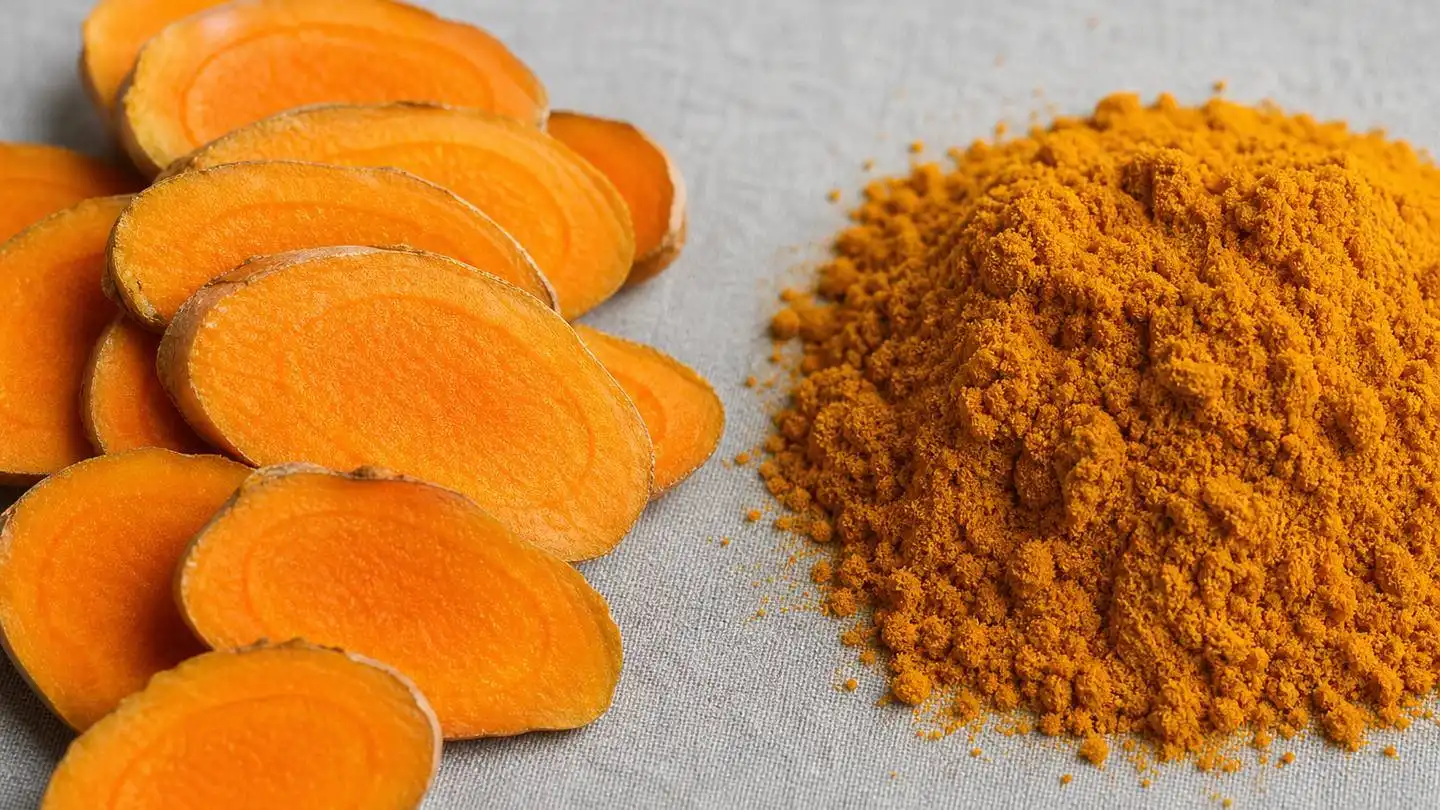
This is the dried rhizome of Curcuma longa, cleaned, sliced, dried and milled. Nothing is removed or added, so it carries the root's full natural profile: pigments, volatile oil, resin, fibre and starch. Composition moves with cultivar, region, harvest age and drying method, so specify a range rather than a single target.
Standardized extract
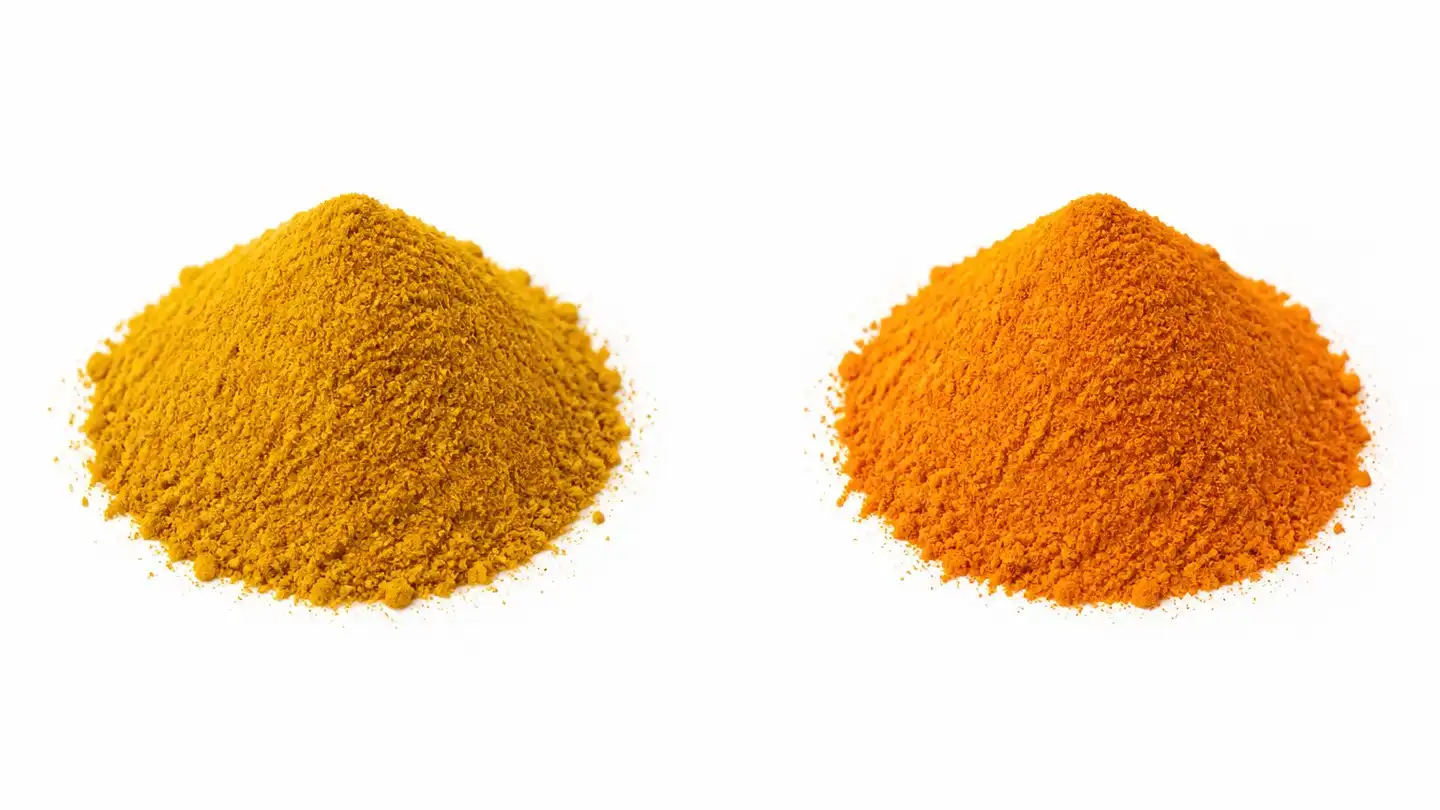
Here the curcuminoids are concentrated and most of the root is removed, which is why the powder reads as a bright orange-yellow fine powder rather than an earthy yellow-brown one. Wellgreen lists this grade at 95% and 98% specification, tested by HPLC or UV, for food and dietary supplement use. Solvent, carrier and drying choices at this step begin to touch your label.
"Organic" is a chain attribute, not a potency grade
Organic certification describes how the rhizome was grown, handled, processed and shipped; it says nothing about curcuminoid content, colour strength or mesh. A certified organic root powder and a conventional 95% extract are not alternatives on one axis: one is a production standard, the other a concentration level. Ask whether the organic chain covers the exact product, made in the exact facility.
The Decision Dimensions That Drive Grade Selection
Eight variables separate the grades in practice. Each belongs in your specification, because each is auditable at goods-in.
| Decision dimension | Organic turmeric root powder | Standardized turmeric extract (95% / 98%) | What to write into the specification |
|---|---|---|---|
| Colour strength and tinting power | Moderate and lot-dependent; the full pigment complement gives a warmer, less saturated hue | High tinting power per gram, with a more saturated orange cast | Colour value by spectrophotometer plus a retained reference sample; state measurement geometry and illuminant |
| Curcuminoid content | Present at natural root level; declare a range and confirm lot by lot | Declared at 95% or 98%, verified by HPLC or UV | Assay method, column and wavelength, plus the acceptable lower limit on a dried basis |
| Flavour and pungency | Full earthy, resinous, slightly bitter root character | Largely de-flavoured; a faint resinous note remains | Sensory descriptor and a blind triangle test against a gold sample |
| Dispersion and solubility | Disperses in water but settles; needs suspension aids or homogenization | Poorly water-soluble; requires emulsifier, carrier or a formulated dispersion grade | Dispersion test medium, shear regime, and whether a water-dispersible version is required |
| Formulation use level | Percent-level additions, limited by taste and colour saturation | Sub-percent additions, limited by uniformity and carrier load | Use level as a percentage of finished mass, to be validated in your matrix |
| Label feasibility | Declares as turmeric or turmeric powder; suits clean-label positioning | Declares as turmeric extract; may need a standardisation statement | Ingredient declaration text and any quantitative labelling trigger in the target market |
| Cost per unit of colour | Lower cost per kilogram, more mass per unit of colour | Higher cost per kilogram, less mass per unit of colour | Cost normalized to colour value and to active content, not price per kilogram |
| Supply stability | Tied to harvest cycles, drying capacity and organic acreage | Tied to root supply plus extraction capacity and solvent availability | Annual contract structure, lead time, and a documented second-source plan |
Colour Strength and Curcumin Content Are Not the Same Variable
This is the most expensive confusion in the category. Curcuminoids are the dominant pigments in turmeric but not the only ones, and assay percentage does not translate into colour in a food matrix. A 95% extract can look weak in a sauce because its particles disperse poorly or pH shifts the hue; a modest-assay root powder can out-colour it because the pigment is better distributed.
Colour therefore has to be measured as colour, in three layers. An instrumental reading: a spectrophotometer in transmission or reflectance, reported as L*a*b* values against a white or black reference, with illuminant, observer angle and sample preparation fixed in writing. A visual comparator: a dilution series read against a retained physical standard under controlled lighting, which catches hue shifts a single number hides. And a matrix trial at your use level, because that is the colour your customer sees.
Two details decide comparability. Particle size changes perceived colour — a finer powder scatters light differently and reads lighter at equal pigment load — so mesh and dispersion state must be fixed alongside the colorimetric method. The extract's hue also sits further toward orange, which matters when matching a target shade rather than adding warmth. Lot-to-lot differences between organic and conventional turmeric powder show up in exactly this reading.
Powder Engineering: The Numbers Behind Handling Behaviour
Particle size. Mesh drives mouthfeel, dispersion and dusting behaviour on a filling line. An 80-mesh powder is a common general-purpose grind for blends and seasonings; 100-mesh gives a smoother suspension and more even colour but costs more to mill and dusts more. Specify mesh with the sieve standard, because "80 mesh" alone is not a complete instruction.
Density and flow. Bulk and tapped density determine how much mass fills a capsule or sachet; flow determines whether that mass arrives consistently. Report both densities plus a flow indicator such as angle of repose, measured on the same moisture basis. Extract powders are hygroscopic, so packaging belongs in the same conversation as flow.
Moisture, ash and volatile oil. Water content governs caking and microbial stability. Total ash and acid-insoluble ash are the cheapest signals of soil contamination and of spent root blended in. Volatile oil, by the method in ISO 6571, is the clearest single indicator of fresh root rather than an extraction by-product.
Microbiology and heavy metals. Spices carry the usual load of aerobic counts, yeasts, moulds and occasionally Salmonella. Every lot should carry a full panel against the target market's criteria with methods named, heavy metals included.
Adulteration and Contaminant Risk Specific to Turmeric
Turmeric has a long history of being extended or brightened. Because it is a strongly coloured powder, adulteration hides easily, so qualify suppliers on detection, not appearance.
Lead salts and chrome yellow dyeing
The classic adulteration is addition of lead chromate or related lead salts to lift colour and weight in low-grade root, a practice well documented in supply-chain investigations — which is why lead testing here belongs among routine identity tests, not annual audits. ICP-MS gives the quantitative figure; X-ray fluorescence gives a fast goods-in screen that can hold a lot before it reaches the laboratory. Set the limit against the destination market's regulation and your customer's specification, and require the result on every certificate of analysis.
Sudan-type dyes and non-permitted colourants
Sudan I–IV and related azo dyes have been found in chilli and turmeric powders as cheap colour boosters, and are not permitted food colours in major markets. A dye screen by LC-MS/MS, or thin-layer chromatography as a cheaper first pass, belongs in the specification for any high-colour grade. If a lot is unexpectedly vivid relative to its assay, the colour is not coming from curcuminoids.
Irradiation and non-organic commingling
Irradiation is permitted in some jurisdictions, restricted in others, and generally not allowed under organic standards. The risk is the missing declaration, so ask for a written irradiation statement per lot and notice of any change. The related risk is commingling: conventional root entering an organic line during drying, milling or storage — a chain-of-custody failure no assay will reveal.
A testing panel you can specify
A defensible goods-in panel contains: identity by macroscopic and microscopic examination plus a curcuminoid profile; assay by HPLC with UV confirmation; lead and other heavy metals by ICP-MS; a dye screen; moisture, total ash and acid-insoluble ash; volatile oil; and a microbiological set. Total plate count, yeasts and moulds follow ISO 4833-1 and ISO 21527-1, with Salmonella alongside. The discipline is requiring all of it, on every lot, from a traceable laboratory.
Verifying the Organic Claim: Scope, Process, Transaction
An organic certificate is a document about a scope, not a statement about a powder. Three checks separate a real claim from a decorative logo.
Scope. Read the certificate's product list and the certified operation's activities. Does it name turmeric root or turmeric powder, and does it cover processing and handling, or only growing and harvesting? A farm certificate does not cover a milling plant, and a third-party mill must appear in the chain.
Process. Confirm that the unit operations applied to your lot — washing, slicing, drying, milling, sterilization, packing — sit inside a certified operation. A step outside the scope breaks the chain however good the paperwork looks.
Transaction certificate. The transaction certificate ties a certified quantity to a specific buyer, invoice and lot. Check that the quantity reconciles with the mass balance of the lot received, that the description matches, and that it was issued for your shipment rather than reused. Qualifying a trusted supplier of organic turmeric powder is largely reading these three documents in sequence.
Wellgreen can supply documentation covering ISO 9001:2015, ISO 22000, Halal, Kosher and HACCP, alongside the organic certificate and transaction certificate set for the specific lot. Organic status is confirmed per shipment through those certificates.
Cost per Unit of Colour, Not Cost per Kilogram
Comparing landed cost per kilogram across these grades produces a conclusion that is almost always wrong. Root powder looks cheap per kilogram and can be expensive per unit of colour; extract looks expensive and can be cheap per unit of delivered active.
For a colour-driven application, normalize to colour value: convert your use level into grams of ingredient per 100 kg of finished product, and divide that cost by the colour units the lot delivers. Cost per colour unit compares fairly across grades and pigment concentrations.
For an active-driven application, normalize to the declared component. At a 95% specification, one kilogram of extract carries 950 g of declared curcuminoids; cost the grams you need, then add carrier cost, displaced fill weight and finished-good testing. The mechanics are clearer without naming a market price: if ingredient A costs X per kilogram and is dosed at 0.5%, its cost per 100 kg of finished product is 0.5X; if ingredient B costs 0.15X and is dosed at 4%, its cost is 0.6X. B is far cheaper per kilogram and slightly dearer per batch — a conclusion no per-kilogram comparison surfaces.
Two further lines belong in the model: yield loss, because a poorly dispersing powder that leaves residue on the mixer wall costs more than its invoice suggests; and label risk, because reformulation cost dwarfs the raw material delta if a grade forces an extract declaration where the brand promises a whole food.
Grade Selection by Application
The table maps common applications to a grade worth trialling, not a substitute for matrix work.
| Application | Recommended grade | Why this grade | Verify before ordering |
|---|---|---|---|
| Curry powder and seasoning blends | Organic turmeric root powder | Flavour, aroma and warm colour are all wanted at once; extract would strip the spice character | Volatile oil, mesh, ash, colour value, sensory match to gold sample |
| Ready-to-drink beverages and concentrates | Organic root powder, or a water-dispersible extract where clarity is required | Root powder gives body and a natural haze; dispersible grades limit sediment in clear systems | Sedimentation after hold time, heat stability through pasteurization, colour after processing |
| Gummies and confectionery | Standardized extract with a dispersion step, or fine-mesh root powder for opaque pieces | Low use levels protect taste; opaque matrices hide undispersed particles | Use level as a percentage of candy mass, colour uniformity across moulds, flavour carry-through |
| Capsules and tablets | Standardized extract at 95% or 98% | Delivers a declared active in a small unit; root powder would need an impractical fill weight | Assay method, bulk density and flow, lubricant compatibility, stability of the dosage form |
| Clean-label colour in sauces and snacks | Organic root powder, or an organic-compliant extract | Turmeric can be declared as a food ingredient rather than a colour additive in many markets | Ingredient declaration rules in the destination market, colour after thermal processing, pH sensitivity |
| Dry mixes and instant sachets | Fine-mesh organic root powder | Uniform colour on reconstitution, with no carrier to declare | Mesh, density, caking on storage, dispersion in hot liquid |
Two patterns emerge. Wherever flavour and label simplicity matter more than dose, root powder wins. Wherever the unit dose must be small and the active must be declared, extract wins. Applications in the middle — beverages, gummies — are decided by the dispersion behaviour of the specific grade. Demand for organic turmeric powder in nutraceutical formats has pushed suppliers to offer both and to state which one is being quoted.
What to Put in the RFQ Before You Compare Quotes
Most quote comparisons fail because the specifications were never comparable. State the grade and, for extract, the declared assay with its test method. State the mesh and sieve standard for powder. State the colour requirement as a method plus a retained standard, not as a word like "bright". State the contaminant panel, including lead and a dye screen, with results per lot. State the organic documentation expected: certificate scope, processing coverage and a transaction certificate per shipment. Then ask for a retained sample to judge the quote against material.
One further question no data sheet answers: what happens when a lot misses specification? A documented deviation process and a defined re-test path are a different commercial risk from a simple drum replacement.
Evaluate Samples in the Order Your Process Will
Sample evaluation tends to start with the certificate of analysis, the least informative document in the set. Run instead the sequence your line will run: identity and assay first, because nothing downstream rescues a mislabelled lot; then instrumental colour and visual comparison; then a matrix trial at your use level, including the thermal or shear steps the product actually sees. Keep a retained portion of every approved sample, labelled with lot, date and conditions — that library makes the next years of incoming lots judgeable.
Working With Wellgreen
Wellgreen supplies both organic turmeric root powder and the standardized extract listed at 95% and 98%, tested by HPLC or UV, packed for food and dietary supplement use. We can send the specification sheet and a certificate of analysis for the current lot, arrange a sample for your matrix trial, and discuss dispersion and colour targets. Write to wgt@allwellcn.com with your application and target market, and we will say which grade fits — including when the answer is the other one. For beverage work, formulating with organic turmeric powder in functional beverages covers the dispersion and heat-stability questions that arise first.
References
- U.S. Food and Drug Administration. 21 CFR Part 182 — Substances Generally Recognized as Safe. 2025.
- European Pharmacopoeia. Monograph: Curcumae longae rhizoma (Turmeric rhizome). 2024.
- United States Pharmacopeia. USP–NF Monograph: Turmeric. 2024.
- International Organization for Standardization. ISO 6571 — Spices, condiments and herbs: Determination of volatile oil content. 2008.
- International Organization for Standardization. ISO 4833-1 — Microbiology of the food chain: Horizontal method for the enumeration of microorganisms. 2013.
- FAO/WHO Joint Expert Committee on Food Additives. Compendium of Food Additive Specifications: Curcumin. 2006.
This article is intended for business-to-business ingredient sourcing and formulation discussion. It does not provide medical, nutritional, or regulatory advice for any specific product or market.