
What Should Buyers Check When Sourcing Standardized Bacopa Monniera Extract?
2026-10-12 14:00:02
Two suppliers can quote the same headline number for Bacopa Monniera Extract and still ship material that behaves nothing alike on your line. The difference is rarely the plant; it is the specification. A commercial standardised botanical is only comparable when the marker basis, the plant part, the physical specification and the documentation format are pinned down in writing before the first purchase order is issued. The practical starting point is therefore a supplier's own declared data sheet — such as the Bacopa Monniera Extract specification — followed by a deliberate decision about which of its fields you will contract on.
What "Standardized" Has to Mean in Writing
"Standardized" is a commercial adjective, not an analytical one. It tells you that somebody chose a marker and a number — not which marker, which analytical principle, which plant part, or which reference material produced it. Until those four things are written into the specification, two certificates of analysis cannot be read side by side.
The declared marker basis decides the number
Bacoside A is not a single molecule. It is a mixture of saponins — bacoside A3, bacopaside II, the jujubogenin isomer of bacopasaponin C, and bacopasaponin C — and the published range for each constituent in plant material collected across different regions of India runs from roughly 0.05% to 0.85% w/w. A validated HPLC method that sums those individual peaks yields one figure; a gravimetric or spectrophotometric "total bacosides" figure yields a different figure for the same lot, because it does not resolve the individual saponins at all.
This is the single most common cause of two certificates disagreeing. Ask for the reference standard used, the detection principle, the calibration approach, and whether the result is a sum of resolved peaks or a single bulk measurement. Where a supplier publishes both a chromatographic and a non-chromatographic marker method for a related botanical, as on the Cnidium monnieri extract page, the order must also state which result the contracted figure is based on.
The plant part must be named
Whole herb and leaf are different raw materials and do not carry the same marker loading. A specification that declares only a percentage leaves the question open, so a leaf-only lot and a whole-herb lot can both "conform" while differing in composition. The Wellgreen data sheet, for example, declares Part Used: Whole herb alongside its assay. The answer belongs on the purchase order as an identity attribute, not a footnote to the assay.
Extraction ratio and standardisation are two different claims
A ratio such as 10:1 is a mass relationship between dried raw material and finished extract, and it says nothing about marker content. Standardisation contracts a marker at a declared content range, verified analytically. Both can legitimately appear on the same product sheet — the Wellgreen specification lists 20%, 50% Bacopasides By HPLC and a 10:1 ratio option — which is precisely why the buyer has to state which claim the order is placed against. If the two are conflated, the released lot may satisfy the ratio and fail the assay, or the reverse. The Wellgreen guide to standardized Polygonum multiflorum extract draws the same distinction, treating ratio extracts and standardised extracts as separate commercial categories.
Specification Fields That Decide Usability
Assay tells you what is in the powder, not whether the powder will run. The fields below decide whether a conforming lot can be used in your process, and each needs a limit and a test method on the purchase order.
Mesh and particle-size distribution
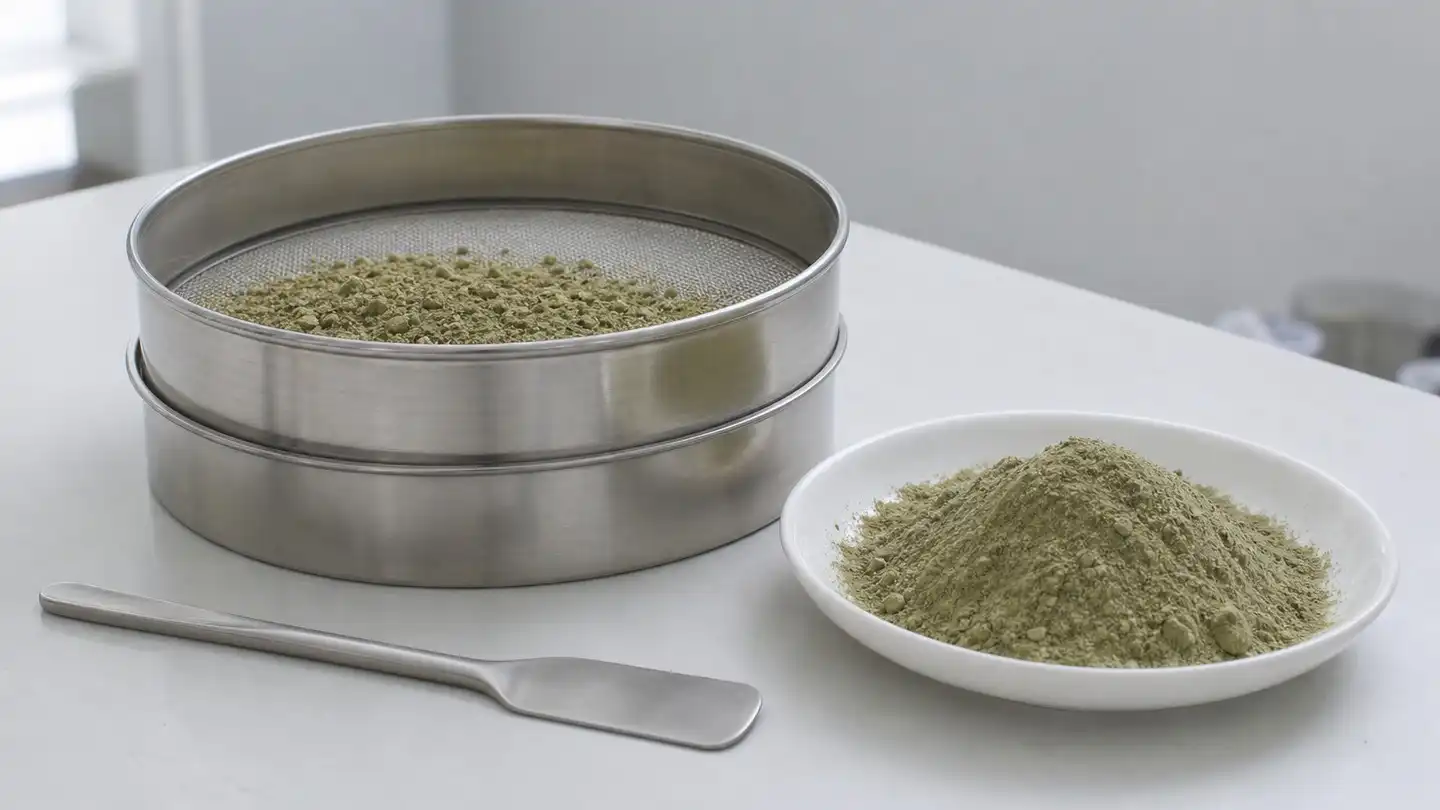
A sieve statement such as "NLT 95% through 80 mesh" is a single-sieve pass/fail, not a distribution. Two lots can both pass it with meaningfully different fines fractions, and fines are what segregate in a blender and dust during weighing. Ask for the distribution across the sieves actually used, and for the mesh of the retained fraction.
Moisture and water activity
Loss on drying and water activity are not the same measurement. A drying loss captures total volatile content; water activity captures the free water that drives caking, flow loss and microbial growth. The Wellgreen specification contracts Loss On Drying: ≤5.0%. If your process or storage climate is sensitive, add a water-activity limit and method: a lot at the top of the drying-loss range with high water activity still causes the problems you were trying to prevent.
Bulk and tapped density
These two numbers set your fill weight and blend volume. Reported together, they also give the compressibility ratio, a fast indicator of flow. A change in bulk density between lots changes the volume a fixed mass occupies, which changes capsule fill and sachet dosing. Where a manufacturer has tuned density for capsule filling or tableting, as in the Wellgreen notes on bulk Boswellia serrata extract production, contract the tuned value rather than leaving it as a typical result.
Solubility and dispersibility in the intended vehicle
The Wellgreen data sheet declares Soluble in Water. That declaration is a starting point, not a performance guarantee in your matrix: confirm dispersion at your own solids loading, temperature and co-ingredients, because wetting behaviour depends heavily on particle size and surface state. The Wellgreen discussion of quercetin dihydrate powder in powder blends shows how mesh, particle surface and moisture state interact during mixing, and treats those variables as specifications rather than assumptions.
Carrier and anti-caking declarations
A carrier or anti-caking agent sits inside the assay basis and changes what a kilogram of powder delivers. Ask for the declared carrier, its identity and its level as a percentage on the certificate. A specification that omits the carrier cannot be compared with one that includes it, and the difference often surfaces only at the blender.
| PO parameter | What to write on the order | Why it decides comparability |
|---|---|---|
| Declared marker | Bacopasides, expressed as a named sum of resolved peaks | Fixes which molecule set the number describes |
| Method of analysis | HPLC, with column, detection and reference standard named | Allows a second lab to reproduce the figure |
| Assay range | Contracted range (for example 20% or 50%) | Converts a headline claim into a release limit |
| Claim basis | Standardised assay, or ratio, or both, stated explicitly | Prevents a ratio lot being accepted against an assay |
| Plant part | Identity attribute; the data sheet declares whole herb | Leaf and whole herb are not interchangeable |
| Particle size | Distribution across named sieves, e.g. NLT 95% through 80 mesh | Controls segregation and dusting |
| Loss on drying | Limit and method, e.g. ≤5.0% | Sets the moisture envelope for storage and blending |
| Water activity | Limit and method | Captures free water that drying loss misses |
| Bulk and tapped density | Two values, reported with method | Sets fill weight, fill volume and flow consistency |
| Solubility / dispersion | Vehicle, solids loading and temperature of the test | Makes the solubility claim meaningful in your matrix |
| Carrier and anti-caking | Identity and level, as a percentage on the COA | Defines what the assay percentage is carried on |
| Contaminant panel | Elements, microbiology, pesticides, residual solvents, each with limits | Fixes the safety envelope once, for every repeat order |
| Documentation pack | COA, method statements, allergen and gluten statements, change-control clause | Makes certificates directly comparable, line for line |
The Contaminant Panel for a Food-Grade Botanical
Botanical extracts concentrate whatever the raw material carried, so the contaminant panel belongs in the specification, not in a one-off due-diligence email. Set it once, with limits, and require it on every lot.
Heavy metals
For this material the Wellgreen certificate line items declare Heavy Metals ≤20 ppm, Lead ≤10 ppm and Arsenic ≤2 ppm. Those are the supplier's declared limits for this product, not a substitute for checking your target market's position. In the European Union, Commission Regulation (EU) 2023/915 sets maximum levels for contaminants in food on an as-low-as-reasonably-achievable basis and relies on strict selection of raw materials — a supplier-selection requirement, not merely a test requirement. Contamination is not hypothetical in this category: a 2025 survey of botanical dietary supplements reported lead and nickel above permissible limits in a majority of products tested, with processed forms worst and material origin measurably affecting nickel content. Review the element panel against the origin documentation, not the certificate alone.
Microbiology
The Wellgreen certificate line items for this product declare Total plate count ≤10,000 cfu/g, Yeast & mold ≤1,000 cfu/g, and not detected for E. coli, Salmonella and Staphylococcus aureus. Request the sampling plan alongside the result, because a result without a plan does not tell you how much of the lot was examined.
Pesticide residue
In the European Union, Regulation (EC) No 396/2005 governs maximum residue levels of pesticides in and on food of plant origin. Ask for a multi-residue report that names the panel tested, the number of analytes and the limit of quantification for each, rather than a single word stating "conforms".
Solvent residue
The Wellgreen certificate declares Solvent residue: USP standard. Name the extraction solvents in the specification and require the residual-solvent method, so the declaration can be checked rather than accepted. Comparable manufacturing notes on the Wellgreen Boswellia serrata extract production page describe extraction with food-grade ethanol and residues held below USP and EP limits — the level of specificity worth asking for here too.
Allergen, gluten and non-GMO statements
The Wellgreen shelf-life and storage note for this product states Non-GMO, Non-irradiated. Add allergen and gluten statements in the format your market requires, and confirm whether they are lot-specific or product-level, because the two carry different weight in an audit.
Documentation That Makes Two Certificates Comparable
A certificate is only useful if its structure is stable. Insist that the certificate line items mirror the purchase-order line items in the same order, that every line names its method, and that the specification column shows the contracted limit rather than a restated result. Two certificates with different layouts force a manual reconciliation on every delivery, and manual reconciliations are where an out-of-specification value gets read as a conformance.
For U.S.-market buyers, 21 CFR Part 111 requires specifications to be established, results to be checked against them, a defined action when a specification is not met, representative and reserve samples, and a documented material review and disposition decision. Those obligations are why the four documents below belong in the supplier agreement.
- Method of analysis per line. Not one method per certificate — one per line item, with the reference standard and the calibration basis named.
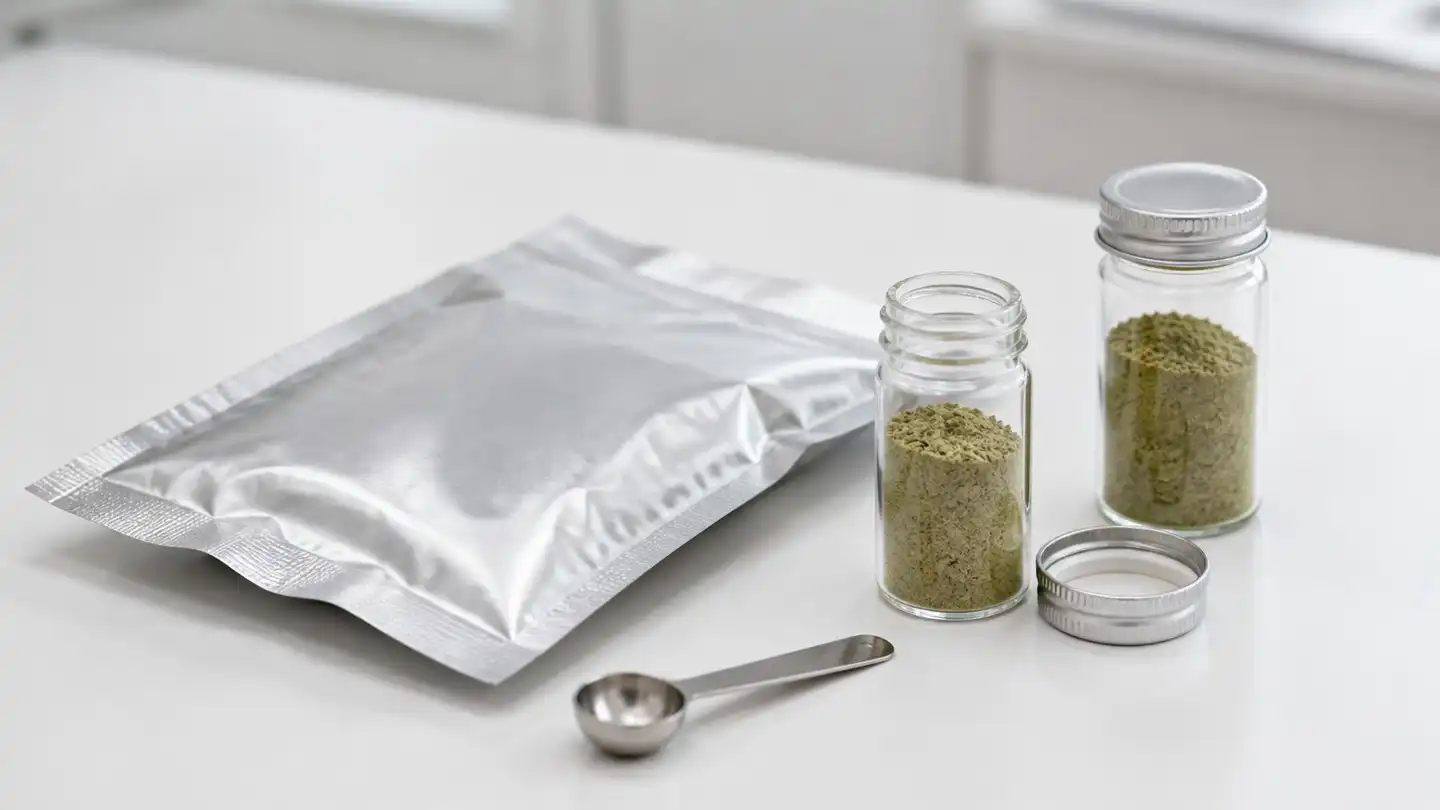
- Retained sample. Draw and seal one from every released lot, hold it for the agreed period, and record where it is stored.
- Sealed reference sample. Keep the approved sample sealed and labelled as the physical reference against which later deliveries are compared.
- Change-control notification. Require written notice before any change to raw-material origin, plant part, extraction solvent, carrier, method of analysis or manufacturing site — with the right to re-qualify before the next order ships.
Lot Release: A Decision Table
Lot release works best as a written decision, not a judgement call. The table below sets each attribute against its acceptance basis and outcome, so that two reviewers reach the same answer.
| Attribute reviewed | Acceptance basis | Outcome if met | Outcome if not met |
|---|---|---|---|
| Assay against declared marker basis | Contracted range by the contracted method | Release | Reject, or re-assay by the contracted method before any concession |
| Identity: plant part | Matches the identity attribute on the order | Release | Quarantine pending supplier clarification |
| Claim basis | Standardised assay, ratio, or both, as ordered | Release | Quarantine; re-negotiate if the order basis was ambiguous |
| Particle-size distribution | Within the contracted sieve envelope | Release | Hold for engineering review against the intended process |
| Loss on drying | Within the contracted limit | Release | Reject, or hold for re-drying only if the method and the supplier permit it |
| Water activity | Within the contracted limit | Release | Reject; storage intervention will not correct the free-water state |
| Bulk and tapped density | Within the contracted values | Release | Hold; re-qualify fill settings before use |
| Dispersion in the intended vehicle | Meets the in-house test at your solids loading | Release | Hold for formulation review |
| Heavy metals | Within the contracted element limits | Release | Reject |
| Microbiology | Within the contracted limits; sampling plan attached | Release | Reject |
| Pesticide residue | Panel named, all analytes below the contracted limits | Release | Reject |
| Residual solvents | Method stated; result within the contracted limit | Release | Reject |
| Certificate completeness | Line items mirror the order, methods named | Release | Hold; request a corrected certificate before disposition |
| Retained sample sealed | Drawn, sealed, labelled and stored | Release | Hold until the sample is drawn |
A Sample Approval Workflow That Makes a Repeat Order Reproducible
Sample approval is the moment the specification becomes real, so it should produce artefacts you can reuse rather than a decision you have to remember.
- Request samples from at least two production lots, not one, so lot-to-lot variation is visible before the order is placed.
- Test the samples in-house against the draft purchase-order parameters, using the contracted methods, and record the results against each line.
- Write the specification from the supplier's declared limits and your own test results, then place those limits on the purchase order verbatim, so the order and the certificate speak the same language.
- Seal and label one retained sample from each approved lot, and record the certificate of analysis that accompanied it as the reference document.
- On every repeat order, compare the new certificate line for line against the reference — field name, method, limit and result — rather than only checking each result against a limit; a changed method with an unchanged margin is a change you need to see.
- Trigger the change-control clause whenever an origin, plant part, solvent, carrier, method or manufacturing site changes, and re-qualify before the next delivery.
Applied consistently, this turns a standardised botanical into a material your quality system can control: fewer rejected lots, fewer blender surprises, and repeat orders that match the numbers of the sample you approved.
Wellgreen supplies Bacopa Monniera Extract to the specification its data sheet declares, with the certificate line items, method statements and documentation pack described above available alongside samples. Send your draft specification to wgt@allwellcn.com and we will confirm which parameters we can contract on, which methods we report against, and what documentation accompanies each lot.
The information in this article is technical and commercial in nature and is not medical advice; use levels, regulatory status and label claims must be confirmed against the rules of your target market and your own product data.
References
- Wellgreen — Bacopa Monniera Extract (product data sheet: part used, declared bacopaside assay by HPLC, ratio option, solubility, shelf life, certificates, and certificate-of-analysis line items).
- Deepak M., Sangli G. K., Arun P. C., Amit A. — Quantitative determination of the major saponin mixture bacoside A in Bacopa monnieri by HPLC. Phytochemical Analysis 2005;16(1):24–29. DOI: 10.1002/pca.805.
- Commission Regulation (EU) 2023/915 of 25 April 2023 on maximum levels for certain contaminants in food. OJ L 119, 5.5.2023, pp. 103–157.
- Regulation (EC) No 396/2005 on maximum residue levels of pesticides in or on food and feed of plant and animal origin. OJ L 70, 16.3.2005, pp. 1–16.
- U.S. eCFR — 21 CFR Part 111: Current Good Manufacturing Practice in Manufacturing, Packaging, Labeling, or Holding Operations for Dietary Supplements (specifications, verification, reserve samples, material review and disposition).
- U.S. Food and Drug Administration — Dietary Supplements (DSHEA framework and the pre-market responsibility of manufacturers and distributors).
- Jasińska-Balwierz A., Krypel P., Świsłowski P., Rajfur M., Balwierz R., Ochędzan-Siodłak W. — Heavy Metal Contamination in Adaptogenic Herbal Dietary Supplements: Experimental, Assessment and Regulatory Safety Perspectives. Biology (Basel) 2025;14(11):1479. DOI: 10.3390/biology14111479.
- Wellgreen — Choosing Standardized Polygonum Multiflorum Extract (ratio extracts versus standardised extracts as separate commercial claims; mesh, moisture and ash fields).
- Wellgreen — Bulk Boswellia Serrata Extract Production with Standardized Plant Extraction (identity testing, bulk density, particle-size distribution, residual-solvent limits, moisture-barrier packaging).
- Wellgreen — Cnidium Monnieri Extract (declared marker with paired test methods, moisture, ash and particle-size fields on a comparison product page).