
Bacopa Monniera Extract for Cognitive Wellness Formulations and Botanical Blends
2026-10-19 15:50:41
Bacopa Monniera Extract is one of the few botanicals that appears on almost every specification sheet filed under cognitive wellness, and one of the few where the commercial conversation is nearly all about analytical control rather than story. It is produced from Bacopa monnieri (L.) Wettst., the creeping wetland herb known in Ayurvedic practice as Brahmi, and sold as a standardized powder whose value is defined by its bacoside content measured by HPLC and by the documents that prove each batch. Wellgreen's standardized Bacopa Monniera Extract shows how the ingredient is presented from the supplier side — defined grades, defined methods, defined paperwork. For formulators the practical questions are narrower: which grade, which specification, which test methods, and which supplier holds those numbers steady across shipments.
Bacopa Monniera Extract as a Bulk Ingredient: Identity, Origin and Market Position
Botanical identity and plant part
Commercially it is the dried whole herb, extracted and standardized — not a single isolated molecule. Purchase documents normally name Bacopa monnieri (L.) Wettst. of the family Plantaginaceae, the variant spelling Bacopa monniera, and CAS 93164-89-7. Treat the botanical name and plant part as specification items: Brahmi names more than one species, so the plant part and an assay figure or extraction ratio belong in the specification, not in a common name.
The chemistry that defines a grade
The marker group is the bacosides — bacoside A (chiefly bacoside A3), bacoside B and the related bacopasides — with flavonoids and other minor constituents alongside them. Two presentations dominate. Standardized extracts carry an assay figure for bacosides determined by HPLC, commonly 20% or 50%. Ratio extracts such as 10:1 are sold on the relationship between raw material and finished extract rather than on a measured marker, so the two are not interchangeable in a specification: a ratio is not an analytical result and cannot be compared between suppliers on the same basis as an assay. Where a brief calls for a bacoside figure, name the method and its basis, because UV- and HPLC-based assays are not directly comparable.
How the ingredient is positioned in the market
From a category standpoint, the ingredient is usually bought for products the industry files under cognitive wellness — a broad label covering capsules, stick packs, gummies, ready-to-drink formats and multivitamin blends. Keep that market positioning language separate from the ingredient specification. The extract's job in a formulation is to arrive at a defined, verifiable strength with a clean document trail; what a finished-product brand then says to consumers is a separate regulatory question, covered later.
Specification Parameters to Fix Before Requesting a Quotation
Settle the specification before discussing price: most late-stage disagreements in this category turn out to be specification disagreements rather than commercial ones. The table below shows the parameters that appear on a supplier's standard sheet for the 20% and 50% grades.
| Parameter | Typical published value | Basis / notes |
|---|---|---|
| Botanical identity | Bacopa monnieri (L.) Wettst., whole herb | Botanical reference; state part used on the COA |
| Bacosides (assay) | 20% or 50% | HPLC; name the grade and method on the specification |
| Ratio extract option | 10:1 | Raw material to extract ratio; not an assay figure |
| Appearance / odour | Yellow-brown to light brown powder | Visual and sensory check |
| Solubility | Water-soluble | Relevant to beverage and stick-pack formats |
| Loss on drying | ≤ 5.0% | Gravimetric |
| Particle size | ≥ 95% through 80 mesh | Sieve analysis |
| Heavy metals | ≤ 20 ppm total; Pb ≤ 10 ppm; As ≤ 2 ppm | Confirm against destination-market limits |
| Shelf life / status | 2 years; non-GMO, non-irradiated | Cool, dry storage away from light and heat |
Two points deserve attention. First, the assay line must carry both the grade and the method, because a 50% bacopaside figure by HPLC and a 10:1 ratio describe different products. Second, contaminant limits on a standard sheet are a baseline, not a ceiling: a herb harvested from standing water warrants tighter heavy-metal and pesticide control than a generic botanical powder, and those limits belong in the purchase specification and in a check against destination-market rules. The same discipline applies across the category — controlling the quality and purity of a botanical extract powder is largely a matter of how tightly acceptance criteria are written and how reliably every batch is tested against them.
Extraction and Standardization: Where Batch Consistency Comes From
Production follows a route common to standardized botanicals: the dried herb is extracted with water-alcohol mixtures, the extract is concentrated, then dried — usually spray-dried with a carrier — into a free-flowing powder. Grade control happens at the end rather than the beginning, because standardized lots are blended to hit the target bacoside figure. That is why the assay anchors the specification, and why the blending step does more to determine shipment-to-shipment consistency than the harvest does.
- Ask for release and blending records, not only a certificate. One passing COA says little about the next lot; records from several recent lots show whether the supplier works to a target or tests after the fact.
- Separate the process question from the grade question. One production line can hold several grades, so compare the specification you ordered against the values actually released.
How a powder is produced and standardized decides which parameters can be held to a narrow band. The production and standardization steps behind a spray-dried botanical extract is a useful parallel when you write the process section of your own supplier requirements.
Quality Control and the Documentation That Supports Each Batch
Quality control rests on three layers that should not be confused: the supplier's in-house release testing against the agreed specification; independent verification by an accredited laboratory on a defined sampling plan; and your own incoming check — identity and assay on receipt, or full re-testing against a retained reference sample.
A workable COA package for a bulk botanical delivery lists the lot number and production date, the botanical name and plant part, the assay result with its method, the contaminant and microbiology panel with limits and results, the residual-solvent statement, storage and expiry conditions, and the declarations the destination market needs — non-GMO, non-irradiated, allergen status and, where relevant, organic status. Reference the specification on the certificate and keep a retention sample of every lot received.
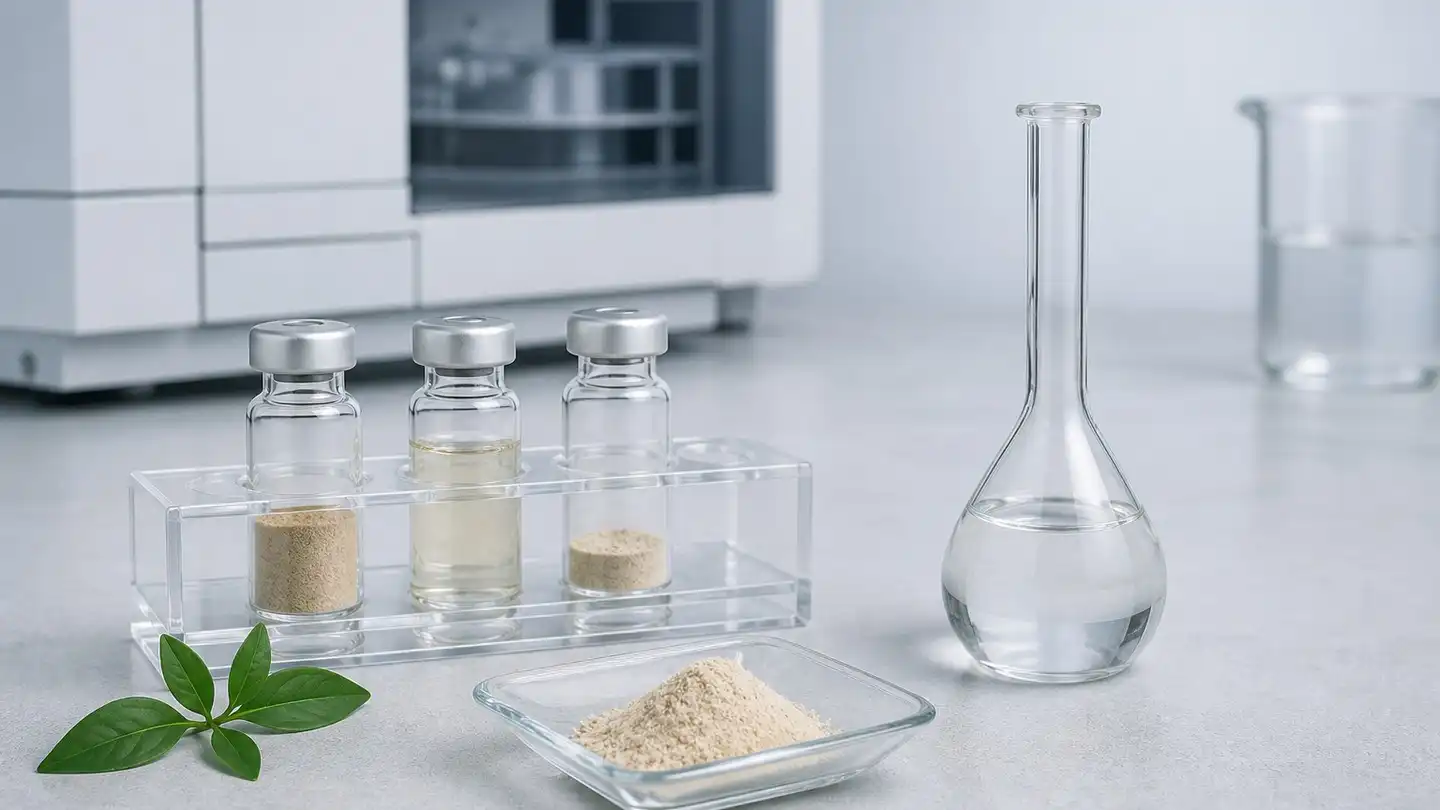
Release testing for a standardized botanical powder: identity, assay and contaminant panel on every lot.
This paperwork deserves the attention because the analytical purchase is the only part of the transaction a buyer can verify. Why standardized extract grades matter to ingredient buyers makes the same case for a comparable botanical: a defined marker, a named method and a batch record are what make two quotations comparable and a supplier switch survivable.
Sourcing, Supplier Qualification and Price Drivers
Supplier qualification checklist
Most raw material in this category originates in South Asia, and quality varies considerably between suppliers working from the same fields. A structured qualification process shortens the argument later:
- Identity and specification agreement — a signed specification naming botanical name, plant part, grade, assay method and carrier.
- Batch documentation — COA and HPLC data for the lot offered, plus three recent lots if you are committing to a supply programme.
- Quality-system evidence — the certificates the supplier holds for the site that produces your material, such as ISO 9001, ISO 22000, HACCP, Halal and Kosher where applicable.
- Change control — a written commitment to notify you before changing sourcing region, carrier, extraction route or grade.
- Commercial flexibility — custom specifications, private-label packing, OEM/ODM support and adjusted minimum order quantities.
What actually drives the price
Three variables explain most of the spread between quotations. The first is the bacoside grade: a higher assay figure costs more per kilogram, because more raw material is consumed per kilogram of finished powder. The second is certification status, where organic material carries a documented premium over conventional. The third is order volume and packaging configuration, which set the fixed cost per lot. Compare quotations on cost per active gram rather than cost per kilogram, and ask for tiered pricing at volumes you genuinely expect to buy: a low price on a 10:1 material is not a saving against a priced 50% assay material, it is a different purchase.
Building Bacopa Monniera Extract into Botanical Blends
Carrier systems and blend compatibility
In a dry blend the extract is one of several botanical powders plus a carrier or flow agent, so compatibility work is mostly physical and analytical: particle-size matching so the blend does not segregate, bulk-density checks before fill weights are fixed, and assay confirmation of the finished blend so that every declared strength traces back to a verified input rather than to the recipe. Where a liquid carrier is used instead, the extract's water solubility becomes the deciding factor, and the more sensible route is often to hold the botanical in the powder phase and use the oil only as the carrier. Specifications, carriers and quality standards for bulk MCT oil powder covers the carrier side of that decision.
Format considerations
- Capsules and tablets — free-flowing spray-dried powder is the usual choice; check bulk density and flow against your filling or compression equipment before fixing fill weight.
- Stick packs, sachets and beverages — water-soluble grades disperse and dissolve cleanly; confirm the blend does not cake during filling and that the extract stays in solution through processing and shelf life.
- Gummies and chewables — the extract's bitter note is the main formulation constraint, so flavour masking and the choice of water-soluble grade are the decisions that matter.
- Multi-botanical blends — where the recipe combines the extract with other standardized materials such as ashwagandha, ginkgo or gotu kola, write a separate assay line for each marker so every declared input is verifiable in the finished blend.
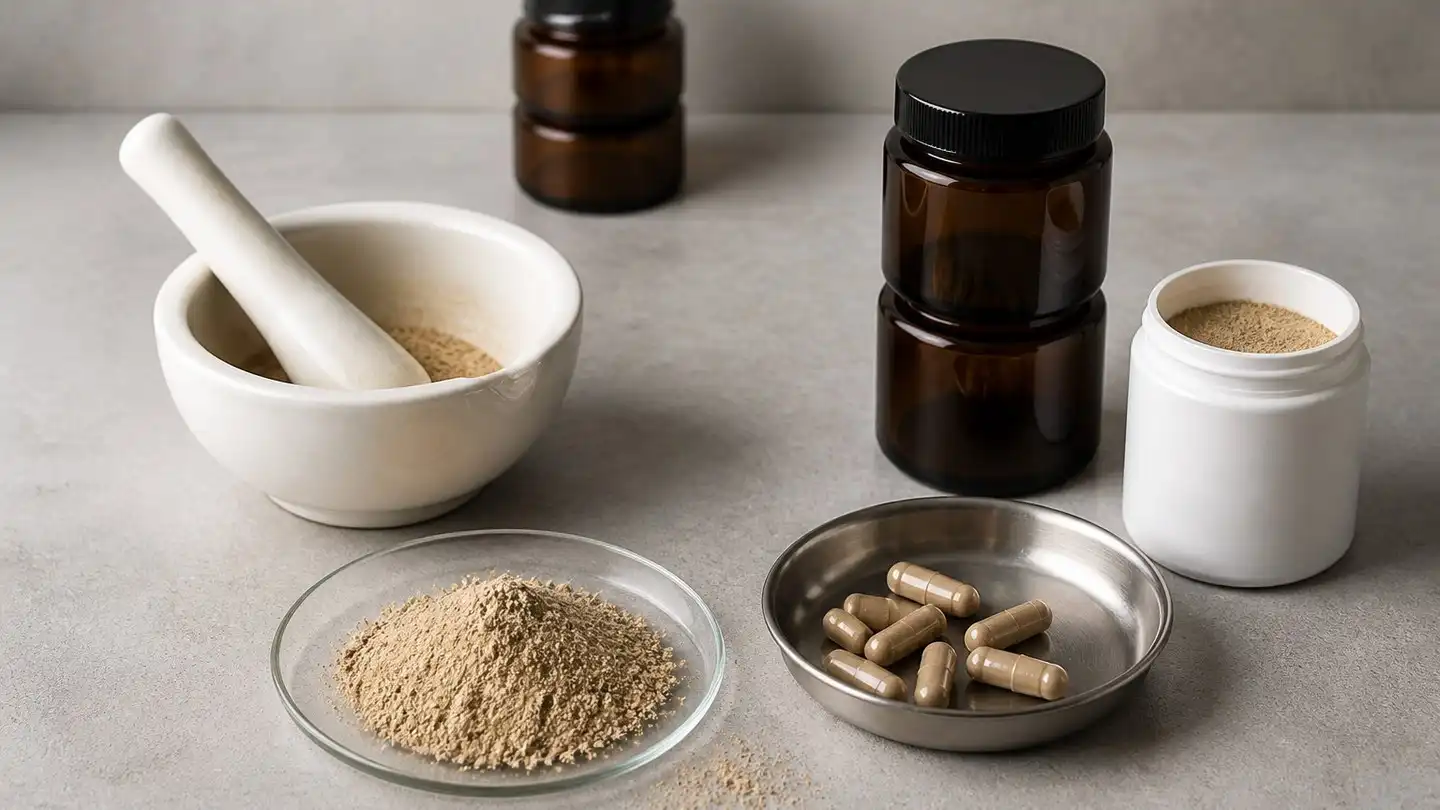
Blend and format work: carrier choice, fill weight and flavour follow from the powder's physical properties.
Packaging, Stability and Storage
Standardized Bacopa Monniera Extract is normally supplied with a two-year shelf life, non-GMO and non-irradiated, provided it is kept cool and dry away from strong light and heat. The powder is hygroscopic enough that packaging, rather than chemistry, usually protects the specification in transit: moisture uptake shows up as caking, a drop in flow and eventually assay drift, so the inner liner matters as much as the outer pack.
| Pack format | Typical net weight | When it is used |
|---|---|---|
| Poly-lined fibre drum with inner bag | 25 kg | Standard bulk shipment for production quantities |
| Bag-in-carton or small drum | 5–10 kg | Samples, trials and small-scale production runs |
| Foil-liner configuration | Agreed per order | Long transit or humid destinations where moisture control is critical |
| Private-label finished pack | Agreed per order | OEM/ODM programmes where the pack is part of the finished offer |
Net weights and liner specifications are agreed at order stage, and the storage conditions and retest interval on the certificate go into your warehouse instructions. If your finished product has a longer shelf life than the ingredient, run a short stability check on the blend rather than assuming that the ingredient's two-year window transfers to the pack.
Regulatory Positioning in the United States and the European Union
In the United States, an extract of this type is normally handled as a dietary supplement ingredient under DSHEA. The finished brand is responsible for any statement it makes about the product and for the substantiation file behind it, and the ingredient must be identified on the label by botanical name and plant part.
In the European Union, botanical ingredients are placed on the market as food or food supplements under the general food law framework, and health claims may only be used if they are authorised under the applicable claims regulation — which in practice means that most positionings around this ingredient family cannot be carried into EU consumer communication. The ingredient, the extract form and the specification also have to be checked against the EU Novel Food Catalogue and any national rules before a product goes on the market.
Neither regime is settled by the ingredient supplier on the buyer's behalf. What a supplier can do is keep the document trail in order: correct botanical identification, a specification that matches the material, and a batch certificate supporting the identity, strength and purity of what was shipped. Everything downstream is the buyer's regulatory work, in the destination market, with local advice.
Working with Wellgreen on Bacopa Monniera Extract Supply
Wellgreen produces standardized Bacopa Monniera Extract from the whole herb in two published grades — 20% and 50% bacopasides by HPLC — alongside a 10:1 ratio extract, food grade and water-soluble, with the site's quality certificates (ISO 9001, ISO 22000, HACCP, Halal and Kosher) documented on the product page and COA and HPLC data supplied per batch. Custom specifications, private-label packaging and OEM/ODM projects are supported, with minimum order quantities confirmed per enquiry.
If you are specifying this ingredient, send your target specification and let the documentation answer the rest: request the current specification sheet, a batch COA or a sample of Bacopa Monniera Extract, or write to wgt@allwellcn.com with your grade, volume and destination market.
Disclaimer: This article is written for B2B ingredient professionals — procurement, quality and formulation teams. It is not medical, nutritional or consumer advice, and nothing in it is a claim about any finished product or about the properties of any ingredient. Statements about regulatory frameworks are general descriptions only; confirm current requirements with your own regulatory team.
References
- Deepak, M., Sangli, G. K., Arun, P. C., & Amit, A. (2005). Quantitative determination of the major saponin mixture bacoside A in Bacopa monnieri by HPLC. Phytochemical Analysis, 16(1), 24–29.
- Dowell, A., Davidson, G., & Ghosh, D. (2015). Validation of quantitative HPLC method for bacosides in KeenMind. Evidence-Based Complementary and Alternative Medicine.
- Gohil, K. J., & Patel, J. A. (2010). A review on Bacopa monniera: current research and future prospects. International Journal of Green Pharmacy, 4(1), 1–9.
- Royal Botanic Gardens, Kew. Bacopa monnieri (L.) Wettst. Plants of the World Online. https://powo.science.kew.org/ (accessed October 2026).