
Tongkat Ali Extract Powder for Sports Nutrition and Functional Beverage Formulations
2026-10-19 15:50:45
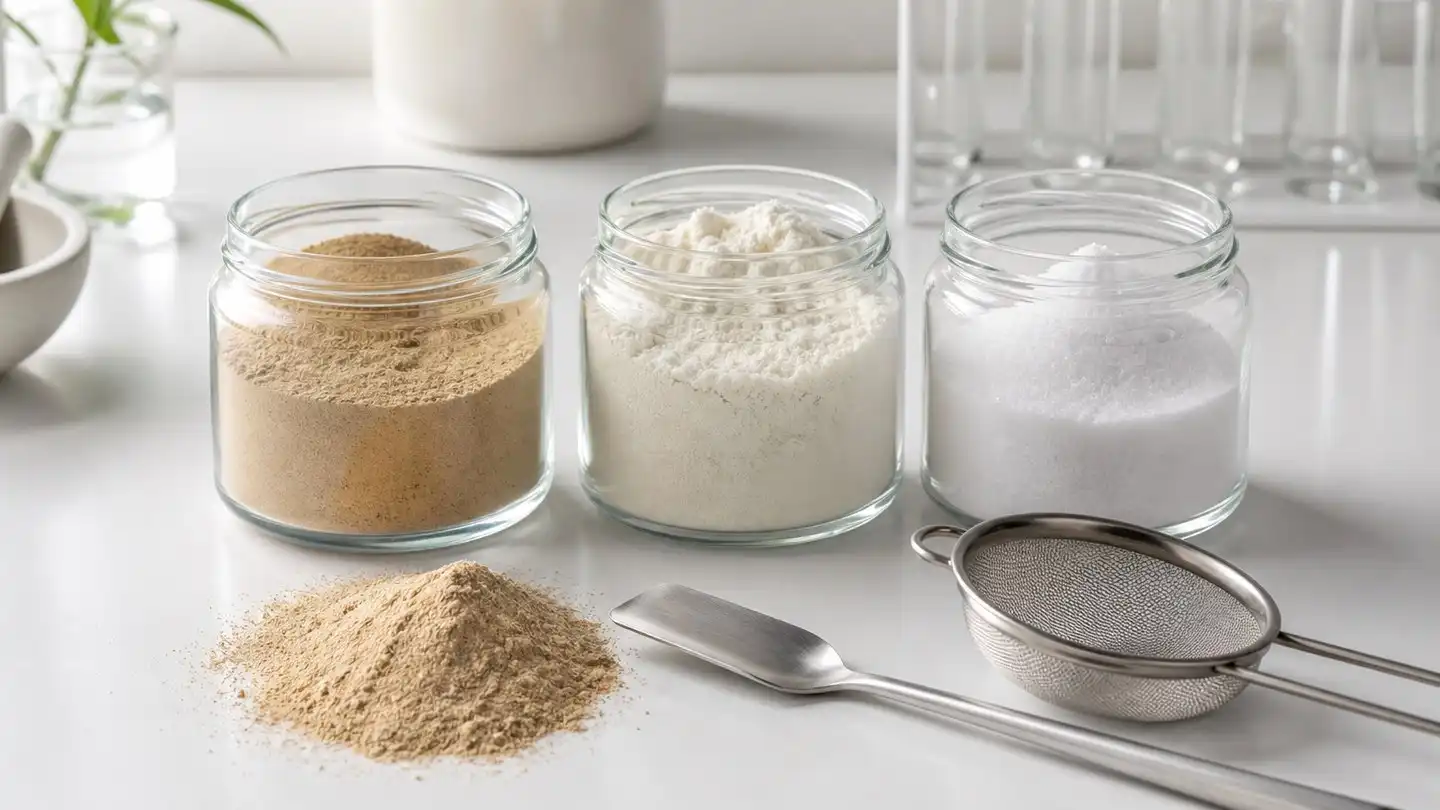
Choosing Tongkat Ali Extract Powder for a sports-nutrition brief is not the same task as choosing it for a single-active supplement. In a multi-active sports powder or ready-to-drink (RTD) formula the botanical shares the matrix with protein, creatine, amino acids, electrolytes, thickeners and sweeteners, and each of those neighbours changes how the extract behaves in the blend, in the shaker and on the shelf. The product page gives the physical starting point — a yellow-brown fine powder offered in 10:1, 20:1 and 200:1 grades, screened so that at least 95% passes 80 mesh, with a two-year shelf life — but the formulation work only begins there. This article is written for the developers, regulatory managers and procurement teams who already know the ingredient belongs in the category and now need to know what the rest of the formula does to it.
What a Multi-Active Sports Formula Asks of a Botanical
In a capsule or sachet brief the extract is usually the only active and the questions are mechanical: fill weight, flow, moisture. In a sports powder the extract is one input among many, and the questions change. Does it release or draw moisture when it sits beside a hygroscopic protein or a deliquescent electrolyte salt? Does its colour show through a clear electrolyte base and vanish into an opaque protein base? Does it sink and leave sediment in cold water, or wet out and disperse? Does the bitterness that comes with the extract's own chemistry survive a sweetener system that was tuned on water?
These are matrix questions, and they are answered by controlled bench work rather than by a supplier's datasheet alone. The sections below work through the four areas a developer has to close before a sports formula is fixed — stack compatibility, flavour-system interaction, dispersion, and process and stability — followed by the constraints that labelling and prohibited-substance rules place on the formula itself.
Stack Compatibility: Behaviour Alongside the Usual Actives and Excipients
Stack compatibility is the first thing that separates a text-book formula from a production one. Every commercial grade of the extract arrives with its own carrier, particle-size distribution and residual moisture, and the supplier-evaluation checklist covers the documents to request before any of that can be judged. What it cannot do is predict how the powder will behave in your specific blend, because that is a property of the mixture, not of the ingredient in isolation.
Hygroscopicity and Moisture Sharing
Water activity is the currency here. A protein isolate, a creatine monohydrate and several electrolyte salts will all compete for the same free moisture, and moisture will migrate to whichever component holds it most tightly. The extract's own moisture is specified on the product page as below 4.0%, but the number that matters in a blend is the equilibrium the mixture reaches after the powders have shared water for a week in the intended package. If the extract ends up as the wettest component it will cake; if it dries out too far it can become dusty and segregate. Neither outcome is visible on a certificate of analysis, so both have to be measured on the blend.
Caking, Flow and the Colour Contribution
A yellow-brown powder at a small mass fraction will tint a clear electrolyte drink, and the same powder will be invisible in an opaque protein base. That asymmetry matters commercially: the same extract can be used at the same inclusion in two SKUs and only one of them will need a colour decision. Flow is the second hidden cost. A powder that flows well alone can bridge in a hopper once it is mixed with a fine amino-acid fraction, because the blend's particle-size distribution — not the extract's — governs flow.
| Blend component | Interaction to test | Why it cannot be assumed |
|---|---|---|
| Protein isolate / concentrate | Moisture sharing, tinting, flavour carry-over | The protein film can both mask and hold the extract's own taste; opacity hides or reveals its colour differently per protein type |
| Creatine monohydrate | Moisture migration, blend uniformity | Its crystal size differs from the extract's screened fraction, so segregation risk changes with the ratio |
| Free amino acids | Flow, dusting, static | Fine crystalline fractions can bridge a hopper that flowed freely with the extract alone |
| Electrolyte salts | Deliquescence, clumping under humidity | Salts take up moisture at different relative humidities and can wet neighbouring particles |
| Thickeners and gums | Wetting rate, viscosity build, sediment | Gums raise viscosity before the extract has fully wetted, trapping dry pockets |
| High-intensity sweeteners | Bitterness masking power against this specific taste | Masking that works on one bitter note often fails on another; the sweetener's own aftertaste can compound it |
| Bulk sweeteners and carriers | Density match, compressibility, moisture | Matching bulk density is what keeps a multi-component powder from separating in transit |
| Acidulants and colourants | pH effects on taste, colour shift, interaction | Low pH shifts perceived bitterness and can move the extract's own colour |
Flavour-System Interaction: Bitterness, Astringency and the Masking Strategy
The extract tastes of what it is. Its bitterness and astringency track its own chemistry, and no sweetener removes them; a sweetener only shifts where they sit in the overall profile. In a clear electrolyte base the bitterness reads early and sharp, because there is little else in the mouth to compete with it. In a high-protein base the protein film coats the palate and changes the timing of the note, so a flavour that was approved in water may read differently once the same flavour is added into the protein matrix. That is why a flavour panel run in water is a starting point, not a validation.
The masking strategy that tends to hold up has three parts: a base flavour direction that already tolerates bitterness, a sweetener system selected for its aftertaste rather than its peak sweetness, and a texture decision — thin and clear, or creamy and opaque — taken before the flavour is locked. The beverage-formulation experience with botanical extracts is a useful reference point, because the same problem — a plant taste that is part of the ingredient's identity — has to be designed around rather than deleted.
Why a Flavour Approved in Water May Fail in the Protein Matrix
Three things change when water becomes a protein suspension. First, the protein binds volatile flavour compounds, so the top notes arrive weaker and later. Second, viscosity slows the release of aroma, flattening the peak. Third, the opacity removes the visual cue that tells a taster the drink is light. A flavour that relied on a bright top note in a clear liquid can therefore read muddy and over-sweet in a protein base at the same inclusion. The practical response is to test the flavour in both matrices from the first trial, not to approve it in water and apply a correction after the protein has been added.
Dispersion in Practice: Shaker, Beaker and Dry-Blend Line
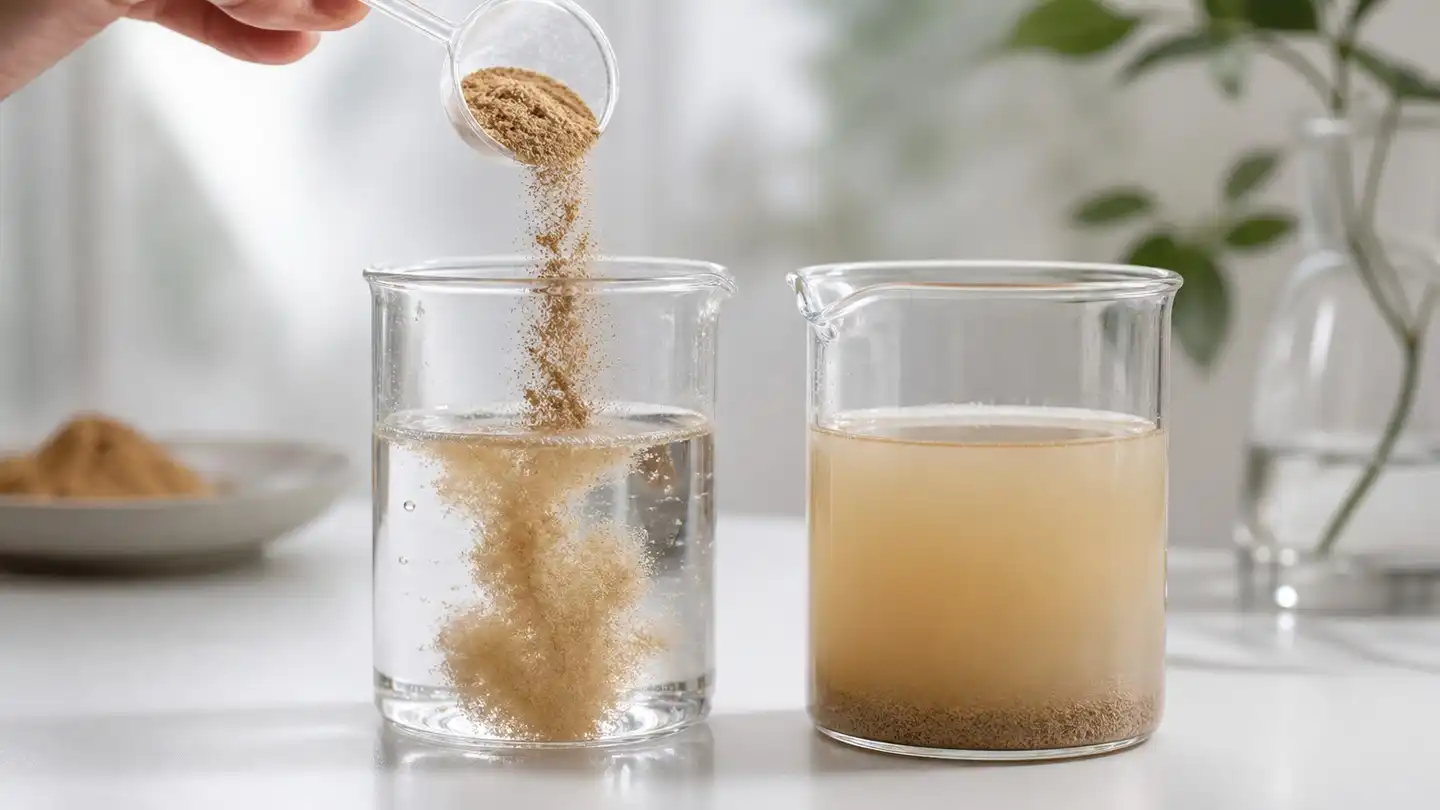
Dispersion is where bench formulations most often fail at scale. In a shaker, the consumer adds powder to cold water and shakes; in the plant, the same powder is metered into a dry blend and then either packed as a powder or dissolved into an RTD stream. Those are different physical processes. Cold-water dispersion depends on how quickly each particle wets and how much of the powder sinks before it does. The product page's screening specification — at least 95% through 80 mesh — is the number to align with the rest of the blend, because a mismatch against a coarser or finer fraction is what produces both segregation and slow wetting. Where a blend contains several poorly soluble actives, the approach taken for other low-solubility powders is a helpful comparison for how the blend as a whole is staged.
Particle Size and Density Matching Against Segregation
Segregation in a multi-component powder is driven by differences in particle size and bulk density, and the extract is only one of the fractions. The developer's job is to match the extract's distribution to the neighbouring fractions closely enough that vibration during filling and transport does not sort the blend into layers. This is also why the same extract can behave differently in two formulas: identical ingredient, different bed.
Reconstitution: Sediment and Foam
Once the powder is in water, two artefacts have to be managed. Sediment is the fraction that never fully wetted and settles; it usually points to a wetting-rate problem rather than a solubility one, and it is fixed by adjusting the blend or the dispersion step, not by changing the active. Foam is the other: a high-protein or gum-containing blend shaken hard in a bottle will foam, and the foam delays the point at which the consumer judges the drink mixed. Both are consumer-visible, so both belong in the acceptance criteria of the first pilot batch.
Process and Stability Constraints on a Sports Powder or RTD Line
The process imposes its own rules, and they are easier to satisfy if they are designed in rather than retro-fitted. Mixing order decides whether the extract is wetted against a dry neighbour or a sticky one. Shear affects gums and proteins far more than it affects the extract, but the extract's dispersion is downstream of the viscosity the shear created. Thermal steps — pasteurisation, hot-fill, or a spray step in an RTD line — are the ones a developer has to treat case by case, because a powder that is perfectly stable in a dry blend is being asked to do something different once it is suspended in a hot liquid. The beverage-formulation notes published on green tea extract show the same sequence of process questions applied to another botanical in a drink.
Mixing Order, Shear and Thermal Steps
A workable sequence usually blends the extract into the dry premix with its closest density match first, then adds the remaining powders, and only then moves to any wet step. That keeps the extract from being the last fine powder into a wet, viscous phase where it cannot wet. Shear and thermal exposure are then applied to a blend that is already uniform, which is the condition under which the process parameters actually mean something.
Moisture Pick-Up and Package Format
Every powder-handling step is a chance to pick up moisture, and the risk is greatest at the transfer points: from blender to hopper, hopper to filler, filler to package. The product page lists a two-year shelf life and typical packaging of 1–5 kg aluminium foil bags or 25 kg drums, with OEM options; the developer's task is to confirm that the chosen format holds the blend's moisture and flow within the specification for the intended market's shelf life, under the conditions the pack will actually see.
Formulation-Side Label and Prohibited-Substance Constraints
Two different forces shape the formula at the end of development, and it helps to keep them separate. The first is what must be declared: the extract's identity and grade, any carrier or processing aid that has to appear on the ingredient statement, and the way the finished product's own claim wording is written. The second is what must be absent: the formula is also constrained by rules about substances that may not be present in a product sold into sport, and the practical consequence is that the blend as a whole — not just the extract — becomes the unit that has to be assessed. The published framework is public: the FDA describes how dietary-supplement ingredients and labelling are regulated, EFSA sets out the novel-food route a botanical food ingredient takes in the EU, and the World Anti-Doping Agency publishes the prohibited list that governs competition. None of those documents tells a developer what to do; they define the boundaries the formula has to sit inside.
| Formula decision | Driven by what must be declared | Driven by what must be absent |
|---|---|---|
| Extract identity and grade in the blend | Ingredient-statement naming and the grade the label refers to | — |
| Carrier and processing aids | Any carrier or aid that must appear on the ingredient statement | Carriers that are not permitted in the target market |
| Flavouring and colour system | Declared flavouring and colour classes | Colourants or flavour sources not cleared for the market |
| Finished blend as a single unit | Serving description and the basis of the label | Whole-blend assessment against prohibited-substance rules |
| Claim wording on pack | Claims the formula's composition can actually support | Wording that would imply an outcome the product may not state |
| Batch and lot traceability | Records that let the pack be traced to inputs | Inputs that cannot be traced and therefore cannot be cleared |
| Packaging format | Net-content and storage statements | Formats that cannot hold the blend within specification |
Closing the Brief
A sports-nutrition brief is a system problem. The extract arrives as a defined powder, and everything that happens to it afterwards — what it sits beside, what masks it, how it wets, how the line treats it and what the label is allowed to say — is a decision the developer owns. Working through the compatibility matrix and the constraint table before the pilot batch is cheaper than discovering a segregation or masking problem after the pack is printed.
To discuss specifications, documentation and packaging formats for a sports-nutrition brief, contact the Wellgreen technical team at wgt@allwellcn.com or review the Tongkat Ali Extract Powder product page directly.
This article is an industry discussion of formulation engineering for sports-nutrition products and is not medical, health or marketing advice; brands remain responsible for their own claims, labelling and compliance review.
References
- Wellgreen. Tongkat Ali Extract Powder (product page: specification, certificate list, packaging and shelf life). https://www.wellgreenherb.com/standardized-extract/tongkat-ali-extract-powder
- Wellgreen. How to Choose Pure Tongkat Ali Extract Powder Products? https://www.wellgreenherb.com/knowledge/how-to-choose-pure-tongkat-ali-extract-powder-products
- Wellgreen. How to Make Tongkat Ali Extract? https://www.wellgreenherb.com/knowledge/how-to-make-tongkat-ali-extract
- Wellgreen. Formulating Functional Beverages with Hibiscus Extract Powder. https://www.wellgreenherb.com/knowledge/formulating-functional-beverages-with-hibiscus-extract-powder
- Wellgreen. Bulk Green Tea Extract for Beverage Formulation and Functional Ingredient Supply. https://www.wellgreenherb.com/knowledge/bulk-green-tea-extract-for-beverage-formulation-and-functional-ingredient-supply
- Wellgreen. How Can Quercetin Dihydrate Powder Solve Solubility Challenges in Powder Blends? https://www.wellgreenherb.com/knowledge/how-can-quercetin-dihydrate-powder-solve-solubility-challenges-in-powder-blends
- Wellgreen. Why Brands Choose Apple Cider Vinegar Powder in Capsules. https://www.wellgreenherb.com/knowledge/why-brands-choose-apple-cider-vinegar-powder-in-capsules
- U.S. Food and Drug Administration. Dietary Supplements (regulatory framework under DSHEA). https://www.fda.gov/food/dietary-supplements
- European Food Safety Authority. Novel food (topic page; Regulation (EU) 2015/2283 framework). https://www.efsa.europa.eu/en/topics/topic/novel-food
- World Anti-Doping Agency. The Prohibited List. https://www.wada-ama.org/en/prohibited-list