
Broccoli Seed Extract for Powder Blends and Specialty Food Formulas - Wellgreen
2026-11-27 14:00:00
A standardized extract behaves well in a capsule and badly in a blend. The capsule holds one material in a fixed volume; a blend puts a small quantity of an expensive powder next to salt, sugar, fibre, minerals and flavours, then moves the mixture through a mixer, a hopper and a filling line. Uniformity is not a property of the extract — it is a property of the blend, and it is decided by density, particle size and the order in which ingredients enter the mixer. This note covers those mechanics for broccoli seed extract.
Why a Blend Is Harder Than a Capsule
In a capsule the dose is small and the material is diluted only by the capsule shell. In a blend the extract may represent a fraction of a percent of the total mass, which means two problems appear at once: the analytical result depends on how well the small fraction is distributed, and the cost of a non-uniform batch is high because the expensive ingredient is the one that varies.
The chemistry of the marker matters here too. Glucoraphanin is stable relative to its conversion product, which is why standardized grades are usually declared on that basis, as described in this product overview of the glucoraphanin-standardized grade. Stability in the drum, however, does not ensure uniformity in the blend.
Density and Particle Size Decide Uniformity
How segregation happens
When a powder blend is poured, vibrated or fluidised, particles of different size and density move at different rates. Fine, light particles rise and coarse, dense particles sink; the effect is strongest when the size ratio between the smallest and largest particles is large and when the mixer discharges into a hopper that allows the blend to flow as a stream.
Matching the extract to its neighbours
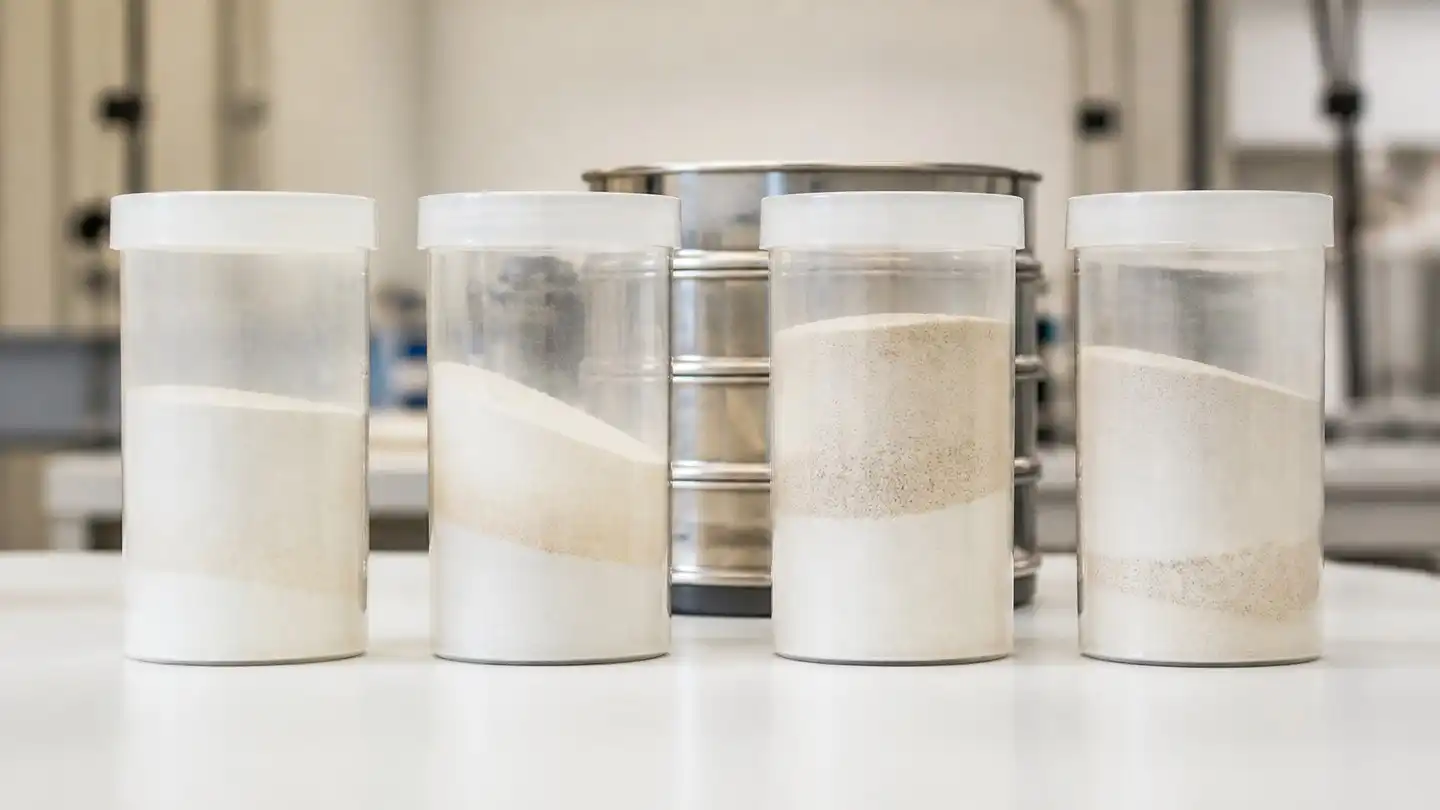
The practical control is to specify the extract's sieve cut close to the dominant particle size in the blend, rather than as fine as possible. A very fine extract disperses quickly but is also the first fraction to segregate or to dust out at the filling head. Where the blend is dominated by a coarse crystalline ingredient, a mid-range cut usually performs better than a micronised one.
Assay Arithmetic: Building the Premix
Most blends should not receive the extract directly. A two-stage approach — a concentrated premix of the extract with a portion of a carrier or of one bland co-ingredient, followed by dilution into the main blend — reduces the ratio problem and makes the arithmetic checkable at each step.
The arithmetic itself is simple but easy to get wrong: the declared marker content, the target dose per serving and the serving size determine the mass of extract per kilogram of finished blend. Carrying that through a premix means tracking the dilution factor twice, and the second step is where transcription errors appear. Writing the calculation into the batch record, rather than recomputing it each time, is the cheapest control available.
A second arithmetic trap is the serving size assumption. Where the finished product is dosed by scoop rather than by unit, the scoop volume is fixed while the blend density varies slightly between runs. A blend that is a little denser delivers more mass per scoop, and therefore more extract, without any change to the formula. Recording the tapped density of each batch and adjusting the scoop volume accordingly is a simple control that keeps the dose claim from drifting.
Carrier Choice and the Label
Where the extract is supplied on a carrier, the carrier is part of the blend whether or not it is wanted. Maltodextrin contributes bulk and dissolves; a mineral carrier contributes opacity and density; a fibre carrier contributes mouthfeel. Each choice changes the label, the taste and the flow behaviour.
Ask for the carrier proportion per lot rather than as a typical value, and check it against the declaration rules for the destination market. A carrier proportion that drifts by a few percent between lots is invisible analytically but changes both the dose of active and the ingredient list position.
Moisture, Water Activity and What Follows
Water activity in a finished blend is set by the wettest component, not by the average. A small quantity of a hygroscopic ingredient can raise the water activity of the whole mixture enough to soften a tablet, cake a powder or accelerate the degradation of a marker.
Two controls are worth building in. First, set a water activity limit for the blend rather than only for the incoming extract. Second, test the blend after mixing rather than assuming that the components behave independently, because sorption is a mixture property.
Stability in a Blend Compared With a Drum
An extract stored in a sealed drum has one environment. The same extract inside a blend has many: it is in contact with acidic, alkaline or hygroscopic particles, exposed to a larger surface area of air, and often packed in a sachet with a thin film.
Stability data generated on the extract alone therefore under-describes the blend. Ask whether the supplier has data in a food matrix, and where they do not, plan a short in-house study: three timepoints, the intended packaging, and the marker assayed alongside water activity. The result is specific to the formulation, which is exactly the point.
Sequencing the Addition
The order of addition matters more than the mixer speed. A common sequence that works: charge the coarse, dense components first, add the premix at the point where the mixer is already moving and the bulk is fluidised, then add any liquid or hygroscopic minor components last, followed by a short final blend without over-mixing.
Over-mixing is a real failure mode in blends containing ingredients of different density, because extended mixing time allows re-segregation once the mixture is fluidised. The rule of thumb is to blend to uniformity and then stop, with the time established by a homogeneity test rather than by habit.
Where a co-packer runs the blend, the buyer's specification should travel with the batch record rather than with the purchase order. Mixing time, addition sequence and sampling positions are process parameters, and a co-packer who receives only a formula will choose its own. Attaching the process parameters to the specification makes the difference between a blend that is reproducible and one that is merely correct on the first occasion.
Verifying Homogeneity
Where to sample
Sample from the mixer at three points (top, middle, bottom) and from the filled containers at the start, middle and end of the run. A blend that is uniform in the mixer and not in the containers has a discharge or hopper problem, not a mixing problem.
How many samples
Enough to see variation, which for a small batch usually means five to ten. Assay the marker in each, calculate the relative standard deviation, and compare it with the acceptance criterion agreed with the customer. A single composite sample cannot detect segregation by definition.
Blend Risks and Their Controls
| Risk | Mechanism | Control |
|---|---|---|
| Segregation in the hopper | Density and size difference during flow | Match cuts; minimise drop height; avoid long hopper residence |
| Dusting loss | Fines carried out at the filling head | Control the fines fraction; containment at filling |
| Non-uniform marker | Direct addition of a small quantity | Two-stage premix with documented dilution |
| Caking | Hygroscopic component raising water activity | Water activity limit for the blend; packaging specification |
| Marker loss in storage | Moisture, heat and contact with reactive particles | Matrix stability study; sachet film check |
| Label error | Carrier proportion drift | Carrier declared per lot and checked against the pack |
Choosing the Grade for the Blend
| Grade attribute | Effect on the blend | Ask for |
|---|---|---|
| Marker content | Sets the mass of extract per kilogram of blend | Value with method, as-is or dry basis |
| Carrier type | Changes flow, taste and the label | Named carrier with proportion per lot |
| Sieve cut | Controls segregation and dusting | Distribution, not a single mesh figure |
| Bulk density | Governs hopper flow and fill weight | Tapped and untapped values |
| Water activity | Sets the shelf-life ceiling for the blend | Value per lot, with the method |
| Microbiological profile | Release criterion for the finished format | Limits, methods and sampling plan |
Two grades can carry the same headline marker figure and behave differently in a blend for every other reason on this list. That is why a grade approved for a capsule should be re-approved before use in a powder blend, even when the supplier considers it the same product.
Specialty Food Formats
Where the blend is a food rather than a supplement, two constraints tighten. The ingredient must be declared in the food's own labelling framework, and the sensory contribution of the extract becomes visible: brassica-derived powders carry a sulphur note that is pleasant in a savoury matrix and unwelcome in a sweet one.
Dose is therefore set by taste as well as by the marker target, and the two often disagree. Running a small sensory panel alongside the assay, at three dose levels in the actual food base, resolves the conflict before the formula is locked. The physics of the carrier and the drying route influence that result, as described in this comparison of spray-dried and freeze-dried powders.
Buyers comparing grades for a blend should also compare the basis on which each grade is described, which is set out in this note on grades described by sulforaphane content, and the commercial landscape is summarised in this review of bulk suppliers for wellness businesses.
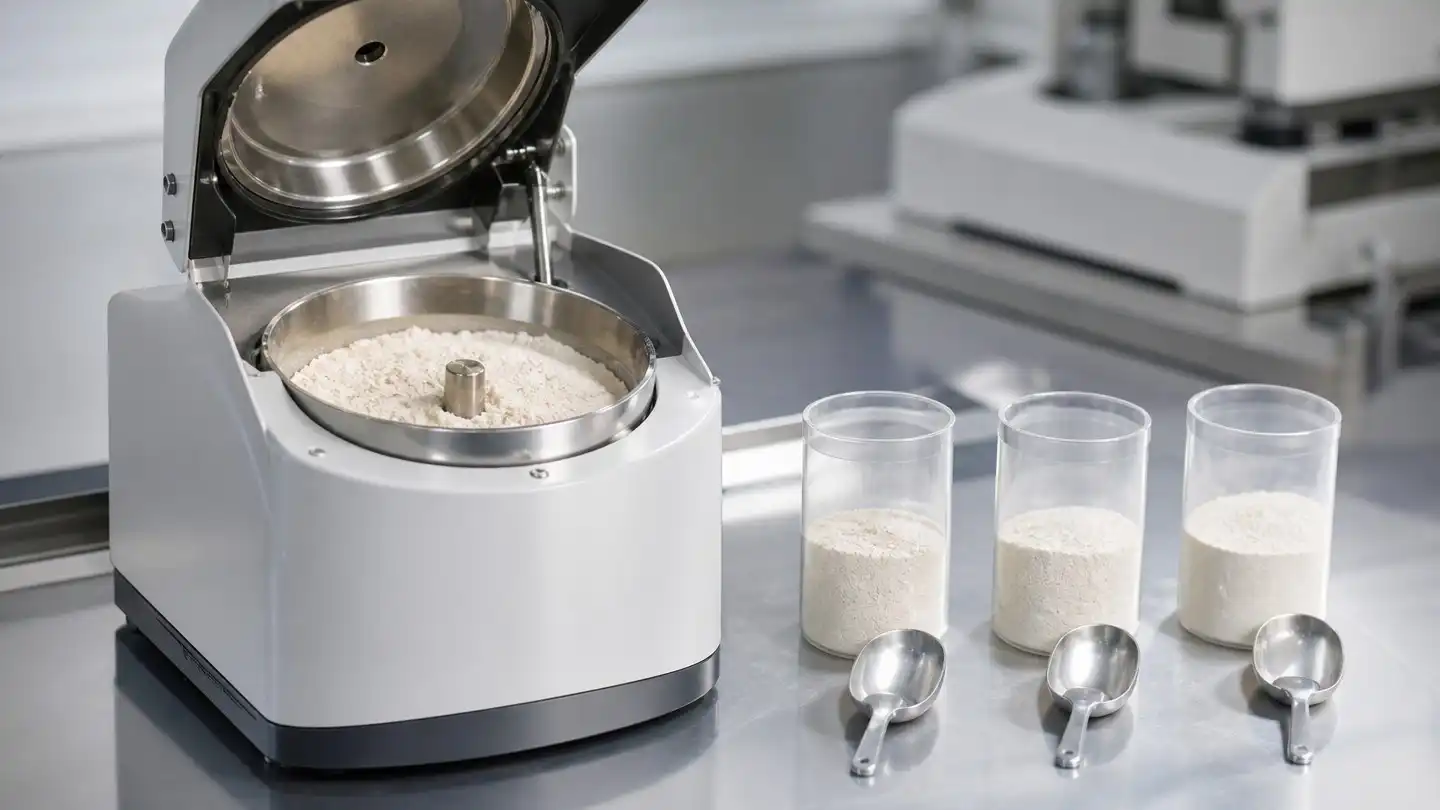
There is a commercial argument for doing this work early. A blend that fails a homogeneity test after launch is expensive to fix: the batch records, the validation and the customer notification all have to be repeated. The same test run once during development costs a day and a small quantity of extract, and it defines the particle cut and the premix ratio that the production team will use for years.
Conclusion
Uniformity in a blend comes from three decisions: a particle cut that matches the co-ingredients, a two-stage premix that makes the arithmetic checkable, and a homogeneity test that samples positions rather than a composite. The extract's specification sets the starting point, but the blend's engineering decides whether the label claim holds in the last sachet of the run.
If you are building a powder blend or a specialty food formula and need the extract matched to your particle size and carrier system, send the blend composition, the target marker per serving and the packaging format to wgt@allwellcn.com. The technical team can supply specification sheets with the assay basis stated, lot data, and samples at two sieve cuts for a homogeneity trial. The certification and quality framework behind the material is described on the quality and accreditation page.
References
- International Organization for Standardization. ISO 3310-1 — Test sieves: technical requirements and testing. 2016.
- U.S. Food and Drug Administration. 21 CFR Part 182 — Substances Generally Recognized as Safe. Current edition.
- U.S. Food and Drug Administration. 21 CFR Part 101 — Food Labeling; ingredient declaration. Current edition.
- Codex Alimentarius Commission. General Standard for Contaminants and Toxins in Food and Feed (CXS 193-1995, as amended). FAO/WHO.
- International Organization for Standardization. ISO 4833-1 — Microbiology of the food chain: colony count at 30 °C. 2013.
- United States Pharmacopeia. General Chapter <467> — Residual Solvents. USP-NF, current edition.
This article is intended for business-to-business ingredient sourcing and formulation discussion. It does not provide medical, nutritional, or regulatory advice for any specific product or market.