
Can Bacopa Monniera Extract Be Used in Functional Powder and Botanical Blends?
2026-10-20 14:38:12
Bacopa monniera extract arrives as a fine, water-soluble botanical powder, and the real question a formulator faces is not whether it can go into a dry blend — it can — but whether it still behaves like a powder once it is a small % w/w of a formulation that also contains a carrier, a fibre, a flavour system and two or three other botanical actives. Feasibility is a parameter-by-parameter question, not a yes or a no. Wellgreen supplies Bacopa monniera extract as a standardized, food-grade botanical ingredient, and the most useful thing we can give a customer is a framework for testing their own project.
This article sets out that framework: the physical, sensory, process and regulatory parameters that decide whether a proposed powder, stick pack, capsule or multi-botanical blend is buildable,. Every inclusion level below is a formulation variable — a % w/w the formulator sets — never a recommendation for a finished product.
What Makes a Botanical Extract Blendable?
A dry blend is less a mixture of powders than a temporary agreement between them. Each component brings its own particle size distribution, density, surface behaviour and moisture affinity, and the blend stays uniform only while those properties stay compatible and the handling steps stay gentle. Because a standardized extract is usually small in weight fraction and complex in surface chemistry, it is often the component that migrates first — into the corners of a hopper, onto the walls of a blender, or into one part of the batch as a dust fraction that no longer matches the rest. Feasibility therefore comes down to four questions: does it combine physically, does it survive the process, does it taste acceptable at the chosen load, and is it permitted in that market in that form.
| Formulation variable | What the formulator controls | Downstream decision it drives |
|---|---|---|
| Actives load | % w/w of extract in the blend | Taste ceiling, compression behaviour, flavour budget |
| Carrier and diluent | Type, gradation and ratio of filler | Flow, dispersion, bitterness masking, fill weight |
| Particle size target | Gradation of extract and carrier | Segregation risk, dusting, blend uniformity |
| Glidant / anticaking level | Addition rate and mixing order | Hopper flow, caking on storage |
| Flavour and sweetener system | Load and choice of mask | Label length, taste acceptance at finished dilution |
| Blend time and blender type | A window, not a minimum | Homogeneity acceptance, de-mixing risk |
| Moisture specification | Room RH, exposure time, pack barrier | Caking, shelf life, fill accuracy |
| Final format | Capsule, tablet, stick pack, drink | Which of the above becomes the binding constraint |
Physical Suitability: Particle Size, Density and Flow
Particle size distribution is the first gate
Ask for a distribution curve rather than a pass/fail sieve result. D10, D50 and D90 show how the extract sits next to the rest of the formula: a fine extract beside a coarse carrier sifts downward through the bed during handling, while an extract cut close to the carrier's own gradation stays where the blender put it. Premixing the extract with a portion of carrier before the main blend is the standard way to close a particle-size gap without changing the ingredient itself — the same constraint seen from the other direction in this look at the practical limits of a botanical powder blend.
Bulk and tapped density
Density sets volume, and volume sets everything downstream: how much the hopper holds, how consistently a volumetric dosator or stick-pack auger delivers, and whether a capsule reaches its target fill weight. Measure bulk and tapped density for the extract and for every other powder, then compare the spread. A wide spread between a dense mineral-type component and a light extract fraction is the classic precursor to segregation, and it usually appears first as fill-weight variation rather than as a failed batch assay.
Flow, dusting and segregation risk
Flow behaviour — angle of repose, flow index, or simply how the material runs through a funnel built to your hopper's geometry — decides whether the blend empties or bridges. Dusting is the other half of the problem: fine particles that become airborne at transfer are hard to contain, may settle unevenly, and call for closed transfer, local exhaust ventilation or a change of gradation. If the powder cannot be moved without a visible dust cloud, that is a process-design finding, not a quality complaint.
Hygroscopicity, Moisture Uptake and the Blending Room
Water-soluble botanical extracts readily pick up moisture, and moisture is the most common reason a blend that behaved in the laboratory fails on the line. Characterise uptake against relative humidity rather than against time: a sorption profile taken at the humidity your blending room actually runs at tells you whether the powder stays free-flowing through a shift or begins to cake on the blender walls. That drives three decisions — the humidity specification for the blending and packing rooms, the maximum exposure time before packing, and the moisture-barrier requirement of the finished pack,.
Loss on drying and water activity are the two routine measurements that keep this visible, and both belong on the finished blend rather than only on the incoming extract.
Compression Behaviour: Tablets and Capsules Versus Sticks and Drinks
Tablets and capsules
At a low % w/w the extract is a minor passenger in a direct-compression formula and behaves as a diluent with an unusual moisture profile. As the load rises it starts to govern the compaction behaviour of the whole blend, and if it is brittle, elastic or poorly flowing, the tablet will not reach its hardness target. The usual answers are a different binder system, roller compaction or dry granulation, or holding the load where the blend still compresses cleanly. For capsules the binding question is fill-weight consistency: a cohesive powder may not flow reliably through a dosator.
Stick packs and powder drinks
A stick pack or powder drink asks for something different. The dose is defined by volume, the powder must not bridge in the auger, and the consumer will see whether it disperses or leaves sediment. Solubility and wetting behaviour dominate, so a free-flowing, rapidly dispersing carrier does more for the format than any processing trick.
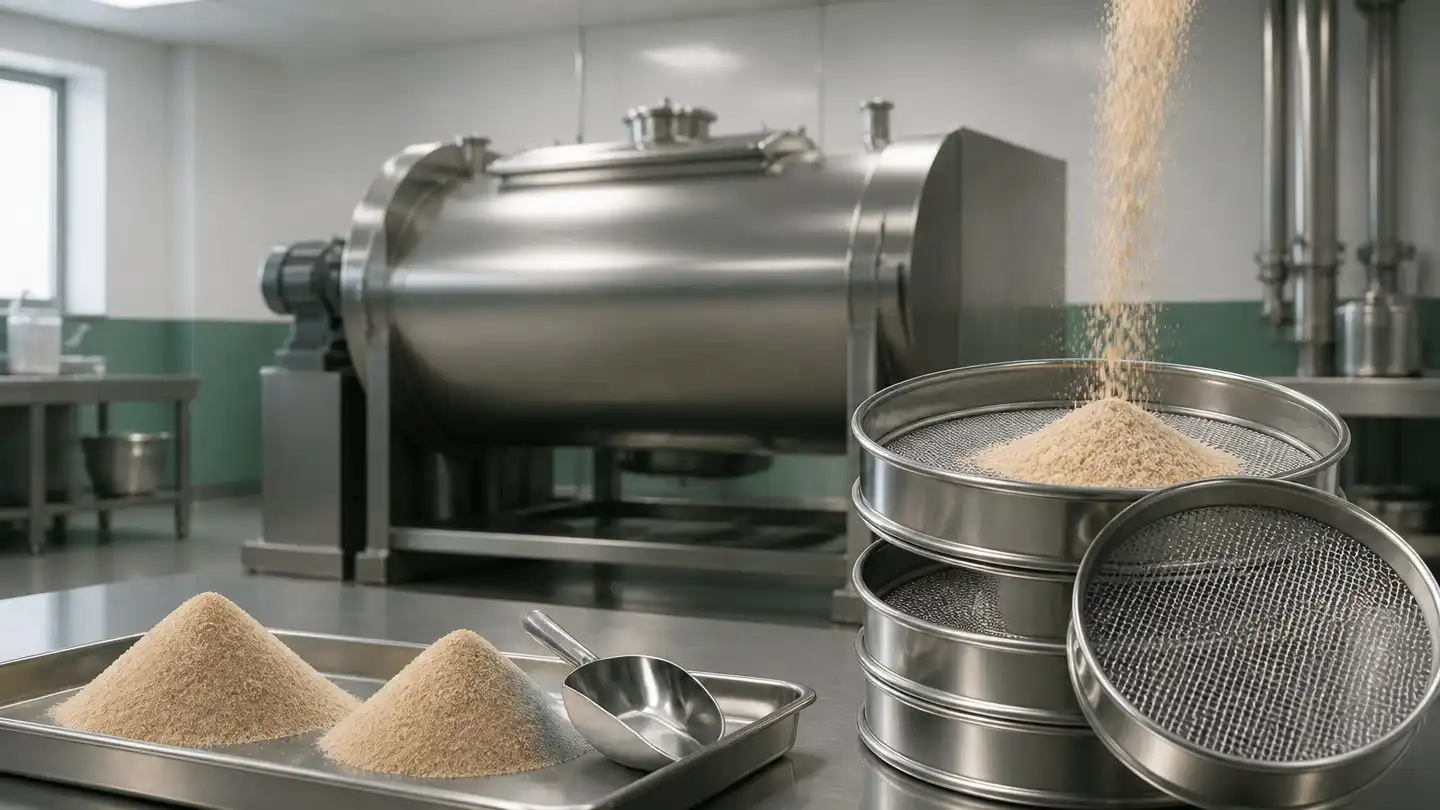
Sensory Load: Bitterness and the Carrier Decision
Bacosides are saponins, and saponins are bitter — a fact that constrains the flavour system more than any other property of the extract, because bitterness scales with the actives load: at the high end of the % w/w range it can dominate the taste profile and force a heavier sweetener and flavour load than the brand wanted on the label. Fix the actives load first, test the blend at its finished dilution with a small panel, and only then design the flavour system — testing the extract alone in water overstates the problem, because the carrier and the rest of the matrix buffer it.
The lever a formulator genuinely controls is the carrier and diluent system. A bland, fast-dissolving carrier dilutes the bitter fraction and carries the flavour; a granular or agglomerated carrier improves dispersion; a carrier chosen for its own mouthfeel hides part of the edge a simple filler cannot. Wellgreen's notes on powder specifications and carrier selection follow the same reasoning for a very different powder, and the questions are identical: what does the carrier contribute to flow, what does it do in the mouth, and how much of the extract can ride along before the flavour budget breaks.
Process Exposure: Heat, pH, Shear and Dwell Time
Every unit operation between the warehouse and the pack is an exposure. Dry blending contributes shear and, more importantly, dwell time — blending long enough to chase uniformity can just as easily de-mix a fragile blend. Extrusion and drying contribute heat and mechanical work, a beverage premix contributes pH, and pasteurisation or hot-fill contributes a thermal load the extract never met during its own manufacture. The formulator's task is to list those exposures in processing order and mark which ones need a stability check.
Two rules keep the list manageable. Test the assay on the finished blend after each significant exposure rather than on the isolated extract, because the matrix changes the outcome. And treat dwell time as a real variable: a blend held hot longer than intended is a different blend, as is a premix held at low pH before filling. Study designs of the kind used for botanical powder stability across supplement manufacturing translate directly, and stability frameworks such as ICH Q1A(R2) supply the protocol structure.
Compatibility in a Multi-Botanical Blend
Botanical blends fail at the interfaces between components, and four mismatches are worth testing explicitly. Hygroscopicity mismatch: if one partner takes up water faster than the rest it clumps and sets locally, and the blend will not recover by further mixing. Particle-size mismatch: a fine extract against a coarse partner segregates during handling, so the bulk analysis can be perfect while individual doses are not. Colour transfer: a dark extract can tint a light blend, which matters when appearance is part of the brand position. Assay interference: when several botanicals carry similar chemistry, the finished-blend method may not resolve the peak that matters, and specificity becomes a development task rather than a routine test.
None of these are reasons to abandon a multi-botanical concept. They are reasons to run a compatibility matrix on the exact combination, at the proposed % w/w rather than at equal parts, before committing to a formulation. Premixing, a carrier bridge and a graduated blend order resolve most of them.
Homogeneity and the Test Your Customer Should Specify
Blend uniformity converts everything above into an acceptance criterion, and it must be specified by the customer before the trial rather than argued about afterwards. A workable specification names the sampling method (thief or stratified in-process samples from defined positions), the number of samples, the acceptance criterion for variability across the blend, the blend time and blender settings at which that criterion must hold, and the separate finished-product uniformity check. Blend time is not "longer is better": most blends reach a minimum variability and then drift upward again as particles re-separate, so the validated time is a window, not a floor.
A processing and quality-control walkthrough such as this guide to botanical extract processing and quality control shows how much of that framework has to be fixed before the run instead of measured during it.
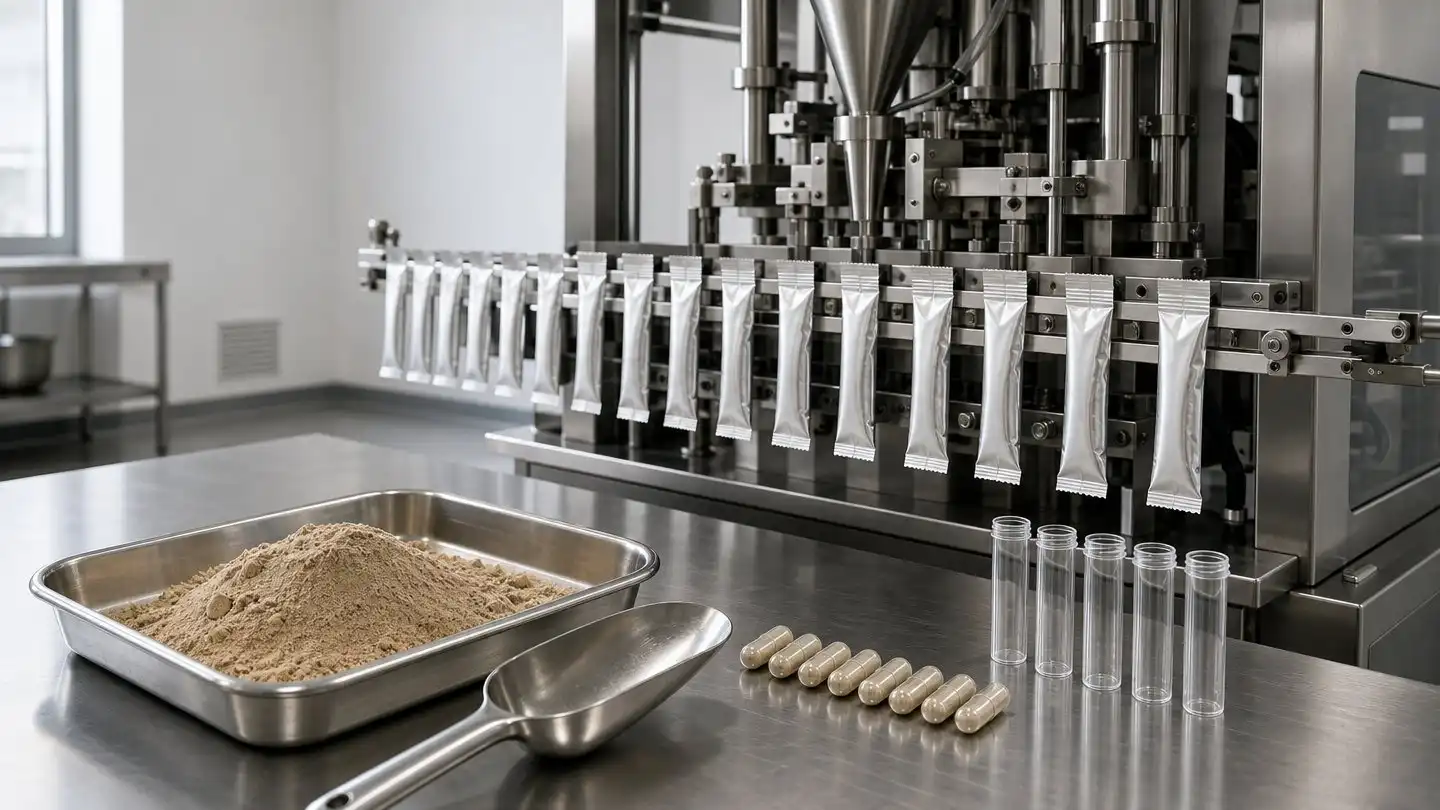
Regulatory Prerequisites to Confirm Before You Commit
Physical feasibility can be perfect and the project still unbuildable, so three regulatory items belong in the feasibility file as questions for the customer's own regulatory lead — not as assumptions made by either side. First, the permitted-use position of the specific extract form in the intended market and category: a standardized extract is not automatically treated like a traditional leaf preparation. Second, whether that extract form raises a novel-food or equivalent status question in the market concerned, which only the customer can settle. Third, labelling and claim language — what the market permits on the pack, and in what wording — together with any category-specific compositional limits.
Ask those three questions in writing at the start of the project. ISO 18664:2015 is a useful citation when the conversation turns to heavy-metal determinations on the incoming botanical, while the European Commission's Novel Food pages and Health Canada's Natural Health Products Ingredients Database are the kind of primary sources a regulatory lead will want to check for the markets they cover.
Go / No-Go: Turning the Framework Into a Decision Table
The framework collapses into one working document: for each parameter, what to test, what a pass looks like, and what a failure blocks. A formulator can adopt the table below directly, replacing each pass signal with their own project limits. A project that clears every row is buildable; a project that fails one has to change a variable
| Parameter | What to test | Pass signal | What a failure blocks |
|---|---|---|---|
| Particle size match | PSD curve of extract against every other powder at the proposed ratios | Curves stay close enough that the blend remains uniform after normal handling | Uniformity claim; forces premix, regradation or granulation |
| Bulk / tapped density | Density of each component and of the finished blend | Spread narrow enough for the chosen dosing principle | Volumetric dosing; may force weight-based dosing |
| Flow | Angle of repose or flow index in the actual hopper geometry | Blend empties without bridging or rat-holing | Line throughput; needs glidant or regradation |
| Dusting | Fines generated at transfer and handling | Dust stays inside the closed system | Open handling; forces closed transfer or LEV |
| Moisture uptake | Sorption profile at the room's real relative humidity | Powder stays free-flowing within the water-activity target | Shelf life and fill accuracy; needs dehumidification or barrier pack |
| Storage stability | Loss on drying, appearance and actives assay on the blended matrix over the target life | No caking; assay inside the customer's limits | Declared shelf life; forces pack change or reformulation |
| Compression | Compactability and hardness at the proposed load | Target hardness reached at the required load | Tablet format; needs binder change or granulation |
| Fill accuracy | Fill-weight variability on the capsule or stick line | Variation inside the customer's limit | Capsule or stick format as specified |
| Taste | Panel test at the finished dilution | Bitterness masked to the panel's acceptance at the chosen load | Format acceptance; forces lower load or a new carrier and flavour system |
| Process exposure | Actives assay after each heat, pH and shear step | Retention inside the process tolerance | Sequence as designed; forces re-sequencing or shorter dwell |
| Component compatibility | Finished-blend assay specificity, colour and moisture in the full matrix | Method resolves the target peak; blend appearance within spec | Analytical release test; may rule out one partner ingredient |
| Blend uniformity | Thief or stratified sampling across the validated blend window | Variability inside the customer's acceptance criterion | Batch release under the intended specification |
| Regulatory position | Permitted use, novel-food status and labelling for the extract form in the target market | Written confirmation from the customer's regulatory lead | The market, the category, or the choice of extract form |
Building the Feasibility File With Wellgreen
Most feasibility questions are answered with data that sits on the supplier's side of the table: the extract's particle size distribution, bulk and tapped density, moisture behaviour, solubility and assay method, plus documentation for the format you intend to run. Wellgreen supplies Bacopa monniera extract as a standardized, food-grade botanical ingredient with documentation available on request; our quality system is certified to ISO 9001:2015 and ISO 22000, with HACCP, Halal and Kosher certification for the relevant product lines.
To begin, review the Bacopa monniera extract specification or email wgt@allwellcn.com to request a sample, a COA, or a formulation data pack for your project. Send us the intended format and the proposed % w/w, and we can shorten the loop considerably.
Disclaimer: this article is written for ingredient sourcing, formulation and technical professionals. It addresses formulation feasibility and material behaviour only; it is not consumer or medical advice, and it makes no recommendation about the intake or use of any finished product.
References
- European Commission, Directorate-General for Health and Food Safety. Novel Food (Regulation (EU) 2015/2283 framework). https://food.ec.europa.eu/food-safety/novel-food_en
- Electronic Code of Federal Regulations. 21 CFR Part 111 — Current Good Manufacturing Practice in Manufacturing, Packaging, Labeling, or Holding Operations for Dietary Supplements. https://www.ecfr.gov/current/title-21/chapter-I/subchapter-B/part-111
- International Council for Harmonisation. ICH Q1A(R2) — Stability Testing of New Drug Substances and Products. https://database.ich.org/sites/default/files/Q1A%28R2%29%20Guideline.pdf
- International Council for Harmonisation. ICH Q2(R2) — Validation of Analytical Procedures. https://database.ich.org/sites/default/files/ICH_Q2(R2)_Guideline_2023_1130.pdf
- International Organization for Standardization. ISO 18664:2015 — Traditional Chinese Medicine: Determination of heavy metals in herbal medicines used in Traditional Chinese Medicine. https://www.iso.org/standard/63150.html
- Health Canada. Natural Health Products Ingredients Database — Organism: Bacopa monnieri. https://webprod.hc-sc.gc.ca/nhpid-bdipsn/orgReq?id=94