
Peppermint Extract Powder for Candy: Flavor Retention and Dosage
2026-10-23 10:13:47
Mint is one of the most expensive notes a confectionery line can lose without noticing. It leaves as vapour, not as a visible defect, so a batch can pass every physical check and still taste flat three weeks after packing. Formulators who work with peppermint extract powder learn quickly that the flavour problem is not a sourcing problem first — it is a heat and mass-transfer problem. This article looks at how mint behaves inside hard candy, gummy and tablet matrices, and how to set a use level you can defend to QA rather than one copied from a supplier email.
Why the Mint Note Disappears From a Finished Candy
Peppermint aroma is a mixture of small, volatile terpenes and related compounds carried in a sugar or gel glass. Once that glass is hot, the aroma has three escape routes, and each one needs a different countermeasure. Losing track of which route dominates is the usual reason a reformulation fails twice in a row.
Route one: evaporation during cooking
Volatility rises steeply with temperature. In a hard candy cook the sugar mass spends time well above the boiling point of water, and any aroma present at that stage is stripped out with the steam. The loss accelerates as the surface-to-volume ratio increases, so a thin film on a hot pan loses far more than a deep batch.
Route two: oxidation after the cook
Terpenes react with oxygen, and the reaction is faster in the presence of light, trace metals and residual heat. The sensory signature is a shift from fresh, green mint toward a dull, slightly woody or "cardboard" note. This is a quality drift rather than a loss of intensity, and it is the failure mode most often blamed on the raw material when the real cause is headspace oxygen in the pack.
Route three: migration and partitioning
Aroma compounds move toward whichever phase dissolves them better. In a multi-phase system — a syrup centre inside a shell, a fat-based coating over a gel, a powder blended into a sticky mass — mint can migrate across the interface over weeks. The centre may gain intensity while the outer layer fades, or the reverse. Migration also explains why flavour that seems correct on day one reads as uneven when a consumer eats through the piece.
The Processing Window Differs by Candy Matrix
There is no single addition temperature for mint, because the three main candy families impose different constraints. The table below is a starting framework to be confirmed on your own equipment, not a fixed recipe.
| Candy matrix | Typical processing temperature | Point of flavour addition | Dominant loss mechanism | What to verify first |
|---|---|---|---|---|
| Hard candy / boiled sweet | Syrup cooked to a high boil; mass then cooled before forming | After the cook, into the cooling mass under low shear | Evaporation during cook, then oxidation in the pack | Mass temperature at addition and total minutes above that temperature |
| Gummy / gel / soft chew | Gelatin or pectin hydrated and held warm, then cooled to set | After hydrocolloid hydration, during cooling | Heat degradation plus moisture-driven migration | Water activity of the finished piece and set time |
| Tablet / compressed candy | Dry blending and compaction at ambient temperature | Dry blend stage, before compression | Segregation and uneven distribution | Blend uniformity and particle size match with the base |
Hard candy tolerates the least abuse. The window between "cool enough to hold the aroma" and "still plastic enough to form" is narrow, and it closes faster on a continuous line than in a pilot kettle. Gummies are more forgiving on temperature but less forgiving on water: a soft body keeps mobilising aroma for the whole shelf life. Tablets avoid heat entirely, yet a coarse or poorly matched powder will segregate in the blender and give one tablet in ten a pronounced mint hit.
Choosing the Ingredient Form: Extract Powder, Oil or Encapsulate
Buyers often compare these three forms on price per kilogram, which is the wrong denominator. The useful comparison is cost per unit of delivered aroma at the point of consumption, after process losses. That number is rarely on a quotation.
| Form | Dispersion behaviour | Thermal stability | Cost structure | Typical use |
|---|---|---|---|---|
| Peppermint extract powder (carrier-based) | Free-flowing, disperses in dry blends and in water; a water-soluble grade wets out instantly | Moderate; carrier protects until it dissolves or is sheared | Carrier and drying cost included in the price; dose is by weight of powder | Hard candy, dry blends, tablets, instant applications |
| Peppermint essential oil | Insoluble in water, needs a diluent or emulsifier; tends to bead on a sugar surface | Low; the whole aroma load is exposed at the interface | Lowest price per kilogram, highest handling and dosing risk | Fat-based systems, coatings, applications with an emulsification step |
| Encapsulated / spray-dried powder | Free-flowing; behaviour depends on wall material and particle size | Higher; the wall delays release until moisture or chewing breaks it | Highest per kilogram; justified where shelf life is the constraint | Long shelf life, high-heat or high-humidity distribution |
The trade-off is real and worth stating plainly. A carrier-based extract powder gives you handling simplicity and a predictable weight-based dose, but part of what you ship is carrier, so the aroma load per kilogram is lower than an oil. An encapsulate buys retention time and pays for it in cost and in a delayed flavour release that some consumers read as weak on the first bite. Oil is the most concentrated option and the least tolerant of a process that was not designed around it. For more on how these forms behave across food categories, see this review of peppermint extract powder applications in the food and beverage industry.
What "Dosage" Actually Means in a Candy Formula
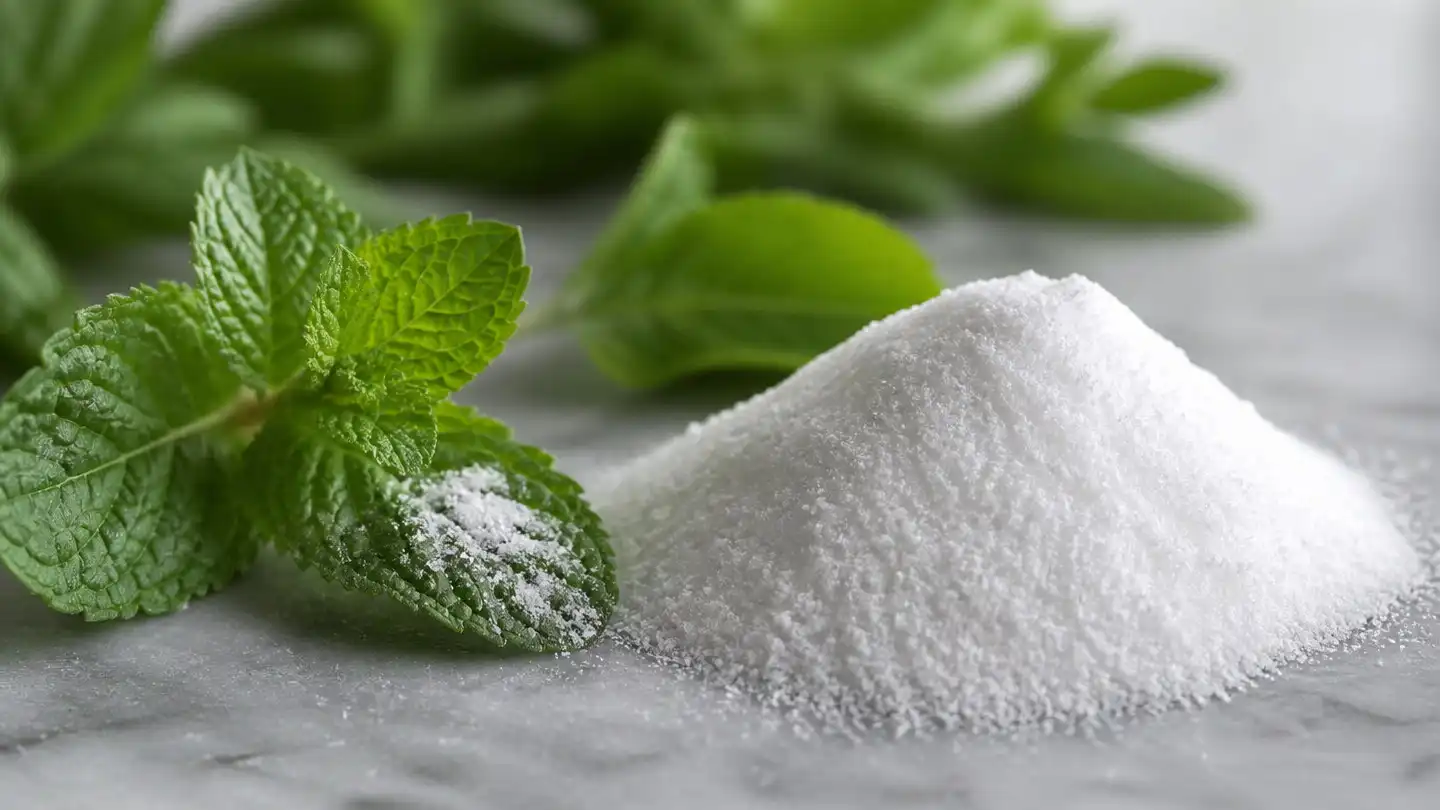
In confectionery, dose is expressed as a percentage of finished candy mass, not as anything else. A practical starting band is 0.05–0.3% of the candy mass, with the lower end for tablets and thin coatings and the upper end for a chewy body that will lose aroma during an extended set. Every point in that band has to be validated in your own matrix, because the same powder at the same percentage behaves differently at different water activities.
Two mechanical details matter more than the headline number. First, weigh the powder into a pre-blended minor-component pack rather than dusting it into a large mass; dosing error scales with batch size. Second, match the powder to the continuous phase. A water-soluble grade disperses cleanly in an aqueous syrup or a gel, but in a fat-continuous coating it may clump unless the carrier is compatible with the fat system. Particle size matters here too: a powder that passes 80 mesh uniformly will blend and distribute more evenly than a fraction with a wide size spread.
Setting the ceiling with a triangle test, not a supplier sheet
Supplier recommendations describe an average application. Your ceiling is a sensory question. Run a triangle test with three samples per assessor — two identical, one different — and increase the dose stepwise until a trained panel can reliably pick the odd sample against the target reference. That threshold is your practical ceiling: above it, additional powder is detectable as a harsh cooling spike rather than as more mint, and it starts to mask the sweet, acid and dairy notes that carry the confection's identity.
Run the same test downward to find the floor at which the mint note stops being identifiable after the intended shelf life, not fresh off the line. The gap between floor and ceiling is your operating window. If the gap is narrow, the answer is usually a process change or an encapsulated grade, not a higher dose.
Process Control Points That Protect the Flavour
Most retention gains come from five controllable points, and all five are cheaper than adding more aroma.
- Addition point. Introduce the powder as late as the process allows, into a mass that is still workable. Earlier addition means more residence time at temperature.
- Residence time. Measure minutes above the addition temperature, not just the peak temperature. A line that holds a mass warm for an extra four minutes can lose more than one that cooks hotter for less time.
- Vacuum cooking. Cooking under vacuum lowers the boiling point, so the mass reaches its final solids at a lower temperature. That single change reduces evaporative loss more than most formulation tweaks.
- Cooling rate. Fast, controlled cooling shortens the window in which the mass is both hot and mobile. Uneven cooling creates local hot spots that keep losing aroma after the bulk has set.
- Packaging barrier. Aroma escapes through the film and oxygen enters through it. A metallised or high-barrier structure with low headspace protects both the intensity and the fresh character of the note.
It is worth recording these as line parameters rather than as operator habits. When a mint candy drifts, the first question should be which of the five changed, and the answer is only available if the values were written down. For background on the powder itself, including how it is produced and specified, this guide to peppermint extract powder covers the manufacturing route in more detail.
Quality and Compliance: What to Read on the COA
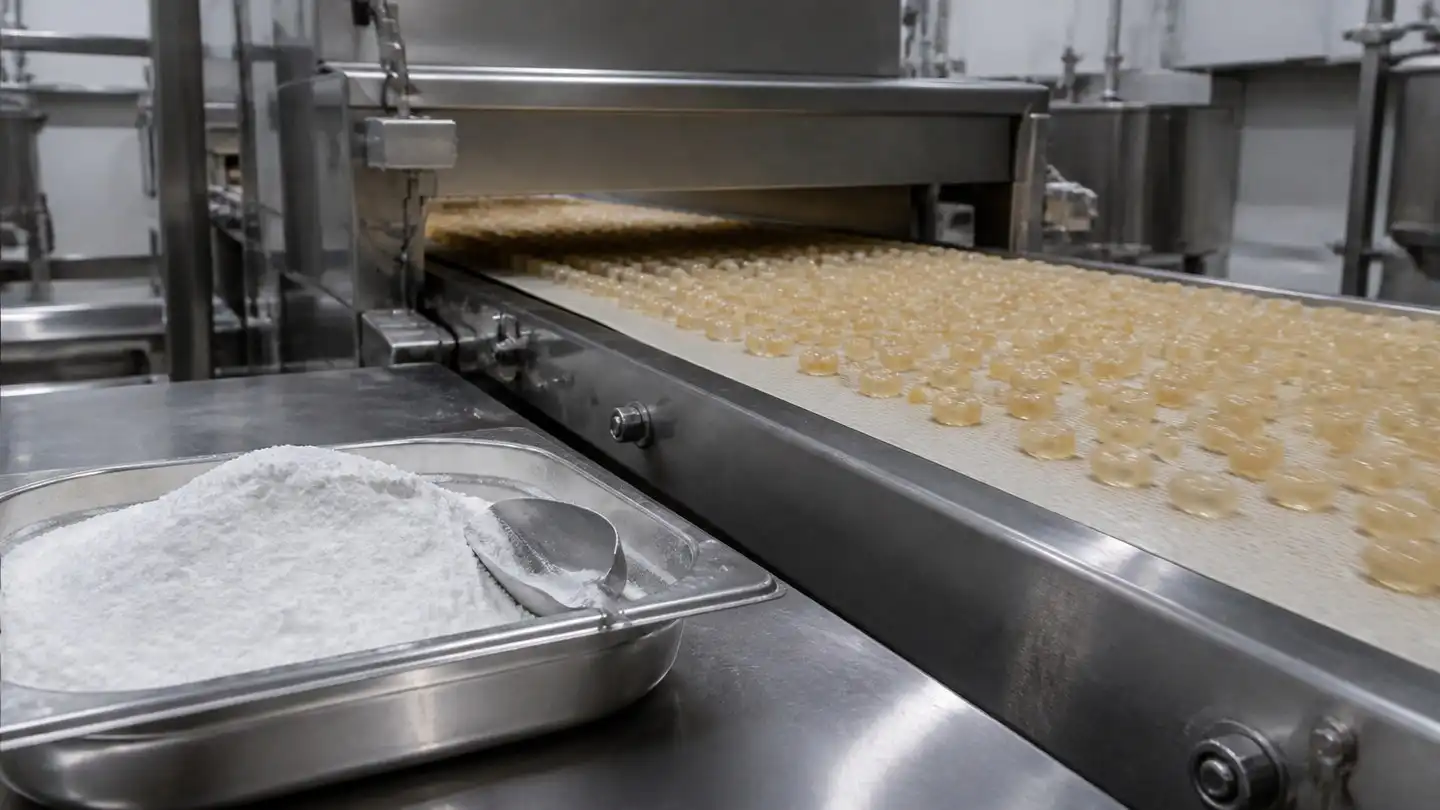
A certificate of analysis is only useful if it lists the attributes that actually predict performance in your process. For a confectionery-grade peppermint powder, the short list is appearance, the volatile oil or menthol-related declaration the supplier commits to, moisture, particle size, microbiology and heavy metals. Appearance should read as a brown yellow powder for the standard grade; a colour shift between lots is an early warning of carrier or drying differences.
| COA item | Why it matters in candy | What to ask for |
|---|---|---|
| Appearance / colour | Signals carrier and drying consistency between lots | Descriptive specification plus a retained sample per lot |
| Volatile oil or menthol-related declaration | Drives flavour intensity per kilogram of powder | The method used and the specification range, stated on every lot |
| Moisture | Affects caking, dispersion and water activity of the candy | A defined limit with the test method |
| Particle size | Controls blend uniformity and mouthfeel | 100% pass 80 mesh, verified by sieve |
| Microbiology | Required for any ready-to-eat confectionery | Total plate count, yeasts and moulds, specified pathogens |
| Heavy metals | Botanical raw materials carry soil-derived risk | Lead, arsenic, cadmium, mercury against your market limits |
Two compliance points regularly trip up procurement teams. The first is grade: food-grade and feed-grade peppermint material are not interchangeable, and a feed-grade COA cannot be accepted for a confectionery line no matter how similar the assay looks. The second is labelling. Peppermint is a botanically derived flavouring, and how it must be declared — as a natural flavouring, as an extract, or with a specific source wording — depends on the target market and on the carrier used. Confirm the declaration with your regulatory team before artwork is approved, because a label change after printing is the most expensive correction in the project.
Batch-to-Batch Consistency and Requalification
Consistency is not the absence of variation; it is variation you have measured and bounded. The workable approach is a two-layer lock. The first layer is documentary: a specification range for the aroma-bearing attribute, a retained sample from every lot, and a COA that states the method rather than only a result. The second layer is sensory: a small internal reference panel tasting a standardised dispersion against a frozen reference sample at each receipt.
When you change lots, do not simply swap bags. Run a shortened version of your original validation — one pilot batch at the qualified dose, held for a defined period, compared against the retained reference from the previous lot. If the pilot batch reads correctly at the same dose, the lot is released. If it needs a dose change to match, that is a formulation event, not a purchasing event, and it should be documented as such.
Common Procurement Mistakes
- Comparing price per kilogram across forms. A carrier-based powder and an essential oil are not equivalent units. Compare cost per unit of delivered aroma after accounting for process loss.
- Assuming a 1:1 swap with oil. A powder carries a diluent, so an equal weight delivers less aroma. Recalculate the dose from the declared specification rather than from habit.
- Buying one grade for every matrix. A grade that disperses instantly in water may be the wrong choice for a fat-continuous coating. Match the grade to the continuous phase.
- Accepting a COA without a method. A number without a test method cannot be reproduced or challenged. Ask which method produced each result.
- Validating only on the bench. Bench dispersions hide shear, residence time and cooling effects. Qualify the dose on the line that will actually run it.
The distinction between a leaf powder and a true extract is also worth settling early, since the two are frequently quoted against each other; this comparison of peppermint extract powder versus peppermint leaf powder sets out where each belongs.
Working With a Supplier on a Candy Programme
The specification you receive should answer three questions before you book a trial: what is declared on the COA and by which method, what particle size and solubility grade you are being offered, and what documentation can be released for your market. Wellgreen supplies a standardized peppermint powder as a brown yellow powder, water-soluble grade at 100% instant, 100% passing 80 mesh, with a two-year shelf life, packed in 1–5 kg aluminium foil bags or 25 kg drums and available for OEM formats. Certificates listed for the product include ISO 9001:2015, ISO 22000, Halal, Kosher and HACCP.
For a formulation discussion, request the specification sheet, a COA for the lot you would receive, and a sample sized for a pilot batch, so the dose can be validated in your own matrix before a purchase order is raised. Write to wgt@allwellcn.com with your candy type, process temperatures and target shelf life, and we can review compatibility against the grade you need.
References
U.S. Food and Drug Administration. 21 CFR Part 182 — Substances Generally Recognized as Safe. 2024.
U.S. Food and Drug Administration. 21 CFR Part 184 — Direct Food Substances Affirmed as Generally Recognized as Safe. 2024.
United States Pharmacopeial Convention. USP–NF Monograph: Peppermint Oil. 2024.
European Directorate for the Quality of Medicines. European Pharmacopoeia Monograph: Peppermint Oil. 2024.
International Organization for Standardization. ISO 6571 — Spices, condiments and herbs: Determination of volatile oil content. 2008.
International Organization for Standardization. ISO 4833-1 — Microbiology of the food chain: Horizontal method for the enumeration of microorganisms. 2013.
This article is intended for business-to-business ingredient sourcing and formulation discussion. It does not provide medical, nutritional, or regulatory advice for any specific product or market.