
Ube Purple Yam Powder for Bakery Products, Lattes, Ice Cream, and Confectionery
2026-09-29 14:00:01
Ube purple yam powder is a starch-bearing tuber powder whose colour comes from anthocyanins, and that combination is why it behaves differently in every matrix it enters. A dough, a milk-based latte, a frozen dessert and a pectin gel each impose a different water activity, pH, heat load and oxygen exposure on the same pigment system. This guide works format by format through the four application families in the title: what the powder does to hydration, hue, body and phase behaviour in each, which unit operation carries the most colour risk, and what to re-validate first. Specification data below comes from the ube purple yam powder product page.
The Pigment System a Developer Is Actually Working With
Anthocyanins are water-soluble pigments built on a flavylium cation. Their visible colour is not a fixed attribute but an equilibrium between four species: the red flavylium cation, the colourless carbinol pseudobase, the chalcone, and the violet-to-blue quinonoidal anions. That equilibrium shifts with pH, temperature, light, oxygen and copigment availability. Khoo et al. give the working numbers: the flavylium cation has a reported pKa of roughly 1–3, the quinonoidal base and chalcone roughly 4–5, and the quinonoidal monoanions roughly 7.5–8.0, with cyanidin reading red below about pH 3, violet at pH 7–8 and blue above pH 11 [1].
Hue Is a pH Function, Not a Fixed Colour
The usable window for a purple yam system is narrower than the raw equilibrium implies. In strongly acidic solution the cation dominates and the colour drifts toward red; between roughly pH 4 and 5 there is very little visible hue, because neither the cation nor the quinonoidal anion is present in useful concentration [1]; above neutrality the quinonoidal anions accumulate and the hue shifts through purple toward blue. A fermented dough, a milk-and-espresso drink and an acidified fruit gel sit at different points on that scale, so one powder lot can present as three ingredients.
| Matrix zone | Approximate pH | Dominant species | Expected appearance |
|---|---|---|---|
| Acidified fruit gel, cultured dairy | Below 4 | Flavylium cation | Red-shifted purple, strongest colour |
| Bread dough, milk base, low-acid gel | 4–5 | Carbinol pseudobase / chalcone | Weak greyish violet; the "dull product" risk zone |
| Neutral cream, ice cream mix, plain milk | 6–7 | Quinonoidal anions forming | True violet to purple |
| Alkaline fillings, some cocoa systems | Above 8 | Quinonoidal monoanions | Blue-shifted and less stable |
Thermal Degradation Is a Rate Problem
Heat does not simply dim the colour; it drives a degradation reaction whose extent depends on temperature and residence time, conventionally modelled with Arrhenius-type kinetics whose parameters vary with matrix, pH and oxygen [2][3]. Shortening time-at-temperature is therefore usually more reliable than dosing more powder into the same process. The product page states a vendor test in which the powder retained 95% of visual colour intensity after 20 minutes at 180°C. That is a supplier validation, not a substitute for a trial in your own crumb.
What Stabilisation Can and Cannot Do
Stabilisation is a set of physical and chemical controls rather than an additive fix: reviews group the options into structural modification of the pigment, copigmentation with other phenolics, and delivery systems such as encapsulation and hydrogels [4][5]. Each changes the degradation rate or the environment around the pigment, but none removes the need to control pH and temperature.
Bakery: Hydration, Bake Loss, and the Crumb-versus-Crust Split
Water Absorption and Dough Handling
Ube powder carries its own starch, so it competes with flour for water in the mixer. Milled fine — the product page states a uniform 80–100 mesh — its particles wet quickly and can draw water away from gluten development if added dry at the start of mixing without a liquid correction. Premix it with the other dry ingredients, raise the liquid slightly, then judge consistency at the mixer and after floor time. The same accounting for a closely related matrix appears in these notes on purple sweet potato powder in baking and snacks.
Colour Loss Through the Bake
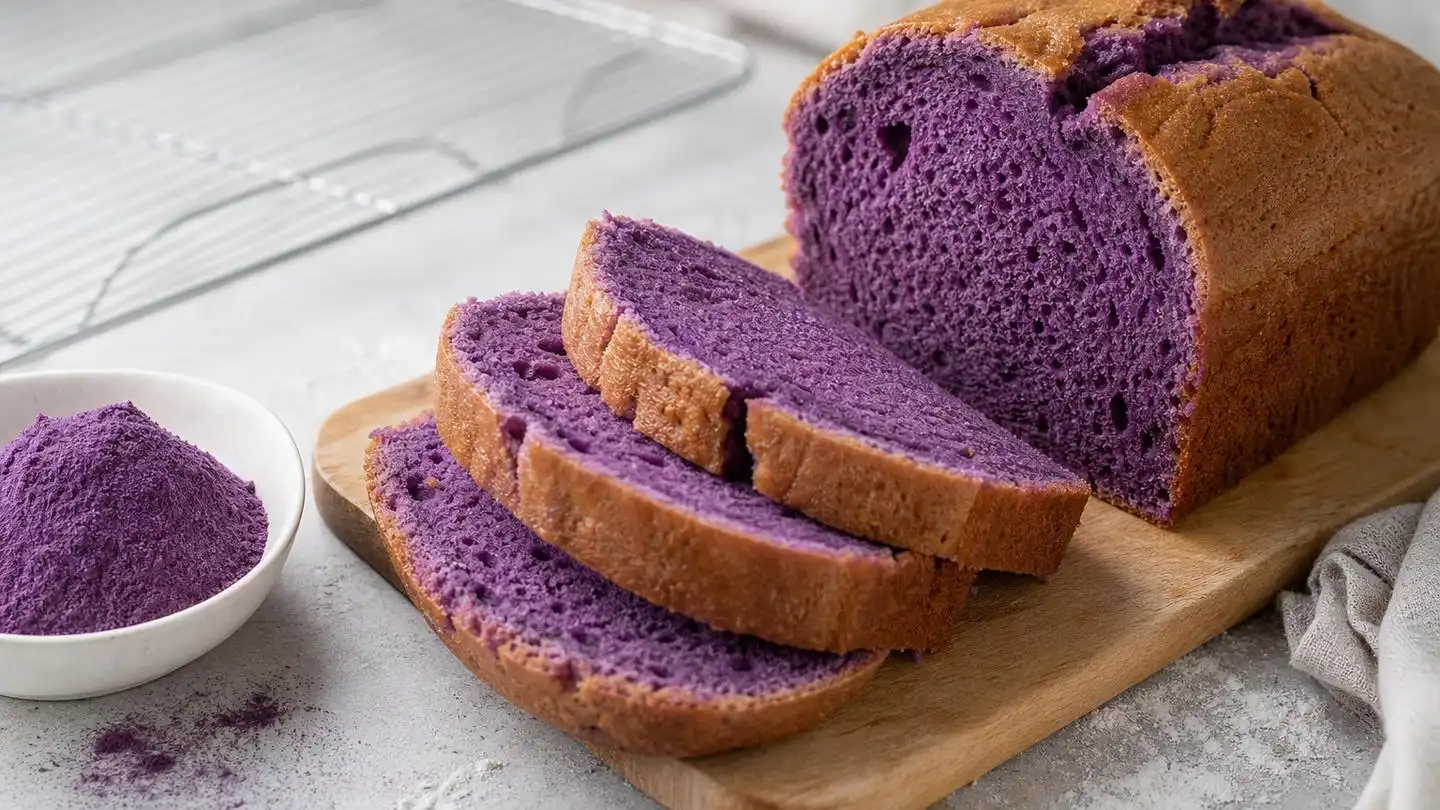
Colour loss is not uniform across a bake. Crumb temperature lags surface temperature, so the crumb sees a lower peak for less time, while the crust is simultaneously undergoing Maillard browning and dextrinisation, generating brown pigments that compete with the violet. An oven profile optimised for structure alone will usually over-bake the surface colour, so where the coloured surface matters, test top heat, bake time and pan lidding before pigment level. Where a coloured core is the goal, a hotter, shorter bake is often kinder to the pigment than a long, cool one.
Crumb Shade versus Surface Shade
Expect the cut face and the exterior of the same piece to differ in hue: the crumb keeps a cooler, deeper violet because it is protected from dry heat, while the surface reads warmer and browner. Matching one flat colour swatch across both is not achievable in a normal bake. Define the target on the cut surface and keep a control sample from the first approved trial as a physical reference.
Lattes and Beverages: Dispersion, Settling, and Dilution
Getting the Powder into the Milk Phase
In a stirred milk system the rate-limiting step is wetting, not solubility: powder that islands on the surface traps air and forms lumps a spoon cannot break. The product page states that the beverage grade disperses to a sediment-free suspension within 30 seconds in milk or water at 80°C. That is a supplier specification, so confirm it in the actual base, at the actual serving temperature, before locking the recipe. Cold bases need a pre-blend with another dry powder or a high-shear step; for dairy alternatives, the dispersion behaviour of pumpkin powder in beverages is a useful parallel.
Colour as a Function of Dilution
Because the colour is carried by a dissolved pigment, hue and intensity move together as a drink is diluted: saturation falls first, then apparent hue shifts. This is why a bench-approved colour often fails in an iced drink loaded with ice melt. Build a dilution series at the intended serve ratio, ice included.
The Acidity Problem in Coffee
Coffee is mildly acidic and contains chlorogenic acids. The lower pH helps, since the flavylium cation is the most stable and most intense form [1], while the chlorogenic acid is an active copigment: a controlled study in model beverage systems found that copigmentation with chlorogenic and ferulic acid changed colour and anthocyanin stability over eight weeks of storage [6]. The coffee phase is therefore not a neutral diluent. Formulate coffee and milk separately, choose the blend ratio on measured colour rather than taste alone.
Ice Cream and Frozen Desserts: Holding Colour Below Zero
Colour Retention in the Frozen Matrix
At frozen storage temperature most of the water is ice and the pigment concentrates in the unfrozen serum. Reaction rates slow but do not stop, and oxygen entrained in the overrun keeps working on the pigment. A storage study on ice cream enriched with microencapsulated black carrot anthocyanins is instructive: the anthocyanins were encapsulated with gum arabic and maltodextrin at a 1:1 ratio, and the formulation containing 9% of the encapsulated powder gave the highest measured anthocyanin content of the test set, at 143.21 ± 1.14 mg/100 g, declining slightly during storage through oxygen exposure and ingredient interaction [7]. That 9% figure is a study condition, not a use recommendation; the mechanism still transfers — encapsulate, and control headspace oxygen.
Freeze–Thaw Behaviour
Anthocyanins are water-soluble, so they follow the serum. When a frozen dessert is temperature-abused, ice recrystallises and serum is expelled; on thaw, pigment migrates with that serum and concentrates again on refreeze. The result is streaking and pooling rather than an even fade: a distribution fault, not a pigment fault. The controls are mechanical: a stabiliser system that limits ice crystal growth, a low draw temperature, and documented excursion limits in the handling specification. Any thawed-and-refrozen sample should be treated as a colour-failure case.
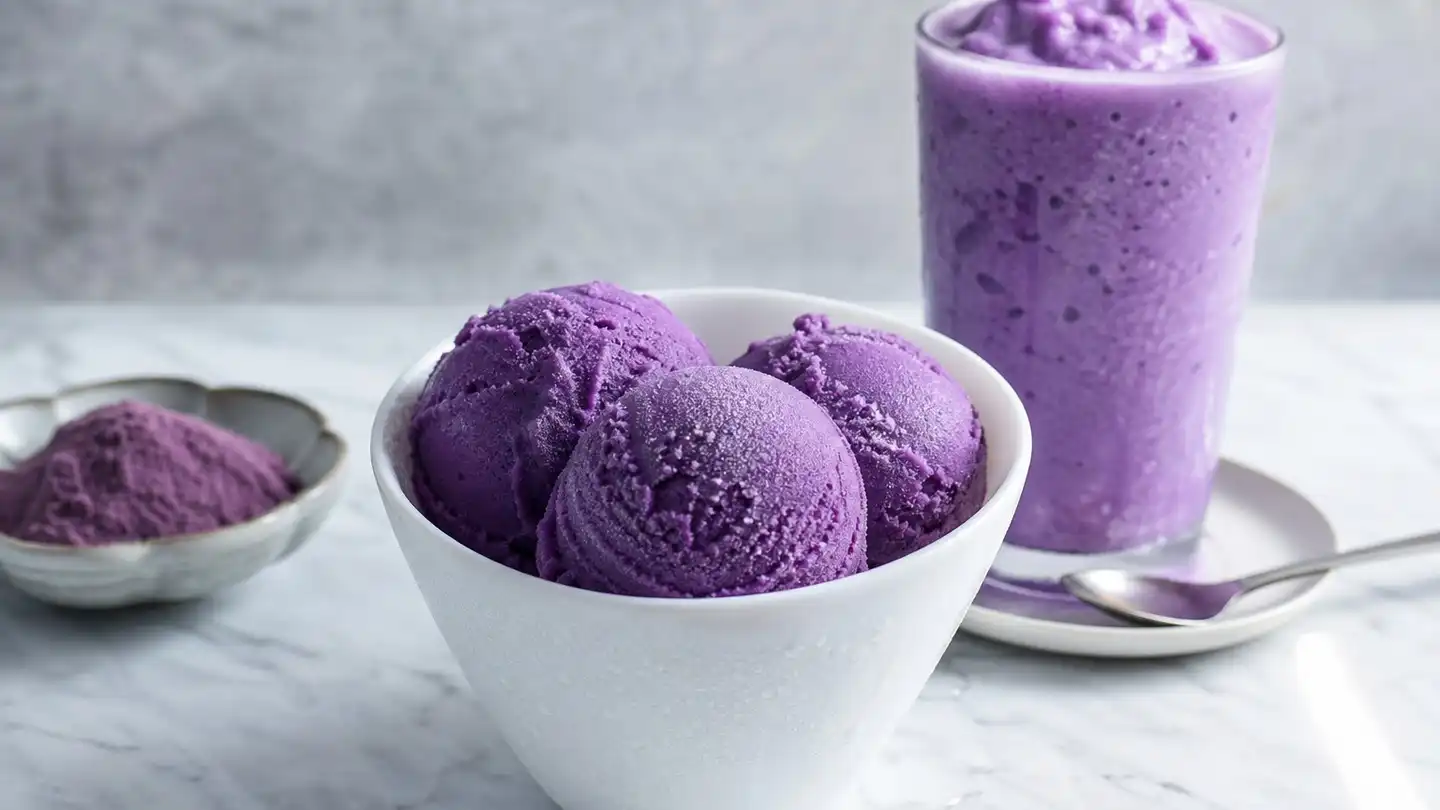
Overrun and Body
Higher overrun means more light-scattering interfaces and a larger pigment-free volume fraction, so a higher-overrun mix looks paler. The powder's native starch also contributes solids and water binding, firming the body and slowing melt. Lock overrun and draw temperature before judging colour. For plant-based frozen bases, the behaviour of coconut powder in dairy-alternative and frozen applications shows how a fine plant powder interacts with a stabiliser system.
Confectionery: Sugar Glasses, Gels, and Phase Colour Migration
Sugar and Gel Matrices
In a boiled sugar mass the pigment dissolves in a low-moisture glass, where low water activity limits the hydration reactions that degrade anthocyanins and the colour is comparatively durable — provided cook temperature and the acid addition point are controlled, because acid added early in a hot mass hydrolyses the pigment along with the sucrose. Colour density tracks the water actually available to the pigment, so the same inclusion level reads deeper in a firm, low-moisture gel than in a soft one. Most fruit-based gummy recipes are already acidic, which is favourable [1].
Colour Migration Between Phases
Where a product has more than one phase — a filled chocolate, a marbled layer or a pan-coated centre — the pigment follows moisture down the water-activity gradient. A water-based purple filling under a chocolate shell will bleed colour into the shell as the phases equilibrate, and the rate is set by the water-activity gap rather than by pigment concentration. Match water activity across phases where the recipe allows, place a fat-based barrier between a water-based colour and a moisture-sensitive phase, and hold a retention sample for the full claimed shelf life.
Pectin and Starch Interaction
Pectin and starch set by different mechanisms and hold water differently. Pectin gels through a calcium- or acid-mediated network that locks serum early, giving a sharper, more even colour with less surface mottling. Starch systems set later, during cooling, and release water unevenly during retrogradation, which is where speckling and edge fading appear. A review of functional gummy development notes that pectin has a different gelling profile from gelatin and can produce a softer, more delicate texture in gummy candies [8].
Stabilisation Routes a Formulator Can Test
The chemistry constrains the options, and the useful ones are process-linked rather than additive-based.
- Move the matrix pH into the acidic window where the sensory profile allows it, since the flavylium cation is the most intense and most stable form [1][3].
- Exploit copigmentation from phenolics already in the recipe — coffee acids, fruit acids, other flavonoids — which modifies colour and stability in beverage systems over storage [6].
- Encapsulate where the process is severe or the shelf life long, choosing the carrier system on the basis of the matrix rather than on availability [5].
- Shorten time-at-temperature and verify the gain by measuring colour before and after the process step, not against a bench standard.
- Control oxygen and light in headspace and in pack, since storage studies attribute in-pack decline to oxygen exposure [7].
- Fix the measurement method early. The product page lists colour value by spectrophotometry among its certificate-of-analysis indicators, so an instrument-based colour tolerance can be set at the first trial. Where you need to compare pigment chemistries, the stability trade-offs between anthocyanin-based natural colourants are a useful technical baseline.
Format-by-Format Process Reference
The table below consolidates the four formats into the operations that most often need re-validation, the degradation mechanism in play, the levers worth testing and the check that shows whether the change worked, as a trial-planning aid rather than a specification.
| Format | Operations to re-check | Dominant colour risk | Levers to test | Verification |
|---|---|---|---|---|
| Bakery — bread, cake, pastry | Dry premix and dispersion, liquid addition, mixer rest, bake profile, cooling | Thermal degradation in the crumb plus browning at the surface | Liquid correction, top heat, bake time, pan lid, humidity | Cut-surface colour reading on a cooled, standardised slice |
| Latte and beverages | Wetting and pre-blend, hydration hold, blend ratio, ice melt, chilled holding | Hue shift from dilution and from the acidity of the coffee phase | Pre-blend ratio, base temperature, coffee-to-milk ratio, holding time | Colour measured at the most dilute point of the serve range |
| Ice cream and frozen desserts | Mix pasteurisation, ageing, freezing and draw, hardening, distribution | Oxygen exposure in the overrun plus serum migration on abuse | Overrun target, stabiliser system, headspace control, excursion limits | Colour and melt-down pattern on a thawed versus control sample |
| Confectionery — gels, fillings, coatings | Cook temperature, acid addition point, depositing, curing, panning | Acid hydrolysis during the cook and moisture-driven migration | Acid addition point, water-activity matching, fat barrier, curing time | Cross-section colour after full-shelf-life retention storage |
Wellgreen supplies food-grade ube purple yam powder with batch documentation and custom specification options. The product page lists ISO22000, HALAL, KOSHER and Non-GMO certification, a stated 80–100 mesh particle size, moisture at or below 7.0% and and a 24-month shelf life; confirm anything your own market requires against the current sheet. To request a sample for a latte, bakery, frozen dessert or confectionery trial, contact the technical team at wgt@allwellcn.com and review the ube purple yam powder specification before your first production run.
Disclaimer: This article provides general technical and commercial information for food-industry professionals only and is not medical advice; use levels, regulatory status and any label claims must be confirmed against the rules of your target market and against your own finished-product data.
References
- Khoo, H.E., Azlan, A., Tang, S.T. and Lim, S.M. (2017) 'Anthocyanidins and anthocyanins: colored pigments as food, pharmaceutical ingredients, and the potential health benefits', Food & Nutrition Research, 61(1): 1361779. DOI: 10.1080/16546628.2017.1361779 (full text: PMC5613902).
- 'Anthocyanins: Factors Affecting Their Stability and Degradation' (2021), Antioxidants, 10(12): 1967. DOI: 10.3390/antiox10121967 (full text: PMC8750456).
- 'A Review of the Current Knowledge of Thermal Stability of Anthocyanins and Approaches to Their Stabilization to Heat' (2021), Antioxidants, 10(9): 1337. DOI: 10.3390/antiox10091337 (full text: PMC8468304).
- 'Factors affecting the stability of anthocyanins and strategies for improving their stability: A review' (2024), Food Chemistry: X, 24: 101883. DOI: 10.1016/j.fochx.2024.101883 (full text: PMC11497485).
- 'Advances in embedding techniques of anthocyanins: Improving stability, bioactivity and bioavailability' (2023), Food Chemistry: X, 20: 100983. DOI: 10.1016/j.fochx.2023.100983 (full text: PMC10740132).
- 'Copigmentation with Chlorogenic and Ferulic Acid Affected Color and Anthocyanin Stability in Model Beverages Colored with Sambucus peruviana, Sambucus nigra, and Daucus carota during Storage' (2020), Foods, 9(10): 1476. DOI: 10.3390/foods9101476 (full text: PMC7602824).
- 'Effect of storage on physicochemical attributes of ice cream enriched with microencapsulated anthocyanins from black carrot' (2023), Food Science & Nutrition, 11(7): 3976–3988. DOI: 10.1002/fsn3.3384 (full text: PMC10345707).
- 'Current Innovations in the Development of Functional Gummy Candies' (2023), Foods, 13(1): 76. DOI: 10.3390/foods13010076 (full text: PMC10778822).
- 'Recent microencapsulation trends for enhancing the stability and functionality of anthocyanins: a review' (2024), Food Science and Biotechnology, 33(12): 2673–2698. DOI: 10.1007/s10068-024-01603-2 (full text: PMC11339212).