Natural Astaxanthin Powder for Functional Beverages: Stability and Color Considerations
2026-10-09 14:00:02
Formulating a drink with natural astaxanthin powder is a solubility problem long before it is a colour problem. Astaxanthin is a lipophilic, oxidation-sensitive carotenoid and a beverage is mostly water; unless the material is engineered to disperse in that water, the first thing a consumer notices is a defect rather than a shade. What separates a usable beverage grade from an unusable one is behaviour as much as assay. This article covers the decisions a developer controls — dispersion form, matrix chemistry, colour target, process envelope and pack — and how to prove afterwards that astaxanthin powder behaved as specified.
Where the Beverage Matrix Punishes an Unprotected Carotenoid
Astaxanthin's chemistry explains most of the difficulty. Encapsulation reviews list the obstacles plainly: instability to high temperatures, acidic pH, oxygen and light, together with very low water solubility and an intense odour and flavour in the raw extract [1]. Manageable in a powder or a softgel, they arrive at once in a dilute, acidic, oxygen-containing and often transparent aqueous system. Because the pigment is the chromophore, its loss is visible — a faded drink reads as a different product, not merely a weaker one. Every unit operation acts on the same material that carries the colour, so stability is a formulation and process question rather than a purchasing one.
Choosing a Dispersion Form for a Water-Based System
The oil, the oleoresin and a plain oil-soluble powder carry the most pigment per gram, and they are the wrong default for a beverage. A lipophilic phase added to a water-continuous drink has no natural place to sit; without an emulsification step it separates, and the visible results — a colour ring at the liquid line, an oil film, an uneven shade from bottle to bottle — are what beverage emulsions exist to prevent. A beverage emulsion is by design a concentrated oil-in-water system of roughly 10–30% diluted into the finished drink, and it can fail by creaming, sedimentation, flocculation or Ostwald ripening, any of which ends in coalescence [5].
A cold-water-dispersible or microencapsulated grade replaces an uncontrolled problem with a designed one. Encapsulation improves water solubility and dispersibility — spray-dried astaxanthin carriers have been reported above 92% water solubility [1]. Lipid nanostructured systems behave differently again: they scatter light weakly, so they suit optically transparent drinks, and are generally resistant to aggregation and gravitational separation [1]. Table 1 sets out the options.
| Form | Why a beverage team chooses it | What to verify before it enters the tank |
|---|---|---|
| Cold-water-dispersible / microencapsulated powder | Water solubility and dispersibility are engineered rather than hoped for; spray-dried carriers have been reported above 92% water solubility, and odour and flavour are masked [1] | Encapsulant identity and carrier solids; dispersibility measured in your base, not in water alone; behaviour after your heat step |
| Oil-soluble powder or oleoresin | Highest pigment load per gram; straightforward if the formula already contains an oil phase | Whether a discrete oil phase exists at all; risk of ringing and oiling-off in a dilute drink; the shear available on your line |
| β-cyclodextrin inclusion complex | Reported to raise solubility roughly 110-fold and to improve stability against heat, pH, UV light and oxidation by 7–9-fold versus free astaxanthin [1] | The complexation ratio — the optimum studied was about 1:200 astaxanthin to cyclodextrin, which adds substantial carrier solids [1] — and the label consequences of those solids |
| Lipid nanoparticles: nanoliposomes, solid lipid nanoparticles, nanostructured lipid carriers | Small lipid particles scatter light weakly, so they suit optically transparent drinks, and are generally stable against aggregation and gravitational separation [1] | Survival of the heat step: in one beverage study, carbonation and thermal pasteurisation of a beer model increased particle size and caused astaxanthin loss [3] |
What to Ask About the Encapsulant and the Carrier
The wall material shapes powder behaviour more than the assay does. Ask which encapsulant and carrier solids are present and in what proportion, since those solids enter your formula and your label. Ask how dispersibility was measured, and for a particle size distribution rather than a mesh figure alone. A protective claim established in an oily carrier does not transfer automatically to a dilute acidic drink.
Dispersion and Stability in the Finished Drink
Wettability is the first practical test. A powder that floats, clumps or sinks on contact with a cold base demands more shear than a beverage line will give, and any surviving clump becomes a spec in the bottle; in-line dispersion, pre-blending against a portion of the base, or pre-dispersion in a compatible liquid are the usual answers. Once dispersed, the system has to hold: a clean liquid line, no oil film on the surface and no sediment band after standing. Those three observations cost nothing and catch failures a day-zero potency result will never show.
Acidulants, pH, Ionic Strength, Protein and Polysaccharide
Acidulants come first: acidic pH destabilises the carotenoid itself [1], and the acidulant also changes the charge on whatever emulsifier holds the dispersion together. Ionic strength matters next. In beverage emulsions, calcium has been reported to destabilise some protein-stabilised systems at around 10 mM and above, while a whey-protein-stabilised emulsion tolerated added potassium chloride up to about 200 mM before phase separation, divalent ions being the more disruptive [5]. Mineral content therefore belongs in the trial design, not only in the water specification.
Protein and polysaccharide content cuts both ways. Hydrocolloids make a dispersed carotenoid possible, and multilayer-coated emulsions have been reported to improve both the chemical stability of encapsulated astaxanthin and its resistance to aggregation at elevated ionic strength and temperature [1]. But the same hydrocolloids raise viscosity and can flocculate when the acidulant or mineral load changes, so re-check a reformulated base before re-setting the colour target.
Colour in Practice: Reading the Shade
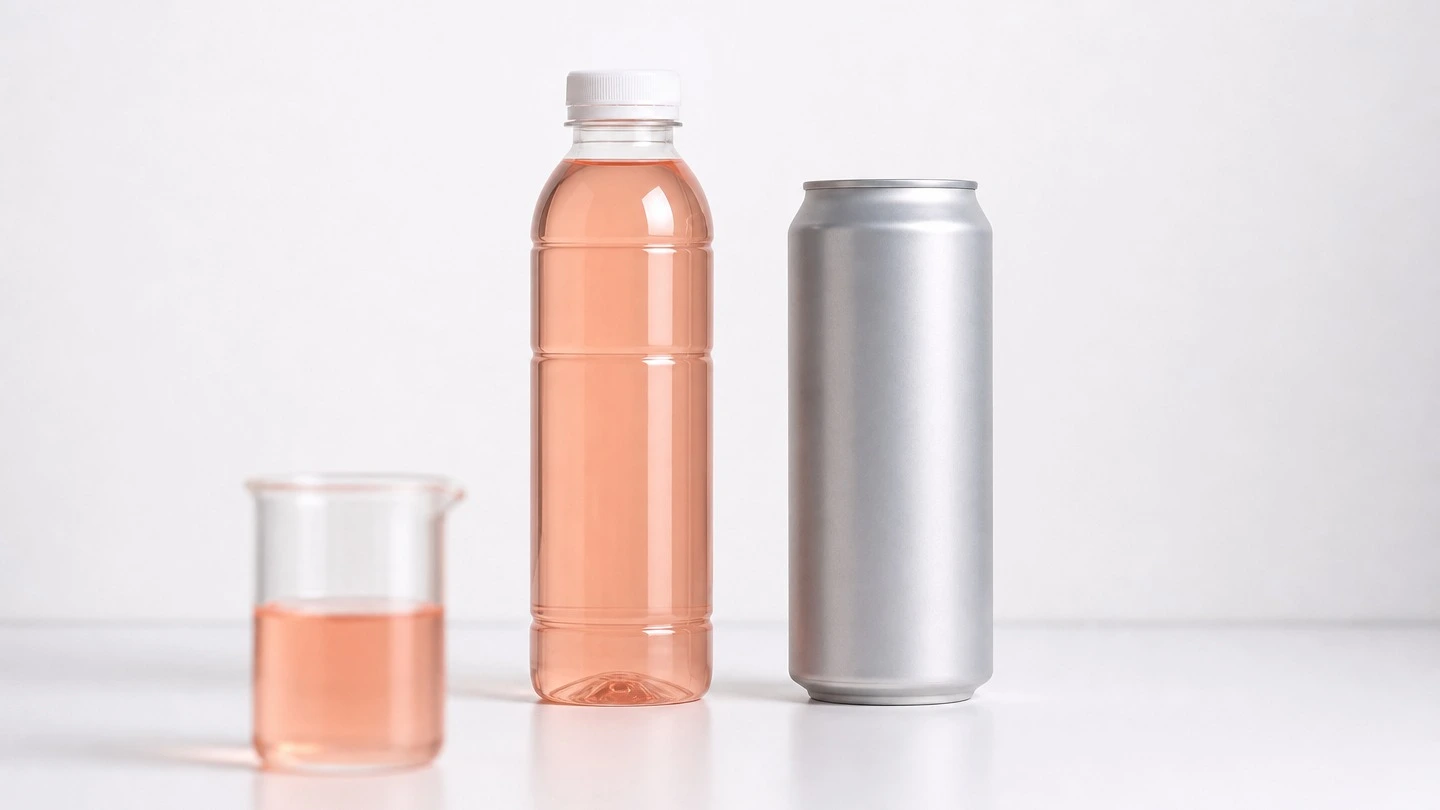
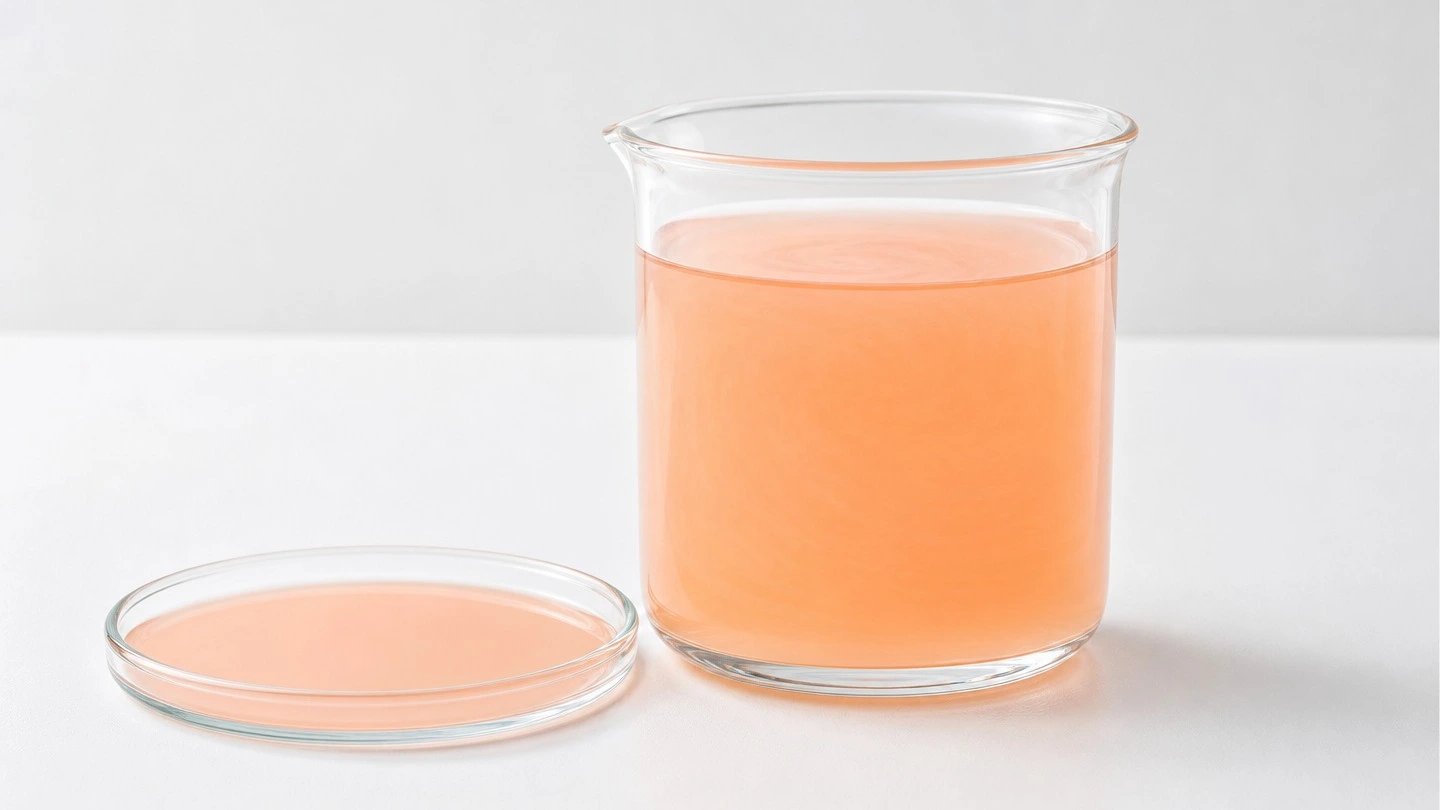
At beverage concentrations the pigment contributes a soft, warm hue rather than the near-black red of the neat powder. In a water-clear base it reads as a translucent pale orange-pink, visibly lighter than the material in the jar, because the light path through a bottle is short. Only a measured colour target on the finished base settles the gap between the powder in the warehouse and the drink in the glass.
Once a target is set, colour becomes the earliest visible failure mode. Because the pigment is the chromophore, degradation shows as fading and a hue shift well before a potency result has moved far enough to be interesting, so a fading trend at month two is a formulation signal rather than a cosmetic one. Where a second botanical colourant sits in the same formula — a hibiscus extract powder, which brings its own anthocyanin colour and pH sensitivity — the two colour systems must be assessed together, because one can mask or exaggerate the fading of the other.
Clear Versus Cloudy and Juice-Based Bases
The same dispersion reads differently depending on its surroundings. In a clear base, colour perception depends on transmitted light, so the shade is judged by looking through the liquid; any haze, undispersed particle or shift in particle size changes the reading. In a cloudy or juice-based base, perception depends far more on light scattered back from the suspended cloud. A pale orange-pink that reads as subtle in a clear drink can be almost invisible against an opaque juice background, and can shift hue as the cloud contributes its own warm tone beneath. Carry a clear and a cloudy version of the same formula from the start, with the colour target set per base rather than per pigment.
Process Exposure: Where the Loss Actually Happens
Thermal load is the dominant process variable, and cumulative rather than nominal: a short very hot step and a long moderate one can deliver comparable damage. Encapsulation helps, within limits. One encapsulation study reported protection that held astaxanthin stable through 80 °C for up to two hours and 100 °C for 30 minutes, though moisture uptake over storage was not mitigated [4]. Carrier-specific results are not uniform either: astaxanthin dispersed in certain edible oils has been reported to retain 84–90% of its content after heating at 70–90 °C [2]. Protection measured in a lab rig is a starting point, not a guarantee for a filled pack on a warm pallet.
Oxygen is the second variable and the most often overlooked. Dissolved oxygen carried into the filler and oxygen in the headspace sit against the dispersion for the whole shelf life; deaeration before pigment addition, nitrogen blanking and minimal headspace are the levers. Light is the third. In a carotenoid-coloured beverage model, degradation accelerated with storage temperature and was faster under illumination than in the dark, with shelf life modelled on retail display at 600 lux for 12 hours per day [6]. The pack is therefore a formulation decision: an opaque can removes the light term almost entirely, a sleeved or UV-blocking bottle reduces it, and plain clear PET leaves the drink exposed in a bright chiller.
| Process step or exposure | What it does to the dispersion | Lever available to the formulator |
|---|---|---|
| Hot-fill | Thermal load on the pigment plus oxygen carried in at fill | Shorten or lower the hold; deaerate or nitrogen-blank before filling; verify the grade in a filled-pack trial rather than a benchtop rig |
| Tunnel pasteurisation | Long, cumulative heat after the pack is sealed, plus light on the way to the cooler | Track accumulated pasteurisation units rather than peak temperature; shield the line and the cool-down |
| Retort | Highest heat dose of the common options, in-pack | Test early; if the colour target cannot be held, either accept a darker specified target or rule retort out for this pigment system |
| UHT with aseptic fill | Very short, very high temperature exposure | Short dwell limits thermal damage but still tests the encapsulant; measure potency immediately after filling to separate process loss from storage loss |
| Dissolved oxygen and headspace | Continuous oxidative exposure over shelf life | Deaeration, nitrogen dosing and minimal headspace; record oxygen at fill as trial data |
| Light exposure in clear pack | Accelerated carotenoid degradation and colour depletion, confirmed in a carotenoid beverage model [6] | Choose the pack as a formulation decision: can, sleeved bottle or light-barrier bottle instead of plain clear PET |
Protection Inside the Formula and Inside the Pack
Two families of protection are available. The first is co-ingredient chemistry: an antioxidant network that is consumed ahead of the pigment, plus chelators that blunt the pro-oxidant effect of trace metals. Tocopherols with ascorbyl palmitate are the familiar pairing; if the drink already carries a bulk green tea extract, the interaction is worth measuring rather than assuming, because polyphenols are themselves heat-, light- and pH-sensitive and can change colour as they oxidise.
The second family is physical: remove the oxidant, the light, or both. Deaeration and nitrogen blanking cover the first, pack selection the second. A plant-derived pigment also avoids added-colour declaration work of its own, the same logic that makes organic goji berry powder attractive in clean-label bases; the difference is that a lipophilic carotenoid brings dispersion requirements a water-soluble botanical colour does not.
Measuring the Loss: Designing a Beverage-Specific Stability Trial
An ingredient stability trial and a beverage stability trial answer different questions. The first asks whether the powder degrades in its own bag; the second asks whether the finished drink still looks and reads the same at month three, in the pack the consumer will buy. The second governs the colour target and the overage decision.
Track potency and colour on the same schedule from the same samples. Potency is best measured by a validated extraction with visible-range absorbance or HPLC against a standard, one method across the whole trial. Colour should be instrumental rather than sensory: tristimulus readings give a panel-free reference comparable between labs and batches, and fixed-light photographs preserve the visual record. Dispersion checks — ringing, surface film, sediment, particle size — run alongside, because a dispersion failure can look exactly like a colour failure until the sample is examined.
| Trial element | Design choice | What it tells you |
|---|---|---|
| Storage conditions | At least one refrigerated, one ambient and one accelerated (elevated-temperature) arm | Expected shelf life, plus a fast stress comparison between candidate forms |
| Light arm | A dark control paired with an illuminated arm at the same temperature | Separates thermal loss from photo-loss, so the pack decision can be costed |
| Container arm | The most transparent pack and the most light-protective pack, same formula | Puts a number on what the packaging change is worth in colour retention |
| Base arm | A clear base and a cloudy or juice-based base at the same pigment load | Whether the colour target has to be specified per base rather than per pigment |
| Potency measurement | Validated extraction plus visible-range absorbance or HPLC on a fixed sampling schedule | How much pigment remains, on a method that can be repeated between labs |
| Colour measurement | Instrumental tristimulus readings (L*, a*, b*) plus fixed-light photographs at each pull | Whether the drink still reads the same, with a panel-free reference |
| Dispersion checks | Visual and instrumental checks for ringing, surface film, sediment and particle size | Whether the dispersion failed before the pigment did |
| Oxygen at fill | Dissolved oxygen and headspace oxygen recorded at filling | Links any colour loss back to the fill operation rather than to the ingredient |
Overage is the output of this trial, not the input. Set the colour target the consumer will judge, find the loss curve, and compute backwards to the activity needed at day zero so the product still meets the target at end of shelf life. Fix what the process can fix — light, oxygen, thermal load — before buying the loss back with overage, and keep the overage inside the applicable regulatory and label framework, so the regulatory question belongs before the trial rather than after it.
Regulatory Framing for a Beverage Application
The position is best stated plainly and checked per market. In the United States, astaxanthin is permanently listed as a colour additive exempt from certification, but the listing covers only enhancing the pink to orange-red colour of salmonid fish flesh at not more than 80 mg/kg of finished feed [7] — a feed provision, not a beverage provision. In the European Union the authorised novel food is astaxanthin-rich oleoresin from Haematococcus pluvialis, currently on the Union list for food supplements at 40–80 mg/day of oleoresin, corresponding to no more than 8 mg astaxanthin per day, limited to adults and adolescents above 14 years, and the same act records an acceptable daily intake of 0.2 mg/kg body weight per day [8]. Those are regulatory ceilings for the supplement route, not beverage use levels.
In practice the same material can be handled as a colourant or as an ingredient, and the route chosen changes the documentation, the labelling and sometimes the extract specification. The general safety and documentation picture is worth reviewing alongside your own market analysis; a useful starting point is this review of astaxanthin powder safety in foods and beverages.
Specifying a Beverage Grade with Wellgreen
Natural astaxanthin powder from Wellgreen is listed at specifications from 1% to 10%, sourced from Haematococcus pluvialis, with a dark red powder appearance, a particle size of 100% through 80 mesh and UV/HPLC as the stated test method; the product page also lists ISO 9001:2015, ISO 22000, HACCP, Halal and Kosher certificates. Send your base composition, process envelope and colour target to wgt@allwellcn.com, or review the forms and documentation on the astaxanthin powder product page before your next trial.
This article is technical and commercial information for industry professionals, not medical advice; use levels, regulatory status and label claims must be confirmed against the rules of the target market and against your own product data.
References
- Martínez-Álvarez, Ó.; Calvo, M.M.; Gómez-Estaca, J. Recent Advances in Astaxanthin Micro/Nanoencapsulation to Improve Its Stability and Functionality as a Food Ingredient. Marine Drugs 2020, 18(8), 406. https://doi.org/10.3390/md18080406
- Ambati, R.R.; Moi, P.S.; Ravi, S.; Aswathanarayana, R.G. Astaxanthin: Sources, Extraction, Stability, Biological Activities and Its Commercial Applications — A Review. Marine Drugs 2014, 12(1), 128–152. https://doi.org/10.3390/md12010128
- Tamjidi, F.; Shahedi, M.; Varshosaz, J.; Nasirpour, A. Stability of astaxanthin-loaded nanostructured lipid carriers in beverage systems. Journal of the Science of Food and Agriculture 2018, 98(2), 511–518. https://doi.org/10.1002/jsfa.8488
- Encapsulation Techniques to Enhance Astaxanthin Utilization as Functional Feed Ingredient. Marine Drugs 2025, 23(4), 143. https://doi.org/10.3390/md23040143
- Molet-Rodríguez, A.; Salvia-Trujillo, L.; Martín-Belloso, O. Beverage Emulsions: Key Aspects of Their Formulation and Physicochemical Stability. Beverages 2018, 4(3), 70. https://doi.org/10.3390/beverages4030070
- Atencio, S.; Verkempinck, S.H.E.; Reineke, K.; Hendrickx, M.; Van Loey, A. Heat and Light Stability of Pumpkin-Based Carotenoids in a Photosensitive Food: A Carotenoid-Coloured Beverage. Foods 2022, 11(3), 485. https://doi.org/10.3390/foods11030485
- U.S. Food and Drug Administration. 21 CFR 73.35 — Astaxanthin. Electronic Code of Federal Regulations. https://www.ecfr.gov/current/title-21/section-73.35
- European Commission. Commission Implementing Regulation (EU) 2023/1581 of 1 August 2023 amending Implementing Regulation (EU) 2017/2470 as regards the conditions of use of the novel food "astaxanthin-rich oleoresin from Haematococcus pluvialis algae". OJ L 194, 2.8.2023, pp. 4–7. https://eur-lex.europa.eu/legal-content/EN/TXT/?uri=CELEX:32023R1581
- Sridhar, K.; Inbaraj, B.S.; Chen, B.-H. Recent Advances on Nanoparticle Based Strategies for Improving Carotenoid Stability and Biological Activity. Antioxidants 2021, 10(5), 713. https://doi.org/10.3390/antiox10050713